
BuddhistCatholicContemplativeEvangelicalGeneral ChristianHinduJewishLatter-day SaintMuslimNew VisionsProgressive Christian
Beliefs
- Buddhist
- Catholic
- Contemplative
- Evangelical
- General Christian
- Hindu
- Jewish
- Latter-day Saint
- More Voices
- Muslim
- New Visions
- Pagan
- Progressive Christian
Topics
- Religion News
- Food and Religion
- Sports and Religion
- Religious Art
- Religious Music and Entertainment
- Religious Events
- History and Religion
- Style and Religion
- Politics and Religion
- Women in Religion
- Recreation Outdoors and Religion
- Business Finance and Religion
- Careers Workplace and Religion
- Education and Religion
- Family Parenting and Religion
- Health Fitness and Religion
- Home and Religion
- Relationships and Religion
- Technology and Religion
- Travel and Religion
Columnists
- Buddhist Columnists
- Business Finance and Religion Columnists
- Careers Workplace and Religion Columnists
- Catholic Columnists
- Contemplative Columnists
- Education and Religion Columnists
- Evangelists Columnists
- Family Parenting and Religion Columnists
- General Christian Columnists
- Health Fitness and Religion Columnists
- Hindu Columnists
- History and Religion Columnists
- Home and Religion Columnists
- Jewish Columnists
- More Voices Columnists
- Latter Day Columnists
- Muslim Columnists
- New Visions Columnists
- Nonreligious Columnists
- Pagan Columnists
- Politics and Religion Columnists
- Progressive Columnists
- Recreation Outdoors and Religion Columnists
- Relationships and Religion Columnists
- Religion News Columnists
- Religious Art Columnists
- Religious Events Columnists
- Religious Music and Entertainment Columnists
- Sports and Religion Columnists
- Style and Religion Columnists
- Technology and Religion Columnists
- Travel and Religion Columnists
- Women in Religion Columnists
Resource Library
- 2026 Calendar
- Library of World Religions
- The 100 Most Holy Places on Earth
- Patheos Answers
- Podcasts
- Videos
- Faith Leaders Database
- Anglican Episcopalian
- Bahai
- Baptist
- Buddhism
- Christianity
- Confucianism
- Eastern Orthodoxy
- Hinduism
- Holiness and Pentecostal
- ISKCON
- Islam
- Judaism
- Lutheran
- Methodist
- The Church of Jesus Christ of Latter-day Saints
- New Age
- Paganism
- Presbytarian and Reformed
- Protestantism
- Religion Behind the Scenes
- Roman Catholic
- Scientology
- Shia Islam
- Sikhism
- Sufism
- Sunni Islam
- Taoism
- Zen
- See all religions
Research Tools
 Ad-Free & Subscriber Log-In Subscription Support
Ad-Free & Subscriber Log-In Subscription Support
Follow Patheos 

- Trending:
- Forgiveness
- |
- Marriage
- |
- Consciousness
- |
- Death Penalty
- |
- Election
- |
- Halloween

- Home
- Progressive Christian
- Eating Your Words. Literally.
Eating Your Words. Literally.
Last updated on: March 14, 2024 at 6:00 am by Vance Morgan
Eating Your Words. Literally. 2024-03-13T14:47:28-04:00 Vance Morgan
Patheos Explore the world's faith through different perspectives on religion and spirituality! Patheos has the views of the prevalent religions and spiritualities of the world.
Truth isn’t sympathetic to our need for certainty or stability.
Jared Enns, “The Bible for Normal People”
There is a self-described atheist who regularly comments on this blog, usually to express his strong disagreement with suggestions that a conception of God might be something more than a myth or fairy tale. His most recent comment was in response to an essay I posted around Christmas titled “Why the Details of Jesus’ Birth Don’t Matter.” He observed that
So, at least we can agree that the notion that the Bible is literally true and inerrant is simply not true. Matthew and Luke present two completely contradictory accounts of Jesus’ birth.
My less-than-congenial response was along these lines:
Thanks for your comment, Captain Obvious. You’ve read enough essays on this blog to have realized this a long time ago.
I was not in a particularly Christian mood that morning.
The belief that the Bible is both inerrant and literally true was a central part of the religious world in which I was raised and which I left a long time ago. But for a professed Christian such as I am, the question remains: What is the Bible? How is one to approach this library of texts if one both rejects the idea that it is literally true and inerrant but also believes that in some sense it is the “Word of God”?
As I implied to the commenter, I have explored this territory on this blog a number of times. A recent episode of the podcast “The Bible for Normal People” provided me with a different angle on questions related to the Bible that intersected with what I do professionally in ways I had not previously considered.
I say “Deconstruction” and you think what? Probably nothing. Or perhaps, as Jared Byas, the host of the BBFNP podcast episode titled “Misconceptions About Deconstruction and the Bible” fromseveral months ago puts it, the word deconstruction “might conjure images of an obscure philosophical concept that only dorks in tweed jackets talk about.” Despite the fact that I actually am one of those philosopher dorks in a tweed jacket, don’t worry—I’m not going to geek out on you in this essay (much). Suffice it to say that deconstruction is a concept that, having leaked out of the ivory towers of academe in the past sixty or seventy years, has had a significant influence on how we understand words and texts—including the Bible. And for many, this influence has been both problematic and destructive. Bear with me.
For our purposes, I’ll use Jared Byas’ simple description of deconstruction as our working definition.
Deconstruction is a set of practices that seeks to answer the two questions “What do words mean?” and “How do words mean?”
With that definition in mind, here are a few points about words, languages, and texts that deconstructionists frequently emphasize:
- Words always mean more than we intend. The meaning of a text is never simply what the author intends. Words don’t work that way.
- Words are not as stable as we think. They aren not standalone entities that represent just one objective reality.
- Deconstruction argues that texts, institutions, traditions, societies, beliefs, and practices of whatever size and sort you chose to consider do not have definable meanings and determinable missions. They are always more than any mission would impose, that they exceed the boundaries they currently occupy.
Jacques Derrida, the French philosopher who is generally considered to be the father of deconstruction, noted that when we look at words, they seem very solid and stable. But when he looked closely using the right tools, what we later called deconstruction, he saw that at a deep level, words operate differently than we thought. They are more chaotic than we had imagined. They’re less solid and less stable than we might wish they were. Words always mean more than we intend them to mean. There are no law-givers that tell us what a word or a phrase or a sentence has to mean. All of which guarantees that the certainty we might seek from texts is unavailable.
It is important to realize that, despite the fears of many of its critics, deconstruction does not open the door to an “anything goes” type of relativism. On the contrary, deconstruction tells us that there’s always more meaning to something than one thing. Truth is always bigger than our personal and cultural conceptions can grasp. No one group of people gets to decide what meaning or truth is. Differences and diversity are actually the path to seeing the fullness of truth. We need all the contexts, all the experiences to weigh in.
What does any of this have to do with the Bible? Jared Byas provides an entertaining but illuminating analogy in his podcast that illustrates the difference between believing that the Bible is written in a language of unchanging certainty and recognizing that it, just as all texts, is subject to deconstruction because it is written in human language. In the Charlie and the Chocolate Factory movie starring Johnny Depp, the story is told of an Indian prince who asked Willie Wonka to build him a palace made of chocolate. Willie Wonka proceeds to build such a palace to the prince’s specifications, but upon completion warns the prince that “it won’t last long—you’d better start eating it right now.”
And Prince Pondicherry says dismissively, “Oh, nonsense. I will not eat my palace, I intend to live in it.” Of course, a hot day comes and melts the palace. The Bible is perfect, as long as we realize it’s made of chocolate, and we start eating it, rather than preserve it and try to live in it forever.
Just as anything constructed out of words and language, the Bible is not intended to be a permanent, unchanging habitation. Rather it is something to be consumed, nourishment for succeeding generations in ways uniquely framed by their own experiences, circumstances, hopes, dreams, and conceptions of faith. As Byas notes,
For many of us, it’s our close reading of the Bible that has led us to the conclusion that it’s made of chocolate. It’s constantly melting and hardening over and over again. It takes different shapes and means different things to the centuries and generations. We aren’t against the Bible; we’re learning to accept it for what it is. Deconstruction isn’t something we do to the Bible. The Bible is subject to deconstruction because it’s written in human language.
I love likening the activity of reading and studying to eating and, as it turns out, it’s an image that frequently shows up in the Bible. For instance, the prophet Jeremiah writes that “Thy words were found, and I did eat them; and thy words were unto me a joy and the rejoicing of my heart,” while Ezekiel tells an interesting story toward the beginning of his prophecy: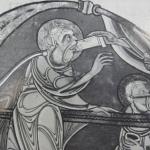
He said to me, “Son of man, eat what you find: eat this scroll and go, speak to the house of Israel.” So I opened my mouth, and he gave me the scroll to eat. Then he said to me, “Son of man, eat this scroll I am giving you and fill your stomach with it.” So I ate it, and it tasted as sweet as honey in my mouth. He then said to me: “Son of man, go now to the house of Israel and speak my words to them.
As Simone Weil writes in her notebooks, “I only read what I am hungry for at the moment when I have an appetite for it, and then I do not read, I eat.” When it comes to the Bible, that’s a good idea—because the Bible is made of chocolate, after all.
Previous Post
March 12, 2024
Introduction to "For Everything There is a Season" . . .
Next Post

March 17, 2024 Saint Patrick? Let Me Introduce you to Saint Bridget!
Recent Comments
"Mary did have a choice. And she was able to make it before the Holy ..."
"i cannot read beyond your recommendations for the books since i like to have a ..."
"AI will never be able to utter with honesty, feeling, or humility, the greeting: "Namaste".It ..."
"They do. I'm sure you could find discussions of the same topic from any of ..."
Browse Our Archives
Select a Category abortion Advent AI Angels Artificial intelligence atheism attention baptism Baptists beauty belief Benedictines Bible bicycling Big Bird books Bovina Camaldoli hermitage Canada Catholicism cats certainty change Christianity Christmas Collegeville Covid-19 creativity Development of Western Civilization dogs doubt Easter Enneagram Epiphany Episcopal ethics Eucharist evil extroverts Facebook faith family fear flowers forgiveness freedom friends God goodness grace happiness heaven hell history Holy Spirit Holy Week hope human nature humility humor idolatry incarnation introverts irreverence Islam Jeanne Jesus Joe Biden joy Judaism justice Kamala Harris knowledge Lent listen literature liturgy love Marsue Memorial Day miracles movies music mystery mythology NPR Old Testament optimism paradox peace Penguins philosophy piano podcast politics power prayer Protestantism Providence College Religion Rhode Island sabbatical sacrament science seeing silence Simone Weil Socrates soul sports St. John's College stories suffering tattoo teaching technology television theology thinking time tolerance transcendence travel trees trust truth Uncategorized Vermont wisdom wonder writing
Select a Month May 2026 April 2026 March 2026 February 2026 January 2026 December 2025 November 2025 October 2025 September 2025 August 2025 July 2025 June 2025 May 2025 April 2025 March 2025 February 2025 January 2025 December 2024 November 2024 October 2024 September 2024 August 2024 July 2024 June 2024 May 2024 April 2024 March 2024 February 2024 January 2024 December 2023 November 2023 October 2023 September 2023 August 2023 July 2023 June 2023 May 2023 April 2023 March 2023 February 2023 January 2023 December 2022 November 2022 October 2022 September 2022 August 2022 July 2022 June 2022 May 2022 April 2022 March 2022 February 2022 January 2022 December 2021 November 2021 October 2021 September 2021 August 2021 July 2021 June 2021 May 2021 April 2021 March 2021 February 2021 January 2021 December 2020 November 2020 October 2020 September 2020 August 2020 July 2020 June 2020 May 2020 April 2020 March 2020 February 2020 January 2020 December 2019 November 2019 October 2019 September 2019 August 2019 July 2019 June 2019 May 2019 April 2019 March 2019 February 2019 January 2019 December 2018 November 2018 October 2018 September 2018 August 2018 July 2018 June 2018 May 2018 April 2018 March 2018 February 2018 January 2018 December 2017 November 2017 October 2017 September 2017 August 2017 July 2017 June 2017 May 2017 April 2017 March 2017 February 2017 January 2017 December 2016 November 2016 October 2016 September 2016 August 2016 July 2016 June 2016 May 2016 April 2016 March 2016 February 2016 January 2016 December 2015 November 2015 October 2015 September 2015 August 2015 July 2015 June 2015 May 2015 April 2015 March 2015 February 2015 January 2015 December 2014 November 2014 October 2014 September 2014 August 2014 July 2014 June 2014 May 2014 April 2014 March 2014 February 2014 January 2014 December 2013 November 2013 October 2013 September 2013 August 2013 July 2013 June 2013 May 2013 April 2013 March 2013 February 2013 January 2013 December 2012 November 2012 October 2012 September 2012
Follow Us!
TAKE THE
Religious Wisdom Quiz
What city did the wise men visit to see King Herod before finding Jesus?
Select your answer to see how you score.
Jerusalem Hebron Nazareth Bethlehem
Books by This Author Books by Vance G. Morgan
Related posts from Freelance Christianity

The Lonely Pawn: On Faith, Doubt, and Meaning


AI and Love: When a Chatbot Becomes a...

TRENDING AT PATHEOS Progressive Christian

What Being a Modern-Day Apostle Means to Me
In my last column, I discussed the ins and outs of modern-day...

Did Ancient China Once Worship the God of...
Across human history, a common thread weaves through the origins of the...

Love Your Neighbor – Including Earth-Kin: Lev. 19,...
God’s command to love your neighbor means acting in an ethical and...

Lead a Church Study of “Jesus and Lao...
Guest writer Jack Thomas (The Irreverent Reverend) reflects on leading his church...

Pastoral Wisdom for Responding to Sermon Pushback
Getting sermon pushback on your social justice sermon? Learn practical, Proverbs-based strategies...

Principles for Understanding the Apostolic Ministry Today
Whenever people discover that my formal ministry title is "apostle," as in...
view all Progressive Christian blogs
What Are Your Thoughts?leave a comment
Ad-Free & Subscriber Log-In Subscription Support
- About Us
- 2026 Calendar
- Videos
- Podcasts
- Library of World Religions
- Faith In Media Tracker
- Advertise With Us
- Write for Us
- Privacy Policy
- Terms of Service
- Do Not Sell My Data
- Contact Us
- Radiant Digital
- Manage Newsletter Subscriptions
- Unsubscribe From Notifications
- Sitemap
Copyright 2008-2026, Patheos. All rights reserved.
Subscription Support Ad-Free & Subscriber Log-In
Follow Patheos