
BuddhistCatholicContemplativeEvangelicalGeneral ChristianHinduJewishLatter-day SaintMuslimNew VisionsProgressive Christian
Beliefs
- Buddhist
- Catholic
- Contemplative
- Evangelical
- General Christian
- Hindu
- Jewish
- Latter-day Saint
- More Voices
- Muslim
- New Visions
- Pagan
- Progressive Christian
Topics
- Religion News
- Food and Religion
- Sports and Religion
- Religious Art
- Religious Music and Entertainment
- Religious Events
- History and Religion
- Style and Religion
- Politics and Religion
- Women in Religion
- Recreation Outdoors and Religion
- Business Finance and Religion
- Careers Workplace and Religion
- Education and Religion
- Family Parenting and Religion
- Health Fitness and Religion
- Home and Religion
- Relationships and Religion
- Technology and Religion
- Travel and Religion
Columnists
- Buddhist Columnists
- Business Finance and Religion Columnists
- Careers Workplace and Religion Columnists
- Catholic Columnists
- Contemplative Columnists
- Education and Religion Columnists
- Evangelists Columnists
- Family Parenting and Religion Columnists
- General Christian Columnists
- Health Fitness and Religion Columnists
- Hindu Columnists
- History and Religion Columnists
- Home and Religion Columnists
- Jewish Columnists
- More Voices Columnists
- Latter Day Columnists
- Muslim Columnists
- New Visions Columnists
- Nonreligious Columnists
- Pagan Columnists
- Politics and Religion Columnists
- Progressive Columnists
- Recreation Outdoors and Religion Columnists
- Relationships and Religion Columnists
- Religion News Columnists
- Religious Art Columnists
- Religious Events Columnists
- Religious Music and Entertainment Columnists
- Sports and Religion Columnists
- Style and Religion Columnists
- Technology and Religion Columnists
- Travel and Religion Columnists
- Women in Religion Columnists
Resource Library
- 2026 Calendar
- Library of World Religions
- The 100 Most Holy Places on Earth
- Patheos Answers
- Podcasts
- Videos
- Faith Leaders Database
- Anglican Episcopalian
- Bahai
- Baptist
- Buddhism
- Christianity
- Confucianism
- Eastern Orthodoxy
- Hinduism
- Holiness and Pentecostal
- ISKCON
- Islam
- Judaism
- Lutheran
- Methodist
- The Church of Jesus Christ of Latter-day Saints
- New Age
- Paganism
- Presbytarian and Reformed
- Protestantism
- Religion Behind the Scenes
- Roman Catholic
- Scientology
- Shia Islam
- Sikhism
- Sufism
- Sunni Islam
- Taoism
- Zen
- See all religions
Research Tools
 Ad-Free & Subscriber Log-In Subscription Support
Ad-Free & Subscriber Log-In Subscription Support
Follow Patheos 

- Trending:
- Forgiveness
- |
- Marriage
- |
- Consciousness
- |
- Death Penalty
- |
- Election
- |
- Halloween

- Home
- Progressive Christian
- Drops Upon the Heart
Drops Upon the Heart
Last updated on: April 17, 2023 at 5:00 pm by Vance Morgan
Drops Upon the Heart 2023-04-17T16:40:37-04:00 Vance Morgan
Patheos Explore the world's faith through different perspectives on religion and spirituality! Patheos has the views of the prevalent religions and spiritualities of the world.
In the interdisciplinary program I teach in and used to direct, the first semester faculty have to make many tough choices. Iliad or Odyssey? What texts from the Hebrew Scriptures? The New Testament? What to use from Plato and Aristotle–or, God forbid, Plato or Aristotle? And no less challenging—which of the triumvirate of great Greek tragedians? Usually it is a toss-up between the profundity of Sophocles and the brilliance of Euripides, but in one recent fall semester, my teammate and I opted for the first of the trio, Aeschylus. We spent a week with sixty-five freshmen in The Oresteia, a trilogy with enough violence and dysfunctional family intrigue to hopefully satisfy the most scandal-hungry eighteen-year-old. Perhaps some of the playwright’s profound insights into the human condition seeped in as well.
More than fifty years ago, early lines from Agamemnon, the first play of Aeschylus’ trilogy, were quoted by Robert F. Kennedy in Indianapolis toward the end of a brief, impromptu eulogy of Martin Luther King, Jr. who had been assassinated in Memphis earlier in the day. Kennedy, who would himself be killed by an assassin’s bullet just two short months later, included these lines from the Chorus’ first speech in the play as a sobering piece of one of the great speeches in American history:
Even in our sleep, pain which cannot forget
falls drop by drop upon the heart until,
in our despair, against our will,
comes wisdom through the awful grace of God.
I was reminded of both Dr. King and Bobby Kennedy as well as these lines from Aeschylus during some time ago during an episode of “The Moth Radio Hour” on NPR.
One of the story-tellers at the Moth event was Sala Udin, who, as a Freedom Rider in Mississippi in the 1960s, came within an inch of losing his life after being stopped and then viciously beaten by the Mississippi State Police. In his jail cell, as he looked at his battered and disfigured face in the mirror, he thought “I don’t know why they didn’t kill me, but they should have. Now I’m committed. I’m clear. I will never stop fighting racism and injustice. I’m going to be a Freedom Rider for the rest of my life.” Udin and thousands like him were some of those drops upon the heart that Aeschylus wrote of over two millennia ago. Because of persons like Udin, change in the direction of wisdom incrementally but inexorably comes “against our will,” a change that although real is nowhere near complete.
I was born in 1956 and was too young to be directly involved in the early days of the Civil Rights movement, but have often wondered whether I would have wanted to be a Freedom Rider if I had been old enough and had been given the opportunity. I have no reason to believe that I would have, but take a small amount of comfort in the belief that once the habit is developed, courage tends to be available in the amounts needed by present circumstances. I have never been faced directly with the question of what I would be willing to stake my life on and possibly die for, but can at least hope that faced with the decision to act on what things are worth risking or even losing my life for, I would not immediately run away.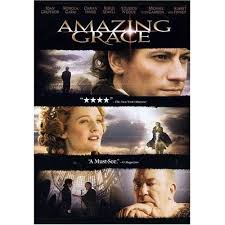
Over Easter weekend Jeanne and I had a couple of unexpected unscheduled days because of illness in the family we were going to be visiting for the holiday. As is our custom with looking for things to do, we watched a lot of movies and television shows, including two-and-a-half seasons of The Chosen. To cap off our Easter watching binge, we returned to one of our favorites, Amazing Grace.
The 2007 movie includes fine acting performances from various rising young actors who eventually became the hottest performers going—Ioan Gruffudd, Benedict Cumberbatch, Rufus Sewell, Romola Garai—the wonderful Ciaran Hinds (who knew that Julius Caesar was in the House of Commons?), and two of my favorite older actors, Michael Gambon and Albert Finney. Amazing Grace is the story of William Wilberforce’s twenty year campaign to end the slave trade in England, finally accomplished in 1807 (the movie is a celebration of the bicentennial of that legislation). I have no idea how historically accurate the movie is, but as my good friend and colleague Rodney used to say, if it isn’t true it should be. It’s a great story.
Although there are certainly “good guys” and “bad guys” in the movie, no one is close to saintly or perfect. Played by IoanGruffudd, Wilberforce’s dogged attempts to end slavery meet with resistance for reasons that sound disturbingly familiar. Ending the slave trade will be devastating economically, there is “evidence” that the slaves in the colonies live better than the poor in England, non-whites in the colonies are “the white man’s burden,” as Rudyard Kipling will write decades later, and so on.
As he encounters multiple defeats and disappointments, Wilberforce is on the brink of despair when he has a conversation with his childhood minister, John Newton (played by Finney). Before becoming a member of the clergy years earlier, Newton had been a successful captain of a slave ship; through various powerful and transformative experiences, he recognized the evil underlying his profession, and famously wrote a poem that he set to a familiar and popular tune. The result was “Amazing Grace,” perhaps the most beloved song in the hymnal, in which the now-blind Newton wrote “I once was lost, but now am found; was blind, but now I see.”
In the middle of their conversation, Newton mentions he has heard that Wilberforce is returning to the faith of his youth; Wilberforce confirms the rumor, but says that while he badly needs divine inspiration and help, there have been no inspirational lightning bolts thus far. “Ah,” replies Newton, “but God sometimes does his work through gentle drizzle rather than storms.”  It is many more years before Wilberforce and his supporting cohorts from all walks of life land on a strategy that finally works, confirming Newton’s insight.
The frontal attacks of previous years, energized by righteous anger, eloquent statesmanship, and the best of moral intentions have failed again and again. It is not until an obscure lawyer in Wilberforce’s entourage of like-minded persons suggests a new strategy—essentially “we cheat”—that success is finally won. Through behind-the-scenes manipulation and the use of a long neglected, virtually unknown set of maritime regulations, Wilberforce and his colleagues do a brilliant end run on their political opponents and slavery in Great Britain soon crumbles under its own weight. It will take more than another half century and a brutal Civil War for the same to happen in the United States.
God sometimes does his work through gentle drizzle rather than storms. Ain’t it the truth? That certainly has been my experience, both in my own life and as I have observed the world around me for more than six-and-a-half decades. In its Latin roots, to “convert” means to “turn around,” but this turning is more often like a sunflower following the sun in its slow course across the sky than a dynamic and once-for-all event.
I am an optimist at heart, something that is often difficult to sustain when I think about how much there is to be accomplished in my own life and in the world around me, thoughts even more present than usual these days. It’s worth remembering that a steady rain, even a gentle drizzle, is better for my plants and grass than an inch-in-a-half-hour downpour. Beneath the layers of violence, hatred, ignorance and despair, something holy is lurking. Let the gentle drizzle and drops upon the heart release it.
Previous Post
April 16, 2023
Spending Time with my Favorite Disciple and my Favorite Philosopher
Next Post

April 20, 2023 So What? Now What?
Recent Comments
"Mary did have a choice. And she was able to make it before the Holy ..."
"i cannot read beyond your recommendations for the books since i like to have a ..."
"AI will never be able to utter with honesty, feeling, or humility, the greeting: "Namaste".It ..."
"They do. I'm sure you could find discussions of the same topic from any of ..."
Browse Our Archives
Select a Category abortion Advent AI Angels Artificial intelligence atheism attention baptism Baptists beauty belief Benedictines Bible bicycling Big Bird books Bovina Camaldoli hermitage Canada Catholicism cats certainty change Christianity Christmas Collegeville Covid-19 creativity Development of Western Civilization dogs doubt Easter Enneagram Epiphany Episcopal ethics Eucharist evil extroverts Facebook faith family fear flowers forgiveness freedom friends God goodness grace happiness heaven hell history Holy Spirit Holy Week hope human nature humility humor idolatry incarnation introverts irreverence Islam Jeanne Jesus Joe Biden joy Judaism justice Kamala Harris knowledge Lent listen literature liturgy love Marsue Memorial Day miracles movies music mystery mythology NPR Old Testament optimism paradox peace Penguins philosophy piano podcast politics power prayer Protestantism Providence College Religion Rhode Island sabbatical sacrament science seeing silence Simone Weil Socrates soul sports St. John's College stories suffering tattoo teaching technology television theology thinking time tolerance transcendence travel trees trust truth Uncategorized Vermont wisdom wonder writing
Select a Month May 2026 April 2026 March 2026 February 2026 January 2026 December 2025 November 2025 October 2025 September 2025 August 2025 July 2025 June 2025 May 2025 April 2025 March 2025 February 2025 January 2025 December 2024 November 2024 October 2024 September 2024 August 2024 July 2024 June 2024 May 2024 April 2024 March 2024 February 2024 January 2024 December 2023 November 2023 October 2023 September 2023 August 2023 July 2023 June 2023 May 2023 April 2023 March 2023 February 2023 January 2023 December 2022 November 2022 October 2022 September 2022 August 2022 July 2022 June 2022 May 2022 April 2022 March 2022 February 2022 January 2022 December 2021 November 2021 October 2021 September 2021 August 2021 July 2021 June 2021 May 2021 April 2021 March 2021 February 2021 January 2021 December 2020 November 2020 October 2020 September 2020 August 2020 July 2020 June 2020 May 2020 April 2020 March 2020 February 2020 January 2020 December 2019 November 2019 October 2019 September 2019 August 2019 July 2019 June 2019 May 2019 April 2019 March 2019 February 2019 January 2019 December 2018 November 2018 October 2018 September 2018 August 2018 July 2018 June 2018 May 2018 April 2018 March 2018 February 2018 January 2018 December 2017 November 2017 October 2017 September 2017 August 2017 July 2017 June 2017 May 2017 April 2017 March 2017 February 2017 January 2017 December 2016 November 2016 October 2016 September 2016 August 2016 July 2016 June 2016 May 2016 April 2016 March 2016 February 2016 January 2016 December 2015 November 2015 October 2015 September 2015 August 2015 July 2015 June 2015 May 2015 April 2015 March 2015 February 2015 January 2015 December 2014 November 2014 October 2014 September 2014 August 2014 July 2014 June 2014 May 2014 April 2014 March 2014 February 2014 January 2014 December 2013 November 2013 October 2013 September 2013 August 2013 July 2013 June 2013 May 2013 April 2013 March 2013 February 2013 January 2013 December 2012 November 2012 October 2012 September 2012
Follow Us!
TAKE THE
Religious Wisdom Quiz
What queen visited Solomon to test his wisdom?
Select your answer to see how you score.
Queen of Egypt Queen of Tyre Queen of Sheba Queen Esther
Books by This Author Books by Vance G. Morgan
Related posts from Freelance Christianity

The Lonely Pawn: On Faith, Doubt, and Meaning


AI and Love: When a Chatbot Becomes a...

TRENDING AT PATHEOS Progressive Christian

What Being a Modern-Day Apostle Means to Me
In my last column, I discussed the ins and outs of modern-day...

Did Ancient China Once Worship the God of...
Across human history, a common thread weaves through the origins of the...

Love Your Neighbor – Including Earth-Kin: Lev. 19,...
God’s command to love your neighbor means acting in an ethical and...

Lead a Church Study of “Jesus and Lao...
Guest writer Jack Thomas (The Irreverent Reverend) reflects on leading his church...

Pastoral Wisdom for Responding to Sermon Pushback
Getting sermon pushback on your social justice sermon? Learn practical, Proverbs-based strategies...

Principles for Understanding the Apostolic Ministry Today
Whenever people discover that my formal ministry title is "apostle," as in...
view all Progressive Christian blogs
What Are Your Thoughts?leave a comment
Ad-Free & Subscriber Log-In Subscription Support
- About Us
- 2026 Calendar
- Videos
- Podcasts
- Library of World Religions
- Faith In Media Tracker
- Advertise With Us
- Write for Us
- Privacy Policy
- Terms of Service
- Do Not Sell My Data
- Contact Us
- Radiant Digital
- Manage Newsletter Subscriptions
- Unsubscribe From Notifications
- Sitemap
Copyright 2008-2026, Patheos. All rights reserved.
Subscription Support Ad-Free & Subscriber Log-In
Follow Patheos