
BuddhistCatholicContemplativeEvangelicalGeneral ChristianHinduJewishLatter-day SaintMuslimNew VisionsProgressive Christian
Beliefs
- Buddhist
- Catholic
- Contemplative
- Evangelical
- General Christian
- Hindu
- Jewish
- Latter-day Saint
- More Voices
- Muslim
- New Visions
- Pagan
- Progressive Christian
Topics
- Religion News
- Food and Religion
- Sports and Religion
- Religious Art
- Religious Music and Entertainment
- Religious Events
- History and Religion
- Style and Religion
- Politics and Religion
- Women in Religion
- Recreation Outdoors and Religion
- Business Finance and Religion
- Careers Workplace and Religion
- Education and Religion
- Family Parenting and Religion
- Health Fitness and Religion
- Home and Religion
- Relationships and Religion
- Technology and Religion
- Travel and Religion
Columnists
- Buddhist Columnists
- Business Finance and Religion Columnists
- Careers Workplace and Religion Columnists
- Catholic Columnists
- Contemplative Columnists
- Education and Religion Columnists
- Evangelists Columnists
- Family Parenting and Religion Columnists
- General Christian Columnists
- Health Fitness and Religion Columnists
- Hindu Columnists
- History and Religion Columnists
- Home and Religion Columnists
- Jewish Columnists
- More Voices Columnists
- Latter Day Columnists
- Muslim Columnists
- New Visions Columnists
- Nonreligious Columnists
- Pagan Columnists
- Politics and Religion Columnists
- Progressive Columnists
- Recreation Outdoors and Religion Columnists
- Relationships and Religion Columnists
- Religion News Columnists
- Religious Art Columnists
- Religious Events Columnists
- Religious Music and Entertainment Columnists
- Sports and Religion Columnists
- Style and Religion Columnists
- Technology and Religion Columnists
- Travel and Religion Columnists
- Women in Religion Columnists
Resource Library
- 2026 Calendar
- Library of World Religions
- The 100 Most Holy Places on Earth
- Patheos Answers
- Podcasts
- Videos
- Faith Leaders Database
- Anglican Episcopalian
- Bahai
- Baptist
- Buddhism
- Christianity
- Confucianism
- Eastern Orthodoxy
- Hinduism
- Holiness and Pentecostal
- ISKCON
- Islam
- Judaism
- Lutheran
- Methodist
- The Church of Jesus Christ of Latter-day Saints
- New Age
- Paganism
- Presbytarian and Reformed
- Protestantism
- Religion Behind the Scenes
- Roman Catholic
- Scientology
- Shia Islam
- Sikhism
- Sufism
- Sunni Islam
- Taoism
- Zen
- See all religions
Research Tools
 Ad-Free & Subscriber Log-In Subscription Support
Ad-Free & Subscriber Log-In Subscription Support
Follow Patheos 

- Trending:
- Forgiveness
- |
- Marriage
- |
- Consciousness
- |
- Death Penalty
- |
- Election
- |
- Halloween

- Home
- Progressive Christian
- Crows I Have Known
Crows I Have Known
Last updated on: November 8, 2012 at 7:00 am by Vance Morgan
Crows I Have Known 2012-11-08T07:00:44-04:00 Vance Morgan
Patheos Explore the world's faith through different perspectives on religion and spirituality! Patheos has the views of the prevalent religions and spiritualities of the world.
My childhood was filled with unusual characters, all products of my father’s fertile imagination. A Freudian would probably say that each was a projection of a different aspect of my father’s personality—all I know is that their appearances were both unpredictable and entertaining. The “Flying Gynzbyrd,” for instance,  was a heavy bird who liked to land with a thud on the breakfast table and stomp through either my brother’s or my toast, leaving imprints the size of the tips of my dad’s index and third finger. The “Claw” was a dangerous creature who liked to be petted but would fly into a rage and attach himself without warning to your face or the top of your head if you ru
 bbed him just slightly the wrong way. My favorite was “Pet Crow.” He was, I’m sure, a projection of my father’s affectionate and emotional side, a part of his personality that was not frequently on display in traditional forms. Pet Crow loved to sit on my shoulder, then work his way farther and farther into the crook of my neck between my clavicle and my jaw in a ticklish way that sent me into spasms of hilarity.
I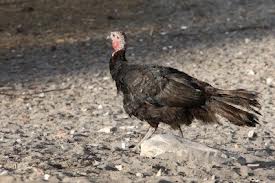 included these childhood companions and several new creatures in my own parenting repertoire; I found that gynzbyrds, claws, crows, Thursday Turkey, and Friday Frog
 were far more successful in getting my sons up for school than yelling “get your asses out of bed NOW!” Crows are an ongoing fascination. When we moved to Providence eighteen years ago, I noticed in short order that the urban crows on our street were unusually large and noticeably louder than other crows in my experience (Pet Crow, for instance, was entirely silent). I also noticed that I never saw more than three crows at a time, so I came to the obviously logical conclusion that they were the only crows. I named them Edgar, Allen, and Poe, after the E.A.P. of “The Raven” fame
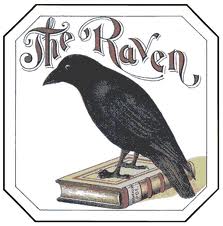 who had a strong Providence connection. Jeanne once asked me how I could tell them apart—I told her that if we saw just one, it was Edgar, just two were Edgar and Allen, with Poe making it a threesome every once in a while. Jeanne, used to these sorts of insights on my part, never questioned my story. She bought me a painting a few years ago of a crow striding down a path with large galoshes-style boots on
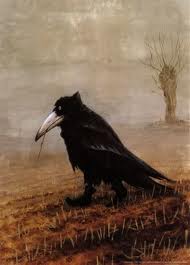 , which hangs proudly by the door in my office. It’s a very dependable conversation starter.
Not everyone is as willing to embrace my crow logic as Jeanne is. Upon seeing two crows on campus once while walking to lunch with some colleagues, I said “Hi, Edgar and Allen.” Asked for an explanation, I filled my colleagues in on my insight that there are only three crows. After an uncomfortable silence, a theology professor said tentatively “Uh, Vance, I think there are more than three crows in the world.” I responded “When have you ever seen more than three crows in one spot?” Of course, he couldn’t think of such a time. To which I responded “Q.E.D.” I wonder why I haven’t been assigned to teach logic recently. O ne time a while ago my smartass son and I saw what appeared to the untrained eye to be four identical crows on a lawn. My son said “So much for your three-crow theory, Dad.” To which I responded, “That’s Edgar, Allen, Poe, and a raven.”
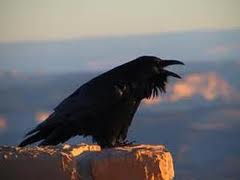 In his later years, my Pennsylvanian-born-turned-Westerner father became interested in various Native American myths and traditions, particularly the idea that certain animals and birds have a special spiritual significance. He claimed for a while that the raven was his totemic bird, which is not a surprise since ravens make occasional appearances in the Bible, including the Noah and Elijah stories.
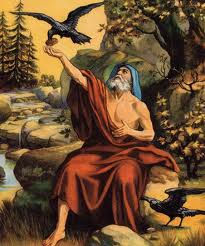 After hearing over the phone yet another of his stories about his latest brilliant insight being confirmed by a mystical raven circling overhead, I asked Dad one day “what’s the difference between a raven and a really big crow”? After a few moments of silence, he honestly admitted “none, I guess.” The next time I heard him say anything about totemic birds, his was now the golden eagle.
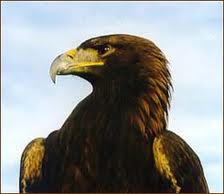 I think he believed his spiritual stature was a bit more exalted than could be handled by a mere crow. Raven, yes, but not a crow.
I don’t know, though—there’s something special about crows. In one of Aesop’s fables, a very thirsty crow comes across a pitcher containing a small amount of water. When the crow put its beak into the mouth of the pitcher, he found that he could not reach far enough down to get at the water. 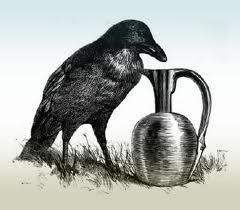 He tried and tried, but at last had to give up in despair. Then he had an Archimedes-like “Eureka!” moment about the physics of water displacement. He picked up a nearby pebble in his beak and dropped it in the pitcher. Then he dropped another pebble in the pitcher. And another one. And another one. After several hundred pebbles or more, the displaced water rose high enough in the pitcher for him to quench his thirst.
In my experience, the Holy Spirit is very much like Aesop’s crow. I’ve felt spiritually dry for a long time, and have considered the liquid faith poured into my pitcher as a child as long gone—good riddance. But the best of that liquid remained, hidden and unattended at the bottom. T he Holy Spirit has been dropping pebbles and drips of water into my pitcher over my whole lifetime—an experience here, a word there, a book someplace else, a person—without my even being aware. Jeanne has told me several times that “this is your time”—all of the spiritually confusing years were actually years of pebbles collecting, one by one, in my pitcher. During my sabbatical three years ago, one of my colleagues said “you’re not the same person you were when you came here.” She was right—I was dry, but now I’m wet and getting wetter all the time.
Previous Post

November 4, 2012
Ordinary Miracles
Next Post
December 23, 2012 God Made Into Flesh
Browse Our Archives
Select a Category abortion Advent AI Angels Artificial intelligence atheism attention baptism Baptists beauty belief Benedictines Bible bicycling Big Bird books Bovina Camaldoli hermitage Canada Catholicism cats certainty change Christianity Christmas Collegeville Covid-19 creativity Development of Western Civilization dogs doubt Easter Enneagram Epiphany Episcopal ethics Eucharist evil extroverts Facebook faith family fear flowers forgiveness freedom friends God goodness grace happiness heaven hell history Holy Spirit Holy Week hope human nature humility humor idolatry incarnation introverts irreverence Islam Jeanne Jesus Joe Biden joy Judaism justice Kamala Harris knowledge Lent listen literature liturgy love Marsue Memorial Day miracles movies music mystery mythology NPR Old Testament optimism paradox peace Penguins philosophy piano podcast politics power prayer Protestantism Providence College Religion Rhode Island sabbatical sacrament science seeing silence Simone Weil Socrates soul sports St. John's College stories suffering tattoo teaching technology television theology thinking time tolerance transcendence travel trees trust truth Uncategorized Vermont wisdom wonder writing
Select a Month May 2026 April 2026 March 2026 February 2026 January 2026 December 2025 November 2025 October 2025 September 2025 August 2025 July 2025 June 2025 May 2025 April 2025 March 2025 February 2025 January 2025 December 2024 November 2024 October 2024 September 2024 August 2024 July 2024 June 2024 May 2024 April 2024 March 2024 February 2024 January 2024 December 2023 November 2023 October 2023 September 2023 August 2023 July 2023 June 2023 May 2023 April 2023 March 2023 February 2023 January 2023 December 2022 November 2022 October 2022 September 2022 August 2022 July 2022 June 2022 May 2022 April 2022 March 2022 February 2022 January 2022 December 2021 November 2021 October 2021 September 2021 August 2021 July 2021 June 2021 May 2021 April 2021 March 2021 February 2021 January 2021 December 2020 November 2020 October 2020 September 2020 August 2020 July 2020 June 2020 May 2020 April 2020 March 2020 February 2020 January 2020 December 2019 November 2019 October 2019 September 2019 August 2019 July 2019 June 2019 May 2019 April 2019 March 2019 February 2019 January 2019 December 2018 November 2018 October 2018 September 2018 August 2018 July 2018 June 2018 May 2018 April 2018 March 2018 February 2018 January 2018 December 2017 November 2017 October 2017 September 2017 August 2017 July 2017 June 2017 May 2017 April 2017 March 2017 February 2017 January 2017 December 2016 November 2016 October 2016 September 2016 August 2016 July 2016 June 2016 May 2016 April 2016 March 2016 February 2016 January 2016 December 2015 November 2015 October 2015 September 2015 August 2015 July 2015 June 2015 May 2015 April 2015 March 2015 February 2015 January 2015 December 2014 November 2014 October 2014 September 2014 August 2014 July 2014 June 2014 May 2014 April 2014 March 2014 February 2014 January 2014 December 2013 November 2013 October 2013 September 2013 August 2013 July 2013 June 2013 May 2013 April 2013 March 2013 February 2013 January 2013 December 2012 November 2012 October 2012 September 2012
Follow Us!
TAKE THE
Religious Wisdom Quiz
How old was Moses when he died?
Select your answer to see how you score.
90 years 110 years 120 years 100 years
Books by This Author Books by Vance G. Morgan
Related posts from Freelance Christianity

AI and Love: When a Chatbot Becomes a...



TRENDING AT PATHEOS Progressive Christian

What Being a Modern-Day Apostle Means to Me
In my last column, I discussed the ins and outs of modern-day...

Did Ancient China Once Worship the God of...
Across human history, a common thread weaves through the origins of the...

Love Your Neighbor – Including Earth-Kin: Lev. 19,...
God’s command to love your neighbor means acting in an ethical and...

Lead a Church Study of “Jesus and Lao...
Guest writer Jack Thomas (The Irreverent Reverend) reflects on leading his church...

Pastoral Wisdom for Responding to Sermon Pushback
Getting sermon pushback on your social justice sermon? Learn practical, Proverbs-based strategies...

Principles for Understanding the Apostolic Ministry Today
Whenever people discover that my formal ministry title is "apostle," as in...
view all Progressive Christian blogs
Ad-Free & Subscriber Log-In Subscription Support
- About Us
- 2026 Calendar
- Videos
- Podcasts
- Library of World Religions
- Faith In Media Tracker
- Advertise With Us
- Write for Us
- Privacy Policy
- Terms of Service
- Do Not Sell My Data
- Contact Us
- Radiant Digital
- Manage Newsletter Subscriptions
- Unsubscribe From Notifications
- Sitemap
Copyright 2008-2026, Patheos. All rights reserved.
Subscription Support Ad-Free & Subscriber Log-In
Follow Patheos