
BuddhistCatholicContemplativeEvangelicalGeneral ChristianHinduJewishLatter-day SaintMuslimNew VisionsProgressive Christian
Beliefs
- Buddhist
- Catholic
- Contemplative
- Evangelical
- General Christian
- Hindu
- Jewish
- Latter-day Saint
- More Voices
- Muslim
- New Visions
- Pagan
- Progressive Christian
Topics
- Religion News
- Food and Religion
- Sports and Religion
- Religious Art
- Religious Music and Entertainment
- Religious Events
- History and Religion
- Style and Religion
- Politics and Religion
- Women in Religion
- Recreation Outdoors and Religion
- Business Finance and Religion
- Careers Workplace and Religion
- Education and Religion
- Family Parenting and Religion
- Health Fitness and Religion
- Home and Religion
- Relationships and Religion
- Technology and Religion
- Travel and Religion
Columnists
- Buddhist Columnists
- Business Finance and Religion Columnists
- Careers Workplace and Religion Columnists
- Catholic Columnists
- Contemplative Columnists
- Education and Religion Columnists
- Evangelists Columnists
- Family Parenting and Religion Columnists
- General Christian Columnists
- Health Fitness and Religion Columnists
- Hindu Columnists
- History and Religion Columnists
- Home and Religion Columnists
- Jewish Columnists
- More Voices Columnists
- Latter Day Columnists
- Muslim Columnists
- New Visions Columnists
- Nonreligious Columnists
- Pagan Columnists
- Politics and Religion Columnists
- Progressive Columnists
- Recreation Outdoors and Religion Columnists
- Relationships and Religion Columnists
- Religion News Columnists
- Religious Art Columnists
- Religious Events Columnists
- Religious Music and Entertainment Columnists
- Sports and Religion Columnists
- Style and Religion Columnists
- Technology and Religion Columnists
- Travel and Religion Columnists
- Women in Religion Columnists
Resource Library
- 2026 Calendar
- Library of World Religions
- The 100 Most Holy Places on Earth
- Patheos Answers
- Podcasts
- Videos
- Faith Leaders Database
- Anglican Episcopalian
- Bahai
- Baptist
- Buddhism
- Christianity
- Confucianism
- Eastern Orthodoxy
- Hinduism
- Holiness and Pentecostal
- ISKCON
- Islam
- Judaism
- Lutheran
- Methodist
- The Church of Jesus Christ of Latter-day Saints
- New Age
- Paganism
- Presbytarian and Reformed
- Protestantism
- Religion Behind the Scenes
- Roman Catholic
- Scientology
- Shia Islam
- Sikhism
- Sufism
- Sunni Islam
- Taoism
- Zen
- See all religions
Research Tools
 Ad-Free & Subscriber Log-In Subscription Support
Ad-Free & Subscriber Log-In Subscription Support
Follow Patheos 

- Trending:
- Forgiveness
- |
- Marriage
- |
- Consciousness
- |
- Death Penalty
- |
- Election
- |
- Halloween

- Home
- Progressive Christian
- Christus Natus Est: Merry Christmas
Christus Natus Est: Merry Christmas
Last updated on: December 24, 2024 at 7:00 am by Vance Morgan
Christus Natus Est: Merry Christmas 2024-12-23T10:57:25-04:00 Vance Morgan
Patheos Explore the world's faith through different perspectives on religion and spirituality! Patheos has the views of the prevalent religions and spiritualities of the world.
Christmas movies are a big deal at my house. Jeanne goes for the classics, such as “Miracle on 34th Street,” “The Bishop’s Wife,” “It’s a Wonderful Life,” and (her favorite) “White Christmas.” Those are all fine (except “White Christmas,” which I can take or leave), but I tend to favor more recent ones, like “The Holiday,” ” Love Actually,” and (my favorite) “The Nativity Story.”
Movies with Biblical themes were both attractive and problematic in my early years. We did not go to movies, but it was okay to watch them on TV (go figure), except on Sundays (go figure again). Of particular interest were Hollywood epics of Biblical proportions, such as “The Ten Commandments,” “Ben Hur,” “The Robe,” and “Quo Vadis.” Moses always has, in my imagination, looked like Charlton Heston (and, I guess, like Ben Hur). Even more daring were the various Hollywood portrayals of Jesus, from “muscular Jesus” in “King of Kings” and “cerebral Jesus” in “The Greatest Story Ever Told” to, some years later, “ethereal and almost effeminate Jesus” in “Jesus of Nazareth.” I have many memories of fellow fundamentalists watching such movies with me and saying “That’s not Scriptural” and “That’s not Biblical” when characters from the sacred text said or did things that were not contained within the leather covers of the King James Version.
“The Nativity Story” would not entirely escape such criticism, but it presents a remarkably straightforward, hence beautiful, melding of the birth of Jesus narratives. All of the standard elements are there—Elizabeth and Zechariah, Mary and Joseph, shepherds and wise men at the manger, angels in appropriate places saying appropriate things, along with a particularly creepy father and son team of Herod the Great and Herod Antipas. These standard elements arise from a conflation of gospel texts. The authors of Mark and John apparently didn’t think the circumstances of Jesus’ birth important enough to even report on, while the authors of Matthew and Luke construct their stories from “cherry-picked” details. Luke does not mention the wise men or the star, but has angels singing to shepherds, who then visit Jesus in a manger in Bethlehem. Matthew has no worshipping shepherds or even a manger, but wise men following a star visit the holy family in a house, probably in Nazareth, sometime after Jesus’ birth. Throw in Santa and some reindeer, and you’d get the usual front lawn decorations for the holiday season.
So where lies the truth? A friend who passed away a few years ago tended to be rather definitive in his pronouncements. Once at lunch he said that “The heart of Christianity is what you believe about the stories. Do you believe the stories are true or don’t you? Yes or No? And if you say ‘let me think about it,’ that’s the same as saying No!” This was not directed at me specifically—he was just drawing a line in the sand, as those of us who knew and loved him expected him to do. But I think I’m in trouble. Because not only am I not sure about whether my answer to his question is “yes,” “no,” “let me think about it,” or even “which stories are you referring to?”—I’m inclined to say that “it doesn’t matter.”
Toward the end of many fall semesters, I spend a couple of weeks in the New Testament with a classroom full of college freshmen in the interdisciplinary course I teach in. Knowing that this was a group, largely the product of twelve years of Catholic parochial school education, for whom the Bible in college might be a tough sell, one year I asked my seminar group an out of the box question right at the start: What difference does it make whether these stories are or aren’t true? If it were definitively proven tomorrow that Jesus never existed, then what? A fascinating discussion ensued, full of more nuance and insight than even I expected. Contributions ranged across the spectrum of possibilities, but one student’s comment particularly stayed with me. “I’d still be a Christian,” she said, “because being a Christian makes me a better person than I would be if I wasn’t.” That’s a good start—the measure of one’s faith is what impact it has in real time on the life being lived.
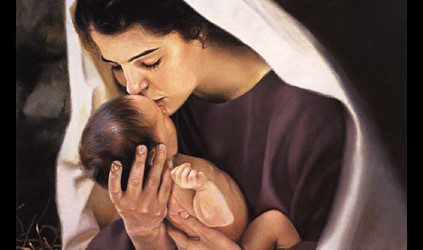
Meister Eckhart once said that the virgin birth is something that happens within us, that the nativity story is the story of the continuing union of the Spirit of God with individual, fleshly human beings. But then Meister Eckhart was accused of heresy, was fortunate to escape being burned at the stake, and died in obscurity. No wonder I resonate with his insight. At the climatic manger scene in “The Nativity Story,” the gold-bearing wise man Melchior, who looks amazingly like a colleague and friend of mine who is a professor emeritus in the history department, gazes at the baby and says “God made into flesh.” There it is in its simplicity and iconoclasm—the heart and soul of Christianity. God made into flesh.
When did the Incarnation become “mine” for the first time? Was it when I consciously noted new space deep inside of me while reciting a Psalm at noon prayer with a bunch of Benedictine monks? Was it when I realized that I was no longer angry at people and issues from my past that had consumed my life? Was it when I heard Catherine of Genoa’s “My deepest me is God” in a homily? It truly doesn’t matter when it happened, just that it did. On good days, I can look at another human being and detect holiness. On really, really good days, I can even turn my eyes inward and find something beautiful. I can say, with gratitude, awe, and disbelief all tangled together, along with Melchior gazing at the manger, “God made into flesh.” Remarkably small. Disturbingly fragile. Completely mysterious. And utterly true.
Merry Christmas
Previous Post

December 22, 2024
The Fourth Sunday of Advent: Mother Mary Comes To Me
Next Post
December 27, 2024 Will we ever fill the hungry with good things?
Recent Comments
"Mary did have a choice. And she was able to make it before the Holy ..."
"i cannot read beyond your recommendations for the books since i like to have a ..."
"AI will never be able to utter with honesty, feeling, or humility, the greeting: "Namaste".It ..."
"They do. I'm sure you could find discussions of the same topic from any of ..."
Browse Our Archives
Select a Category abortion Advent AI Angels Artificial intelligence atheism attention baptism Baptists beauty belief Benedictines Bible bicycling Big Bird books Bovina Camaldoli hermitage Canada Catholicism cats certainty change Christianity Christmas Collegeville Covid-19 creativity Development of Western Civilization dogs doubt Easter Enneagram Epiphany Episcopal ethics Eucharist evil extroverts Facebook faith family fear flowers forgiveness freedom friends God goodness grace happiness heaven hell history Holy Spirit Holy Week hope human nature humility humor idolatry incarnation introverts irreverence Islam Jeanne Jesus Joe Biden joy Judaism justice Kamala Harris knowledge Lent listen literature liturgy love Marsue Memorial Day miracles movies music mystery mythology NPR Old Testament optimism paradox peace Penguins philosophy piano podcast politics power prayer Protestantism Providence College Religion Rhode Island sabbatical sacrament science seeing silence Simone Weil Socrates soul sports St. John's College stories suffering tattoo teaching technology television theology thinking time tolerance transcendence travel trees trust truth Uncategorized Vermont wisdom wonder writing
Select a Month May 2026 April 2026 March 2026 February 2026 January 2026 December 2025 November 2025 October 2025 September 2025 August 2025 July 2025 June 2025 May 2025 April 2025 March 2025 February 2025 January 2025 December 2024 November 2024 October 2024 September 2024 August 2024 July 2024 June 2024 May 2024 April 2024 March 2024 February 2024 January 2024 December 2023 November 2023 October 2023 September 2023 August 2023 July 2023 June 2023 May 2023 April 2023 March 2023 February 2023 January 2023 December 2022 November 2022 October 2022 September 2022 August 2022 July 2022 June 2022 May 2022 April 2022 March 2022 February 2022 January 2022 December 2021 November 2021 October 2021 September 2021 August 2021 July 2021 June 2021 May 2021 April 2021 March 2021 February 2021 January 2021 December 2020 November 2020 October 2020 September 2020 August 2020 July 2020 June 2020 May 2020 April 2020 March 2020 February 2020 January 2020 December 2019 November 2019 October 2019 September 2019 August 2019 July 2019 June 2019 May 2019 April 2019 March 2019 February 2019 January 2019 December 2018 November 2018 October 2018 September 2018 August 2018 July 2018 June 2018 May 2018 April 2018 March 2018 February 2018 January 2018 December 2017 November 2017 October 2017 September 2017 August 2017 July 2017 June 2017 May 2017 April 2017 March 2017 February 2017 January 2017 December 2016 November 2016 October 2016 September 2016 August 2016 July 2016 June 2016 May 2016 April 2016 March 2016 February 2016 January 2016 December 2015 November 2015 October 2015 September 2015 August 2015 July 2015 June 2015 May 2015 April 2015 March 2015 February 2015 January 2015 December 2014 November 2014 October 2014 September 2014 August 2014 July 2014 June 2014 May 2014 April 2014 March 2014 February 2014 January 2014 December 2013 November 2013 October 2013 September 2013 August 2013 July 2013 June 2013 May 2013 April 2013 March 2013 February 2013 January 2013 December 2012 November 2012 October 2012 September 2012
Follow Us!
TAKE THE
Religious Wisdom Quiz
In 1 Timothy, what does Paul say is the root of all kinds of evil?
Select your answer to see how you score.
Pride Greed Money itself The love of money
Books by This Author Books by Vance G. Morgan
Related posts from Freelance Christianity

The Lonely Pawn: On Faith, Doubt, and Meaning


AI and Love: When a Chatbot Becomes a...

TRENDING AT PATHEOS Progressive Christian

What Being a Modern-Day Apostle Means to Me
In my last column, I discussed the ins and outs of modern-day...

Did Ancient China Once Worship the God of...
Across human history, a common thread weaves through the origins of the...

Love Your Neighbor – Including Earth-Kin: Lev. 19,...
God’s command to love your neighbor means acting in an ethical and...

Lead a Church Study of “Jesus and Lao...
Guest writer Jack Thomas (The Irreverent Reverend) reflects on leading his church...

Pastoral Wisdom for Responding to Sermon Pushback
Getting sermon pushback on your social justice sermon? Learn practical, Proverbs-based strategies...

Principles for Understanding the Apostolic Ministry Today
Whenever people discover that my formal ministry title is "apostle," as in...
view all Progressive Christian blogs
What Are Your Thoughts?leave a comment
Ad-Free & Subscriber Log-In Subscription Support
- About Us
- 2026 Calendar
- Videos
- Podcasts
- Library of World Religions
- Faith In Media Tracker
- Advertise With Us
- Write for Us
- Privacy Policy
- Terms of Service
- Do Not Sell My Data
- Contact Us
- Radiant Digital
- Manage Newsletter Subscriptions
- Unsubscribe From Notifications
- Sitemap
Copyright 2008-2026, Patheos. All rights reserved.
Subscription Support Ad-Free & Subscriber Log-In
Follow Patheos