
BuddhistCatholicContemplativeEvangelicalGeneral ChristianHinduJewishLatter-day SaintMuslimNew VisionsProgressive Christian
Beliefs
- Buddhist
- Catholic
- Contemplative
- Evangelical
- General Christian
- Hindu
- Jewish
- Latter-day Saint
- More Voices
- Muslim
- New Visions
- Pagan
- Progressive Christian
Topics
- Religion News
- Food and Religion
- Sports and Religion
- Religious Art
- Religious Music and Entertainment
- Religious Events
- History and Religion
- Style and Religion
- Politics and Religion
- Women in Religion
- Recreation Outdoors and Religion
- Business Finance and Religion
- Careers Workplace and Religion
- Education and Religion
- Family Parenting and Religion
- Health Fitness and Religion
- Home and Religion
- Relationships and Religion
- Technology and Religion
- Travel and Religion
Columnists
- Buddhist Columnists
- Business Finance and Religion Columnists
- Careers Workplace and Religion Columnists
- Catholic Columnists
- Contemplative Columnists
- Education and Religion Columnists
- Evangelists Columnists
- Family Parenting and Religion Columnists
- General Christian Columnists
- Health Fitness and Religion Columnists
- Hindu Columnists
- History and Religion Columnists
- Home and Religion Columnists
- Jewish Columnists
- More Voices Columnists
- Latter Day Columnists
- Muslim Columnists
- New Visions Columnists
- Nonreligious Columnists
- Pagan Columnists
- Politics and Religion Columnists
- Progressive Columnists
- Recreation Outdoors and Religion Columnists
- Relationships and Religion Columnists
- Religion News Columnists
- Religious Art Columnists
- Religious Events Columnists
- Religious Music and Entertainment Columnists
- Sports and Religion Columnists
- Style and Religion Columnists
- Technology and Religion Columnists
- Travel and Religion Columnists
- Women in Religion Columnists
Resource Library
- 2026 Calendar
- Library of World Religions
- The 100 Most Holy Places on Earth
- Patheos Answers
- Podcasts
- Videos
- Faith Leaders Database
- Anglican Episcopalian
- Bahai
- Baptist
- Buddhism
- Christianity
- Confucianism
- Eastern Orthodoxy
- Hinduism
- Holiness and Pentecostal
- ISKCON
- Islam
- Judaism
- Lutheran
- Methodist
- The Church of Jesus Christ of Latter-day Saints
- New Age
- Paganism
- Presbytarian and Reformed
- Protestantism
- Religion Behind the Scenes
- Roman Catholic
- Scientology
- Shia Islam
- Sikhism
- Sufism
- Sunni Islam
- Taoism
- Zen
- See all religions
Research Tools
 Ad-Free & Subscriber Log-In Subscription Support
Ad-Free & Subscriber Log-In Subscription Support
Follow Patheos 

- Trending:
- Forgiveness
- |
- Marriage
- |
- Consciousness
- |
- Death Penalty
- |
- Election
- |
- Halloween

- Home
- Progressive Christian
- Childish or Childlike?
Childish or Childlike?
Last updated on: March 11, 2018 at 7:00 am by Vance Morgan
Childish or Childlike? 2018-03-05T21:07:13-04:00 Vance Morgan
Patheos Explore the world's faith through different perspectives on religion and spirituality! Patheos has the views of the prevalent religions and spiritualities of the world.
One of stories that was emphasized regularly in the Baptist Sunday school of my youth was Jesus’s apparent love of children from Matthew’s gospel. Actually, Matthew provides a couple of vignettes in back-to-back chapters that often get conflated. In response to the ubiquitous, “adult” questions about who is going to be greatest in the kingdom of heaven, Jesus uses a kid for a “show-and-tell” moment.
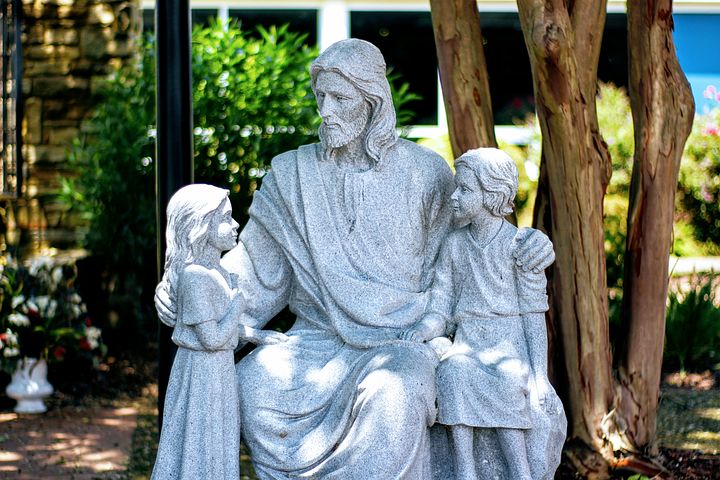
Unless you are converted and become as little children, you will by no means enter the kingdom of heaven. Therefore whoever humbles himself as this little child is the greatest in the kingdom of heaven. And whoever receives on little child like this in my name receives me.
Then in the very next chapter, when the disciples try to stop people from bringing their children to Jesus for prayer and blessing, presumably because Jesus has more important things to do than hang out with kids, Jesus tells the disciples to knock it off.
Let the little children come to me, and do not forbid them; for of such is the kingdom of heaven.
I must confess that I had no idea of what Jesus was talking about, since the children I knew, myself included, exhibited none of the characteristics that one might think would be important in the kingdom of heaven (whatever that is). Petty, mean, nasty, ignorant–hardly the values worth promoting in any kingdom worth being part of. No one wants to be “childish,” but Jesus apparently thinks that there is something valuable about being “childlike.” What is it?
I had the opportunity to explore this question with my sophomore students recently as we read and discussed Cormac McCarthy’s The Road in my “Apocalypse” colloquium. In a post-apocalyptic world, an unnamed father and son wander through a close-to-dead landscape covered in ash, several years after an unnamed cataclysm (Nuclear holocaust? Meteor strike?) ended human civilization. The man and the boy are hungry, close to starving, scrounging to find whatever sustenance they can as they wander south through the ash-covered former American southeast. The majority of human beings remaining have reverted to cannibalism in order to stay alive. The land is dead, civilization is dead, hope is dead, the man and the boy are likely to be dead soon—“dead” is undoubtedly the word most frequently used in the novel.
Yet according to Tony Hillcoat, the director of the 2007 film version of The Road, Cormac McCarthy once told him that although his previous novel Blood Meridian is about “the worst in human nature,” The Road “is very much about the absolute best.” If we are to take the author seriously, it is clear that he intends us to find “the absolute best” that humans can be in the nameless boy.
Throughout the story, the man tells the boy, who was born after the unnamed apocalyptic event(s) occurred, stories of heroism and values. It is clear that the man loves the boy unconditionally—his son is the only reason he has to continue living. But the boy has a natural and powerful moral goodness that cannot be accounted for by stories from his father or any of his own experiences. The boy repeatedly confirms with his father that they are “the good guys,” that they are “carrying the fire,” and that they would never eat someone, no matter how hungry they got. He shows compassion and mercy for those who do not deserve it, often against his father’s contrary wishes, including for a thief who intended to leave the father and son provisionless. When the man and boy stumble across an underground bunker stocked with sufficient canned goods, powdered milk, and dried meat to keep them alive for another week or two, the boy offers a simple prayer of thanks to the people who left the provisions, even though they have undoubtedly been dead for years.
The man recognizes a small glimmer of hope and beauty in his son in a world that otherwise is devoid of both. On the third page of the novel, as he observes his son from a short distance, the man says “If he is not the word of God, then God never spoke.” Later in the novel, the man and boy spend a short time with another wanderer, an old man whom the boy insists on sharing his food and blanket with. The two adults discuss the boy’s generosity that night as the boy sleeps next to them.
You should thank him, you know. I wouldn’t have given you anything.
Maybe I should and maybe I shouldn’t.
Why wouldn’t you?
I wouldn’t have given him mine. Why did he do it?
You wouldn’t understand. I’m not sure I do.
Maybe he believes in God.
I don’t know what he believes in.
He’ll get over it.
No he won’t.
That is the crux of the matter. There are some things we should grow out of, that we should “get over,” and some things we should not. I presented this tension to my students by asking them, in preparation for our seminar, to consider the difference between being “childish” and being “childlike.” What is McCarthy proposing to us in this boy? What, for that matter, did Jesus have in mind?
It was clear from both their weekly intellectual notebook entries and class discussion that my students were not in agreement about how best to understand the boy. Some found him to be “annoying,” others “unrealistic” or “naïve,” agreeing with the old man that if he survives into adulthood, real life will beat this childish, black-and-white ethic out of the boy in favor of a much grayer, but also more “realistic” and “pragmatic” approach to the world. Others, however, found something profoundly attractive, almost holy, in the boy’s commitment to moral principles and goodness in the darkest of circumstances. One student tackled the issue head on in her notebook entry:
We generally accept that children are typically associated with purity and innocence. If we agree with this generalization, then the next question is; “is the son childish or child-like?” This question asks, are children pure because they are temporarily naïve and innocent due to their age or are they the truest representation of human nature before it is overridden with responsibility and the experiences that cause adults to act immorally?
This student raises the classic question “Why be moral?” then takes the side of those who, like Plato, argue that human beings are naturally good, a goodness that gets warped, sometimes beyond recognition, by life. Can this goodness be preserved? My student continued:
Acting childish is a fleeting moment based on the situation but being child-like defines you. I think this question is answered by the last part of the quote. The father claims his son will not get over ‘it’. The ‘it’ refers to the son’s goodness and generosity that the rest of the world seems to have given up on. The son is child-like. Therefore, it is my belief that the son represents humans in their most natural form. He is going to continue to see and act morally because he will not be faced with the external pressures of a society which can change his nature because civilization doesn’t exist. The father represents a person who has overrun their natural human pure instincts because he faces the responsibilities the son is not burdened with.
Whether or not my student’s position that we are naturally good but then are corrupted by society can be supported or not is a matter for discussion. But she, as Cormac McCarthy and Jesus, believes at least that there is something good and pure at the core of our being, something that we would do well to locate, nurture, and preserve. The best evidence for it, at least in The Road, is that the boy is a completely believable character. We know, in other words, that no matter how encrusted with real life it becomes, each of us has at our core a spark of goodness—something that may be the best evidence available for the reality of the divine.
Believing in such natural goodness, even in the face of so much contrary evidence, is a matter of choice and commitment rather than of objective data. It is a reason to respect the dignity and value of all persons, regardless of their race, gender, socio/economic status, or any of the other reasons on the basis of which we deny human equality and value. As Simone Weil writes,
Whoever recognizes that reality . . . holds every human being without any exception as something sacred to which each of us is bound to show respect. This is the only possible motive for universal respect towards all human beings.
Previous Post

March 9, 2018
Do I (Still) Really Hate Donald Trump?
Next Post
March 13, 2018 Dr. Seuss, an Unborn Child, and Why Each Of Us Matters
Browse Our Archives
Select a Category abortion Advent AI Angels Artificial intelligence atheism attention baptism Baptists beauty belief Benedictines Bible bicycling Big Bird books Bovina Camaldoli hermitage Canada Catholicism cats certainty change Christianity Christmas Collegeville Covid-19 creativity Development of Western Civilization dogs doubt Easter Enneagram Epiphany Episcopal ethics Eucharist evil extroverts Facebook faith family fear flowers forgiveness freedom friends God goodness grace happiness heaven hell history Holy Spirit Holy Week hope human nature humility humor idolatry incarnation introverts irreverence Islam Jeanne Jesus Joe Biden joy Judaism justice Kamala Harris knowledge Lent listen literature liturgy love Marsue Memorial Day miracles movies music mystery mythology NPR Old Testament optimism paradox peace Penguins philosophy piano podcast politics power prayer Protestantism Providence College Religion Rhode Island sabbatical sacrament science seeing silence Simone Weil Socrates soul sports St. John's College stories suffering tattoo teaching technology television theology thinking time tolerance transcendence travel trees trust truth Uncategorized Vermont wisdom wonder writing
Select a Month May 2026 April 2026 March 2026 February 2026 January 2026 December 2025 November 2025 October 2025 September 2025 August 2025 July 2025 June 2025 May 2025 April 2025 March 2025 February 2025 January 2025 December 2024 November 2024 October 2024 September 2024 August 2024 July 2024 June 2024 May 2024 April 2024 March 2024 February 2024 January 2024 December 2023 November 2023 October 2023 September 2023 August 2023 July 2023 June 2023 May 2023 April 2023 March 2023 February 2023 January 2023 December 2022 November 2022 October 2022 September 2022 August 2022 July 2022 June 2022 May 2022 April 2022 March 2022 February 2022 January 2022 December 2021 November 2021 October 2021 September 2021 August 2021 July 2021 June 2021 May 2021 April 2021 March 2021 February 2021 January 2021 December 2020 November 2020 October 2020 September 2020 August 2020 July 2020 June 2020 May 2020 April 2020 March 2020 February 2020 January 2020 December 2019 November 2019 October 2019 September 2019 August 2019 July 2019 June 2019 May 2019 April 2019 March 2019 February 2019 January 2019 December 2018 November 2018 October 2018 September 2018 August 2018 July 2018 June 2018 May 2018 April 2018 March 2018 February 2018 January 2018 December 2017 November 2017 October 2017 September 2017 August 2017 July 2017 June 2017 May 2017 April 2017 March 2017 February 2017 January 2017 December 2016 November 2016 October 2016 September 2016 August 2016 July 2016 June 2016 May 2016 April 2016 March 2016 February 2016 January 2016 December 2015 November 2015 October 2015 September 2015 August 2015 July 2015 June 2015 May 2015 April 2015 March 2015 February 2015 January 2015 December 2014 November 2014 October 2014 September 2014 August 2014 July 2014 June 2014 May 2014 April 2014 March 2014 February 2014 January 2014 December 2013 November 2013 October 2013 September 2013 August 2013 July 2013 June 2013 May 2013 April 2013 March 2013 February 2013 January 2013 December 2012 November 2012 October 2012 September 2012
Follow Us!
TAKE THE
Religious Wisdom Quiz
In this Gospel, Jesus' first miracle is not recorded, and the narrative begins with a voice crying in the wilderness. Which Gospel starts with John the Baptist's ministry?
Select your answer to see how you score.
Luke Mark Matthew John
Books by This Author Books by Vance G. Morgan
Related posts from Freelance Christianity

The Lonely Pawn: On Faith, Doubt, and Meaning


AI and Love: When a Chatbot Becomes a...

TRENDING AT PATHEOS Progressive Christian

What Being a Modern-Day Apostle Means to Me
In my last column, I discussed the ins and outs of modern-day...

Did Ancient China Once Worship the God of...
Across human history, a common thread weaves through the origins of the...

Love Your Neighbor – Including Earth-Kin: Lev. 19,...
God’s command to love your neighbor means acting in an ethical and...

Lead a Church Study of “Jesus and Lao...
Guest writer Jack Thomas (The Irreverent Reverend) reflects on leading his church...

Pastoral Wisdom for Responding to Sermon Pushback
Getting sermon pushback on your social justice sermon? Learn practical, Proverbs-based strategies...

Principles for Understanding the Apostolic Ministry Today
Whenever people discover that my formal ministry title is "apostle," as in...
view all Progressive Christian blogs
Ad-Free & Subscriber Log-In Subscription Support
- About Us
- 2026 Calendar
- Videos
- Podcasts
- Library of World Religions
- Faith In Media Tracker
- Advertise With Us
- Write for Us
- Privacy Policy
- Terms of Service
- Do Not Sell My Data
- Contact Us
- Radiant Digital
- Manage Newsletter Subscriptions
- Unsubscribe From Notifications
- Sitemap
Copyright 2008-2026, Patheos. All rights reserved.
Subscription Support Ad-Free & Subscriber Log-In
Follow Patheos