
BuddhistCatholicContemplativeEvangelicalGeneral ChristianHinduJewishLatter-day SaintMuslimNew VisionsProgressive Christian
Beliefs
- Buddhist
- Catholic
- Contemplative
- Evangelical
- General Christian
- Hindu
- Jewish
- Latter-day Saint
- More Voices
- Muslim
- New Visions
- Pagan
- Progressive Christian
Topics
- Religion News
- Food and Religion
- Sports and Religion
- Religious Art
- Religious Music and Entertainment
- Religious Events
- History and Religion
- Style and Religion
- Politics and Religion
- Women in Religion
- Recreation Outdoors and Religion
- Business Finance and Religion
- Careers Workplace and Religion
- Education and Religion
- Family Parenting and Religion
- Health Fitness and Religion
- Home and Religion
- Relationships and Religion
- Technology and Religion
- Travel and Religion
Columnists
- Buddhist Columnists
- Business Finance and Religion Columnists
- Careers Workplace and Religion Columnists
- Catholic Columnists
- Contemplative Columnists
- Education and Religion Columnists
- Evangelists Columnists
- Family Parenting and Religion Columnists
- General Christian Columnists
- Health Fitness and Religion Columnists
- Hindu Columnists
- History and Religion Columnists
- Home and Religion Columnists
- Jewish Columnists
- More Voices Columnists
- Latter Day Columnists
- Muslim Columnists
- New Visions Columnists
- Nonreligious Columnists
- Pagan Columnists
- Politics and Religion Columnists
- Progressive Columnists
- Recreation Outdoors and Religion Columnists
- Relationships and Religion Columnists
- Religion News Columnists
- Religious Art Columnists
- Religious Events Columnists
- Religious Music and Entertainment Columnists
- Sports and Religion Columnists
- Style and Religion Columnists
- Technology and Religion Columnists
- Travel and Religion Columnists
- Women in Religion Columnists
Resource Library
- 2026 Calendar
- Library of World Religions
- The 100 Most Holy Places on Earth
- Patheos Answers
- Podcasts
- Videos
- Faith Leaders Database
- Anglican Episcopalian
- Bahai
- Baptist
- Buddhism
- Christianity
- Confucianism
- Eastern Orthodoxy
- Hinduism
- Holiness and Pentecostal
- ISKCON
- Islam
- Judaism
- Lutheran
- Methodist
- The Church of Jesus Christ of Latter-day Saints
- New Age
- Paganism
- Presbytarian and Reformed
- Protestantism
- Religion Behind the Scenes
- Roman Catholic
- Scientology
- Shia Islam
- Sikhism
- Sufism
- Sunni Islam
- Taoism
- Zen
- See all religions
Research Tools
 Ad-Free & Subscriber Log-In Subscription Support
Ad-Free & Subscriber Log-In Subscription Support
Follow Patheos 

- Trending:
- Forgiveness
- |
- Marriage
- |
- Consciousness
- |
- Death Penalty
- |
- Election
- |
- Halloween

- Home
- Progressive Christian
- Can We Trust Each Other? A Reflection on Human Nature
Can We Trust Each Other? A Reflection on Human Nature
Last updated on: February 4, 2024 at 12:37 pm by Vance Morgan
Can We Trust Each Other? A Reflection on Human Nature 2024-02-04T12:37:18-04:00 Vance Morgan
Patheos Explore the world's faith through different perspectives on religion and spirituality! Patheos has the views of the prevalent religions and spiritualities of the world.
The other day upon returning from her early morning visit to the gym, the first thing Jeanne said was “I was listening to an episode of ‘Throughline’ on the radio that you will love! It’s all about the problem of evil—they were just starting to talk about Hobbes when I got home!” Not many people’s spouses get excited about conversations that focus on 17th century English philosophers, but she knows me well. We listened to the podcast together later the next day as we were getting ready for supper. Here’s the link in case you are interested (you should be!).
https://www.npr.org/2023/01/24/1151023362/when-things-fall-apart
I often tell my students that by far the most interesting philosophical subject is us—human beings. And central to philosophical investigations of human beings is the question of what we are by nature, apart from and prior to culture and societal influences. When attempting to tease out what is “nature” in human beings and what is “nurture,” philosophers have often sought to imagine what the “state of nature,” an existence prior to civilization, society, and urban life, must have been like for human beings. Which brings us to Thomas Hobbes.
Thomas Hobbes lived during the English Civil War and had first-hand experience with the worst that human beings can be. In his greatest work, Leviathan, Hobbes imagined the state of nature to have been violent and destructive, a world in which the natural aggression of human beings dominated in a “survival of the fittest” mode, as he describes in this famous passage:
In such condition, there is no place for Industry; because the fruit thereof is uncertain; and consequently no Culture of the Earth; no Navigation, nor use of the commodities that may be imported by Sea; no commodious Building; no Instruments of moving, and removing such things as require much force; no Knowledge of the face of the Earth; no account of Time; no Arts; no Letters; no Society; and which is worst of all, continual fear, and danger of violent death; And the life of man: solitary, poor, nasty, brutish, and short.
As an aside, the biggest laugh I ever got in a classroom was when I noted that Hobbes’ famous phrase “solitary, poor, nasty, brutish, and short” reminded me of my ex-wife. Hobbes argued that human beings enter into society and the social contract in order to protect themselves and their interests from the threat of other people. 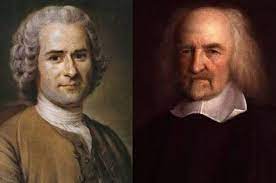 We create communities with laws, norms, and restrictions on our natural impulses, in other words, in order to protect ourselves from each other
Other philosophers, such as Jean-Jacques Rousseau in the 18th century, imagined the state of nature as idyllic and simple, a world in which human beings’ natural goodness ruled. Rousseau believed that most, if not all, of the evils of the world and in human behavior is due to the corruption of our natural goodness by the pressures and temptations of society, describing his imaginary person in the state of nature as follows:
If we strip this being, thus constituted, of all the supernatural gifts he may have received, and all the artificial faculties he can have acquired only by a long process; if we consider him, in a word, just as he must have come from the hands of nature, we behold in him an animal weaker than some, and less agile than others; but, taking him all round, the most advantageously organized of any. I see him satisfying his hunger at the first oak, and slaking his thirst at the first brook; finding his bed at the foot of the tree which afforded him a repast; and, with that, all his wants supplied.
According to Rousseau, our life in the state of nature was actually pretty good. We were healthy, had lots of exercisealong with a varied diet; things were peaceful as well. But everything went wrong when we gave up our liberty, invented private property, and settled down in villages and cities, thus creating this thing called civilization.
Often what is “natural” is considered to be what is “best,” even in the moral life–but that depends on what we are really like naturally. Which of the above visions of the state of nature–that Rousseau’s or Hobbes’–is more likely to be accurate? This is more than a merely academic or blog post exercise. As the “Throughline” podcast points out, how we think about societal organization, the workplace, education, politics, and more depends on what we truly are at our core.
If you believe that kids are fundamentally lazy and selfish, then you need a quite hierarchical schooling system. But if you think that kids are naturally curious and creative, then maybe you don’t need, you know, all that homework. Maybe you can just give kids the freedom to decide for themselves what they find interesting. If you are the CEO of a company, if you believe that your employees are fundamentally selfish, well, what are you going to do? You need a lot of bureaucracy, probably. Maybe you’re going to place cameras to make sure that your employees don’t steal equipment.
If you believe that your employees are fundamentally cooperative and actually wanna do what’s best for the company, then maybe you can work in self-directed teams and you don’t need all those managers, and you can actually rely on people’s intrinsic motivation. So again and again, again and again, our view of human nature has pretty practical implications for how we live our lives.
And, of course, much of the political polarization in our country demonstrates the stark differences between Hobbesian and Rousseauvian assumptions concerning human nature. From a Hobbesian perspective, on the one hand, strong government and law enforcement is needed from the top down, the assumption always being that people are inclined to behave in their exclusive self-interest and will act badly and violently unless controlled in various ways. Fear tends to be the primary factor in maintaining the social order.
On the other hand, Rousseau’s more positive perspective concerning basic human nature leads to a greater basis for hope in the future, regardless of how bleak the present might seem. Martin Luther King Jr.’s hopeful claim that “the arc of the moral universe is long but it bends toward justice” can become more than a utopian platitudinous vision only if there is a fundamental goodness in human beings that can over time bend that arc. As one of the interviewees in the “Throughline” podcast observes,
I’ve always believed in the power of utopia, thinking every milestone of civilization, the end of slavery, democracy, equal rights for men and women. These were all utopian fantasies once until they happened. That’s why I think that history is actually the most subversive discipline of all the social sciences because history shows us that things can be different. They don’t have to be this way. We can change them. We have to believe in the power of hope. If you believe in hope, if you’re actually hopeful for the future, then you know you have to do something.
There is far more in this issue than can be considered in one blog post—more will be coming soon. One final thought, though. It’s worth noting that Thomas Hobbes wrote not only wrote in an England in the midst of a bloody civil war, but also wrote in a very Christian society that was heavily influenced by the Protestant Reformation that began a century and a half earlier. One of the most basic tenets of various versions of traditional Christianity, particularly conservative Protestantism, is the utter depravity of human nature. Tell whatever story you want—original sin, eviction from the Garden Eden, influence of dark forces—the claim is that human beings are fundamentally flawed by nature and can do nothing to fix the problem. Hence the need for salvation.
In the meantime, the only way to keep such creatures under control is with strong authoritarian influence throughout society. If you want to know why a wannabe authoritarian like Donald Trump continues to garner strong support from among white conservative evangelical Christians despite his moral failings and legal troubles, this is a good place to start. If you live in fear of others and consider this world to be little more than a difficult and problematic temporary stop on the way to eternal bliss, why wouldn’t you want someone in control who clearly has authoritarian tendencies?
Stay tuned!
Previous Post

February 1, 2024
Is Religion a Virus?
Next Post

February 6, 2024 Who Am I? How to Build a Person
Recent Comments
"Mary did have a choice. And she was able to make it before the Holy ..."
"i cannot read beyond your recommendations for the books since i like to have a ..."
"AI will never be able to utter with honesty, feeling, or humility, the greeting: "Namaste".It ..."
"They do. I'm sure you could find discussions of the same topic from any of ..."
Browse Our Archives
Select a Category abortion Advent AI Angels Artificial intelligence atheism attention baptism Baptists beauty belief Benedictines Bible bicycling Big Bird books Bovina Camaldoli hermitage Canada Catholicism cats certainty change Christianity Christmas Collegeville Covid-19 creativity Development of Western Civilization dogs doubt Easter Enneagram Epiphany Episcopal ethics Eucharist evil extroverts Facebook faith family fear flowers forgiveness freedom friends God goodness grace happiness heaven hell history Holy Spirit Holy Week hope human nature humility humor idolatry incarnation introverts irreverence Islam Jeanne Jesus Joe Biden joy Judaism justice Kamala Harris knowledge Lent listen literature liturgy love Marsue Memorial Day miracles movies music mystery mythology NPR Old Testament optimism paradox peace Penguins philosophy piano podcast politics power prayer Protestantism Providence College Religion Rhode Island sabbatical sacrament science seeing silence Simone Weil Socrates soul sports St. John's College stories suffering tattoo teaching technology television theology thinking time tolerance transcendence travel trees trust truth Uncategorized Vermont wisdom wonder writing
Select a Month May 2026 April 2026 March 2026 February 2026 January 2026 December 2025 November 2025 October 2025 September 2025 August 2025 July 2025 June 2025 May 2025 April 2025 March 2025 February 2025 January 2025 December 2024 November 2024 October 2024 September 2024 August 2024 July 2024 June 2024 May 2024 April 2024 March 2024 February 2024 January 2024 December 2023 November 2023 October 2023 September 2023 August 2023 July 2023 June 2023 May 2023 April 2023 March 2023 February 2023 January 2023 December 2022 November 2022 October 2022 September 2022 August 2022 July 2022 June 2022 May 2022 April 2022 March 2022 February 2022 January 2022 December 2021 November 2021 October 2021 September 2021 August 2021 July 2021 June 2021 May 2021 April 2021 March 2021 February 2021 January 2021 December 2020 November 2020 October 2020 September 2020 August 2020 July 2020 June 2020 May 2020 April 2020 March 2020 February 2020 January 2020 December 2019 November 2019 October 2019 September 2019 August 2019 July 2019 June 2019 May 2019 April 2019 March 2019 February 2019 January 2019 December 2018 November 2018 October 2018 September 2018 August 2018 July 2018 June 2018 May 2018 April 2018 March 2018 February 2018 January 2018 December 2017 November 2017 October 2017 September 2017 August 2017 July 2017 June 2017 May 2017 April 2017 March 2017 February 2017 January 2017 December 2016 November 2016 October 2016 September 2016 August 2016 July 2016 June 2016 May 2016 April 2016 March 2016 February 2016 January 2016 December 2015 November 2015 October 2015 September 2015 August 2015 July 2015 June 2015 May 2015 April 2015 March 2015 February 2015 January 2015 December 2014 November 2014 October 2014 September 2014 August 2014 July 2014 June 2014 May 2014 April 2014 March 2014 February 2014 January 2014 December 2013 November 2013 October 2013 September 2013 August 2013 July 2013 June 2013 May 2013 April 2013 March 2013 February 2013 January 2013 December 2012 November 2012 October 2012 September 2012
Follow Us!
TAKE THE
Religious Wisdom Quiz
In Revelation, what do the four living creatures say day and night without ceasing?
Select your answer to see how you score.
Blessing and honor and glory Worthy is the Lamb Holy, holy, holy is the Lord God Almighty Come, Lord Jesus
Books by This Author Books by Vance G. Morgan
Related posts from Freelance Christianity

The Lonely Pawn: On Faith, Doubt, and Meaning


AI and Love: When a Chatbot Becomes a...

TRENDING AT PATHEOS Progressive Christian

What Being a Modern-Day Apostle Means to Me
In my last column, I discussed the ins and outs of modern-day...

Did Ancient China Once Worship the God of...
Across human history, a common thread weaves through the origins of the...

Love Your Neighbor – Including Earth-Kin: Lev. 19,...
God’s command to love your neighbor means acting in an ethical and...

Lead a Church Study of “Jesus and Lao...
Guest writer Jack Thomas (The Irreverent Reverend) reflects on leading his church...

Pastoral Wisdom for Responding to Sermon Pushback
Getting sermon pushback on your social justice sermon? Learn practical, Proverbs-based strategies...

Principles for Understanding the Apostolic Ministry Today
Whenever people discover that my formal ministry title is "apostle," as in...
view all Progressive Christian blogs
What Are Your Thoughts?leave a comment
Ad-Free & Subscriber Log-In Subscription Support
- About Us
- 2026 Calendar
- Videos
- Podcasts
- Library of World Religions
- Faith In Media Tracker
- Advertise With Us
- Write for Us
- Privacy Policy
- Terms of Service
- Do Not Sell My Data
- Contact Us
- Radiant Digital
- Manage Newsletter Subscriptions
- Unsubscribe From Notifications
- Sitemap
Copyright 2008-2026, Patheos. All rights reserved.
Subscription Support Ad-Free & Subscriber Log-In
Follow Patheos