
BuddhistCatholicContemplativeEvangelicalGeneral ChristianHinduJewishLatter-day SaintMuslimNew VisionsProgressive Christian
Beliefs
- Buddhist
- Catholic
- Contemplative
- Evangelical
- General Christian
- Hindu
- Jewish
- Latter-day Saint
- More Voices
- Muslim
- New Visions
- Pagan
- Progressive Christian
Topics
- Religion News
- Food and Religion
- Sports and Religion
- Religious Art
- Religious Music and Entertainment
- Religious Events
- History and Religion
- Style and Religion
- Politics and Religion
- Women in Religion
- Recreation Outdoors and Religion
- Business Finance and Religion
- Careers Workplace and Religion
- Education and Religion
- Family Parenting and Religion
- Health Fitness and Religion
- Home and Religion
- Relationships and Religion
- Technology and Religion
- Travel and Religion
Columnists
- Buddhist Columnists
- Business Finance and Religion Columnists
- Careers Workplace and Religion Columnists
- Catholic Columnists
- Contemplative Columnists
- Education and Religion Columnists
- Evangelists Columnists
- Family Parenting and Religion Columnists
- General Christian Columnists
- Health Fitness and Religion Columnists
- Hindu Columnists
- History and Religion Columnists
- Home and Religion Columnists
- Jewish Columnists
- More Voices Columnists
- Latter Day Columnists
- Muslim Columnists
- New Visions Columnists
- Nonreligious Columnists
- Pagan Columnists
- Politics and Religion Columnists
- Progressive Columnists
- Recreation Outdoors and Religion Columnists
- Relationships and Religion Columnists
- Religion News Columnists
- Religious Art Columnists
- Religious Events Columnists
- Religious Music and Entertainment Columnists
- Sports and Religion Columnists
- Style and Religion Columnists
- Technology and Religion Columnists
- Travel and Religion Columnists
- Women in Religion Columnists
Resource Library
- 2026 Calendar
- Library of World Religions
- The 100 Most Holy Places on Earth
- Patheos Answers
- Podcasts
- Videos
- Faith Leaders Database
- Anglican Episcopalian
- Bahai
- Baptist
- Buddhism
- Christianity
- Confucianism
- Eastern Orthodoxy
- Hinduism
- Holiness and Pentecostal
- ISKCON
- Islam
- Judaism
- Lutheran
- Methodist
- The Church of Jesus Christ of Latter-day Saints
- New Age
- Paganism
- Presbytarian and Reformed
- Protestantism
- Religion Behind the Scenes
- Roman Catholic
- Scientology
- Shia Islam
- Sikhism
- Sufism
- Sunni Islam
- Taoism
- Zen
- See all religions
Research Tools
 Ad-Free & Subscriber Log-In Subscription Support
Ad-Free & Subscriber Log-In Subscription Support
Follow Patheos 

- Trending:
- Forgiveness
- |
- Marriage
- |
- Consciousness
- |
- Death Penalty
- |
- Election
- |
- Halloween

- Home
- Progressive Christian
- Being Open to the Possibility of God: An excerpt from my new book “Prayer for People Who Don’t Believe in God”
Being Open to the Possibility of God: An excerpt from my new book “Prayer for People Who Don’t Believe in God”
Last updated on: September 28, 2019 at 8:10 pm by Vance Morgan
Being Open to the Possibility of God: An excerpt from my new book “Prayer for People Who Don’t Believe in God” 2019-09-28T20:05:54-04:00 Vance Morgan
Patheos Explore the world's faith through different perspectives on religion and spirituality! Patheos has the views of the prevalent religions and spiritualities of the world.
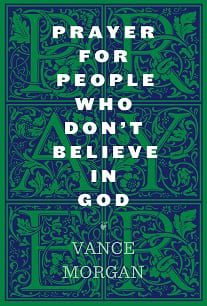 I am pleased to announce that my new book, Prayer for People Who Don’t Believe in God, will be released by Wood Lake Publishing on Tuesday, October 1. The promotional materials describe my book as an exploration of How prayer has power for those who are opening themselves to the “possibility of God.” This book is steeped in the ideas and issues that I engage with regularly in this blog. You will be able to find information about how to order my new book on my “Publications” page as soon as it is released.
To whet your appetite, here is an excerpt from Chapter Two (“Prayer Is Not for Experts”).
Excerpt from Prayer for People Who Don’t Believe in God (Wood Lake Publishing)
In her spiritual memoir Still, Lauren Winner tells the story of a conversation between poet Anne Sexton and a Catholic priest who came to visit her while she was in a mental health facility. The title of Sexton’s eighth collection of poems, The Awful Rowing Toward God, reportedly came from this conversation. The collection was published a few months after she committed suicide.
Anne began the conversation by letting the priest know that he was probably wasting his time: “Well, I’ve lost it all.” In response, he sat for a time and read her poems aloud to her. Their subsequent conversation went something like this:
Anne: “Look, I’m not sure I believe in God, anyway.”
Priest: “Your typewriter is your altar.”
Anne: “I can’t go to church. I can’t pray.”
Priest: “Your poems are your prayers.”
Later in the conversation, Sexton said that she would like the priest to baptize her, after which she would like to take communion. Falling into his official role, the priest gives Anne the party line: before she can be baptized and take communion, she would first have to study the faith tradition, the councils, the creeds, and more.
“I can’t do that, Father,” Anne replied. “It would ruin my thinking: I’d want Him to be my God, anyway. I don’t want to be taught about Him; I want to make Him up.”
As the priest was leaving, Anne asked him to pray for her. “No,” he replied. “You pray for me.”
The “expert” clearly recognized something holy in the troubled poet, something that cuts across traditional conceptions of prayer and more. Reflecting on this story, Winner observes that Sexton is insisting that “she has the right to be on the terrain of the sacred,” even though by all measures she has not “earned” that right in any traditional sense. In Anne Sexton’s estimation, Winner writes, “the sacred must answer to her private experience of reality – the only sacred on which she can stand is a sacred that makes some kind of sense in her actual life…not some imagined life or even longed-for life but this here real actual life, hers.” For Anne Sexton, and for each of us, prayer invites the divine into our lives, not as a distant, untouchable temporary visitor, but as a holiness that is adaptable to each experience and each life. For Sexton, “the sacred must change shape to meet her, not just she bend and fold to fit on holy ground.”
The story of Anne Sexton and the priest reminds me of a similar encounter between a spiritually powerful woman who was a person standing just outside the edges of traditional religion, and a Catholic priest. Simone Weil, a 20th-century Jewish social activist, philosopher, and mystic whom we will encounter more fully in a later chapter, exchanged several lengthy letters with a Dominican priest friend, letters in which she expressed both her close-to-obsessive desire for God and her equally strong reluctance to align herself with any specific religious tradition. For Weil, even the thought of prayer in any traditional or organized sense was problematic, because formal prayer contains a significant power of suggestion – the very words we use unfailingly create a sketch of what we think the divine is.
All such sketches, in Weil’s estimation, place limits on one’s search for the divine. Weil insisted that, whatever or whoever God is, searching for the divine requires the unfettered use of all of our capacities, as she describes in this memorable passage from one of her letters:
It seemed to me certain, and I still think so today, that one can never wrestle enough with God if one does so out of pure regard for the truth. Christ likes us to prefer the truth to him, because before being Christ, he is truth. If one turns aside from him to go toward the truth, one will not go far before falling into his arms.
There is a fearlessness in this passage that is rooted in one simple insight: God is big enough to handle all of our good-faith attempts to engage in conversation with what is greater than us – there are no “experts” in this endeavour. Weil elaborates on this fearless willingness to pursue the truth and face reality, without consoling stories, in one of her most important essays, “The Love of God and Affliction.”
They alone will see God who prefer to recognize the truth and die, instead of living a long and happy existence in a state of illusion. One must want to go towards reality; then, when one thinks one has found a corpse, one meets an angel who says: “He is risen.”
Previous Post
September 26, 2019
Lessons learned from a "glow in the dark" cross
Next Post

October 1, 2019 Are you a "Christian Capitalist" or a "Capitalist Christian"?
Browse Our Archives
Select a Category abortion Advent AI Angels Artificial intelligence atheism attention baptism Baptists beauty belief Benedictines Bible bicycling Big Bird books Bovina Camaldoli hermitage Canada Catholicism cats certainty change Christianity Christmas Collegeville Covid-19 creativity Development of Western Civilization dogs doubt Easter Enneagram Epiphany Episcopal ethics Eucharist evil extroverts Facebook faith family fear flowers forgiveness freedom friends God goodness grace happiness heaven hell history Holy Spirit Holy Week hope human nature humility humor idolatry incarnation introverts irreverence Islam Jeanne Jesus Joe Biden joy Judaism justice Kamala Harris knowledge Lent listen literature liturgy love Marsue Memorial Day miracles movies music mystery mythology NPR Old Testament optimism paradox peace Penguins philosophy piano podcast politics power prayer Protestantism Providence College Religion Rhode Island sabbatical sacrament science seeing silence Simone Weil Socrates soul sports St. John's College stories suffering tattoo teaching technology television theology thinking time tolerance transcendence travel trees trust truth Uncategorized Vermont wisdom wonder writing
Select a Month May 2026 April 2026 March 2026 February 2026 January 2026 December 2025 November 2025 October 2025 September 2025 August 2025 July 2025 June 2025 May 2025 April 2025 March 2025 February 2025 January 2025 December 2024 November 2024 October 2024 September 2024 August 2024 July 2024 June 2024 May 2024 April 2024 March 2024 February 2024 January 2024 December 2023 November 2023 October 2023 September 2023 August 2023 July 2023 June 2023 May 2023 April 2023 March 2023 February 2023 January 2023 December 2022 November 2022 October 2022 September 2022 August 2022 July 2022 June 2022 May 2022 April 2022 March 2022 February 2022 January 2022 December 2021 November 2021 October 2021 September 2021 August 2021 July 2021 June 2021 May 2021 April 2021 March 2021 February 2021 January 2021 December 2020 November 2020 October 2020 September 2020 August 2020 July 2020 June 2020 May 2020 April 2020 March 2020 February 2020 January 2020 December 2019 November 2019 October 2019 September 2019 August 2019 July 2019 June 2019 May 2019 April 2019 March 2019 February 2019 January 2019 December 2018 November 2018 October 2018 September 2018 August 2018 July 2018 June 2018 May 2018 April 2018 March 2018 February 2018 January 2018 December 2017 November 2017 October 2017 September 2017 August 2017 July 2017 June 2017 May 2017 April 2017 March 2017 February 2017 January 2017 December 2016 November 2016 October 2016 September 2016 August 2016 July 2016 June 2016 May 2016 April 2016 March 2016 February 2016 January 2016 December 2015 November 2015 October 2015 September 2015 August 2015 July 2015 June 2015 May 2015 April 2015 March 2015 February 2015 January 2015 December 2014 November 2014 October 2014 September 2014 August 2014 July 2014 June 2014 May 2014 April 2014 March 2014 February 2014 January 2014 December 2013 November 2013 October 2013 September 2013 August 2013 July 2013 June 2013 May 2013 April 2013 March 2013 February 2013 January 2013 December 2012 November 2012 October 2012 September 2012
Follow Us!
TAKE THE
Religious Wisdom Quiz
Who passed by in the Parable of the Good Samaritan before the Samaritan helped?
Select your answer to see how you score.
Rich man and Lazarus Soldier and merchant Priest and Levite Two robbers
Books by This Author Books by Vance G. Morgan
Related posts from Freelance Christianity

The Lonely Pawn: On Faith, Doubt, and Meaning


AI and Love: When a Chatbot Becomes a...

TRENDING AT PATHEOS Progressive Christian

Why Christians Have a Sacred Duty to Vote:...
The Bible offers strong support for the sacred duty to vote. Here...

What Being a Modern-Day Apostle Means to Me
In my last column, I discussed the ins and outs of modern-day...

Did Ancient China Once Worship the God of...
Across human history, a common thread weaves through the origins of the...

Love Your Neighbor – Including Earth-Kin: Lev. 19,...
God’s command to love your neighbor means acting in an ethical and...

Lead a Church Study of “Jesus and Lao...
Guest writer Jack Thomas (The Irreverent Reverend) reflects on leading his church...

Principles for Understanding the Apostolic Ministry Today
Whenever people discover that my formal ministry title is "apostle," as in...
view all Progressive Christian blogs
Ad-Free & Subscriber Log-In Subscription Support
- About Us
- 2026 Calendar
- Videos
- Podcasts
- Library of World Religions
- Faith In Media Tracker
- Advertise With Us
- Write for Us
- Privacy Policy
- Terms of Service
- Do Not Sell My Data
- Contact Us
- Radiant Digital
- Manage Newsletter Subscriptions
- Unsubscribe From Notifications
- Sitemap
Copyright 2008-2026, Patheos. All rights reserved.
Subscription Support Ad-Free & Subscriber Log-In
Follow Patheos