
BuddhistCatholicContemplativeEvangelicalGeneral ChristianHinduJewishLatter-day SaintMuslimNew VisionsProgressive Christian
Beliefs
- Buddhist
- Catholic
- Contemplative
- Evangelical
- General Christian
- Hindu
- Jewish
- Latter-day Saint
- More Voices
- Muslim
- New Visions
- Pagan
- Progressive Christian
Topics
- Religion News
- Food and Religion
- Sports and Religion
- Religious Art
- Religious Music and Entertainment
- Religious Events
- History and Religion
- Style and Religion
- Politics and Religion
- Women in Religion
- Recreation Outdoors and Religion
- Business Finance and Religion
- Careers Workplace and Religion
- Education and Religion
- Family Parenting and Religion
- Health Fitness and Religion
- Home and Religion
- Relationships and Religion
- Technology and Religion
- Travel and Religion
Columnists
- Buddhist Columnists
- Business Finance and Religion Columnists
- Careers Workplace and Religion Columnists
- Catholic Columnists
- Contemplative Columnists
- Education and Religion Columnists
- Evangelists Columnists
- Family Parenting and Religion Columnists
- General Christian Columnists
- Health Fitness and Religion Columnists
- Hindu Columnists
- History and Religion Columnists
- Home and Religion Columnists
- Jewish Columnists
- More Voices Columnists
- Latter Day Columnists
- Muslim Columnists
- New Visions Columnists
- Nonreligious Columnists
- Pagan Columnists
- Politics and Religion Columnists
- Progressive Columnists
- Recreation Outdoors and Religion Columnists
- Relationships and Religion Columnists
- Religion News Columnists
- Religious Art Columnists
- Religious Events Columnists
- Religious Music and Entertainment Columnists
- Sports and Religion Columnists
- Style and Religion Columnists
- Technology and Religion Columnists
- Travel and Religion Columnists
- Women in Religion Columnists
Resource Library
- 2026 Calendar
- Library of World Religions
- The 100 Most Holy Places on Earth
- Patheos Answers
- Podcasts
- Videos
- Faith Leaders Database
- Anglican Episcopalian
- Bahai
- Baptist
- Buddhism
- Christianity
- Confucianism
- Eastern Orthodoxy
- Hinduism
- Holiness and Pentecostal
- ISKCON
- Islam
- Judaism
- Lutheran
- Methodist
- The Church of Jesus Christ of Latter-day Saints
- New Age
- Paganism
- Presbytarian and Reformed
- Protestantism
- Religion Behind the Scenes
- Roman Catholic
- Scientology
- Shia Islam
- Sikhism
- Sufism
- Sunni Islam
- Taoism
- Zen
- See all religions
Research Tools
 Ad-Free & Subscriber Log-In Subscription Support
Ad-Free & Subscriber Log-In Subscription Support
Follow Patheos 

- Trending:
- Forgiveness
- |
- Marriage
- |
- Consciousness
- |
- Death Penalty
- |
- Election
- |
- Halloween

- Home
- Progressive Christian
- Because Survival is Insufficient
Because Survival is Insufficient
Last updated on: May 3, 2021 at 5:00 pm by Vance Morgan
Because Survival is Insufficient 2021-05-03T16:54:47-04:00 Vance Morgan
Patheos Explore the world's faith through different perspectives on religion and spirituality! Patheos has the views of the prevalent religions and spiritualities of the world.
“Remember K from our colloquium last year?” my teaching partner emailed late last week. “G [a student in our colloquium this year] is K’s roommate; G tells me that K got a ‘Survival is Insufficient’ tattoo!” The subject line of the email was “Education leaves a mark!” Let me explain.
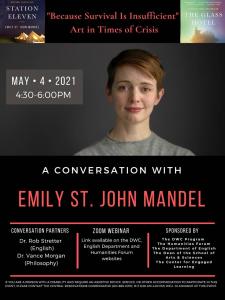 We are in the last week of my “Apocalypse” colloquium; our final text is Emily St. John Mandel’s 2014 novel Station Eleven. Thanks to the tireless efforts of my teaching colleague, our class today will be visited by the author herself, who also will be doing an afternoon event for the whole college community with the title “Art in Times of Crisis—A Conversation with Emily St. John Mandel.” Trust me, this is a big deal. I only wish that by this time the pandemic was behind us that Emily St. John Mandel could join us in person.
Station Eleven is set in a post-apocalyptic world in the aftermath of a pandemic that killed over 99.9% of the earth’s human population. Not surprisingly, our current colloquium students have found this novel eerily relevant to the world in which we have all lived for the past fourteen months. But that is nothing compared to how strange it was last year to study this novel in the early weeks of the new world of pandemic shut down. The graduating seniors were robbed of all traditional end-of-your-college-career events that are so important. I imagined at the time what I would say to the graduating seniors if I had the chance. As I return to my remarks a year later, I find that much of it is still directly relevant.
Dear Graduating Seniors:
This is not what you hoped for. This is not how you imagined your years of hard work, commitment, and dedication at Providence College would end. Some very important events, celebrations meant to honor you and to establish lifelong memories, have been cancelled. They are irreplaceable, and their loss is palpable, even for those who, as I, are accustomed to annually standing on the fringes of such gatherings and smiling a lot, occasionally glimpsing students from the past four years hugging each other, as well as their friends and families, and perhaps even having the privilege of meeting the most important people in the lives of the students who have become so important to me.
But none of that is happening this year. And it’s sad. And the loss of graduation celebrations is just one aspect of how your worlds—how all of our worlds—have been turned upside down. Whatever your plans were last January for this coming summer, for the fall, for graduate school or starting the job that would launch you into your new career, those plans have—as my brother-in-law would say—gone “tits up.” We can’t wait until things get back to normal, until we can move our lives from “on hold” status to “reboot” or “move forward” status. Until we can stop just surviving and start living.
We know, though, that we are currently in the middle of one of those events that will mark “before” and “after” for the rest of our lives. However we define “normal” gradually over the coming weeks and months, it will undoubtedly be different than the pre-coronavirus “normal” in important and irreversible ways. Some things aren’t coming back. Others will return in significantly different forms.
In one of the strangest confluences of imagination and reality I’ve ever encountered, I team-taught a colloquium this semester called “Apocalypse.” During the last half of the course, we studied various apocalyptic texts—from novels and documentaries to comic books and movies—while immersed with everyone else across the globe in an apocalyptic event. Even more strangely, our last text of the semester—Emily St. John Mandel’s 2014 novel Station Eleven—is about a global pandemic that kills off 99.9% of the world’s population. In the post-apocalyptic world, a group of musicians and actors who call themselves the “Travelling Symphony” wanders from small community to small community performing works of Shakespeare and giving concerts.
Why? In a world in which survival from day to day is not guaranteed, in which deadly cults and feral gangs threaten around every corner, what is the value of Shakespeare? Why listen to a concert? The answer is provided in a slogan written on a banner on the side of one of the group’s caravan wagons, words also tattooed on the arm of Kirsten, the novel’s main character:
Because survival is insufficient
We discussed frequently in our colloquium whether survival is the primary human instinct, whether some lives are not worth living, and what sorts of things make a life worth living. The Travelling Symphony’s slogan reminds us that there is far more to being fully human than simply being alive. In their intellectual notebooks, my students frequently wrote that the truth of this slogan became much more apparent to them as they were socially distanced and isolated at home.
One student illustrated her point by referencing Clark, another central character in Station Eleven. Before the pandemic, Clark was a corporate problem-solver, hired by various firms to help “fix” various leadership problems. During an interview with a woman whose boss was Clark’s current target, she described her boss as a “high-functioning sleepwalker,” a man who she suspects will become more efficient and productive with Clark’s help, but who will still remain a “joyless bastard.” Her boss is one of “those people who’ve ended up in one life instead of another and they are just so disappointed. They’ve done what’s expected of them. They want to do something different but it’s impossible now, there’s a mortgage, kids, whatever, they’re trapped.”
Two decades later in a post-pandemic world, Clark realizes that he himself, wealthy and successful, had been a “high-functioning sleepwalker.” Remembering his pre-apocalyptic self, Clark noted that
He had been moving through the motions of his life for a while . . . not specifically unhappy, but when had he last found real joy in his work? When was the last time he’d been truly moved by anything? When had he last felt awe or inspiration?
My student suggested that reading this during coronavirus seclusion motivated her to look for answers to Clark’s questions for herself. What are the things that last, that bring joy, satisfaction, contentment, or inspiration when the things you thought you could depend on get taken away? How does one avoid being like Clark before the pandemic?
In another one of my classes, I spent a semester with my students in the world of 16th-century French philosopher Michel de Montaigne. Montaigne’s world was violent and unpredictable; in his essays he frequently sought for strategies intended to establish peace, centeredness, and confidence in the midst of swirling chaos. One of my students’ favorite passages from Montaigne comes from his essay “Of solitude.”
We should have wife, children, goods, and above all health, if we can; but we must not bind ourselves to them so strongly that our happiness depends on them. We should set aside a room at the back of the shop, just for ourselves, quite isolated, where, as the principal retreat for our solitude, we establish our true freedom.
What is in your “room at the back of the shop”? Have you ever entered it? Are you even aware of its existence? Many of my students told me that coronavirus seclusion introduced them, some for the first time, to the internal space where one is perfectly free to decide who they are and what they will be. “In that back room,” one student wrote, “I began to discover who I am, what my true loves and interests are, apart from what I think other people—even those whom I love the most—expect me to be.”
My hope for each of you is that you will become acquainted with the room at the back of your shop. Use it to identify what matters to you the most. If survival, simply keeping your head above water, is insufficient, use your back room to discover what—uniquely for you—is central to a life that far exceeds mere sufficiency. Become a deliberate and intentional person. The world already has too many high-functioning sleepwalkers.
Previous Post

May 2, 2021
Perfect Love Casts Out Fear--or so we're told
Next Post

May 5, 2021 No One Owns God
Browse Our Archives
Select a Category abortion Advent AI Angels Artificial intelligence atheism attention baptism Baptists beauty belief Benedictines Bible bicycling Big Bird books Bovina Camaldoli hermitage Canada Catholicism cats certainty change Christianity Christmas Collegeville Covid-19 creativity Development of Western Civilization dogs doubt Easter Enneagram Epiphany Episcopal ethics Eucharist evil extroverts Facebook faith family fear flowers forgiveness freedom friends God goodness grace happiness heaven hell history Holy Spirit Holy Week hope human nature humility humor idolatry incarnation introverts irreverence Islam Jeanne Jesus Joe Biden joy Judaism justice Kamala Harris knowledge Lent listen literature liturgy love Marsue Memorial Day miracles movies music mystery mythology NPR Old Testament optimism paradox peace Penguins philosophy piano podcast politics power prayer Protestantism Providence College Religion Rhode Island sabbatical sacrament science seeing silence Simone Weil Socrates soul sports St. John's College stories suffering tattoo teaching technology television theology thinking time tolerance transcendence travel trees trust truth Uncategorized Vermont wisdom wonder writing
Select a Month May 2026 April 2026 March 2026 February 2026 January 2026 December 2025 November 2025 October 2025 September 2025 August 2025 July 2025 June 2025 May 2025 April 2025 March 2025 February 2025 January 2025 December 2024 November 2024 October 2024 September 2024 August 2024 July 2024 June 2024 May 2024 April 2024 March 2024 February 2024 January 2024 December 2023 November 2023 October 2023 September 2023 August 2023 July 2023 June 2023 May 2023 April 2023 March 2023 February 2023 January 2023 December 2022 November 2022 October 2022 September 2022 August 2022 July 2022 June 2022 May 2022 April 2022 March 2022 February 2022 January 2022 December 2021 November 2021 October 2021 September 2021 August 2021 July 2021 June 2021 May 2021 April 2021 March 2021 February 2021 January 2021 December 2020 November 2020 October 2020 September 2020 August 2020 July 2020 June 2020 May 2020 April 2020 March 2020 February 2020 January 2020 December 2019 November 2019 October 2019 September 2019 August 2019 July 2019 June 2019 May 2019 April 2019 March 2019 February 2019 January 2019 December 2018 November 2018 October 2018 September 2018 August 2018 July 2018 June 2018 May 2018 April 2018 March 2018 February 2018 January 2018 December 2017 November 2017 October 2017 September 2017 August 2017 July 2017 June 2017 May 2017 April 2017 March 2017 February 2017 January 2017 December 2016 November 2016 October 2016 September 2016 August 2016 July 2016 June 2016 May 2016 April 2016 March 2016 February 2016 January 2016 December 2015 November 2015 October 2015 September 2015 August 2015 July 2015 June 2015 May 2015 April 2015 March 2015 February 2015 January 2015 December 2014 November 2014 October 2014 September 2014 August 2014 July 2014 June 2014 May 2014 April 2014 March 2014 February 2014 January 2014 December 2013 November 2013 October 2013 September 2013 August 2013 July 2013 June 2013 May 2013 April 2013 March 2013 February 2013 January 2013 December 2012 November 2012 October 2012 September 2012
Follow Us!
TAKE THE
Religious Wisdom Quiz
How many years did the Israelites wander in the wilderness?
Select your answer to see how you score.
100 years 40 years 10 years 25 years
Books by This Author Books by Vance G. Morgan
Related posts from Freelance Christianity

The Lonely Pawn: On Faith, Doubt, and Meaning


AI and Love: When a Chatbot Becomes a...

TRENDING AT PATHEOS Progressive Christian

What Being a Modern-Day Apostle Means to Me
In my last column, I discussed the ins and outs of modern-day...

Did Ancient China Once Worship the God of...
Across human history, a common thread weaves through the origins of the...

Love Your Neighbor – Including Earth-Kin: Lev. 19,...
God’s command to love your neighbor means acting in an ethical and...

Lead a Church Study of “Jesus and Lao...
Guest writer Jack Thomas (The Irreverent Reverend) reflects on leading his church...

Pastoral Wisdom for Responding to Sermon Pushback
Getting sermon pushback on your social justice sermon? Learn practical, Proverbs-based strategies...

Principles for Understanding the Apostolic Ministry Today
Whenever people discover that my formal ministry title is "apostle," as in...
view all Progressive Christian blogs
Ad-Free & Subscriber Log-In Subscription Support
- About Us
- 2026 Calendar
- Videos
- Podcasts
- Library of World Religions
- Faith In Media Tracker
- Advertise With Us
- Write for Us
- Privacy Policy
- Terms of Service
- Do Not Sell My Data
- Contact Us
- Radiant Digital
- Manage Newsletter Subscriptions
- Unsubscribe From Notifications
- Sitemap
Copyright 2008-2026, Patheos. All rights reserved.
Subscription Support Ad-Free & Subscriber Log-In
Follow Patheos