
BuddhistCatholicContemplativeEvangelicalGeneral ChristianHinduJewishLatter-day SaintMuslimNew VisionsProgressive Christian
Beliefs
- Buddhist
- Catholic
- Contemplative
- Evangelical
- General Christian
- Hindu
- Jewish
- Latter-day Saint
- More Voices
- Muslim
- New Visions
- Pagan
- Progressive Christian
Topics
- Religion News
- Food and Religion
- Sports and Religion
- Religious Art
- Religious Music and Entertainment
- Religious Events
- History and Religion
- Style and Religion
- Politics and Religion
- Women in Religion
- Recreation Outdoors and Religion
- Business Finance and Religion
- Careers Workplace and Religion
- Education and Religion
- Family Parenting and Religion
- Health Fitness and Religion
- Home and Religion
- Relationships and Religion
- Technology and Religion
- Travel and Religion
Columnists
- Buddhist Columnists
- Business Finance and Religion Columnists
- Careers Workplace and Religion Columnists
- Catholic Columnists
- Contemplative Columnists
- Education and Religion Columnists
- Evangelists Columnists
- Family Parenting and Religion Columnists
- General Christian Columnists
- Health Fitness and Religion Columnists
- Hindu Columnists
- History and Religion Columnists
- Home and Religion Columnists
- Jewish Columnists
- More Voices Columnists
- Latter Day Columnists
- Muslim Columnists
- New Visions Columnists
- Nonreligious Columnists
- Pagan Columnists
- Politics and Religion Columnists
- Progressive Columnists
- Recreation Outdoors and Religion Columnists
- Relationships and Religion Columnists
- Religion News Columnists
- Religious Art Columnists
- Religious Events Columnists
- Religious Music and Entertainment Columnists
- Sports and Religion Columnists
- Style and Religion Columnists
- Technology and Religion Columnists
- Travel and Religion Columnists
- Women in Religion Columnists
Resource Library
- 2026 Calendar
- Library of World Religions
- The 100 Most Holy Places on Earth
- Patheos Answers
- Podcasts
- Videos
- Faith Leaders Database
- Anglican Episcopalian
- Bahai
- Baptist
- Buddhism
- Christianity
- Confucianism
- Eastern Orthodoxy
- Hinduism
- Holiness and Pentecostal
- ISKCON
- Islam
- Judaism
- Lutheran
- Methodist
- The Church of Jesus Christ of Latter-day Saints
- New Age
- Paganism
- Presbytarian and Reformed
- Protestantism
- Religion Behind the Scenes
- Roman Catholic
- Scientology
- Shia Islam
- Sikhism
- Sufism
- Sunni Islam
- Taoism
- Zen
- See all religions
Research Tools
 Ad-Free & Subscriber Log-In Subscription Support
Ad-Free & Subscriber Log-In Subscription Support
Follow Patheos 

- Trending:
- Forgiveness
- |
- Marriage
- |
- Consciousness
- |
- Death Penalty
- |
- Election
- |
- Halloween

- Home
- Progressive Christian
- Be Like a Tree
Be Like a Tree
Last updated on: January 19, 2023 at 7:00 am by Vance Morgan
Be Like a Tree 2023-01-11T17:07:36-04:00 Vance Morgan
Patheos Explore the world's faith through different perspectives on religion and spirituality! Patheos has the views of the prevalent religions and spiritualities of the world.
There are two kinds of living things. They are distinguished by the strategies they have developed in response to perceived threat and danger. One kind responds to danger by running away from it, developing strategies and evolving tools to sidestep threats in more and more complex and sophisticated ways. We call this kind of living thing Animals.
The other kind’s strategy is to hunker down, grow roots along with protective armor, and face danger by refusing to be moved. We call this kind of living thing Plants. We human beings tend to consider our animal capacities to choose between various strategies as one of our most important and wonderful abilities, going so far as defining “freedom” in terms of how many options we have to choose from. But the older I get, the more I think that the nature of true freedom is a lot more like the strategy of plants.
In The Cruelest Month, the third of Louise Penney’s outstanding Inspector Gamache series, the good Inspector has a conversation with Gilles Sandon, one of more than a half-dozen suspects in the most recent murder in Three Pines, Quebec. Sandon is a former lumberjack, a hulking brute of a guy with an unexpected sensitive side.
Gilles tells Gamache of a day a number of years ago when he walked with his tree-cutting colleagues into the woods for a day of work and heard a whimpering that sounded like a baby animal. As the whimpering became louder and turned into a cry, then a scream, Gilles realized that this wasn’t an animal sound at all. Furthermore, none of his companions could hear it.
Something had changed overnight. I’d changed. I could hear the trees. I think I could always hear their happiness. I think that’s why I felt so happy myself in the forest. But now I could hear their terror too . . . Mostly trees are quiet. Just want to be left alone. Funny how I learned about freedom from creatures that are rooted in place.
Gilles’ life was changed, beginning with his understandably being fired from his lumberjacking job (if a lumberjack won’t cut trees, what’s the point?). Over time he became a woodworking artist, specializing in making chairs out of dead trees that he carefully selects after they have fallen; as Gamache says, Gilles makes his living giving dead trees new life.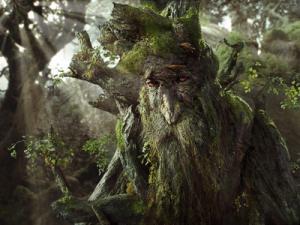
“Funny how I learned about freedom from creatures that are rooted in place.” In Tolkien’s The Two Towers, the middle book in his classic trilogy The Lord of the Rings, the hobbits Merry and Pippin learn a similar lesson from Treebeard and the Ents, the oldest creatures in Middle Earth who are, for all intents and purposes, talking trees who have the ability to walk, think, and talk—very, VERY slowly and deliberately. Merry and Pippin, running for their lives from a band of murderous orcs from whom they have just escaped, find themselves in middle of Fangorn Forest where the Ents live.
After hearing about the forces gathering for a classic battle between good and evil on the borders of their forest, Treebeard calls for an “Entmoot,” a council of Ents to decide what, if anything, they should do about these disturbing events. It takes days for the Ents to gather, and many more days for the debate to take place at a one-sentence-per-hour pace. Merry and Pippin are driven close to madness with impatience over the snail-like deliberateness of the Ents—but when they finally choose to take a side in the battle, their participation sways the conflict, at least for a while, in the direction of the good guys.
In our American culture, freedom is often thought of as the ability to do whatever I want, whenever I want to do it, free from the interference of anyone other than me. Any perceived limitation on what I want to do, even if clearly in my own interest and that of others, is a violation of my “freedom.” But philosophers have argued for centuries that this uninhibited throwing around of my deliberative weight is anything but true freedom.
Aristotle conceived of the life of freedom and moral excellence as a life constructed out of the virtues, good habits that, when cultivated, incline a person to do the right thing as a matter of developed character rather than conscious choice. More than two millennia later, Iris Murdoch provides a contemporary spin on Aristotle’s insight in The Sovereignty of Good by suggesting that it is in the small choices concerning what we pay attention to and adopt as centrally important that true freedom is to be found.
But if we consider what the work of attention is like, how continuously it goes on, and how imperceptibly it builds up structures of value round about us, we shall not be surprised that at crucial moments of choice most of the business of choosing is already over. This does not imply that we are not free, certainly not. But it implies that the exercise of our freedom is a small piecemeal business which goes on all the time and not a grandiose leaping about unimpeded at important moments.
True freedom, under this description, is acting in attunement with one’s character and conscience—items that are constructed slowly, deliberately, and in accord with one’s best nature. A lot like a tree, in other words.
A human being can never entirely trade its animal survival strategy for the rootedness of a plant. But we can, as Gilles, Merry, and Pippin did, learn a lot about freedom and how to be in the world from a tree.  I used to wonder what Martin Luther meant when, at the Diet of Worms, he concluded his refusal to recant his heretical writings by saying “Here I stand. I can do no other.” Of course he could have done otherwise! I would complain. No one is forcing him not to recant.
But Luther’s point was that at this moment in his life, recanting his writings would be the same as ceasing to be Martin Luther. He can do no other because his character has rooted him in place. As Murdoch suggests, if one has paid attention to the incremental tiny choices that shape one’s character and life over time, what to do at “crucial moments of choice” will not only be clear—it will be unavoidable. Be like a tree.
Previous Post
January 17, 2023
The Spirit of the Lord is Upon Me . . .
Next Post

January 22, 2023 When the Well Runs Dry
Recent Comments
"Mary did have a choice. And she was able to make it before the Holy ..."
"i cannot read beyond your recommendations for the books since i like to have a ..."
"AI will never be able to utter with honesty, feeling, or humility, the greeting: "Namaste".It ..."
"They do. I'm sure you could find discussions of the same topic from any of ..."
Browse Our Archives
Select a Category abortion Advent AI Angels Artificial intelligence atheism attention baptism Baptists beauty belief Benedictines Bible bicycling Big Bird books Bovina Camaldoli hermitage Canada Catholicism cats certainty change Christianity Christmas Collegeville Covid-19 creativity Development of Western Civilization dogs doubt Easter Enneagram Epiphany Episcopal ethics Eucharist evil extroverts Facebook faith family fear flowers forgiveness freedom friends God goodness grace happiness heaven hell history Holy Spirit Holy Week hope human nature humility humor idolatry incarnation introverts irreverence Islam Jeanne Jesus Joe Biden joy Judaism justice Kamala Harris knowledge Lent listen literature liturgy love Marsue Memorial Day miracles movies music mystery mythology NPR Old Testament optimism paradox peace Penguins philosophy piano podcast politics power prayer Protestantism Providence College Religion Rhode Island sabbatical sacrament science seeing silence Simone Weil Socrates soul sports St. John's College stories suffering tattoo teaching technology television theology thinking time tolerance transcendence travel trees trust truth Uncategorized Vermont wisdom wonder writing
Select a Month May 2026 April 2026 March 2026 February 2026 January 2026 December 2025 November 2025 October 2025 September 2025 August 2025 July 2025 June 2025 May 2025 April 2025 March 2025 February 2025 January 2025 December 2024 November 2024 October 2024 September 2024 August 2024 July 2024 June 2024 May 2024 April 2024 March 2024 February 2024 January 2024 December 2023 November 2023 October 2023 September 2023 August 2023 July 2023 June 2023 May 2023 April 2023 March 2023 February 2023 January 2023 December 2022 November 2022 October 2022 September 2022 August 2022 July 2022 June 2022 May 2022 April 2022 March 2022 February 2022 January 2022 December 2021 November 2021 October 2021 September 2021 August 2021 July 2021 June 2021 May 2021 April 2021 March 2021 February 2021 January 2021 December 2020 November 2020 October 2020 September 2020 August 2020 July 2020 June 2020 May 2020 April 2020 March 2020 February 2020 January 2020 December 2019 November 2019 October 2019 September 2019 August 2019 July 2019 June 2019 May 2019 April 2019 March 2019 February 2019 January 2019 December 2018 November 2018 October 2018 September 2018 August 2018 July 2018 June 2018 May 2018 April 2018 March 2018 February 2018 January 2018 December 2017 November 2017 October 2017 September 2017 August 2017 July 2017 June 2017 May 2017 April 2017 March 2017 February 2017 January 2017 December 2016 November 2016 October 2016 September 2016 August 2016 July 2016 June 2016 May 2016 April 2016 March 2016 February 2016 January 2016 December 2015 November 2015 October 2015 September 2015 August 2015 July 2015 June 2015 May 2015 April 2015 March 2015 February 2015 January 2015 December 2014 November 2014 October 2014 September 2014 August 2014 July 2014 June 2014 May 2014 April 2014 March 2014 February 2014 January 2014 December 2013 November 2013 October 2013 September 2013 August 2013 July 2013 June 2013 May 2013 April 2013 March 2013 February 2013 January 2013 December 2012 November 2012 October 2012 September 2012
Follow Us!
TAKE THE
Religious Wisdom Quiz
What was primary method of debt resolution in Biblical times?
Select your answer to see how you score.
Public trial Fine payment Community service Slavery
Books by This Author Books by Vance G. Morgan
Related posts from Freelance Christianity

The Lonely Pawn: On Faith, Doubt, and Meaning


AI and Love: When a Chatbot Becomes a...

TRENDING AT PATHEOS Progressive Christian

What Being a Modern-Day Apostle Means to Me
In my last column, I discussed the ins and outs of modern-day...

Did Ancient China Once Worship the God of...
Across human history, a common thread weaves through the origins of the...

Love Your Neighbor – Including Earth-Kin: Lev. 19,...
God’s command to love your neighbor means acting in an ethical and...

Lead a Church Study of “Jesus and Lao...
Guest writer Jack Thomas (The Irreverent Reverend) reflects on leading his church...

Pastoral Wisdom for Responding to Sermon Pushback
Getting sermon pushback on your social justice sermon? Learn practical, Proverbs-based strategies...

Principles for Understanding the Apostolic Ministry Today
Whenever people discover that my formal ministry title is "apostle," as in...
view all Progressive Christian blogs
What Are Your Thoughts?leave a comment
Ad-Free & Subscriber Log-In Subscription Support
- About Us
- 2026 Calendar
- Videos
- Podcasts
- Library of World Religions
- Faith In Media Tracker
- Advertise With Us
- Write for Us
- Privacy Policy
- Terms of Service
- Do Not Sell My Data
- Contact Us
- Radiant Digital
- Manage Newsletter Subscriptions
- Unsubscribe From Notifications
- Sitemap
Copyright 2008-2026, Patheos. All rights reserved.
Subscription Support Ad-Free & Subscriber Log-In
Follow Patheos