
BuddhistCatholicContemplativeEvangelicalGeneral ChristianHinduJewishLatter-day SaintMuslimNew VisionsProgressive Christian
Beliefs
- Buddhist
- Catholic
- Contemplative
- Evangelical
- General Christian
- Hindu
- Jewish
- Latter-day Saint
- More Voices
- Muslim
- New Visions
- Pagan
- Progressive Christian
Topics
- Religion News
- Food and Religion
- Sports and Religion
- Religious Art
- Religious Music and Entertainment
- Religious Events
- History and Religion
- Style and Religion
- Politics and Religion
- Women in Religion
- Recreation Outdoors and Religion
- Business Finance and Religion
- Careers Workplace and Religion
- Education and Religion
- Family Parenting and Religion
- Health Fitness and Religion
- Home and Religion
- Relationships and Religion
- Technology and Religion
- Travel and Religion
Columnists
- Buddhist Columnists
- Business Finance and Religion Columnists
- Careers Workplace and Religion Columnists
- Catholic Columnists
- Contemplative Columnists
- Education and Religion Columnists
- Evangelists Columnists
- Family Parenting and Religion Columnists
- General Christian Columnists
- Health Fitness and Religion Columnists
- Hindu Columnists
- History and Religion Columnists
- Home and Religion Columnists
- Jewish Columnists
- More Voices Columnists
- Latter Day Columnists
- Muslim Columnists
- New Visions Columnists
- Nonreligious Columnists
- Pagan Columnists
- Politics and Religion Columnists
- Progressive Columnists
- Recreation Outdoors and Religion Columnists
- Relationships and Religion Columnists
- Religion News Columnists
- Religious Art Columnists
- Religious Events Columnists
- Religious Music and Entertainment Columnists
- Sports and Religion Columnists
- Style and Religion Columnists
- Technology and Religion Columnists
- Travel and Religion Columnists
- Women in Religion Columnists
Resource Library
- 2026 Calendar
- Library of World Religions
- The 100 Most Holy Places on Earth
- Patheos Answers
- Podcasts
- Videos
- Faith Leaders Database
- Anglican Episcopalian
- Bahai
- Baptist
- Buddhism
- Christianity
- Confucianism
- Eastern Orthodoxy
- Hinduism
- Holiness and Pentecostal
- ISKCON
- Islam
- Judaism
- Lutheran
- Methodist
- The Church of Jesus Christ of Latter-day Saints
- New Age
- Paganism
- Presbytarian and Reformed
- Protestantism
- Religion Behind the Scenes
- Roman Catholic
- Scientology
- Shia Islam
- Sikhism
- Sufism
- Sunni Islam
- Taoism
- Zen
- See all religions
Research Tools
 Ad-Free & Subscriber Log-In Subscription Support
Ad-Free & Subscriber Log-In Subscription Support
Follow Patheos 

- Trending:
- Forgiveness
- |
- Marriage
- |
- Consciousness
- |
- Death Penalty
- |
- Election
- |
- Halloween

- Home
- Progressive Christian
- Balancing Humility with Expertise
Balancing Humility with Expertise
Last updated on: February 16, 2023 at 7:00 am by Vance Morgan
Balancing Humility with Expertise 2023-02-08T16:23:03-04:00 Vance Morgan
Patheos Explore the world's faith through different perspectives on religion and spirituality! Patheos has the views of the prevalent religions and spiritualities of the world.
As I continue early preparation for the book on the teaching life that I hope to write during my upcoming Fall semester sabbatical, I find myself considering many of the misconceptions that people outside of academia have concerning professors. One of these misconceptions, one that has become more and more prevalent over the past decade or two, is that although they present themselves as “experts,” academics are generally far more impressed with their knowledge and expertise than they should be. Let me start with allowing that I know a few academics for which this description is dead-on accurate. But as is usually the case, there is a lot more going on than the stereotype presents.
Once around twenty-five years ago, while a still untenured member of the philosophy department at my college, I participated in a symposium on the late Pope John Paul II’s encyclical Fides et Ratio (Faith and Reason) which had been released the previous year. The symposium was a shared event between the philosophy and theology departments. One member from each department would present a twenty-minute paper, and a panel of four philosophers and theologians would present brief comments. Sounds like a lot of fun, huh? The original presenters would have a chance for response, then the whole thing would be turned over to the audience for questions and interaction.
I was assigned to present the longer paper for the philosophy department. In the paper I did what philosophers do—I raised what I considered to be some critical problems with the encyclical, suggesting that the Pope might even have gotten some important things wrong—for instance his conclusion that reason must always submit to the authority of faith when they are in conflict. I knew from the start, of course, that this might be a bit controversial at a Catholic college—I was right.
The audience that evening was impressive in size, exceeding what I’ve seen for any academic event in subsequent years at the college until last semester’s discussion of the abortion issue for which I was a panelist. The larger community, particularly the parishioners of St. Pius V church across the street, had been invited and came in droves, expecting I’m sure to hear a cheerleading love-fest for their beloved Pope. Instead they got me raining on their parade. A colleague reported afterwards that one woman in the back row complained during the paper to her neighbor in an audible stage whisper: “I can’t believe they let people like him teach here!”
Rumblings during my paper exploded into direct challenge during the Q and A. After defending and clarifying my position—pretty well, I thought—for a few minutes, an exasperated older gentleman in the front row asked “Dr. Morgan, is there no place in philosophy for humility?” I responded, honestly but perhaps a bit uncharitably, with a guffaw of laughter (if introverts ever guffaw). “The longer I do philosophy, the more I realize how much I don’t know!” Twenty-five years later, I am even more convinced of what I don’t know and of the importance of humility in the teaching profession.
Still, I didn’t spend nine years in college earning three degrees culminating in a Ph.D. in philosophy to simply be humble about what I have learned and what I know. I actually get a bit testy when someone commenting on this blog, as has happened many times, tells me in no uncertain terms that my training as a philosopher and experience as a philosophy professor actually makes me less qualified to say anything definitive within the realm of philosophy than what they came up with last evening in conversation with their buddies over a few joints and beers. How exactly should humility and expertise temper each other?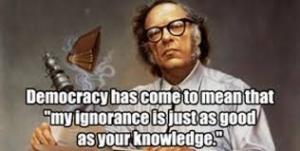
More than four decades ago, at the dawn of the Reagan era, the late Isaac Asimov wrote that
There is a cult of ignorance in the United States, and there has always been. The strain of anti-intellectualism has been a constant thread winding its way through our political and cultural life, nurtured by the false notion that democracy means that “my ignorance is just as good as your knowledge.”
Sadly, it has gotten worse since Asimov wrote this. As an academic and a college professor, I find myself at the crossroads of expertise and common knowledge on a daily basis. Consider a recent example of an academic asked to provide publicly her expert analysis of an important issue.
You might remember a House Judiciary Committee hearing in December 2019 that was an early part of the hearings that resulted in the first impeachment of then President Donald Trump. The witnesses at the hearing were four academic, legal experts on all matters concerning impeachment. One of the witnesses was Stanford law professor Pamela Karlan. There was something about Professor Karlan that some found so off-putting that they just had to bloviate about it. Here’s a representative reaction to Professor Karlan from “Fox and Friends” the morning after the hearing:
The disdain is evident, and, you know, it sort of recalls back to the 2016 election when voters didn’t feel heard, when they resonated with President Trump, because there is this elitist, disdainful reproachment coming from the far left, and especially in academia, that makes people feel disconnected and undercut. Everything about her exuded that she was better, and smarter, than anyone watching. And that’s so off-putting.
Now that just pisses me off.
It pisses me off for many reasons, but primarily because the quote from “Fox and Friends” exhibits a whole bunch of lame stereotypes about academics, stereotypes that anyone whose life is spent in academia (as mine has been for more than three decades) quickly becomes so sick of that they want to vomit. After seeing the clip quoted above on Twitter, I responded with this:
I’ve been a college professor for 30 years. I’m used to being in a room where everyone believes they are the smartest person there. And they very well may be. Half the people at monthly department meetings in my department of twenty faculty have confidence that could seem like disdain (but isn’t). Deal with it.
As I read my tweet now, more than three years later, I realize that it is far more measured than I was feeling at the time.
Over the past two decades I have been both a department chair and the director of a large interdisciplinary academic program that, at any given time, involved at least seventy-five faculty and 1800+ students. People often used to suggest that trying to direct faculty must be like “herding cats.” I always responded that it’s worse. It’s like herding cats when each of the cats in the room has a Ph.D. and is sure that she or he is the smartest cat in the room.
 My guess is that during the December 2019 hearing, Dr. Karlan was in academic “professor and expert” mode; that is, after all, why she was asked, along with her three expert colleagues to be there. A highly educated and trained scholar with relevant expertise—in this case, expertise in legal and interpretive matters concerning impeachment—was asked to respond to questions relying on her training and expertise. She did, directly and pointedly. And then she is criticized for acting and sounding like the very expert and highly trained person that caused her to be summoned to the hearing in the first place.
Any academic or college professor could provide you with multiple examples of the same dynamic. “Please provide us with your expertise and knowledge, but please don’t do it in such a way that makes us feel that you have more knowledge or expertise than we do. Otherwise we might decide that you are an elitist and that you think that you are better than we are.” News flash, people. Dr. Karlan did know more about the topic under consideration at the hearing than you do.
That’s what being an “expert” on something means. The fact that she communicated her knowledge and expertise in a manner that you find “elitist” is your problem, not hers. Your ignorance is not just as good as her knowledge. If you are threatened or annoyed when you find out that some people know more than you on any number of subjects, that’s on you, not them. There is a difference between elitism and knowing what the f__k you are talking about.
To quote a phrase from 24/7 news channel talking heads that is vastly overused, “let me be perfectly clear.” If you got the impression, “Fox and Friends” person, from Professor Kaplan’s testimony that she thinks she is “smarter” than you, that’s because concerning the matters on which she was speaking, she is smarter than you. And me. And probably all but a couple hundred or so human beings on the planet. That’s why she’s an “expert.” She’s earned the right to deliver her insights with an authority and air that might cause you to surmise that she thinks she’s better than you. That’s because in this case she is better than you. Her opinion matters more than yours. That’s why the Judiciary committee wanted to speak to her and not to you. In this case, your opinion doesn’t matter. But her knowledge does.
This, of course, provides no formula for balancing humility with expertise, just as there is no formula for any part of work/life balance. But do me—and everyone else who in some part of their life has earned a certain amount of expertise—a favor. The next time someone speaks from within the expertise that they have gained through education and/or experience, give them the benefit of a doubt, even if what they are saying is contrary to what you think or want to believe. They probably know more than you and I do on the topic. Imagine that.
Previous Post

February 14, 2023
Beautiful Souls on Valentine's Day
Next Post

February 19, 2023 Longing to be Whole: A Reflection for Transfiguration Sunday
Recent Comments
"Mary did have a choice. And she was able to make it before the Holy ..."
"i cannot read beyond your recommendations for the books since i like to have a ..."
"AI will never be able to utter with honesty, feeling, or humility, the greeting: "Namaste".It ..."
"They do. I'm sure you could find discussions of the same topic from any of ..."
Browse Our Archives
Select a Category abortion Advent AI Angels Artificial intelligence atheism attention baptism Baptists beauty belief Benedictines Bible bicycling Big Bird books Bovina Camaldoli hermitage Canada Catholicism cats certainty change Christianity Christmas Collegeville Covid-19 creativity Development of Western Civilization dogs doubt Easter Enneagram Epiphany Episcopal ethics Eucharist evil extroverts Facebook faith family fear flowers forgiveness freedom friends God goodness grace happiness heaven hell history Holy Spirit Holy Week hope human nature humility humor idolatry incarnation introverts irreverence Islam Jeanne Jesus Joe Biden joy Judaism justice Kamala Harris knowledge Lent listen literature liturgy love Marsue Memorial Day miracles movies music mystery mythology NPR Old Testament optimism paradox peace Penguins philosophy piano podcast politics power prayer Protestantism Providence College Religion Rhode Island sabbatical sacrament science seeing silence Simone Weil Socrates soul sports St. John's College stories suffering tattoo teaching technology television theology thinking time tolerance transcendence travel trees trust truth Uncategorized Vermont wisdom wonder writing
Select a Month May 2026 April 2026 March 2026 February 2026 January 2026 December 2025 November 2025 October 2025 September 2025 August 2025 July 2025 June 2025 May 2025 April 2025 March 2025 February 2025 January 2025 December 2024 November 2024 October 2024 September 2024 August 2024 July 2024 June 2024 May 2024 April 2024 March 2024 February 2024 January 2024 December 2023 November 2023 October 2023 September 2023 August 2023 July 2023 June 2023 May 2023 April 2023 March 2023 February 2023 January 2023 December 2022 November 2022 October 2022 September 2022 August 2022 July 2022 June 2022 May 2022 April 2022 March 2022 February 2022 January 2022 December 2021 November 2021 October 2021 September 2021 August 2021 July 2021 June 2021 May 2021 April 2021 March 2021 February 2021 January 2021 December 2020 November 2020 October 2020 September 2020 August 2020 July 2020 June 2020 May 2020 April 2020 March 2020 February 2020 January 2020 December 2019 November 2019 October 2019 September 2019 August 2019 July 2019 June 2019 May 2019 April 2019 March 2019 February 2019 January 2019 December 2018 November 2018 October 2018 September 2018 August 2018 July 2018 June 2018 May 2018 April 2018 March 2018 February 2018 January 2018 December 2017 November 2017 October 2017 September 2017 August 2017 July 2017 June 2017 May 2017 April 2017 March 2017 February 2017 January 2017 December 2016 November 2016 October 2016 September 2016 August 2016 July 2016 June 2016 May 2016 April 2016 March 2016 February 2016 January 2016 December 2015 November 2015 October 2015 September 2015 August 2015 July 2015 June 2015 May 2015 April 2015 March 2015 February 2015 January 2015 December 2014 November 2014 October 2014 September 2014 August 2014 July 2014 June 2014 May 2014 April 2014 March 2014 February 2014 January 2014 December 2013 November 2013 October 2013 September 2013 August 2013 July 2013 June 2013 May 2013 April 2013 March 2013 February 2013 January 2013 December 2012 November 2012 October 2012 September 2012
Follow Us!
TAKE THE
Religious Wisdom Quiz
What does "Bethel" mean in Hebrew?
Select your answer to see how you score.
House of God God's Dwelling City of Light Holy Ground
Books by This Author Books by Vance G. Morgan
Related posts from Freelance Christianity

The Lonely Pawn: On Faith, Doubt, and Meaning


AI and Love: When a Chatbot Becomes a...

TRENDING AT PATHEOS Progressive Christian

What Being a Modern-Day Apostle Means to Me
In my last column, I discussed the ins and outs of modern-day...

Did Ancient China Once Worship the God of...
Across human history, a common thread weaves through the origins of the...

Love Your Neighbor – Including Earth-Kin: Lev. 19,...
God’s command to love your neighbor means acting in an ethical and...

Lead a Church Study of “Jesus and Lao...
Guest writer Jack Thomas (The Irreverent Reverend) reflects on leading his church...

Pastoral Wisdom for Responding to Sermon Pushback
Getting sermon pushback on your social justice sermon? Learn practical, Proverbs-based strategies...

Principles for Understanding the Apostolic Ministry Today
Whenever people discover that my formal ministry title is "apostle," as in...
view all Progressive Christian blogs
What Are Your Thoughts?leave a comment
Ad-Free & Subscriber Log-In Subscription Support
- About Us
- 2026 Calendar
- Videos
- Podcasts
- Library of World Religions
- Faith In Media Tracker
- Advertise With Us
- Write for Us
- Privacy Policy
- Terms of Service
- Do Not Sell My Data
- Contact Us
- Radiant Digital
- Manage Newsletter Subscriptions
- Unsubscribe From Notifications
- Sitemap
Copyright 2008-2026, Patheos. All rights reserved.
Subscription Support Ad-Free & Subscriber Log-In
Follow Patheos