
BuddhistCatholicContemplativeEvangelicalGeneral ChristianHinduJewishLatter-day SaintMuslimNew VisionsProgressive Christian
Beliefs
- Buddhist
- Catholic
- Contemplative
- Evangelical
- General Christian
- Hindu
- Jewish
- Latter-day Saint
- More Voices
- Muslim
- New Visions
- Pagan
- Progressive Christian
Topics
- Religion News
- Food and Religion
- Sports and Religion
- Religious Art
- Religious Music and Entertainment
- Religious Events
- History and Religion
- Style and Religion
- Politics and Religion
- Women in Religion
- Recreation Outdoors and Religion
- Business Finance and Religion
- Careers Workplace and Religion
- Education and Religion
- Family Parenting and Religion
- Health Fitness and Religion
- Home and Religion
- Relationships and Religion
- Technology and Religion
- Travel and Religion
Columnists
- Buddhist Columnists
- Business Finance and Religion Columnists
- Careers Workplace and Religion Columnists
- Catholic Columnists
- Contemplative Columnists
- Education and Religion Columnists
- Evangelists Columnists
- Family Parenting and Religion Columnists
- General Christian Columnists
- Health Fitness and Religion Columnists
- Hindu Columnists
- History and Religion Columnists
- Home and Religion Columnists
- Jewish Columnists
- More Voices Columnists
- Latter Day Columnists
- Muslim Columnists
- New Visions Columnists
- Nonreligious Columnists
- Pagan Columnists
- Politics and Religion Columnists
- Progressive Columnists
- Recreation Outdoors and Religion Columnists
- Relationships and Religion Columnists
- Religion News Columnists
- Religious Art Columnists
- Religious Events Columnists
- Religious Music and Entertainment Columnists
- Sports and Religion Columnists
- Style and Religion Columnists
- Technology and Religion Columnists
- Travel and Religion Columnists
- Women in Religion Columnists
Resource Library
- 2026 Calendar
- Library of World Religions
- The 100 Most Holy Places on Earth
- Patheos Answers
- Podcasts
- Videos
- Faith Leaders Database
- Anglican Episcopalian
- Bahai
- Baptist
- Buddhism
- Christianity
- Confucianism
- Eastern Orthodoxy
- Hinduism
- Holiness and Pentecostal
- ISKCON
- Islam
- Judaism
- Lutheran
- Methodist
- The Church of Jesus Christ of Latter-day Saints
- New Age
- Paganism
- Presbytarian and Reformed
- Protestantism
- Religion Behind the Scenes
- Roman Catholic
- Scientology
- Shia Islam
- Sikhism
- Sufism
- Sunni Islam
- Taoism
- Zen
- See all religions
Research Tools
 Ad-Free & Subscriber Log-In Subscription Support
Ad-Free & Subscriber Log-In Subscription Support
Follow Patheos 

- Trending:
- Forgiveness
- |
- Marriage
- |
- Consciousness
- |
- Death Penalty
- |
- Election
- |
- Halloween

- Home
- Progressive Christian
- Are you a “Christian Capitalist” or a “Capitalist Christian”?
Are you a “Christian Capitalist” or a “Capitalist Christian”?
Last updated on: October 1, 2019 at 7:56 am by Vance Morgan
Are you a “Christian Capitalist” or a “Capitalist Christian”? 2019-10-01T07:56:52-04:00 Vance Morgan
Patheos Explore the world's faith through different perspectives on religion and spirituality! Patheos has the views of the prevalent religions and spiritualities of the world.
For those who claim to be persons of Christian faith and who also are largely unconcerned with the radical inequities of wealth in our contemporary world, last Sunday would have been a good day to stay away from church. The lectionary readings for the day began with Amos announcing divine judgment on those who “are at ease in Zion,” who “lie on beds of ivory, and lounge on their couches,” and who indulge in music, wine, and luxuries while ignoring the ruinous plight of those around them. This was followed by Paul telling Timothy that “the love of money is the root of all kinds of evil,” exhorting that those who happen to be rich should “be rich in good works, generous, and ready to share” with those who are less fortunate.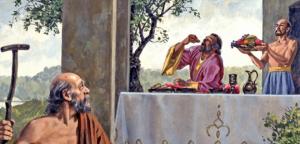
Then the hammer drops with the familiar story of the rich man and Lazarus from Luke’s gospel. The rich man, “who was dressed in purple and fine linen and who feasted sumptuously every day” while ignoring the very existence of Lazarus, his culture’s version of a homeless person who lived on the garbage thrown out after the rich man’s meals. Both men die; Lazarus is “carried away by the angels,” while the rich man, perhaps not surprisingly, lands in Hades. You know the story—the rich man begs Abraham, who is hanging out with Lazarus in heaven, for relief or, at least, for Lazarus to be sent to his brothers to warn them not to be like their deceased brother.
Abraham’s answer to the rich man’s pleas is important and devastating. If you failed to recognize the inequities that your earthly life embodied, it is now too late. If your brothers are so dense and set in their ways that they (as the dead man did) fail to recognize the injustices that are staring them in the face on a daily basis, “neither will they be convinced even if someone rises from the dead.” It doesn’t take much creative insight to apply these lessons to our current world.
There are few things that attract the ire of various commenters on this blog than when someone perceives, rightly or wrongly, that I might be a socialist, one of those evil and frightening folks who suggest that we might need to do something about the radical inequities of wealth and privilege that confront us every day. Now, I freely admit that both my Christian faith and my natural liberal tendencies lean me more strongly in a communitarian direction than an individualistic one when the interests of the community and the individual are in conflict, so my critics’ perception is somewhat accurate.
But set the endless “capitalism vs. socialism” smackdown event aside for a bit. I have a question for those persons—and you are legion—who claim both to embrace the Christian faith and to be a committed devotee of free market capitalism, a 21st century version of the lessons embedded in last Sunday’s readings. Are you a Christian capitalist or a Capitalist Christian? This is not a matter of semantics, nor am I seeking to subject you to a lesson in grammar (or at least not much of one). Because figuring out which of these you are will say a lot about your priorities. Let me explain.
If you claim to be both a “Christian” and a “capitalist,” the question is “which is the noun, and which is the adjective?” If you are a Christian (adjective) capitalist (noun), your primary commitment is to free market capitalism—including all of its accompanying inequities—first and foremost. The “Christian” adjective means that you also are attempting to apply a Christian framework to your prior (and more fundamental) economic and political commitments. Good luck with that. This is the position of many commenters on my blog. The tortuous contortions they go through in order to explain how capitalism and Christianity are fully compatible would be amusing were they not so sad and tragic. I learned, for instance, from one recent commenter that Jesus actually was quite wealthy (what the three kings brought at his birth was worth a lot of money, after all); Jesus used this wealth to bankroll his disciples and followers during his three-year ministry. Really.
It is the capitalist (adjective) Christian (noun), the person whose primary commitment is to her Christian faith, but who also wants to impose a capitalist framework on it, that I find more interesting. In preparation for a seminar with a bunch of sophomores this week, I spent the last several days reviewing Pope Leo XIII’s 1891 encyclical “Rerum Novarum,” a highly influential discussion of labor and social justice. The 19th century was one of economic and political revolution, something that Leo is looking back on and attempting to place within what has come to be known as a classic expression of Catholic social teaching.
Perhaps because he knows that some of the heart of his encyclical sounds quite “socialist,” Leo is clear in the opening paragraphs that his message is not one of Communism. He argues that the ownership of private property is a divinely-given right, that attempts to enforce the collective ownership of property are a threat to basic institutions such as the family and the workplace, and that the primary reason people work is in order to support themselves and those dependent on them with the fruits of their labor. Unspoken, but also a likely reason for Leo’s rejection of socialism, is the reputation of atheism that—accurate or not—had been (and still is) often attached to Communism.
The meat of the encyclical is the enumeration of various duties that are owed, both by workers and their capitalist bosses, in the workplace. In a central passage, Leo attempts to thread the needle between private ownership of property and what is owed to those who do not have enough. Leo frames this discussion by citing Aquinas:
It is lawful, says St. Thomas Aquinas, “for a man to hold private property; and it is also necessary for the carrying on of human existence.” But if the question be asked: How must one’s possessions be used?—the Church relies without hesitation in the words of the same holy Doctor: “Man should not consider his material possessions as his own, but as common to all, so as to share them without hesitation when others are in need . . .
This seems to be a case of the “Angelic Doctor” wanting to have his cake and eat it too, offering with one hand the individual, private ownership of property, then with the other hand taking it away by saying that said individual “should not consider his material possessions as his own.” Leo’s continues by trying to sort this apparent contradiction out.
No one is commanded to distribute to others that which is required for his own needs and those of his household . . . But, when what necessity demands has been supplied, and one’s standing fairly taken thought for, it becomes a duty to give to the indigent out of what remains over. It is a duty, not of justice (save in extreme cases), but of Christian charity—a duty not enforced by human law. But the laws and judgment of men must yield place to the laws and judgments of Christ . . .
Fully unpacking this would be an appropriate task for a full semester course, not for the concluding paragraphs of a blog post. But at the very least, Leo is providing important food for thought for the capitalist Christian, the person who wonders to what extent a commitment to free market capitalism might be compatible with a foundational commitment to following Jesus. The good news for the capitalist side is Leo’s point that the duty to “give to the indigent” cannot be “enforced by human law.” The not-so-good news for the individualist capitalist is that this duty is rooted, not in human law, but in the very roots of the Christian faith.
Capitalist Christians tend to describe the sharing of what remains after one has taken care of basic needs of self and family as “charity,” something that has come to mean “nice if you choose to do it, but not a necessary requirement of morality or faith commitment.” Not so, says Leo. The “duty to give to the indigent out of what remains over” is just that—a duty. It isn’t optional. It isn’t up to me, even though capitalism says that what I am giving is mine. It is a duty whose demands exceed anything that human law can enforce, a duty whose necessity is established by the very Christian faith I profess.
Aquinas himself says as much in a different passage when he considers what the “haves” owe to the “have nots.” He writes that “Whatever certain persons have in superabundance is due, by natural law, to the purpose of succoring the poor.” If you have more than you need, that extra literally does not belong to you. And in case you missed that, Aquinas then quotes Saint Ambrose, one of the most influential ecclesial figures in history: “It is the hungry man’s bread that you withhold, the naked man’s cloak that you store away, the money that you bury in the earth is the price of the poor man’s ransom and freedom.”
The tension between capitalism and Christianity could not be greater. Will you temper and adjust your faith in order to accommodate a hardcore commitment to free market capitalism? Or will you adjust your capitalist talking points in order to accommodate your commitment to the life of faith? That entirely depends on whether you are Christian capitalist or a Capitalist Christian. You decide.

Next Post

October 3, 2019 Possible Responses to the Current Insanity: "Whatever" and "Oh, Well"
Browse Our Archives
Select a Category abortion Advent AI Angels Artificial intelligence atheism attention baptism Baptists beauty belief Benedictines Bible bicycling Big Bird books Bovina Camaldoli hermitage Canada Catholicism cats certainty change Christianity Christmas Collegeville Covid-19 creativity Development of Western Civilization dogs doubt Easter Enneagram Epiphany Episcopal ethics Eucharist evil extroverts Facebook faith family fear flowers forgiveness freedom friends God goodness grace happiness heaven hell history Holy Spirit Holy Week hope human nature humility humor idolatry incarnation introverts irreverence Islam Jeanne Jesus Joe Biden joy Judaism justice Kamala Harris knowledge Lent listen literature liturgy love Marsue Memorial Day miracles movies music mystery mythology NPR Old Testament optimism paradox peace Penguins philosophy piano podcast politics power prayer Protestantism Providence College Religion Rhode Island sabbatical sacrament science seeing silence Simone Weil Socrates soul sports St. John's College stories suffering tattoo teaching technology television theology thinking time tolerance transcendence travel trees trust truth Uncategorized Vermont wisdom wonder writing
Select a Month May 2026 April 2026 March 2026 February 2026 January 2026 December 2025 November 2025 October 2025 September 2025 August 2025 July 2025 June 2025 May 2025 April 2025 March 2025 February 2025 January 2025 December 2024 November 2024 October 2024 September 2024 August 2024 July 2024 June 2024 May 2024 April 2024 March 2024 February 2024 January 2024 December 2023 November 2023 October 2023 September 2023 August 2023 July 2023 June 2023 May 2023 April 2023 March 2023 February 2023 January 2023 December 2022 November 2022 October 2022 September 2022 August 2022 July 2022 June 2022 May 2022 April 2022 March 2022 February 2022 January 2022 December 2021 November 2021 October 2021 September 2021 August 2021 July 2021 June 2021 May 2021 April 2021 March 2021 February 2021 January 2021 December 2020 November 2020 October 2020 September 2020 August 2020 July 2020 June 2020 May 2020 April 2020 March 2020 February 2020 January 2020 December 2019 November 2019 October 2019 September 2019 August 2019 July 2019 June 2019 May 2019 April 2019 March 2019 February 2019 January 2019 December 2018 November 2018 October 2018 September 2018 August 2018 July 2018 June 2018 May 2018 April 2018 March 2018 February 2018 January 2018 December 2017 November 2017 October 2017 September 2017 August 2017 July 2017 June 2017 May 2017 April 2017 March 2017 February 2017 January 2017 December 2016 November 2016 October 2016 September 2016 August 2016 July 2016 June 2016 May 2016 April 2016 March 2016 February 2016 January 2016 December 2015 November 2015 October 2015 September 2015 August 2015 July 2015 June 2015 May 2015 April 2015 March 2015 February 2015 January 2015 December 2014 November 2014 October 2014 September 2014 August 2014 July 2014 June 2014 May 2014 April 2014 March 2014 February 2014 January 2014 December 2013 November 2013 October 2013 September 2013 August 2013 July 2013 June 2013 May 2013 April 2013 March 2013 February 2013 January 2013 December 2012 November 2012 October 2012 September 2012
Follow Us!
TAKE THE
Religious Wisdom Quiz
How did the people show honor when Jesus entered Jerusalem on a donkey?
Select your answer to see how you score.
Sounded trumpets Offered sacrifices Built an altar Laid down palm branches
Books by This Author Books by Vance G. Morgan
Related posts from Freelance Christianity

The Lonely Pawn: On Faith, Doubt, and Meaning


AI and Love: When a Chatbot Becomes a...

TRENDING AT PATHEOS Progressive Christian

What Being a Modern-Day Apostle Means to Me
In my last column, I discussed the ins and outs of modern-day...

Did Ancient China Once Worship the God of...
Across human history, a common thread weaves through the origins of the...

Love Your Neighbor – Including Earth-Kin: Lev. 19,...
God’s command to love your neighbor means acting in an ethical and...

Lead a Church Study of “Jesus and Lao...
Guest writer Jack Thomas (The Irreverent Reverend) reflects on leading his church...

Pastoral Wisdom for Responding to Sermon Pushback
Getting sermon pushback on your social justice sermon? Learn practical, Proverbs-based strategies...

Principles for Understanding the Apostolic Ministry Today
Whenever people discover that my formal ministry title is "apostle," as in...
view all Progressive Christian blogs
Ad-Free & Subscriber Log-In Subscription Support
- About Us
- 2026 Calendar
- Videos
- Podcasts
- Library of World Religions
- Faith In Media Tracker
- Advertise With Us
- Write for Us
- Privacy Policy
- Terms of Service
- Do Not Sell My Data
- Contact Us
- Radiant Digital
- Manage Newsletter Subscriptions
- Unsubscribe From Notifications
- Sitemap
Copyright 2008-2026, Patheos. All rights reserved.
Subscription Support Ad-Free & Subscriber Log-In
Follow Patheos