
BuddhistCatholicContemplativeEvangelicalGeneral ChristianHinduJewishLatter-day SaintMuslimNew VisionsProgressive Christian
Beliefs
- Buddhist
- Catholic
- Contemplative
- Evangelical
- General Christian
- Hindu
- Jewish
- Latter-day Saint
- More Voices
- Muslim
- New Visions
- Pagan
- Progressive Christian
Topics
- Religion News
- Food and Religion
- Sports and Religion
- Religious Art
- Religious Music and Entertainment
- Religious Events
- History and Religion
- Style and Religion
- Politics and Religion
- Women in Religion
- Recreation Outdoors and Religion
- Business Finance and Religion
- Careers Workplace and Religion
- Education and Religion
- Family Parenting and Religion
- Health Fitness and Religion
- Home and Religion
- Relationships and Religion
- Technology and Religion
- Travel and Religion
Columnists
- Buddhist Columnists
- Business Finance and Religion Columnists
- Careers Workplace and Religion Columnists
- Catholic Columnists
- Contemplative Columnists
- Education and Religion Columnists
- Evangelists Columnists
- Family Parenting and Religion Columnists
- General Christian Columnists
- Health Fitness and Religion Columnists
- Hindu Columnists
- History and Religion Columnists
- Home and Religion Columnists
- Jewish Columnists
- More Voices Columnists
- Latter Day Columnists
- Muslim Columnists
- New Visions Columnists
- Nonreligious Columnists
- Pagan Columnists
- Politics and Religion Columnists
- Progressive Columnists
- Recreation Outdoors and Religion Columnists
- Relationships and Religion Columnists
- Religion News Columnists
- Religious Art Columnists
- Religious Events Columnists
- Religious Music and Entertainment Columnists
- Sports and Religion Columnists
- Style and Religion Columnists
- Technology and Religion Columnists
- Travel and Religion Columnists
- Women in Religion Columnists
Resource Library
- 2026 Calendar
- Library of World Religions
- The 100 Most Holy Places on Earth
- Patheos Answers
- Podcasts
- Videos
- Faith Leaders Database
- Anglican Episcopalian
- Bahai
- Baptist
- Buddhism
- Christianity
- Confucianism
- Eastern Orthodoxy
- Hinduism
- Holiness and Pentecostal
- ISKCON
- Islam
- Judaism
- Lutheran
- Methodist
- The Church of Jesus Christ of Latter-day Saints
- New Age
- Paganism
- Presbytarian and Reformed
- Protestantism
- Religion Behind the Scenes
- Roman Catholic
- Scientology
- Shia Islam
- Sikhism
- Sufism
- Sunni Islam
- Taoism
- Zen
- See all religions
Research Tools
 Ad-Free & Subscriber Log-In Subscription Support
Ad-Free & Subscriber Log-In Subscription Support
Follow Patheos 

- Trending:
- Forgiveness
- |
- Marriage
- |
- Consciousness
- |
- Death Penalty
- |
- Election
- |
- Halloween

- Home
- Progressive Christian
- Are We Tending Toward Justice?
Are We Tending Toward Justice?
Last updated on: August 6, 2019 at 8:07 am by Vance Morgan
Are We Tending Toward Justice? 2019-08-06T08:07:17-04:00 Vance Morgan
Patheos Explore the world's faith through different perspectives on religion and spirituality! Patheos has the views of the prevalent religions and spiritualities of the world.
I was reminded when I visited the MLK Memorial in Washington DC a couple of days ago of a hopeful statement from Dr. Martin Luther King, Jr. that former President Barack Obama quoted frequently, one of the many MLK statements carved into the walls of the memorial: “The arc of the moral universe is long, but it tends toward justice.” The quote was so important to the former President that he had it woven into a rug in the Oval Office. The statement is controversial, because it can be used to justify all sorts of ideas (since there are many conceptions of what “justice” amounts to), as well as a justification for doing nothing (since history is guided in the long term toward justice regardless of what we do). A more basic question to ask about Dr. King’s claim is simply “Is it true?”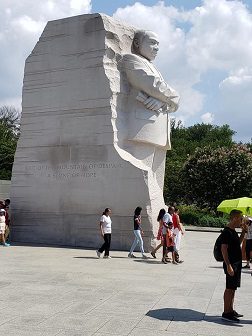
This claim came to my attention a bit over a year ago, as I spent a couple of mornings with fifteen colleagues at a seminar for honors faculty that occurs at the end of every academic year on my campus. One of my colleagues led the second morning’s discussion on Ta-Nehisi Coates’ Between the World and Me, a book that had been on my “must read” list for the past two or three years. Coates’ book is written as an extended letter to his son, providing as much insight and wisdom as Coates can muster concerning the challenges of growing up as a black man in this country.
The book has many virtues, but there is one particular feature of it that I keet thinking about several weeks after our discussion. Coates is an unapologetic atheist, cautioning his son frequently against the temptation to see some sort of divine plan behind the suffering of African-Americans over the centuries in this country. He references, for instance, the notion that the horrors of slavery were a necessary step in the direction of slow but inexorable progress toward rights and freedom.
You must struggle to truly remember this past in all its nuance, error, and humanity. You must resist the common urge toward the comforting narrative of divine law, toward fairy tales that imply some irrepressible justice. The enslaved were not bricks in your road, and their lives were not chapters in your redemptive history. They were people turned to fuel for the American machine . . . It is wrong to claim our present circumstance—no matter how improved—as the redemption for the lives of people who never asked for the posthumous, untouchable glory of dying for their children.
It is tempting and so easy to read history as an unfolding story intended to produce us, the various stories differing radically depending on who the “us” at the center of each story happens to be. Behind the scenes in many of these stories is cosmic and divine intention. But Coates argues that if we stop telling such stories and simply consider what actually has happened and is happening, we have little reason to see progress or to detect a divine plan.
Perhaps struggle is all we have because the god of history is an atheist, and nothing about his world is meant to be. So you must wake up every morning knowing that no promise is unbreakable, least of all the promise of waking up at all. This is not despair. These are the preferences of the universe itself: Verbs over nouns, actions over states, struggle over hope.
Simone Weil, who was no atheist, once wrote that “atheism is a purification.” Coates’ point here is an example of Weil’s observation in action. If we refuse, at least temporarily, to be consoled by comforting stories, we find ourselves in the middle of a reality that shows no preference for any of the things that we claim to love most. Everything can be taken away. Everyone dies. For every apparent step forward there are at least as many equally apparent steps in the other direction. A dose of atheism is something like the ubiquitous bucket challenges of a few years ago—it dumps cold water on all of our preconceptions and unsupported hopes.
Despite the stereotypical attitudes of persons of faith toward atheism, a dose of atheism can be clarifying, even purifying as Weil suggests. A godless world is not a meaningless world—but it is a world in which meaning must be created, not found. Additionally, atheism need not take wonder, beauty, inspiration, or awe out of the equation; indeed, it might open our eyes in a new way to what is right in front of us. Coates writes that
Godless though I am, the fact of being human, the fact of possessing the gift of study, and thus being remarkable among all the matter floating through the cosmos, still awes me.
Perhaps no more than this is needed to establish a foundation for seeking justice, equal rights for all, and equal access to the possible fulfillment of our best hopes and dreams for every individual. The God of history being an atheist does not eliminate the possibility of justice. It does, however, mean that we have no reason to believe that justice will happen because of some divine plan—it is up to us.
Coates is not an aggressive atheist; there are times when it is clear that he wishes he could resonate with the faith that has been so important to the generations that produced him.
I thought of my own distance from an institution that has, so often, been the only support for our people. I often wonder if in that distance I’ve missed something, some notions of cosmic hope, some wisdom beyond my mean physical perception of the world, something beyond the body, that I might have transmitted to you.
I have become convinced over the years that human beings cannot live for long without hope, and find that the strong conviction that there is something more going on than meets the eye is a conviction that not only shapes my life, but is one that I cannot imagine lacking. But this does not make my faith commitment “better” than Coates’ atheism—it simply means that each of us has to find our own ways toward meaning through a reality that very possibly offers little or no meaning to be found. The arc of the moral universe will tend toward justice only if we are committed daily to bending it in that direction.
Previous Post

August 4, 2019
The National Cathedral Speaks Truth to Donald Trump
Next Post

August 8, 2019 We are not better than this, and this is exactly who we are
Browse Our Archives
Select a Category abortion Advent AI Angels Artificial intelligence atheism attention baptism Baptists beauty belief Benedictines Bible bicycling Big Bird books Bovina Camaldoli hermitage Canada Catholicism cats certainty change Christianity Christmas Collegeville Covid-19 creativity Development of Western Civilization dogs doubt Easter Enneagram Epiphany Episcopal ethics Eucharist evil extroverts Facebook faith family fear flowers forgiveness freedom friends God goodness grace happiness heaven hell history Holy Spirit Holy Week hope human nature humility humor idolatry incarnation introverts irreverence Islam Jeanne Jesus Joe Biden joy Judaism justice Kamala Harris knowledge Lent listen literature liturgy love Marsue Memorial Day miracles movies music mystery mythology NPR Old Testament optimism paradox peace Penguins philosophy piano podcast politics power prayer Protestantism Providence College Religion Rhode Island sabbatical sacrament science seeing silence Simone Weil Socrates soul sports St. John's College stories suffering tattoo teaching technology television theology thinking time tolerance transcendence travel trees trust truth Uncategorized Vermont wisdom wonder writing
Select a Month May 2026 April 2026 March 2026 February 2026 January 2026 December 2025 November 2025 October 2025 September 2025 August 2025 July 2025 June 2025 May 2025 April 2025 March 2025 February 2025 January 2025 December 2024 November 2024 October 2024 September 2024 August 2024 July 2024 June 2024 May 2024 April 2024 March 2024 February 2024 January 2024 December 2023 November 2023 October 2023 September 2023 August 2023 July 2023 June 2023 May 2023 April 2023 March 2023 February 2023 January 2023 December 2022 November 2022 October 2022 September 2022 August 2022 July 2022 June 2022 May 2022 April 2022 March 2022 February 2022 January 2022 December 2021 November 2021 October 2021 September 2021 August 2021 July 2021 June 2021 May 2021 April 2021 March 2021 February 2021 January 2021 December 2020 November 2020 October 2020 September 2020 August 2020 July 2020 June 2020 May 2020 April 2020 March 2020 February 2020 January 2020 December 2019 November 2019 October 2019 September 2019 August 2019 July 2019 June 2019 May 2019 April 2019 March 2019 February 2019 January 2019 December 2018 November 2018 October 2018 September 2018 August 2018 July 2018 June 2018 May 2018 April 2018 March 2018 February 2018 January 2018 December 2017 November 2017 October 2017 September 2017 August 2017 July 2017 June 2017 May 2017 April 2017 March 2017 February 2017 January 2017 December 2016 November 2016 October 2016 September 2016 August 2016 July 2016 June 2016 May 2016 April 2016 March 2016 February 2016 January 2016 December 2015 November 2015 October 2015 September 2015 August 2015 July 2015 June 2015 May 2015 April 2015 March 2015 February 2015 January 2015 December 2014 November 2014 October 2014 September 2014 August 2014 July 2014 June 2014 May 2014 April 2014 March 2014 February 2014 January 2014 December 2013 November 2013 October 2013 September 2013 August 2013 July 2013 June 2013 May 2013 April 2013 March 2013 February 2013 January 2013 December 2012 November 2012 October 2012 September 2012
Follow Us!
TAKE THE
Religious Wisdom Quiz
Who was cast into a fiery furnace but was unharmed?
Select your answer to see how you score.
Daniel Shadrach, Meshach, and Abednego Moses, Aaron, and Joshua Elijah and Elisha
Books by This Author Books by Vance G. Morgan
Related posts from Freelance Christianity

The Lonely Pawn: On Faith, Doubt, and Meaning


AI and Love: When a Chatbot Becomes a...

TRENDING AT PATHEOS Progressive Christian

Why Christians Have a Sacred Duty to Vote:...
The Bible offers strong support for the sacred duty to vote. Here...

What Being a Modern-Day Apostle Means to Me
In my last column, I discussed the ins and outs of modern-day...

Did Ancient China Once Worship the God of...
Across human history, a common thread weaves through the origins of the...

Love Your Neighbor – Including Earth-Kin: Lev. 19,...
God’s command to love your neighbor means acting in an ethical and...

Lead a Church Study of “Jesus and Lao...
Guest writer Jack Thomas (The Irreverent Reverend) reflects on leading his church...

Principles for Understanding the Apostolic Ministry Today
Whenever people discover that my formal ministry title is "apostle," as in...
view all Progressive Christian blogs
Ad-Free & Subscriber Log-In Subscription Support
- About Us
- 2026 Calendar
- Videos
- Podcasts
- Library of World Religions
- Faith In Media Tracker
- Advertise With Us
- Write for Us
- Privacy Policy
- Terms of Service
- Do Not Sell My Data
- Contact Us
- Radiant Digital
- Manage Newsletter Subscriptions
- Unsubscribe From Notifications
- Sitemap
Copyright 2008-2026, Patheos. All rights reserved.
Subscription Support Ad-Free & Subscriber Log-In
Follow Patheos