
BuddhistCatholicContemplativeEvangelicalGeneral ChristianHinduJewishLatter-day SaintMuslimNew VisionsProgressive Christian
Beliefs
- Buddhist
- Catholic
- Contemplative
- Evangelical
- General Christian
- Hindu
- Jewish
- Latter-day Saint
- More Voices
- Muslim
- New Visions
- Pagan
- Progressive Christian
Topics
- Religion News
- Food and Religion
- Sports and Religion
- Religious Art
- Religious Music and Entertainment
- Religious Events
- History and Religion
- Style and Religion
- Politics and Religion
- Women in Religion
- Recreation Outdoors and Religion
- Business Finance and Religion
- Careers Workplace and Religion
- Education and Religion
- Family Parenting and Religion
- Health Fitness and Religion
- Home and Religion
- Relationships and Religion
- Technology and Religion
- Travel and Religion
Columnists
- Buddhist Columnists
- Business Finance and Religion Columnists
- Careers Workplace and Religion Columnists
- Catholic Columnists
- Contemplative Columnists
- Education and Religion Columnists
- Evangelists Columnists
- Family Parenting and Religion Columnists
- General Christian Columnists
- Health Fitness and Religion Columnists
- Hindu Columnists
- History and Religion Columnists
- Home and Religion Columnists
- Jewish Columnists
- More Voices Columnists
- Latter Day Columnists
- Muslim Columnists
- New Visions Columnists
- Nonreligious Columnists
- Pagan Columnists
- Politics and Religion Columnists
- Progressive Columnists
- Recreation Outdoors and Religion Columnists
- Relationships and Religion Columnists
- Religion News Columnists
- Religious Art Columnists
- Religious Events Columnists
- Religious Music and Entertainment Columnists
- Sports and Religion Columnists
- Style and Religion Columnists
- Technology and Religion Columnists
- Travel and Religion Columnists
- Women in Religion Columnists
Resource Library
- 2026 Calendar
- Library of World Religions
- The 100 Most Holy Places on Earth
- Patheos Answers
- Podcasts
- Videos
- Faith Leaders Database
- Anglican Episcopalian
- Bahai
- Baptist
- Buddhism
- Christianity
- Confucianism
- Eastern Orthodoxy
- Hinduism
- Holiness and Pentecostal
- ISKCON
- Islam
- Judaism
- Lutheran
- Methodist
- The Church of Jesus Christ of Latter-day Saints
- New Age
- Paganism
- Presbytarian and Reformed
- Protestantism
- Religion Behind the Scenes
- Roman Catholic
- Scientology
- Shia Islam
- Sikhism
- Sufism
- Sunni Islam
- Taoism
- Zen
- See all religions
Research Tools
 Ad-Free & Subscriber Log-In Subscription Support
Ad-Free & Subscriber Log-In Subscription Support
Follow Patheos 

- Trending:
- Forgiveness
- |
- Marriage
- |
- Consciousness
- |
- Death Penalty
- |
- Election
- |
- Halloween

- Home
- Progressive Christian
- An Excuse Not To Think
An Excuse Not To Think
Last updated on: February 17, 2019 at 7:00 am by Vance Morgan
An Excuse Not To Think 2019-02-16T08:56:17-04:00 Vance Morgan
Patheos Explore the world's faith through different perspectives on religion and spirituality! Patheos has the views of the prevalent religions and spiritualities of the world.
I recently read the following observations:
They weren’t such bad fellows. He had mixed with their type all his life: patriotic, conservative, clannish. For them, ______ was like some crude gamekeeper who had mysteriously contrived to take over the running of their family estates: once installed, he had proved an unexpected success, and they had consented to tolerate his occasional bad manners and lapses into violence in return for a quiet life. Now they had discovered they couldn’t get rid of him and they looked as if they were starting to regret it.
No big surprise here—we’ve been hearing a lot about buyer’s and voter’s remorse recently. Later, the author observed another phenomenon that we all have become more and more familiar with. No matter what the person in question said,
People would believe it, because people believed what they wanted to believe—that was ______’s great insight. They no longer had any need to bother themselves with inconvenient truths. He had given them an excuse not to think.
No kidding, I thought. But this was not an article about the Republican Party’s evolving attitudes concerning Donald Trump, nor was the later observation referring to the tendency of Trump’s base to believe everything he says. These passages are from Munich, Robert Harris’ 2017 novel about the ill-fated 1938 Munich Agreement, an agreement between the United Kingdom, France, Italy, and Hitler’s Germany that, according to British Prime Minister Neville Chamberlain established “peace in our time,” only to be shattered in the succeeding days and weeks as Germany invaded Czechoslovakia, then Poland, and World War II began.
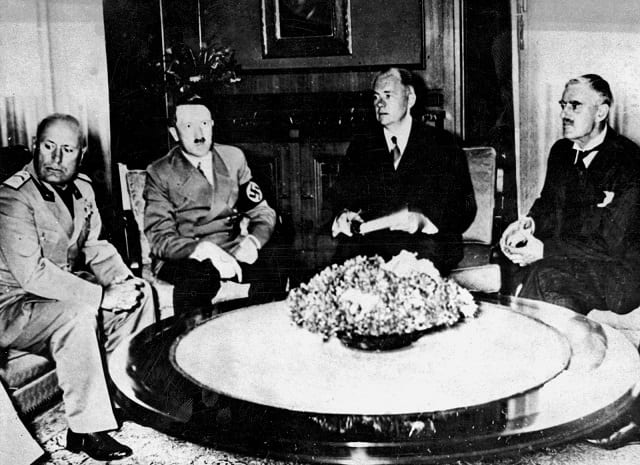
These comments are Paul von Hartmann’s—one of the novel’s two main characters—observations about his fellow German mid-level politicians and bureaucrats, upon whom it is dawning, too late as it turns out, that the crude and boorish guy in charge is not only more dangerous than they thought, but also increasingly impossible to get rid of.
In the second passage a few pages later, von Hartmann is noting, with reluctant admiration, the truth of Joseph Goebbels’ insight that people will believe whatever they want to believe, often in the face of contrary evidence. For many of us, the “truth” is not something we discover on the basis of argumentation and evidence-gathering; rather, the “truth” is something that we establish first for all sorts of reasons, then seek to support by cherry-picking favorable evidence while ignoring everything that might count against our assumptions.
I read Munich over Christmas Break, both because I love historical fiction and because I thought it might be an interesting way to finish preparing for the “Grace, Truth, and Freedom in the Nazi Era” colloquium that I am team-teaching this semester. Now about one month into that course, it is clear from our study of real persons involved with and caught up in the rise of Hitler and the Nazis that Paul von Hartmann, although a fictional character, is disturbingly accurate in his observations of German civil servants, bureaucrats, and politicians, as well of millions of German citizens who either embraced the rise of the Nazis, selectively supported it, or chose to look away for an number of reasons.
But as I often tell my students, studying the events of the past needs to be more than a spectator event. Our work in this colloquium has to be more than a semester-long, in-depth tour of the Nazi wing of “The Worst that Humans Can Be” museum. With no prodding from me, my nineteen- and twenty-year-old students are able to see in short order that if one fill in the blanks above with “Donald Trump” in the first quote and “Andrew Breitbart’s” or “Steve Bannon’s” in the second, the passages become directly relevant to now with no loss of meaning. Many American citizens place a lot of faith in the fact that in this country we have many more safety valves and constitutional layers of safety nets than were in place in 1920s and 1930s Germany. But we are experiencing something now so reminiscent of what happened then that we ignore or turn a blind eye to the glaring similarities at our peril.
To be honest, however, I find Goebbel’s insight about the human tendency to believe whatever we want to believe, then find ways to establish it as “truth,” to be more disturbing than any parallels between Adolf and Donald. Thinking is hard, so much so that each of us frequently seeks for a “get out of thinking free” card in various areas of our lives. This card can be a matter of not questioning authority, laziness, chosen ignorance, or any number of other tactics that each of us can become far too skilled with.
In another colloquium I am team-teaching this semester, “Apocalypse,” we just finished our first unit on apocalyptic thinking infused with religious belief. We began with biblical texts such as “Daniel” and “Revelation,” then studied various apocalyptic groups, “cults” if you will, that took these and similar texts seriously and ran with them in ultimately damaging and destructive ways. Jonestown, the Branch Davidians, Heaven’s Gate—each of these groups began, sometimes ended, with people treating their various interpretations of complicated texts and situations with an energy of unwarranted and unearned certainty.
It often seems that people are most likely to excuse themselves from thinking when the stakes are the highest. Attach yourself to a set of beliefs, treat them as if they are certain and immune to change or revision, and you’re good. For example, over the past several weeks on this blog, my essays have frequently explored the blurry boundaries between truth and opinion, faith and intellect, belief and action—all matters in which most of us would be far more comfortable with sharp and clear dividing lines than with shifting and blurry boundaries.
For the very same essay I have been taken to task by evangelical Christians for not respecting the clear and obvious truths of the faith, while being criticized with similar energy and self-righteousness by atheists who cannot believe that anyone with a brain fails to clearly accept the non-existence of God. I am reminded that it is not the content of what we believe that causes us to stop thinking and treat our beliefs as if they are certain. A person can become rigid in their thinking about anything—it’s far easier to embrace an unwarranted certainty than to commit to the far more difficult task of continual revision and updating of what one believes to be true.
I was reminded this week as I prepared for a class on the work of Simone Weil of something she wrote in a letter to a Jesuit priest friend in an attempt to explain why she, on principle, steadfastly refused to become a baptized member of his religion, just as she on principle refused to sign on the dotted line of any doctrinal statement, religious or secular, faith-based or political
It seemed to me certain, and I still think so today, that one can never wrestle enough with God if one does so out of pure regard for the truth. Christ likes us to prefer truth to him because, before being Christ, he is truth. If one turns aside from him to go toward the truth, one will not go far before falling into his arms.
Weil’s larger point, one that goes beyond simply refusing to accept doctrinal limitations on her search for what is greater than us, is simply this: The truth is bigger and more resilient than we think it is. The truth is larger that whatever straitjackets we seek to impose on it. Don’t be afraid to question everything, even one’s own beliefs that seem most foundational and certain. Because the truth is greater than we are. Don’t be afraid.
Previous Post

February 14, 2019
Grownup Love: A Post for Valentine's Day
Next Post
February 19, 2019 God's Works are as Good as We Make Them
Browse Our Archives
Select a Category abortion Advent AI Angels Artificial intelligence atheism attention baptism Baptists beauty belief Benedictines Bible bicycling Big Bird books Bovina Camaldoli hermitage Canada Catholicism cats certainty change Christianity Christmas Collegeville Covid-19 creativity Development of Western Civilization dogs doubt Easter Enneagram Epiphany Episcopal ethics Eucharist evil extroverts Facebook faith family fear flowers forgiveness freedom friends God goodness grace happiness heaven hell history Holy Spirit Holy Week hope human nature humility humor idolatry incarnation introverts irreverence Islam Jeanne Jesus Joe Biden joy Judaism justice Kamala Harris knowledge Lent listen literature liturgy love Marsue Memorial Day miracles movies music mystery mythology NPR Old Testament optimism paradox peace Penguins philosophy piano podcast politics power prayer Protestantism Providence College Religion Rhode Island sabbatical sacrament science seeing silence Simone Weil Socrates soul sports St. John's College stories suffering tattoo teaching technology television theology thinking time tolerance transcendence travel trees trust truth Uncategorized Vermont wisdom wonder writing
Select a Month May 2026 April 2026 March 2026 February 2026 January 2026 December 2025 November 2025 October 2025 September 2025 August 2025 July 2025 June 2025 May 2025 April 2025 March 2025 February 2025 January 2025 December 2024 November 2024 October 2024 September 2024 August 2024 July 2024 June 2024 May 2024 April 2024 March 2024 February 2024 January 2024 December 2023 November 2023 October 2023 September 2023 August 2023 July 2023 June 2023 May 2023 April 2023 March 2023 February 2023 January 2023 December 2022 November 2022 October 2022 September 2022 August 2022 July 2022 June 2022 May 2022 April 2022 March 2022 February 2022 January 2022 December 2021 November 2021 October 2021 September 2021 August 2021 July 2021 June 2021 May 2021 April 2021 March 2021 February 2021 January 2021 December 2020 November 2020 October 2020 September 2020 August 2020 July 2020 June 2020 May 2020 April 2020 March 2020 February 2020 January 2020 December 2019 November 2019 October 2019 September 2019 August 2019 July 2019 June 2019 May 2019 April 2019 March 2019 February 2019 January 2019 December 2018 November 2018 October 2018 September 2018 August 2018 July 2018 June 2018 May 2018 April 2018 March 2018 February 2018 January 2018 December 2017 November 2017 October 2017 September 2017 August 2017 July 2017 June 2017 May 2017 April 2017 March 2017 February 2017 January 2017 December 2016 November 2016 October 2016 September 2016 August 2016 July 2016 June 2016 May 2016 April 2016 March 2016 February 2016 January 2016 December 2015 November 2015 October 2015 September 2015 August 2015 July 2015 June 2015 May 2015 April 2015 March 2015 February 2015 January 2015 December 2014 November 2014 October 2014 September 2014 August 2014 July 2014 June 2014 May 2014 April 2014 March 2014 February 2014 January 2014 December 2013 November 2013 October 2013 September 2013 August 2013 July 2013 June 2013 May 2013 April 2013 March 2013 February 2013 January 2013 December 2012 November 2012 October 2012 September 2012
Follow Us!
TAKE THE
Religious Wisdom Quiz
Why did God reject Saul as king?
Select your answer to see how you score.
He was tricked by David He lost in battle He was too old He disobeyed God
Books by This Author Books by Vance G. Morgan
Related posts from Freelance Christianity

The Lonely Pawn: On Faith, Doubt, and Meaning


AI and Love: When a Chatbot Becomes a...

TRENDING AT PATHEOS Progressive Christian

What Being a Modern-Day Apostle Means to Me
In my last column, I discussed the ins and outs of modern-day...

Did Ancient China Once Worship the God of...
Across human history, a common thread weaves through the origins of the...

Love Your Neighbor – Including Earth-Kin: Lev. 19,...
God’s command to love your neighbor means acting in an ethical and...

Lead a Church Study of “Jesus and Lao...
Guest writer Jack Thomas (The Irreverent Reverend) reflects on leading his church...

Pastoral Wisdom for Responding to Sermon Pushback
Getting sermon pushback on your social justice sermon? Learn practical, Proverbs-based strategies...

Principles for Understanding the Apostolic Ministry Today
Whenever people discover that my formal ministry title is "apostle," as in...
view all Progressive Christian blogs
Ad-Free & Subscriber Log-In Subscription Support
- About Us
- 2026 Calendar
- Videos
- Podcasts
- Library of World Religions
- Faith In Media Tracker
- Advertise With Us
- Write for Us
- Privacy Policy
- Terms of Service
- Do Not Sell My Data
- Contact Us
- Radiant Digital
- Manage Newsletter Subscriptions
- Unsubscribe From Notifications
- Sitemap
Copyright 2008-2026, Patheos. All rights reserved.
Subscription Support Ad-Free & Subscriber Log-In
Follow Patheos