
BuddhistCatholicContemplativeEvangelicalGeneral ChristianHinduJewishLatter-day SaintMuslimNew VisionsProgressive Christian
Beliefs
- Buddhist
- Catholic
- Contemplative
- Evangelical
- General Christian
- Hindu
- Jewish
- Latter-day Saint
- More Voices
- Muslim
- New Visions
- Pagan
- Progressive Christian
Topics
- Religion News
- Food and Religion
- Sports and Religion
- Religious Art
- Religious Music and Entertainment
- Religious Events
- History and Religion
- Style and Religion
- Politics and Religion
- Women in Religion
- Recreation Outdoors and Religion
- Business Finance and Religion
- Careers Workplace and Religion
- Education and Religion
- Family Parenting and Religion
- Health Fitness and Religion
- Home and Religion
- Relationships and Religion
- Technology and Religion
- Travel and Religion
Columnists
- Buddhist Columnists
- Business Finance and Religion Columnists
- Careers Workplace and Religion Columnists
- Catholic Columnists
- Contemplative Columnists
- Education and Religion Columnists
- Evangelists Columnists
- Family Parenting and Religion Columnists
- General Christian Columnists
- Health Fitness and Religion Columnists
- Hindu Columnists
- History and Religion Columnists
- Home and Religion Columnists
- Jewish Columnists
- More Voices Columnists
- Latter Day Columnists
- Muslim Columnists
- New Visions Columnists
- Nonreligious Columnists
- Pagan Columnists
- Politics and Religion Columnists
- Progressive Columnists
- Recreation Outdoors and Religion Columnists
- Relationships and Religion Columnists
- Religion News Columnists
- Religious Art Columnists
- Religious Events Columnists
- Religious Music and Entertainment Columnists
- Sports and Religion Columnists
- Style and Religion Columnists
- Technology and Religion Columnists
- Travel and Religion Columnists
- Women in Religion Columnists
Resource Library
- 2026 Calendar
- Library of World Religions
- The 100 Most Holy Places on Earth
- Patheos Answers
- Podcasts
- Videos
- Faith Leaders Database
- Anglican Episcopalian
- Bahai
- Baptist
- Buddhism
- Christianity
- Confucianism
- Eastern Orthodoxy
- Hinduism
- Holiness and Pentecostal
- ISKCON
- Islam
- Judaism
- Lutheran
- Methodist
- The Church of Jesus Christ of Latter-day Saints
- New Age
- Paganism
- Presbytarian and Reformed
- Protestantism
- Religion Behind the Scenes
- Roman Catholic
- Scientology
- Shia Islam
- Sikhism
- Sufism
- Sunni Islam
- Taoism
- Zen
- See all religions
Research Tools
 Ad-Free & Subscriber Log-In Subscription Support
Ad-Free & Subscriber Log-In Subscription Support
Follow Patheos 

- Trending:
- Forgiveness
- |
- Marriage
- |
- Consciousness
- |
- Death Penalty
- |
- Election
- |
- Halloween

- Home
- Progressive Christian
- An Ambivalent Faith: Finding Meaning in Uncertainty
An Ambivalent Faith: Finding Meaning in Uncertainty
Last updated on: May 19, 2025 at 1:45 pm by Vance Morgan
An Ambivalent Faith: Finding Meaning in Uncertainty 2025-05-19T13:45:28-04:00 Vance Morgan
Patheos Explore the world's faith through different perspectives on religion and spirituality! Patheos has the views of the prevalent religions and spiritualities of the world.

Fair Use
I tend to have a difficult time falling and/or staying asleep at night when Jeanne is away. She’s been away the past week for work—I’ve found that sometimes playing a podcast on relatively low volume on my phone often puts me to sleep within ten minutes. My phone automatically shifts to an unplayed episode of either the same podcast or one of the other twenty or so podcasts I have bookmarked and listen to semi-regularly. I usually partially wake up at least two or three times in the night. Each time I’ll hear a podcast episode playing other than the one I began the night with. Either too asleep or too lazy to do anything other than fall back to sleep, my phone continues to cycle through podcast episodes without anyone listening.
Tuesday night I fell asleep to the latest episode of “The Moth”; I woke up around 6:00 on Wednesday morning (my usual waking time) in the middle of an episode of “Hidden Brain,” hosted by Shankar Vedantam, that originally aired in 2022. The name of the episode was “Emotions 2.0: The Benefits of Mixed Emotions.” Vedantam’s guest was psychologist Naomi Rothman, a professor at Lehigh University.
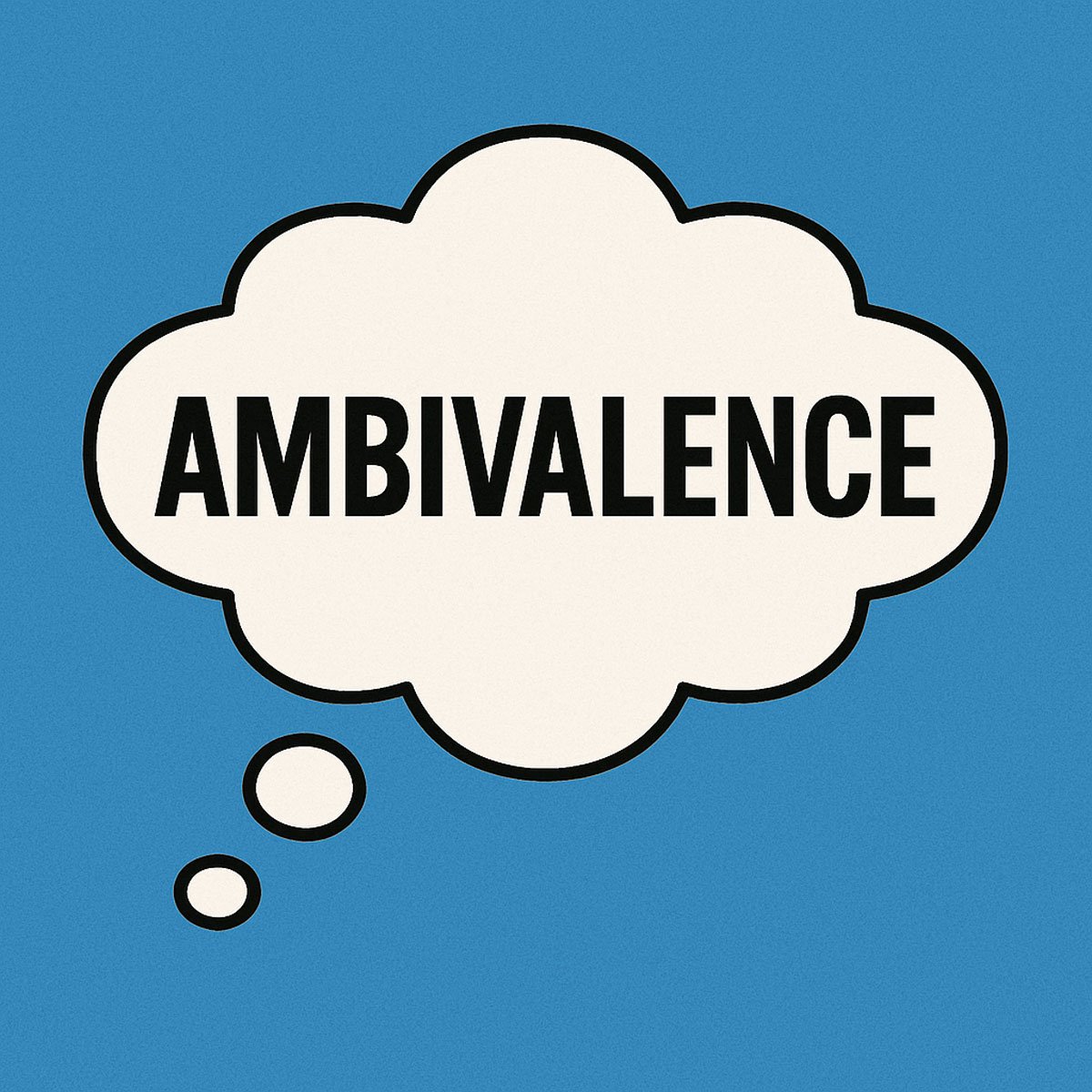
| Image created in Dalle for Patheos.
The conversation was so interesting that I continued listening to the episode as I took Bovina out for her morning walk and as I walked up to school for the workday. The focus of the conversation was the mixed emotion “ambivalence,” the state of having simultaneous and contradictory attitudes or feelings (such as attraction and repulsion) toward something or someone. Toward the end of the episode, the conversation made me think about the uncertainties and doubts that are woven through the life of faith in new ways.
At the outset, it’s important to note that “ambivalent” doesn’t mean “apathetic.” The ambivalent person does care, but is torn between contradictory possibilities, while the apathetic person generally doesn’t give a shit. Still, ambivalence tends to have negative connotations. We live in a culture that demands certainty and tends to see things in terms of black-and-white, even in cases when ambivalence might be more appropriate. No one wants a physician who is definitive and certain about what is wrong with you, but is ambivalent about the proper course of action going forward. A politician who appears ambivalent about an issue or who has changed her mind over the years about it is considered to be weak, indecisive, or a flip-flopper. People are likely to see an ambivalent person as less dominant and confident than a happy person, an angry person, or even someone who is neutral.
For the ambivalent person, the subjective and internal conflict is uncomfortable, a feeling that the person will often seek to get rid of by choosing to act on one side of the conflict or the other, even without sufficient supporting evidence. Naomi Rothman’s research, however, reveals that there is a great deal more to the story of ambivalence than just an emotion that can be both uncomfortable and can be annoying to friends, family, and colleagues.
Research shows that ambivalence frequently arises in the context of circumstances or situations that are unfamiliar or highly complex. Emotions provide us with signals indicating how to respond to the world; ambivalence prompts a person not to make premature judgments or to act quickly just in order to get rid of an uncomfortable state of being. In other words, feeling emotional ambivalence can make a person more cognitively flexible. Vedantam and Rothman discus several ways in which ambivalence can be a valuable asset in leadership, even though we stereotypically look for decisiveness at all costs in both our business and political leaders.
Toward the latter part of the interview, Vendantam turned the conversation away from leadership qualities toward my wheelhouse, asking “What’s the relationship between experiencing ambivalence and being able to derive greater meaning from our existence?” Rothman answers that according to current research,
When you have mixed emotions such as ambivalence, perhaps in the face of contradictory goals, you also are more likely to experience eudaimonic wellbeing, which is a form of wellbeing that is rooted in meaning making.
I wasn’t expecting to hear about the concept of eudaimonia or human flourishing, the centerpiece of Aristotle’s ethical theory, in a contemporary podcast, but it makes sense. Aristotle understood the complexities of human life and resisted the common temptation in moral theory to reduce things to principles and rules. As I tell my students when working with them through Aristotle’s ethic, eudaimonia is not something to achieve. It is something that one lives. And emotions such as ambivalence are appropriate tools for the journey.
The life of faith, of course, is a continuing exercise in meaning making in the midst of issues and commitments that doggedly resist certainty and confidence. Faith traditions and their frameworks are full of paradoxes, conflicting claims that equally demand our commitment. Jesus is fully divine and fully human. A good and loving God created a world full of suffering and despair. Just to name a couple. The tendency is to endorse one side of the contradiction with conviction, then either ignore the other side or morph it into something that fits with what we have committed to.
Rothman, however, suggest something called the “paradox mindset” that is a compelling alternative to forced certainty. This is where you
Consider the world with a both-and approach instead of an either-or approach. It can be really helpful for dealing with competing demands. Although tensions arise when you have these competing demands, the tensions themselves are not the problem. The problem is people’s mindset. If people believe that addressing one demand means neglecting another, then they’re going to struggle. But with a paradoxical mindset, people accept and learn to live with the tensions. They might need the tension to thrive.
I just listened to this podcast this morning, so I’m sure I’ll be making more connections as I ruminate. At this point, it strikes me that cultivating a paradox mindset in one’s faith and embracing the notion of an ambivalent faith is an attractive possibility.
One of my favorite writers on matter of faith and spirit is Anne Lamott; she has made many appearances on this blog as well as in my classes over the years. In her many books she shows a remarkable comfort with paradox in all aspects of life, including faith—her most recent book published last year, Somehow: Thoughts on Love is no exception. She regularly observes how our expectations of what God will do and what actually happens are often not only not in synch, but are actually opposites.
We are the ones we’ve been waiting for. No one is going to come save us from our deepest fears. This is so incredibly disappointing.
I don’t even know what it is I pray to sometimes—let’s say to whatever made the trees and whatever hears my heart. I said to this power, “You think you’re so big? Here, have a go at it.”
Life is such a mystery that you have to wonder if God drinks a little.
If I were in charge of things, I would hand God a magic wand, but I guess the magic wand turns out to be worried old us.
Above everything else, above all of our attempts to tame divine wildness, God is mystery. God is a paradox. An ambivalent faith is probably the most appropriate response.
General Christian
Previous Post

April 29, 2025
Being a Philosopher and a Christian
Next Post
May 4, 2025 Finding Hope on the Road to Emmaus
Recent Comments
"Mary did have a choice. And she was able to make it before the Holy ..."
"i cannot read beyond your recommendations for the books since i like to have a ..."
"AI will never be able to utter with honesty, feeling, or humility, the greeting: "Namaste".It ..."
"They do. I'm sure you could find discussions of the same topic from any of ..."
Browse Our Archives
Select a Category abortion Advent AI Angels Artificial intelligence atheism attention baptism Baptists beauty belief Benedictines Bible bicycling Big Bird books Bovina Camaldoli hermitage Canada Catholicism cats certainty change Christianity Christmas Collegeville Covid-19 creativity Development of Western Civilization dogs doubt Easter Enneagram Epiphany Episcopal ethics Eucharist evil extroverts Facebook faith family fear flowers forgiveness freedom friends God goodness grace happiness heaven hell history Holy Spirit Holy Week hope human nature humility humor idolatry incarnation introverts irreverence Islam Jeanne Jesus Joe Biden joy Judaism justice Kamala Harris knowledge Lent listen literature liturgy love Marsue Memorial Day miracles movies music mystery mythology NPR Old Testament optimism paradox peace Penguins philosophy piano podcast politics power prayer Protestantism Providence College Religion Rhode Island sabbatical sacrament science seeing silence Simone Weil Socrates soul sports St. John's College stories suffering tattoo teaching technology television theology thinking time tolerance transcendence travel trees trust truth Uncategorized Vermont wisdom wonder writing
Select a Month May 2026 April 2026 March 2026 February 2026 January 2026 December 2025 November 2025 October 2025 September 2025 August 2025 July 2025 June 2025 May 2025 April 2025 March 2025 February 2025 January 2025 December 2024 November 2024 October 2024 September 2024 August 2024 July 2024 June 2024 May 2024 April 2024 March 2024 February 2024 January 2024 December 2023 November 2023 October 2023 September 2023 August 2023 July 2023 June 2023 May 2023 April 2023 March 2023 February 2023 January 2023 December 2022 November 2022 October 2022 September 2022 August 2022 July 2022 June 2022 May 2022 April 2022 March 2022 February 2022 January 2022 December 2021 November 2021 October 2021 September 2021 August 2021 July 2021 June 2021 May 2021 April 2021 March 2021 February 2021 January 2021 December 2020 November 2020 October 2020 September 2020 August 2020 July 2020 June 2020 May 2020 April 2020 March 2020 February 2020 January 2020 December 2019 November 2019 October 2019 September 2019 August 2019 July 2019 June 2019 May 2019 April 2019 March 2019 February 2019 January 2019 December 2018 November 2018 October 2018 September 2018 August 2018 July 2018 June 2018 May 2018 April 2018 March 2018 February 2018 January 2018 December 2017 November 2017 October 2017 September 2017 August 2017 July 2017 June 2017 May 2017 April 2017 March 2017 February 2017 January 2017 December 2016 November 2016 October 2016 September 2016 August 2016 July 2016 June 2016 May 2016 April 2016 March 2016 February 2016 January 2016 December 2015 November 2015 October 2015 September 2015 August 2015 July 2015 June 2015 May 2015 April 2015 March 2015 February 2015 January 2015 December 2014 November 2014 October 2014 September 2014 August 2014 July 2014 June 2014 May 2014 April 2014 March 2014 February 2014 January 2014 December 2013 November 2013 October 2013 September 2013 August 2013 July 2013 June 2013 May 2013 April 2013 March 2013 February 2013 January 2013 December 2012 November 2012 October 2012 September 2012
Follow Us!
TAKE THE
Religious Wisdom Quiz
What language was the Old Testament mostly written in?
Select your answer to see how you score.
Aramaic Latin Greek Hebrew
Books by This Author Books by Vance G. Morgan
Related posts from Freelance Christianity

The Lonely Pawn: On Faith, Doubt, and Meaning



AI and Love: When a Chatbot Becomes a...
TRENDING AT PATHEOS Progressive Christian

What Being a Modern-Day Apostle Means to Me
In my last column, I discussed the ins and outs of modern-day...

Did Ancient China Once Worship the God of...
Across human history, a common thread weaves through the origins of the...

Love Your Neighbor – Including Earth-Kin: Lev. 19,...
God’s command to love your neighbor means acting in an ethical and...

Lead a Church Study of “Jesus and Lao...
Guest writer Jack Thomas (The Irreverent Reverend) reflects on leading his church...

Pastoral Wisdom for Responding to Sermon Pushback
Getting sermon pushback on your social justice sermon? Learn practical, Proverbs-based strategies...

Principles for Understanding the Apostolic Ministry Today
Whenever people discover that my formal ministry title is "apostle," as in...
view all Progressive Christian blogs
What Are Your Thoughts?leave a comment
Ad-Free & Subscriber Log-In Subscription Support
- About Us
- 2026 Calendar
- Videos
- Podcasts
- Library of World Religions
- Faith In Media Tracker
- Advertise With Us
- Write for Us
- Privacy Policy
- Terms of Service
- Do Not Sell My Data
- Contact Us
- Radiant Digital
- Manage Newsletter Subscriptions
- Unsubscribe From Notifications
- Sitemap
Copyright 2008-2026, Patheos. All rights reserved.
Subscription Support Ad-Free & Subscriber Log-In
Follow Patheos