
BuddhistCatholicContemplativeEvangelicalGeneral ChristianHinduJewishLatter-day SaintMuslimNew VisionsProgressive Christian
Beliefs
- Buddhist
- Catholic
- Contemplative
- Evangelical
- General Christian
- Hindu
- Jewish
- Latter-day Saint
- More Voices
- Muslim
- New Visions
- Pagan
- Progressive Christian
Topics
- Religion News
- Food and Religion
- Sports and Religion
- Religious Art
- Religious Music and Entertainment
- Religious Events
- History and Religion
- Style and Religion
- Politics and Religion
- Women in Religion
- Recreation Outdoors and Religion
- Business Finance and Religion
- Careers Workplace and Religion
- Education and Religion
- Family Parenting and Religion
- Health Fitness and Religion
- Home and Religion
- Relationships and Religion
- Technology and Religion
- Travel and Religion
Columnists
- Buddhist Columnists
- Business Finance and Religion Columnists
- Careers Workplace and Religion Columnists
- Catholic Columnists
- Contemplative Columnists
- Education and Religion Columnists
- Evangelists Columnists
- Family Parenting and Religion Columnists
- General Christian Columnists
- Health Fitness and Religion Columnists
- Hindu Columnists
- History and Religion Columnists
- Home and Religion Columnists
- Jewish Columnists
- More Voices Columnists
- Latter Day Columnists
- Muslim Columnists
- New Visions Columnists
- Nonreligious Columnists
- Pagan Columnists
- Politics and Religion Columnists
- Progressive Columnists
- Recreation Outdoors and Religion Columnists
- Relationships and Religion Columnists
- Religion News Columnists
- Religious Art Columnists
- Religious Events Columnists
- Religious Music and Entertainment Columnists
- Sports and Religion Columnists
- Style and Religion Columnists
- Technology and Religion Columnists
- Travel and Religion Columnists
- Women in Religion Columnists
Resource Library
- 2026 Calendar
- Library of World Religions
- The 100 Most Holy Places on Earth
- Patheos Answers
- Podcasts
- Videos
- Faith Leaders Database
- Anglican Episcopalian
- Bahai
- Baptist
- Buddhism
- Christianity
- Confucianism
- Eastern Orthodoxy
- Hinduism
- Holiness and Pentecostal
- ISKCON
- Islam
- Judaism
- Lutheran
- Methodist
- The Church of Jesus Christ of Latter-day Saints
- New Age
- Paganism
- Presbytarian and Reformed
- Protestantism
- Religion Behind the Scenes
- Roman Catholic
- Scientology
- Shia Islam
- Sikhism
- Sufism
- Sunni Islam
- Taoism
- Zen
- See all religions
Research Tools
 Ad-Free & Subscriber Log-In Subscription Support
Ad-Free & Subscriber Log-In Subscription Support
Follow Patheos 

- Trending:
- Forgiveness
- |
- Marriage
- |
- Consciousness
- |
- Death Penalty
- |
- Election
- |
- Halloween

- Home
- Progressive Christian
- AI and the Life of Faith
AI and the Life of Faith
Last updated on: May 3, 2026 at 3:32 pm by Vance Morgan
AI and the Life of Faith 2026-05-03T15:32:24-04:00 Vance Morgan
Patheos Explore the world's faith through different perspectives on religion and spirituality! Patheos has the views of the prevalent religions and spiritualities of the world.
The rise of artificial intelligence technology is causing considerable widespread anxiety. What will the impact be on us and our children? Is the social fabric that holds us together beginning to unravel? What makes a human life worth living, and how is this unique, valuable, and distinct from what technology offers us? From “The Delta Framework”
I team-taught two different colloquia this semester, “Apocalypse” and “We Can . . . But Should We?,” both of which intersected with issues related to Artificial Intelligence on a regular basis. During my final seminar with my “We Can . . .” students, the three students tasked with leading the discussion included this AI surprise in one of their PowerPoint slides:
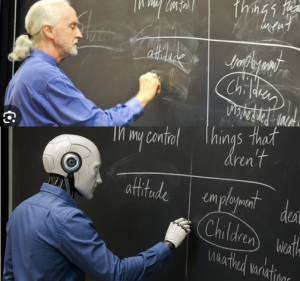
“Wait a minute!” I complained. ‘Where the hell is the ponytail? Why does the robot’s shirt fit better than mine? Why is the robot’s handwriting better than mine? And what does ‘uaathed’ mean??” And, of course, as a Boomer I wanted to know “how did you do that?” Simple–get a picture of me from the Internet (this one’s from a talk I gave thirteen years ago–I’m still that good looking!), plug it into your favorite AI portal, instruct it to “make an AI image of this picture replacing the professor with a robot,” and voila! You have created my AI replacement who undoubtedly knows a lot more about Stoicism (the topic of the talk) than I do.
During the last week of “We Can . . . But Should We?” my teaching partner and I chose to reflect back on the semester through the lens of a specific moral framework. One of the assignments that week was to watch the video of a talk given by Dr. Meghan Sullivan, a philosophy professor at the University of Notre Dame, last September on the topic of “AI, Faith, and Human Flourishing.” It was the keynote address at a Notre Dame conference with the same name which “brought together a dynamic, ecumenical network of scholars, faith leaders, technologists, journalists, and policymakers who believe in the enduring relevance of Christian ethical thought in a world of powerful AI.” The talk begins at around 6:30.
Sullivan begins her talk by inviting us to “contemplate what it would mean for there to be a growth in conscience and ethics that is proportional to the astounding growth in digital technology that we are currently witnessing,” After the first successful test of a nuclear bomb, a commenter referenced the prophet Hosea from the Jewish scriptures: “They have sown the wind, and they shall reap the whirlwind.” In many ways, this same warning applies to artificial intelligence. We have created something incredibly useful and seducitve, while also dangerous and concerning, something that threatens to break free of any possible guardrails or limits we might devise.
The central focus of Sullivan’s talk is to ask how we should imagine ourselves as human beings in a world both saturated with and threatened by artificial intelligence. How do we preserve a sense of human virtue and flourishing going forward in a world in which many fear that what we believe to be most distinctive and important about being human–autonomy, free choice, intelligence, moral awareness–will become more and more irrelevant?
Persons of Christian faith need to ask what it means to live a faithful and viruous life, as well as what it means to serve the common good, in a world that has changed radically in a mere handful of years. What specific and unique contributions might persons of faith make to creating the future world that we are rushing toward? We can’t slow the technology down, so maybe we need to speed up the conversations about how to bring our faith forward.
Over the past two yeas, Sullivan and several colleagues have asked technology and faith leaders, journalists and policy makers, two questions. 1: What unique perspectives do you think the Christian community has to offer to the discussion of AI ethics that is currently unfolding? 2: What would it take to get those voices into the conversation, and what are the prospects for getting Christians to participate in this debate?
What might be the “ethical floor” in creating AI technology, what I call the “moral minimum” in my ethics classes? Interviewees, both secular and persons of faith, agree that this floor includes protecting right to privacy, safety, explainability, responsibility to users in key ways, and so on. But what might a moral framework that rises above the floor, the moral minimum, include? Christians in particular have a lot to contribute here. If the ethical floor is necessary but not sufficient, what are other indispensable parts of a moral framework for AI?
Sullivan’s insights resonate with me as a fellow philosopher who has taught introductory ethics courses at least 100 times over my career. The ethical floor for AI is compliance, obedience to rules that serve human interests in basic ways–something similar to what Immanuel Kant might endorse. On top of that foundation, Sullivan’s research advocates for a virtue ethics model, a ethical vision that includes human flourishing and the common good, features that rise far above mere obedience to rule-based duties. Developing technology, AI in this conversation, should serve these features rather than present obstacles to them in service to efficiency or productivity.
In specific, the framework Sullivan and her colleagues have developed goes by the acronym “DELTA,” described in the following brief video:
‘What makes a human life worth living, and how is this unique, valuable, and distinct from what technology offers us?” Here are five things to consider that will guide the ongoing conversation:
Dignity: Every human is valuable simply because they are human, not because of how smart or productive they are.
Embodiment: We are physical, vulnerable, social creatures. Mortality makes life precious. Virtual reality can never fully capture lived experience.
Love: Loving relationships involve two-way exchanges. AI tools and systems can simulate such relationships, but true flourishing requires real, messy human connection.
Transcendence: There are many beautiful and wonderful things that transcend human capacities, things that inspire awe and wonder. Not everything is reducible to our capacities.
Agency: Human flourishing requires the freedom and ability to make moral choices. We must protect decisions that only a human conscience should make against the tendency of technology to diminish these capacities.
Over my next several posts I will be considering each of the “DELTA” elements specifically, both looking back in the archives and looking forward in my discussion. Stay tuned!
Heads up! Three weeks from today, May 24, big changes will be coming to this blog. New format, new platform, and more! Stay tuned over the next three weeks for more information.
Previous Post

April 30, 2026
Advice that Saint Francis Never Gave
Next Post

May 6, 2026 AI and Human Dignity
Recent Comments
"Mary did have a choice. And she was able to make it before the Holy ..."
"i cannot read beyond your recommendations for the books since i like to have a ..."
"AI will never be able to utter with honesty, feeling, or humility, the greeting: "Namaste".It ..."
"They do. I'm sure you could find discussions of the same topic from any of ..."
Browse Our Archives
Select a Category abortion Advent AI Angels Artificial intelligence atheism attention baptism Baptists beauty belief Benedictines Bible bicycling Big Bird books Bovina Camaldoli hermitage Canada Catholicism cats certainty change Christianity Christmas Collegeville Covid-19 creativity Development of Western Civilization dogs doubt Easter Enneagram Epiphany Episcopal ethics Eucharist evil extroverts Facebook faith family fear flowers forgiveness freedom friends God goodness grace happiness heaven hell history Holy Spirit Holy Week hope human nature humility humor idolatry incarnation introverts irreverence Islam Jeanne Jesus Joe Biden joy Judaism justice Kamala Harris knowledge Lent listen literature liturgy love Marsue Memorial Day miracles movies music mystery mythology NPR Old Testament optimism paradox peace Penguins philosophy piano podcast politics power prayer Protestantism Providence College Religion Rhode Island sabbatical sacrament science seeing silence Simone Weil Socrates soul sports St. John's College stories suffering tattoo teaching technology television theology thinking time tolerance transcendence travel trees trust truth Uncategorized Vermont wisdom wonder writing
Select a Month May 2026 April 2026 March 2026 February 2026 January 2026 December 2025 November 2025 October 2025 September 2025 August 2025 July 2025 June 2025 May 2025 April 2025 March 2025 February 2025 January 2025 December 2024 November 2024 October 2024 September 2024 August 2024 July 2024 June 2024 May 2024 April 2024 March 2024 February 2024 January 2024 December 2023 November 2023 October 2023 September 2023 August 2023 July 2023 June 2023 May 2023 April 2023 March 2023 February 2023 January 2023 December 2022 November 2022 October 2022 September 2022 August 2022 July 2022 June 2022 May 2022 April 2022 March 2022 February 2022 January 2022 December 2021 November 2021 October 2021 September 2021 August 2021 July 2021 June 2021 May 2021 April 2021 March 2021 February 2021 January 2021 December 2020 November 2020 October 2020 September 2020 August 2020 July 2020 June 2020 May 2020 April 2020 March 2020 February 2020 January 2020 December 2019 November 2019 October 2019 September 2019 August 2019 July 2019 June 2019 May 2019 April 2019 March 2019 February 2019 January 2019 December 2018 November 2018 October 2018 September 2018 August 2018 July 2018 June 2018 May 2018 April 2018 March 2018 February 2018 January 2018 December 2017 November 2017 October 2017 September 2017 August 2017 July 2017 June 2017 May 2017 April 2017 March 2017 February 2017 January 2017 December 2016 November 2016 October 2016 September 2016 August 2016 July 2016 June 2016 May 2016 April 2016 March 2016 February 2016 January 2016 December 2015 November 2015 October 2015 September 2015 August 2015 July 2015 June 2015 May 2015 April 2015 March 2015 February 2015 January 2015 December 2014 November 2014 October 2014 September 2014 August 2014 July 2014 June 2014 May 2014 April 2014 March 2014 February 2014 January 2014 December 2013 November 2013 October 2013 September 2013 August 2013 July 2013 June 2013 May 2013 April 2013 March 2013 February 2013 January 2013 December 2012 November 2012 October 2012 September 2012
Follow Us!
TAKE THE
Religious Wisdom Quiz
Who said, "Whom shall I send, and who will go for us?"
Select your answer to see how you score.
God Isaiah Moses Jesus
Books by This Author Books by Vance G. Morgan
Related posts from Freelance Christianity

The Lonely Pawn: On Faith, Doubt, and Meaning


AI and Love: When a Chatbot Becomes a...

TRENDING AT PATHEOS Progressive Christian

What Being a Modern-Day Apostle Means to Me
In my last column, I discussed the ins and outs of modern-day...

Did Ancient China Once Worship the God of...
Across human history, a common thread weaves through the origins of the...

Love Your Neighbor – Including Earth-Kin: Lev. 19,...
God’s command to love your neighbor means acting in an ethical and...

Lead a Church Study of “Jesus and Lao...
Guest writer Jack Thomas (The Irreverent Reverend) reflects on leading his church...

Pastoral Wisdom for Responding to Sermon Pushback
Getting sermon pushback on your social justice sermon? Learn practical, Proverbs-based strategies...

Principles for Understanding the Apostolic Ministry Today
Whenever people discover that my formal ministry title is "apostle," as in...
view all Progressive Christian blogs
What Are Your Thoughts?leave a comment
Ad-Free & Subscriber Log-In Subscription Support
- About Us
- 2026 Calendar
- Videos
- Podcasts
- Library of World Religions
- Faith In Media Tracker
- Advertise With Us
- Write for Us
- Privacy Policy
- Terms of Service
- Do Not Sell My Data
- Contact Us
- Radiant Digital
- Manage Newsletter Subscriptions
- Unsubscribe From Notifications
- Sitemap
Copyright 2008-2026, Patheos. All rights reserved.
Subscription Support Ad-Free & Subscriber Log-In
Follow Patheos