
BuddhistCatholicContemplativeEvangelicalGeneral ChristianHinduJewishLatter-day SaintMuslimNew VisionsProgressive Christian
Beliefs
- Buddhist
- Catholic
- Contemplative
- Evangelical
- General Christian
- Hindu
- Jewish
- Latter-day Saint
- More Voices
- Muslim
- New Visions
- Pagan
- Progressive Christian
Topics
- Religion News
- Food and Religion
- Sports and Religion
- Religious Art
- Religious Music and Entertainment
- Religious Events
- History and Religion
- Style and Religion
- Politics and Religion
- Women in Religion
- Recreation Outdoors and Religion
- Business Finance and Religion
- Careers Workplace and Religion
- Education and Religion
- Family Parenting and Religion
- Health Fitness and Religion
- Home and Religion
- Relationships and Religion
- Technology and Religion
- Travel and Religion
Columnists
- Buddhist Columnists
- Business Finance and Religion Columnists
- Careers Workplace and Religion Columnists
- Catholic Columnists
- Contemplative Columnists
- Education and Religion Columnists
- Evangelists Columnists
- Family Parenting and Religion Columnists
- General Christian Columnists
- Health Fitness and Religion Columnists
- Hindu Columnists
- History and Religion Columnists
- Home and Religion Columnists
- Jewish Columnists
- More Voices Columnists
- Latter Day Columnists
- Muslim Columnists
- New Visions Columnists
- Nonreligious Columnists
- Pagan Columnists
- Politics and Religion Columnists
- Progressive Columnists
- Recreation Outdoors and Religion Columnists
- Relationships and Religion Columnists
- Religion News Columnists
- Religious Art Columnists
- Religious Events Columnists
- Religious Music and Entertainment Columnists
- Sports and Religion Columnists
- Style and Religion Columnists
- Technology and Religion Columnists
- Travel and Religion Columnists
- Women in Religion Columnists
Resource Library
- 2026 Calendar
- Library of World Religions
- The 100 Most Holy Places on Earth
- Patheos Answers
- Podcasts
- Videos
- Faith Leaders Database
- Anglican Episcopalian
- Bahai
- Baptist
- Buddhism
- Christianity
- Confucianism
- Eastern Orthodoxy
- Hinduism
- Holiness and Pentecostal
- ISKCON
- Islam
- Judaism
- Lutheran
- Methodist
- The Church of Jesus Christ of Latter-day Saints
- New Age
- Paganism
- Presbytarian and Reformed
- Protestantism
- Religion Behind the Scenes
- Roman Catholic
- Scientology
- Shia Islam
- Sikhism
- Sufism
- Sunni Islam
- Taoism
- Zen
- See all religions
Research Tools
 Ad-Free & Subscriber Log-In Subscription Support
Ad-Free & Subscriber Log-In Subscription Support
Follow Patheos 

- Trending:
- Forgiveness
- |
- Marriage
- |
- Consciousness
- |
- Death Penalty
- |
- Election
- |
- Halloween

- Home
- Progressive Christian
- A Physical Body Plus Something More
A Physical Body Plus Something More
Last updated on: April 19, 2022 at 6:00 am by Vance Morgan
A Physical Body Plus Something More 2022-04-15T14:17:38-04:00 Vance Morgan
Patheos Explore the world's faith through different perspectives on religion and spirituality! Patheos has the views of the prevalent religions and spiritualities of the world.
The central theme of my ethics class last fall was human dignity. Through short stories, excerpts from novels and plays, and philosophical articles we explored the reasons why we believe that human beings, simply by virtue of being human beings, are morally set apart from everything else. This is a high stakes issue, since our commitment to universal human rights and equal treatment of all human beings, despite our obvious differences, is built on our claim that a human being’s value is intrinsic, rooted in what we are rather than what we do. 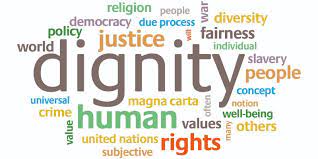 Human dignity is not something we earn, in other words. It is something we possess simply by virtue of what we are.
Most of us have been taught to believe this since our youth, but as I tell my students in every course I teach on the first day of class, a liberally educated person has to earn the right to her or his beliefs and opinions. Early in the semester, I proposed the following definition to my students: A human being is a physical body plus something more. Just about everyone resonated positively with this definition, agreeing that while being a physical thing connects us to everything else that exists, it is the “something more” that makes us special. If there is such a thing as “human dignity,” they thought, it is this “something more” that confers it. But what is this “something more”?
I teach at a Catholic college, so it’s not surprising that the go-to answer among my students was the “soul.” But upon further investigation, it was clear that no one knew what the “soul” is—other than the “something more” that makes all of us different than everything else. A small group exercise focused on generating a definition of “soul”; this exercise produced a range of possibilities, often including characteristics such as “immaterial” and “immortal.” Subsequent discussion indicated that these characteristics were probably reflections of what my students had been taught to believe rather than anything with philosophically coherent content. Try to come up with a explanation of what the oxymoronic phrase “immaterial thing,” a distinct entity with no distinguishing characteristics other than what it is not, even means and you’ll see the problem.
All of the definitions indicated that the “soul” is what is responsible for our abilities to think, emote, dream, choose, create, imagine, love—all of the capacities that we intuitively believe cannot be reduced to the activity of physical stuff, no matter how complicated. In other words, “soul” is a shorthand umbrella term that covers all of the natural human capacities that we consider to be uniquely definitive of what it means to be human rather than something else. This places the discussion on a non-theological level. Are the capabilities that we consider to be definitionally human also exclusively human? If the answer is yes, how do we account for these capabilities?
The final assignment of the semester, a final paper intended to be an opportunity for students to apply the many philosophical tools we had identified and learned to use over the course of the semester, was Nobel prize-winning novelist Kazuo Ishiguro’s 2005 novel Never Let Me Go. Ishiguro’s work, among other things, is an extended exploration of the very questions my students and I had been grappling with all semester. Is there a soul, something, anything that’s beyond the reach of technology—or are we simply a complicated conglomeration of matter that, in time, will be capable of duplication and replication?
Never Let Me Go is set in a dystopian future in which clones are produced for the sole purpose of being organ donors for “normal” human beings. I vividly remember the first time I read this novel years ago. Given Ishiguro’s mastery, it is not clear why we are spending time with these students at what, on the surface, appears to be a typical British boarding school. But there is clearly something different about these students. As it turns out, Hailsham—the school at the center of the narrative—was created for the raising and education of clones who, when they come to adulthood, will donate organs until their demise.
One of the central activities at Hailsham is art classes, which take on an elevated importance when we learn, toward the end of the novel, that the student artwork is used by the teachers and authorities at Hailsham in an attempt to prove to an intentionally uncaring populace that these clones are more “human” than one might want to believe an artificially created source of life-saving and life-extending organ transplants might be. As one of the “guardians” at Hailsham tells one of the clones late in the novel, “we were trying to prove that you were human, that you had souls.” By demonstrating that the clones had artistic abilities and creativity that we expect of young adolescent human beings, the guardians sought to demonstrate that despite their “artificial” origin, the clones were deserving of the respect we reserve for creatures with dignity and intrinsic value.
I just finished Ishiguro’s most recent (2021) novel, Klara and the Sun, a few weeks ago. There is no author who is better at observing human beings from the perspective of someone who is almost, but not exactly, human. This time the perspective is that of an AF, an “Artificial Friend” in another dystopian future that is too-close-for-comfort. I won’t spoil the story—suffice it to say that the narrator is Klara, an AF who is purchased to be the companion for Josie, an early teen with an unidentified serious, perhaps terminal, illness. Lurking behind the scenes is an important but uncomfortable question. Is there anything about a human being that cannot be precisely duplicated by technology? Does each of us have an ineffable “something” that cannot be captured even with the most advanced science?
In a conversation late in the novel, an important character in the story suggests that our insistence that there is something ineffable about human beings is a remnant of an earlier age.
You’re like me. We’re both of us sentimental. We can’t help it. Our generation still carries the old feelings. A part of us refuses to let go. The part that wants to keep believing there’s something unreachable inside each of us. Something that’s unique and won’t transfer. But there’s nothing like that, we know that now. . . . There’s nothing there.
There is plenty to be argued in favor of this perspective. If we are nothing but complicated conglomerations of matter, then in principle everything about us can be duplicated by technology.
But we seem hard wired to resist believing that this could be true. In a subsequent conversation, another character worries that, despite our resistance, it very well might be.
I think I hate [him] because deep down I suspect he may be right. That what he claims is true. That science has now proved beyond doubt there’s nothing so unique about [us], nothing there our modern tools can’t excavate, copy, transfer. That people have been living with one another all this time, centuries, loving and hating each other, and all on a mistaken premise. A kind of superstition we kept going while we didn’t know better.
Later in the conversation, the most important question comes to the fore.
Let me ask you this. Do you believe in the human heart? I don’t mean simply the organ, obviously. I’m speaking in the poetic sense. The human heart. Do you think there is such a thing? Something that makes each of us special and individual? And if we just suppose that there is. Then don’t you think, in order to truly learn [another person], you’d have to learn not just her mannerisms but what’s deeply inside her? Wouldn’t you have to learn her heart?
I appreciate Ishiguro’s use of “heart” rather than “soul” here. It avoids unnecessary religious connotations and baggage. Does each human being carry at her or his core something ineffable and irreducible, something unique that cannot be replicated even by any future technology? Is this ineffable something so important that it overrides all of the differences that divide us? We all know what we want the answer to be. It is incumbent on all of us to act as if we believe the answer to be an undeniable “yes.” That answer, taken seriously, would change everything.
Previous Post

April 17, 2022
I Will Awaken the Dawn: Some Thoughts for Easter
Next Post
April 20, 2022 Curb Your Enthusiasm
Browse Our Archives
Select a Category abortion Advent AI Angels Artificial intelligence atheism attention baptism Baptists beauty belief Benedictines Bible bicycling Big Bird books Bovina Camaldoli hermitage Canada Catholicism cats certainty change Christianity Christmas Collegeville Covid-19 creativity Development of Western Civilization dogs doubt Easter Enneagram Epiphany Episcopal ethics Eucharist evil extroverts Facebook faith family fear flowers forgiveness freedom friends God goodness grace happiness heaven hell history Holy Spirit Holy Week hope human nature humility humor idolatry incarnation introverts irreverence Islam Jeanne Jesus Joe Biden joy Judaism justice Kamala Harris knowledge Lent listen literature liturgy love Marsue Memorial Day miracles movies music mystery mythology NPR Old Testament optimism paradox peace Penguins philosophy piano podcast politics power prayer Protestantism Providence College Religion Rhode Island sabbatical sacrament science seeing silence Simone Weil Socrates soul sports St. John's College stories suffering tattoo teaching technology television theology thinking time tolerance transcendence travel trees trust truth Uncategorized Vermont wisdom wonder writing
Select a Month May 2026 April 2026 March 2026 February 2026 January 2026 December 2025 November 2025 October 2025 September 2025 August 2025 July 2025 June 2025 May 2025 April 2025 March 2025 February 2025 January 2025 December 2024 November 2024 October 2024 September 2024 August 2024 July 2024 June 2024 May 2024 April 2024 March 2024 February 2024 January 2024 December 2023 November 2023 October 2023 September 2023 August 2023 July 2023 June 2023 May 2023 April 2023 March 2023 February 2023 January 2023 December 2022 November 2022 October 2022 September 2022 August 2022 July 2022 June 2022 May 2022 April 2022 March 2022 February 2022 January 2022 December 2021 November 2021 October 2021 September 2021 August 2021 July 2021 June 2021 May 2021 April 2021 March 2021 February 2021 January 2021 December 2020 November 2020 October 2020 September 2020 August 2020 July 2020 June 2020 May 2020 April 2020 March 2020 February 2020 January 2020 December 2019 November 2019 October 2019 September 2019 August 2019 July 2019 June 2019 May 2019 April 2019 March 2019 February 2019 January 2019 December 2018 November 2018 October 2018 September 2018 August 2018 July 2018 June 2018 May 2018 April 2018 March 2018 February 2018 January 2018 December 2017 November 2017 October 2017 September 2017 August 2017 July 2017 June 2017 May 2017 April 2017 March 2017 February 2017 January 2017 December 2016 November 2016 October 2016 September 2016 August 2016 July 2016 June 2016 May 2016 April 2016 March 2016 February 2016 January 2016 December 2015 November 2015 October 2015 September 2015 August 2015 July 2015 June 2015 May 2015 April 2015 March 2015 February 2015 January 2015 December 2014 November 2014 October 2014 September 2014 August 2014 July 2014 June 2014 May 2014 April 2014 March 2014 February 2014 January 2014 December 2013 November 2013 October 2013 September 2013 August 2013 July 2013 June 2013 May 2013 April 2013 March 2013 February 2013 January 2013 December 2012 November 2012 October 2012 September 2012
Follow Us!
TAKE THE
Religious Wisdom Quiz
Who said, "I have been crucified with Christ and I no longer live, but Christ lives in me"?
Select your answer to see how you score.
James John Peter Paul
Books by This Author Books by Vance G. Morgan
Related posts from Freelance Christianity

The Lonely Pawn: On Faith, Doubt, and Meaning


AI and Love: When a Chatbot Becomes a...

TRENDING AT PATHEOS Progressive Christian

Why Christians Have a Sacred Duty to Vote:...
The Bible offers strong support for the sacred duty to vote. Here...

What Being a Modern-Day Apostle Means to Me
In my last column, I discussed the ins and outs of modern-day...

Did Ancient China Once Worship the God of...
Across human history, a common thread weaves through the origins of the...

Love Your Neighbor – Including Earth-Kin: Lev. 19,...
God’s command to love your neighbor means acting in an ethical and...

Lead a Church Study of “Jesus and Lao...
Guest writer Jack Thomas (The Irreverent Reverend) reflects on leading his church...

Principles for Understanding the Apostolic Ministry Today
Whenever people discover that my formal ministry title is "apostle," as in...
view all Progressive Christian blogs
Ad-Free & Subscriber Log-In Subscription Support
- About Us
- 2026 Calendar
- Videos
- Podcasts
- Library of World Religions
- Faith In Media Tracker
- Advertise With Us
- Write for Us
- Privacy Policy
- Terms of Service
- Do Not Sell My Data
- Contact Us
- Radiant Digital
- Manage Newsletter Subscriptions
- Unsubscribe From Notifications
- Sitemap
Copyright 2008-2026, Patheos. All rights reserved.
Subscription Support Ad-Free & Subscriber Log-In
Follow Patheos