
BuddhistCatholicContemplativeEvangelicalGeneral ChristianHinduJewishLatter-day SaintMuslimNew VisionsProgressive Christian
Beliefs
- Buddhist
- Catholic
- Contemplative
- Evangelical
- General Christian
- Hindu
- Jewish
- Latter-day Saint
- More Voices
- Muslim
- New Visions
- Pagan
- Progressive Christian
Topics
- Religion News
- Food and Religion
- Sports and Religion
- Religious Art
- Religious Music and Entertainment
- Religious Events
- History and Religion
- Style and Religion
- Politics and Religion
- Women in Religion
- Recreation Outdoors and Religion
- Business Finance and Religion
- Careers Workplace and Religion
- Education and Religion
- Family Parenting and Religion
- Health Fitness and Religion
- Home and Religion
- Relationships and Religion
- Technology and Religion
- Travel and Religion
Columnists
- Buddhist Columnists
- Business Finance and Religion Columnists
- Careers Workplace and Religion Columnists
- Catholic Columnists
- Contemplative Columnists
- Education and Religion Columnists
- Evangelists Columnists
- Family Parenting and Religion Columnists
- General Christian Columnists
- Health Fitness and Religion Columnists
- Hindu Columnists
- History and Religion Columnists
- Home and Religion Columnists
- Jewish Columnists
- More Voices Columnists
- Latter Day Columnists
- Muslim Columnists
- New Visions Columnists
- Nonreligious Columnists
- Pagan Columnists
- Politics and Religion Columnists
- Progressive Columnists
- Recreation Outdoors and Religion Columnists
- Relationships and Religion Columnists
- Religion News Columnists
- Religious Art Columnists
- Religious Events Columnists
- Religious Music and Entertainment Columnists
- Sports and Religion Columnists
- Style and Religion Columnists
- Technology and Religion Columnists
- Travel and Religion Columnists
- Women in Religion Columnists
Resource Library
- 2026 Calendar
- Library of World Religions
- The 100 Most Holy Places on Earth
- Patheos Answers
- Podcasts
- Videos
- Faith Leaders Database
- Anglican Episcopalian
- Bahai
- Baptist
- Buddhism
- Christianity
- Confucianism
- Eastern Orthodoxy
- Hinduism
- Holiness and Pentecostal
- ISKCON
- Islam
- Judaism
- Lutheran
- Methodist
- The Church of Jesus Christ of Latter-day Saints
- New Age
- Paganism
- Presbytarian and Reformed
- Protestantism
- Religion Behind the Scenes
- Roman Catholic
- Scientology
- Shia Islam
- Sikhism
- Sufism
- Sunni Islam
- Taoism
- Zen
- See all religions
Research Tools
 Ad-Free & Subscriber Log-In Subscription Support
Ad-Free & Subscriber Log-In Subscription Support
Follow Patheos 

- Trending:
- Forgiveness
- |
- Marriage
- |
- Consciousness
- |
- Death Penalty
- |
- Election
- |
- Halloween

- Home
- Progressive Christian
- A Lonely Pawn
A Lonely Pawn
Last updated on: November 2, 2017 at 6:15 am by Vance Morgan
A Lonely Pawn 2017-11-02T06:12:05-04:00 Vance Morgan
Patheos Explore the world's faith through different perspectives on religion and spirituality! Patheos has the views of the prevalent religions and spiritualities of the world.
Have you never felt like one of those pawns forgotten in a corner of the board, with the sounds of battle fading behind them? They try to stand straight but wonder if they still have a king to serve. Arturo Pérez-Reverte
I am a great lover of mysteries. Arturo Pérez-Reverte, an internationally acclaimed Spanish author of mysteries and thrillers notable for their intricate and labyrinthine plots, is a current favorite. He’s good—not at the top of my list of mystery authors with Elizabeth George, Louise Penny, or P. D. James, but no more than one rung lower on the ladder of excellence. I just finished The Flanders Panel, a complicated and multi-layered story with a sixteenth-century painting by a Flemish master at the center. The painting depicts two men playing a game of chess, with an aristocratic woman reading a book by the window in the background—a game within a game within a game, as it turns out. I’m glad I know a little bit about chess, because its intricacies and strategies take center stage as various characters seek to decipher hidden clues in the painting that promise to reveal the story of a murder that inspired the work of art, as well as to shed light on more recent suspicious deaths.
Let me be clear—I am a horrible chess player. I learned the rules of the game and the movements of each piece from my Dad (also a horrible player), but I know nothing about strategy. The chess matches I have participated in over the years have been bloodbaths, similar to the Battle of the Bastards toward the end of the most recent season of “Game of Thrones.” I recall many games where the losing side had only a naked and solitary king left when things finally ended. You don’t need to know anything about chess to realize that when one piece is being chased around sixty-four squares by several hostile enemy pieces, checkmate will soon occur.
I taught my youngest son Justin the basics of chess as my father had taught me—my older son Caleb lacked the patience. Justin took the game far more seriously than I ever have, joining the chess club in high school and practicing at home when he could get me to play. “I’ll play you until you beat me,” I said—and I was true to my word. He beat me for the first time during his freshman or sophomore year, and I never played him again. My willingness to be humiliated is limited.
The Flanders Panel is good, but the Pérez-Reverte quotation at the beginning of this essay is from a different mystery—The Seville Communion. Because it involves ideas and issues that I am perpetually fascinated by, this story is my favorite of the four Pérez-Reverte mysteries I have read so far. The main character in The Seville Communion is Lorenzo Quart, a Jesuit priest sent from the Vatican to Seville charged with sorting out a complicated and tangled situation involving Our Lady of Tears, a historic but crumbling Catholic church built on land for which various constituencies have plans that do not include a church in which only a few dozen people worship per week.
Father Quart considers himself to be a soldier in the Roman Catholic army rather than a priest; he is intelligent, effective, agnostic, and cynical. But he meets his match in Father Priamo Ferro, the aging priest in charge of the church in question. Quart expects Ferro to be an embodiment of everything Quart hates—old-style Catholicism with Latin masses for the benefit of a handful of elderly female parishioners. What he finds instead generates conversations reminiscent of another famous literary conversation set in Seville—Dostoevsky’s Grand Inquisitor tale from The Brothers Karamazov.
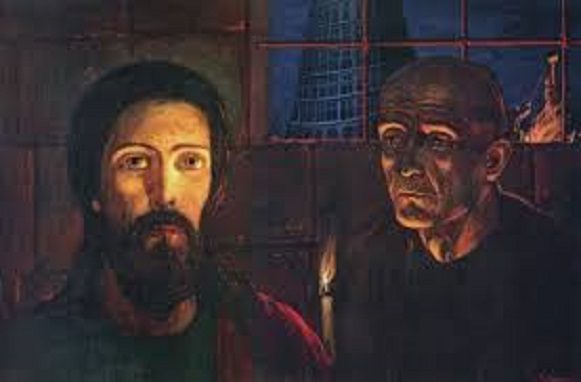
Dostoevsky’s Inquisitor converses with Jesus, who has unexpectedly and inexplicably shown up in sixteenth-century Seville. Their wide-ranging conversation focuses on the impossibility of Jesus’ message of individual freedom, choice, and responsibility—the Inquisitor points out that the Catholic church has spent centuries repackaging Christianity into something that human beings want and can handle. The freedom proclaimed by Jesus is too demanding and makes people unhappy. Human beings prefer security and consolation to an unendurable freedom. All that human beings want is to be saved from the great anxiety and terrible agony they endure at present in making free decisions for themselves. In The Seville Communion, the conversations between Fathers Quart and Ferro focus on precisely why human beings need consolation and security in the first place.
Quart is surprised to find that Ferro, who appears to be an embodiment of traditional, faithful Catholicism, has not believed in the existence of God for some time; Ferro is convinced that not even the Pope believes in God any more. But this doesn’t matter. As Ferro tells Quart, the purpose of faith is
To reassure man confronted with the horror of his own solitude, death, and the void . . . Faith doesn’t even need the existence of God. It’s a blind leap into a pair of welcoming arms. It’s solace in the face of senseless fear and suffering. The child’s trust in the hand that leads out of darkness.
The greatest human fear? That nothing means anything. That life’s a bitch and then we die. As the Grand Inquisitor tells Jesus, the purpose of faith is to convince ourselves, in the face of contrary evidence, that somewhere, somehow, there is a purpose to it all. The church’s role is to facilitate this illusion. As Ferro explains, the challenge is
How to preserve, then, the message of life in a world that bears the seal of death? Man dies, he knows he will die, and also knows that, unlike kings, popes, and generals, he’ll leave no trace. He tells himself there must be something more. Otherwise, the universe is simply a joke in very poor taste; senseless chaos. So faith becomes a kind of hope, a solace.
In the great game of life, most of us are lonely pawns. Pawns are the most plentiful and least powerful pieces on a chessboard. Pawns can move only one square at a time, and only forward. It must often be tempting for a pawn to imagine that there is no point to the game, that other pieces with more options are the only ones that can make a difference, that perhaps the king who the pawn is assigned to defend does not even exist. And yet the pawn endures—until it is taken and removed from the board. No wonder we embrace stories that tell us otherwise, stories intended to convince us that there is something bigger going on in which each of us, often unwittingly and in ignorance, plays a part.
The Grand Inquisitor and Father Ferro have a point—there’s a lot to be said for exchanging the challenge of freedom and responsibility for the security of what Dostoevsky calls “miracle, mystery, and authority.” But to exchange freedom and responsibility for security and comfort, no matter how seductive, is to sacrifice both what makes us human and the heart of true faith. As Simon Critchley, in an essay focusing on the Grand Inquisitor story, writes:
It is the freedom of faith. It is the acceptance—submission to, even—a demand that both places a perhaps intolerable burden on the self, but which also energizes a movement of subjective conversion, to begin again . . . Faith hopes for grace . . . Such an experience of faith is not certainty . . . On this view, doubt is not the enemy of faith. On the contrary, it is certainty. If faith becomes certainty, then we have become seduced by the temptations of miracle, mystery, and authority . . . [Faith] is defined by an essential insecurity, tempered by doubt and defined by a radical experience of freedom.
In the midst of uncertainty and lack of information, each lonely pawn has a continual choice to make. Does my life mean anything? Can I make a difference? When considering these questions, it is worth remembering that even the lowly pawn, once in a while, gets to move one space diagonally and perhaps change the whole landscape of the game. True faith is a leap, but not into the security of collective conformity. Rather, it is a continuing commitment to and embrace of both freedom and responsibility–the choice to pursue that most elusive of goals: the meaning of my life.
Previous Post

October 31, 2017
A Halloween Frame of Mind
Next Post

November 5, 2017 Silence and Submission
Browse Our Archives
Select a Category abortion Advent AI Angels Artificial intelligence atheism attention baptism Baptists beauty belief Benedictines Bible bicycling Big Bird books Bovina Camaldoli hermitage Canada Catholicism cats certainty change Christianity Christmas Collegeville Covid-19 creativity Development of Western Civilization dogs doubt Easter Enneagram Epiphany Episcopal ethics Eucharist evil extroverts Facebook faith family fear flowers forgiveness freedom friends God goodness grace happiness heaven hell history Holy Spirit Holy Week hope human nature humility humor idolatry incarnation introverts irreverence Islam Jeanne Jesus Joe Biden joy Judaism justice Kamala Harris knowledge Lent listen literature liturgy love Marsue Memorial Day miracles movies music mystery mythology NPR Old Testament optimism paradox peace Penguins philosophy piano podcast politics power prayer Protestantism Providence College Religion Rhode Island sabbatical sacrament science seeing silence Simone Weil Socrates soul sports St. John's College stories suffering tattoo teaching technology television theology thinking time tolerance transcendence travel trees trust truth Uncategorized Vermont wisdom wonder writing
Select a Month May 2026 April 2026 March 2026 February 2026 January 2026 December 2025 November 2025 October 2025 September 2025 August 2025 July 2025 June 2025 May 2025 April 2025 March 2025 February 2025 January 2025 December 2024 November 2024 October 2024 September 2024 August 2024 July 2024 June 2024 May 2024 April 2024 March 2024 February 2024 January 2024 December 2023 November 2023 October 2023 September 2023 August 2023 July 2023 June 2023 May 2023 April 2023 March 2023 February 2023 January 2023 December 2022 November 2022 October 2022 September 2022 August 2022 July 2022 June 2022 May 2022 April 2022 March 2022 February 2022 January 2022 December 2021 November 2021 October 2021 September 2021 August 2021 July 2021 June 2021 May 2021 April 2021 March 2021 February 2021 January 2021 December 2020 November 2020 October 2020 September 2020 August 2020 July 2020 June 2020 May 2020 April 2020 March 2020 February 2020 January 2020 December 2019 November 2019 October 2019 September 2019 August 2019 July 2019 June 2019 May 2019 April 2019 March 2019 February 2019 January 2019 December 2018 November 2018 October 2018 September 2018 August 2018 July 2018 June 2018 May 2018 April 2018 March 2018 February 2018 January 2018 December 2017 November 2017 October 2017 September 2017 August 2017 July 2017 June 2017 May 2017 April 2017 March 2017 February 2017 January 2017 December 2016 November 2016 October 2016 September 2016 August 2016 July 2016 June 2016 May 2016 April 2016 March 2016 February 2016 January 2016 December 2015 November 2015 October 2015 September 2015 August 2015 July 2015 June 2015 May 2015 April 2015 March 2015 February 2015 January 2015 December 2014 November 2014 October 2014 September 2014 August 2014 July 2014 June 2014 May 2014 April 2014 March 2014 February 2014 January 2014 December 2013 November 2013 October 2013 September 2013 August 2013 July 2013 June 2013 May 2013 April 2013 March 2013 February 2013 January 2013 December 2012 November 2012 October 2012 September 2012
Follow Us!
TAKE THE
Religious Wisdom Quiz
True or False: Paul wrote to the Philippians while he was imprisoned.
Select your answer to see how you score.
TRUE FALSE
Books by This Author Books by Vance G. Morgan
Related posts from Freelance Christianity

The Lonely Pawn: On Faith, Doubt, and Meaning


AI and Love: When a Chatbot Becomes a...

TRENDING AT PATHEOS Progressive Christian

Why Christians Have a Sacred Duty to Vote:...
The Bible offers strong support for the sacred duty to vote. Here...

What Being a Modern-Day Apostle Means to Me
In my last column, I discussed the ins and outs of modern-day...

Did Ancient China Once Worship the God of...
Across human history, a common thread weaves through the origins of the...

Love Your Neighbor – Including Earth-Kin: Lev. 19,...
God’s command to love your neighbor means acting in an ethical and...

Lead a Church Study of “Jesus and Lao...
Guest writer Jack Thomas (The Irreverent Reverend) reflects on leading his church...

Principles for Understanding the Apostolic Ministry Today
Whenever people discover that my formal ministry title is "apostle," as in...
view all Progressive Christian blogs
Ad-Free & Subscriber Log-In Subscription Support
- About Us
- 2026 Calendar
- Videos
- Podcasts
- Library of World Religions
- Faith In Media Tracker
- Advertise With Us
- Write for Us
- Privacy Policy
- Terms of Service
- Do Not Sell My Data
- Contact Us
- Radiant Digital
- Manage Newsletter Subscriptions
- Unsubscribe From Notifications
- Sitemap
Copyright 2008-2026, Patheos. All rights reserved.
Subscription Support Ad-Free & Subscriber Log-In
Follow Patheos