
BuddhistCatholicContemplativeEvangelicalGeneral ChristianHinduJewishLatter-day SaintMuslimNew VisionsProgressive Christian
Beliefs
- Buddhist
- Catholic
- Contemplative
- Evangelical
- General Christian
- Hindu
- Jewish
- Latter-day Saint
- More Voices
- Muslim
- New Visions
- Pagan
- Progressive Christian
Topics
- Religion News
- Food and Religion
- Sports and Religion
- Religious Art
- Religious Music and Entertainment
- Religious Events
- History and Religion
- Style and Religion
- Politics and Religion
- Women in Religion
- Recreation Outdoors and Religion
- Business Finance and Religion
- Careers Workplace and Religion
- Education and Religion
- Family Parenting and Religion
- Health Fitness and Religion
- Home and Religion
- Relationships and Religion
- Technology and Religion
- Travel and Religion
Columnists
- Buddhist Columnists
- Business Finance and Religion Columnists
- Careers Workplace and Religion Columnists
- Catholic Columnists
- Contemplative Columnists
- Education and Religion Columnists
- Evangelists Columnists
- Family Parenting and Religion Columnists
- General Christian Columnists
- Health Fitness and Religion Columnists
- Hindu Columnists
- History and Religion Columnists
- Home and Religion Columnists
- Jewish Columnists
- More Voices Columnists
- Latter Day Columnists
- Muslim Columnists
- New Visions Columnists
- Nonreligious Columnists
- Pagan Columnists
- Politics and Religion Columnists
- Progressive Columnists
- Recreation Outdoors and Religion Columnists
- Relationships and Religion Columnists
- Religion News Columnists
- Religious Art Columnists
- Religious Events Columnists
- Religious Music and Entertainment Columnists
- Sports and Religion Columnists
- Style and Religion Columnists
- Technology and Religion Columnists
- Travel and Religion Columnists
- Women in Religion Columnists
Resource Library
- 2026 Calendar
- Library of World Religions
- The 100 Most Holy Places on Earth
- Patheos Answers
- Podcasts
- Videos
- Faith Leaders Database
- Anglican Episcopalian
- Bahai
- Baptist
- Buddhism
- Christianity
- Confucianism
- Eastern Orthodoxy
- Hinduism
- Holiness and Pentecostal
- ISKCON
- Islam
- Judaism
- Lutheran
- Methodist
- The Church of Jesus Christ of Latter-day Saints
- New Age
- Paganism
- Presbytarian and Reformed
- Protestantism
- Religion Behind the Scenes
- Roman Catholic
- Scientology
- Shia Islam
- Sikhism
- Sufism
- Sunni Islam
- Taoism
- Zen
- See all religions
Research Tools
 Ad-Free & Subscriber Log-In Subscription Support
Ad-Free & Subscriber Log-In Subscription Support
Follow Patheos 

- Trending:
- Forgiveness
- |
- Marriage
- |
- Consciousness
- |
- Death Penalty
- |
- Election
- |
- Halloween

- Home
- Progressive Christian
- A Hard Saying
A Hard Saying
Last updated on: February 15, 2017 at 8:51 am by Vance Morgan
A Hard Saying 2017-02-15T08:51:31-04:00 Vance Morgan
Patheos Explore the world's faith through different perspectives on religion and spirituality! Patheos has the views of the prevalent religions and spiritualities of the world.
 Yesterday I introduced a bunch of college sophomores to Dietrich Bonhoeffer’s distinction between “Cheap grace” and “Costly grace,” the difference between committing verbally to one’s faith while allowing it to affect one’s life only on the surface level (cheap), and embracing the life-changing and completely disruptive things that will happen if one takes one’s faith seriously (costly). I likened the distinction to the difference between light beer and real beer. Light beer smells like and looks like beer, but upon taking one taste one will say “that isn’t real beer!” Neither is cheap grace the real thing.
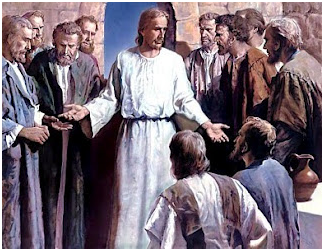 In the Gospel of John, a number of Jesus’ followers complain after one of his teachings that “this is a hard saying; who can understand it?” When Jesus responds with a few more of his patented cryptic remarks, the writer tells us that “from that time many of His disciples went back and walked with Him no more.” These are not just hangers-on or fringe bystanders, looking to be entertained by another miracle. They are disciples, people who have been following Jesus for some time and have been witnesses to and recipients of the vast range of what the man has to offer. And they’ve had enough.
These frustrated former disciples have a point. I have to honestly admit that I might have gone with them. The sermon that causes them to finally fold up shop and go home is indeed a difficult one, wrapping up with the claim that only those who drink Jesus’ blood and eat his flesh will have eternal life.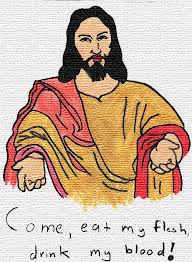 But this is by no means the only “hard saying” that they’ve heard from Jesus. From selling all you have being a prerequisite for following him, and letting your enemy smack both sides of your face while giving him your sweater to go with the coat he stole, to letting the dead bury the dead and hating your father and mother if you want to be his disciple, Jesus is full of “hard sayings.” Small wonder that Christians generally, lacking the guts to simply walk away, tend to water down and systematize the radical elements of the gospel into manageable directives. These reduced commands require behaviors and commitments that, although burdensome at times, can be carried out by any reasonably dedicated and sincere adult. For many of us, “this is a hard saying—who can understand it?” is not really a question of understanding at all. For we understand the hard sayings all too well, and conclude that they are just too much.
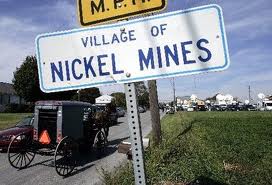 In October of 2006, the news of a shooting in an Amish schoolhouse in Nickel Mines, PA burst onto the nightly news. A neighborhood milkman carrying a small arsenal of weapons walked into the school and started shooting, killing five and wounding many more before turning his gun on himself and committing suicide.
 In the midst of deep grief, the interconnectedness of the Amish community was demonstrated through comprehensive mutual support and, most shockingly, immediate forgiveness. At a prayer service the night after the shootings, the Rev. Dwight Lefever of Living Faith Church of God said that earlier in the day he was in the kitchen of the shooter’s family home when an Amish neighbor came by. “He wrapped his arms around Charlie’s dad for an hour,” Lefever reported. “He said, ‘We will forgive you.’” The pastor’s conclusion: “God met us in that kitchen.”
For the past several years, I have included this tragic event and its aftermath as the central part of the midterm exam in my General Ethics class. I provide my students with a newspaper account of the Amish community’s reaction to the shootings , and then ask them to try to make sense of what happened, particularly of the immediate forgiveness offered to the shooter’s family, within the structures of the moral frameworks we have studied during the first half of the semester. They can’t do it. Furthermore, many of my mostly parochial-school educated students find something twisted, even offensive, in the willingness of the Amish community to forgive the murderer of their children. Comments range from “this is completely abnormal” to “these people are sick.” Over several semesters of this assignment, no student has yet commented favorably on a quote from a member of the Amish community included in the article: “Our faith tells us to act like Christ did on his way to the cross.”
Once shortly after reading the midterms, I was drinking a beer (not a lite one) with a colleague at the local watering hole on Friday afternoon, unwinding from the week. I described the reactions of my students to the behavior of the Amish, reactions that were still fresh in my mind. In response, he said “I also am shocked by what the Amish did, but I don’t know why. As a Christian, I should be shocked that I’m shocked. They are just trying to do what Jesus said to do.”
Perhaps I can excuse my 19-20 year old students for being unable to find a place for radical forgiveness in their moral worldviews, which have been heavily influenced not only by strong family connections but also by a culture of the self and Christianity on the cheap. But what about me, someone significantly older and more experienced than my students? As someone who has grappled with issues of Christian faith from my youth, my own temptation is to think of the Amish as über-Christians, somehow capable of moral heroics that normal persons such as I can only admire from a distance and not even aspire to. That rationale is particularly tempting because I, as many mainstream Christians, have been encouraged to think that it is the priests, pastors, monks, nuns, and missionaries who are the elite corps of Christians, freeing me to reduce expectations considerably.
But there is nothing in the Gospels to justify that easy out. Jesus’ call to take up my cross and follow him does not contain a loophole or room for an amendment. Which brings me back to the beginning—“this is a hard saying.” Christ apparently demands everything of me, which is far more than I can give. I can’t love my neighbor as myself. I can’t love God more than I love Jeanne. I can’t sell all that I have, give the proceeds to the poor, and follow Jesus. It’s too hard, and I’ve grown tired of pretending that a lukewarm, watered-down version is sufficient. Maybe I’m one of those who should “walk with Him no more.”
But that’s not an option for me. I identify with the remaining disciples who asked, “Lord, to whom shall we go? You have the words of eternal life.” So, where does that leave me? I want to follow. I can’t follow.
A still small voice offers a bit of hope. “Of course it’s too hard. Of course you can’t do any of these things. That’s the point. I can, and I am in you.” If divine love has indeed overcome the world, then perhaps it can even overcome me.
Previous Post

February 14, 2017
Valentine's Day for the Mature
Next Post
February 17, 2017 Socratic Faith
Browse Our Archives
Select a Category abortion Advent AI Angels Artificial intelligence atheism attention baptism Baptists beauty belief Benedictines Bible bicycling Big Bird books Bovina Camaldoli hermitage Canada Catholicism cats certainty change Christianity Christmas Collegeville Covid-19 creativity Development of Western Civilization dogs doubt Easter Enneagram Epiphany Episcopal ethics Eucharist evil extroverts Facebook faith family fear flowers forgiveness freedom friends God goodness grace happiness heaven hell history Holy Spirit Holy Week hope human nature humility humor idolatry incarnation introverts irreverence Islam Jeanne Jesus Joe Biden joy Judaism justice Kamala Harris knowledge Lent listen literature liturgy love Marsue Memorial Day miracles movies music mystery mythology NPR Old Testament optimism paradox peace Penguins philosophy piano podcast politics power prayer Protestantism Providence College Religion Rhode Island sabbatical sacrament science seeing silence Simone Weil Socrates soul sports St. John's College stories suffering tattoo teaching technology television theology thinking time tolerance transcendence travel trees trust truth Uncategorized Vermont wisdom wonder writing
Select a Month May 2026 April 2026 March 2026 February 2026 January 2026 December 2025 November 2025 October 2025 September 2025 August 2025 July 2025 June 2025 May 2025 April 2025 March 2025 February 2025 January 2025 December 2024 November 2024 October 2024 September 2024 August 2024 July 2024 June 2024 May 2024 April 2024 March 2024 February 2024 January 2024 December 2023 November 2023 October 2023 September 2023 August 2023 July 2023 June 2023 May 2023 April 2023 March 2023 February 2023 January 2023 December 2022 November 2022 October 2022 September 2022 August 2022 July 2022 June 2022 May 2022 April 2022 March 2022 February 2022 January 2022 December 2021 November 2021 October 2021 September 2021 August 2021 July 2021 June 2021 May 2021 April 2021 March 2021 February 2021 January 2021 December 2020 November 2020 October 2020 September 2020 August 2020 July 2020 June 2020 May 2020 April 2020 March 2020 February 2020 January 2020 December 2019 November 2019 October 2019 September 2019 August 2019 July 2019 June 2019 May 2019 April 2019 March 2019 February 2019 January 2019 December 2018 November 2018 October 2018 September 2018 August 2018 July 2018 June 2018 May 2018 April 2018 March 2018 February 2018 January 2018 December 2017 November 2017 October 2017 September 2017 August 2017 July 2017 June 2017 May 2017 April 2017 March 2017 February 2017 January 2017 December 2016 November 2016 October 2016 September 2016 August 2016 July 2016 June 2016 May 2016 April 2016 March 2016 February 2016 January 2016 December 2015 November 2015 October 2015 September 2015 August 2015 July 2015 June 2015 May 2015 April 2015 March 2015 February 2015 January 2015 December 2014 November 2014 October 2014 September 2014 August 2014 July 2014 June 2014 May 2014 April 2014 March 2014 February 2014 January 2014 December 2013 November 2013 October 2013 September 2013 August 2013 July 2013 June 2013 May 2013 April 2013 March 2013 February 2013 January 2013 December 2012 November 2012 October 2012 September 2012
Follow Us!
TAKE THE
Religious Wisdom Quiz
What does Proverbs say about a soft answer?
Select your answer to see how you score.
It brings wealth It starts a fight It turns away wrath It is useless
Books by This Author Books by Vance G. Morgan
Related posts from Freelance Christianity

The Lonely Pawn: On Faith, Doubt, and Meaning


AI and Love: When a Chatbot Becomes a...

TRENDING AT PATHEOS Progressive Christian

What Being a Modern-Day Apostle Means to Me
In my last column, I discussed the ins and outs of modern-day...

Did Ancient China Once Worship the God of...
Across human history, a common thread weaves through the origins of the...

Love Your Neighbor – Including Earth-Kin: Lev. 19,...
God’s command to love your neighbor means acting in an ethical and...

Lead a Church Study of “Jesus and Lao...
Guest writer Jack Thomas (The Irreverent Reverend) reflects on leading his church...

Pastoral Wisdom for Responding to Sermon Pushback
Getting sermon pushback on your social justice sermon? Learn practical, Proverbs-based strategies...

Principles for Understanding the Apostolic Ministry Today
Whenever people discover that my formal ministry title is "apostle," as in...
view all Progressive Christian blogs
Ad-Free & Subscriber Log-In Subscription Support
- About Us
- 2026 Calendar
- Videos
- Podcasts
- Library of World Religions
- Faith In Media Tracker
- Advertise With Us
- Write for Us
- Privacy Policy
- Terms of Service
- Do Not Sell My Data
- Contact Us
- Radiant Digital
- Manage Newsletter Subscriptions
- Unsubscribe From Notifications
- Sitemap
Copyright 2008-2026, Patheos. All rights reserved.
Subscription Support Ad-Free & Subscriber Log-In
Follow Patheos