
BuddhistCatholicContemplativeEvangelicalGeneral ChristianHinduJewishLatter-day SaintMuslimNew VisionsProgressive Christian
Beliefs
- Buddhist
- Catholic
- Contemplative
- Evangelical
- General Christian
- Hindu
- Jewish
- Latter-day Saint
- More Voices
- Muslim
- New Visions
- Pagan
- Progressive Christian
Topics
- Religion News
- Food and Religion
- Sports and Religion
- Religious Art
- Religious Music and Entertainment
- Religious Events
- History and Religion
- Style and Religion
- Politics and Religion
- Women in Religion
- Recreation Outdoors and Religion
- Business Finance and Religion
- Careers Workplace and Religion
- Education and Religion
- Family Parenting and Religion
- Health Fitness and Religion
- Home and Religion
- Relationships and Religion
- Technology and Religion
- Travel and Religion
Columnists
- Buddhist Columnists
- Business Finance and Religion Columnists
- Careers Workplace and Religion Columnists
- Catholic Columnists
- Contemplative Columnists
- Education and Religion Columnists
- Evangelists Columnists
- Family Parenting and Religion Columnists
- General Christian Columnists
- Health Fitness and Religion Columnists
- Hindu Columnists
- History and Religion Columnists
- Home and Religion Columnists
- Jewish Columnists
- More Voices Columnists
- Latter Day Columnists
- Muslim Columnists
- New Visions Columnists
- Nonreligious Columnists
- Pagan Columnists
- Politics and Religion Columnists
- Progressive Columnists
- Recreation Outdoors and Religion Columnists
- Relationships and Religion Columnists
- Religion News Columnists
- Religious Art Columnists
- Religious Events Columnists
- Religious Music and Entertainment Columnists
- Sports and Religion Columnists
- Style and Religion Columnists
- Technology and Religion Columnists
- Travel and Religion Columnists
- Women in Religion Columnists
Resource Library
- 2026 Calendar
- Library of World Religions
- The 100 Most Holy Places on Earth
- Patheos Answers
- Podcasts
- Videos
- Faith Leaders Database
- Anglican Episcopalian
- Bahai
- Baptist
- Buddhism
- Christianity
- Confucianism
- Eastern Orthodoxy
- Hinduism
- Holiness and Pentecostal
- ISKCON
- Islam
- Judaism
- Lutheran
- Methodist
- The Church of Jesus Christ of Latter-day Saints
- New Age
- Paganism
- Presbytarian and Reformed
- Protestantism
- Religion Behind the Scenes
- Roman Catholic
- Scientology
- Shia Islam
- Sikhism
- Sufism
- Sunni Islam
- Taoism
- Zen
- See all religions
Research Tools
 Ad-Free & Subscriber Log-In Subscription Support
Ad-Free & Subscriber Log-In Subscription Support
Follow Patheos 

- Trending:
- Forgiveness
- |
- Marriage
- |
- Consciousness
- |
- Death Penalty
- |
- Election
- |
- Halloween

- Home
- Progressive Christian
- Hope in Exile
Hope in Exile
Last updated on: December 30, 2017 at 9:30 am by Vance Morgan
Hope in Exile 2017-12-30T09:30:18-04:00 Vance Morgan
Patheos Explore the world's faith through different perspectives on religion and spirituality! Patheos has the views of the prevalent religions and spiritualities of the world.
As is the case with any profession, the life of an academic includes some great and some not-so-great features. After twenty-five years of being a college professor, here’s a brief list:
Great:
• Sabbatical
• Being in the classroom
• Team-teaching with colleagues
• Planning courses
• Writing
• Beer with fellow teachers on Friday afternoons
Not So Much:
• Grading
• Being in a dysfunctional department
• Trying to get what you have written published
• Technology in the classroom
And academic conferences. Especially academic conferences
I have written in the past about my dislike of academic conferences. Conference papers are the bread-and-butter of the academic life when climbing the tenure and promotion ladder, but I’ve never been a fan. A lot of posturing, name-dropping, networking and having papers read at you. Not to mention overheated and ugly seminar rooms along with stale pastries and lukewarm coffee. I do not learn much just by listening to someone—I’m more a visual and tactile learner—but traditionally that’s been the way things go at conferences.  Of course I usually forget that when I present a paper, I’m expecting my audience to appreciate mine far more than I enjoy theirs.
Fortunately I have not had to work the academic conference circuit vigorously since I earned promotion to full professor almost fifteen years ago. There is, however, one group of academics that I enjoy gathering with annually for a conference—the American Weil Society. If you read this blog regularly or even occasionally, you know that Simone Weil shows up on a semi-regular basis. I’ve had an intellectual affair with this strange woman from the first half of the twentieth century for at over fifteen years now (Jeanne calls Simone my mistress), a connection that has produced a book, several articles, and a paper at the Weil colloquy almost every year.
I have attended the annual Weil Society colloquy just about every year for the past couple of decades; we have hosted the Weil colloquy twice in the past ten years here at Providence College. There are a solid two dozen or so Weil scholars from North America who attend just about every colloquy. The theme of this year’s colloquy is  “Hope in Exile,” an evocative topic that prompted me to send in a brief proposal. The proposal was accepted, so now I have to write the paper. That’s one of the great things about a blog—it provides me with an opportunity to run my thoughts past intelligent people before I am responsible for them in person.
As I searched my notes and Simone Weil texts the other day for “hope” references, I was surprised to find that she doesn’t explicitly discuss the topic very often. And yet, the theme of how to avoid despair in the middle of a world that seems determined to drive us toward it on a daily basis is a thread that winds through most of her writing. In her final work, 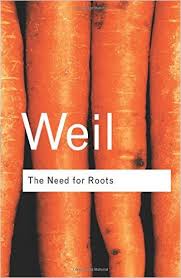 The Need for Roots, Weil considers why despair is not a necessity.
If pure good were never capable of producing on this earth true greatness in art, science, theoretical speculation, public enterprise, if in all these spheres there were only false greatness, if in all these spheres everything were despicable, and consequently condemnable, there would be no hope at all for the affairs of this world; no possible illumination of this world by the other one. But it is not so. (Emphasis mine)
This reminded me of something I just read the other day from Marilynne Robinson:
Cultural pessimism is always fashionable, and, since we are human, there are always grounds for it. It has the negative consequence of depressing the level of aspiration, the sense of the possible. And from time to time it has the extremely negative consequence of encouraging a kind of somber panic, a collective dream-state in which recourse to terrible remedies is inspired by delusions of mortal threat.
One encounters this sort of “somber panic” and such proposed “terrible remedies” everywhere one turns these days. When everything is pushing intelligent people toward cynicism and/or despair, what reasons are there, if any, to cultivate hope? The cynic is likely to agree with Violet, dowager countess of  Downton Abbey, who says that “hope is a tease to keep us from accepting reality.” The hopeful person might counter with something like what I heard Maria Popova say on NPR’s “On Point” the other day: “Cynicism is the sewage of the soul.” My guess is that the truth lies somewhere between these extremes.
Simone Weil’s insight is a good place to start. If it is actually the case that human beings are incapable of producing anything of value, if it is true that even the best of human endeavors are polluted by falsity and worthy of condemnation, then cynicism or despair are the reasonable order of the day. There is no reason other than naïveté to hope for anything other than a continuation of mediocrity, violence, and death until we finally manage to snuff ourselves out. But after setting the stage for such despair, Weil opens the window a crack with just one sentence: But it is not so.  Marilynne Robinson concludes her comments on the attractiveness of cultural pessimism with a similar sentiment.
When panic on one side is creating alarm on the other, it is easy to forget that there are always as good grounds for optimism as for pessimism—exactly the same grounds, in fact—that is, because we are human . . . To value one another is our greatest safety, and to indulge in fear and contempt is our gravest error.
The stakes could not possibly be higher. As I begin working on this with the upcoming conference in mind, I start with the premise that what really needs to be sorted out is the relationship between critical thinking and hope, since critical thinking without hope is cynicism, but hope without critical thinking is naïveté. Our contemporary challenge is to find a place between the  Scylla of cynicism and the Charybdis of naïveté, seeking to build a life in that space because finding fault and feeling hopeless about improving our situation produces resignation of which cynicism is a symptom as well as a futile self-protection mechanism. And perhaps it is worth taking note of Simone Weil’s suggestion that the illumination of this world by “the other one” might be a reason to hope. What is that other world? How might a passageway for mutual illumination be opened? Stay tuned—I welcome your ideas and contributions!
Previous Post

January 29, 2016
We Are More Than We Are
Next Post
February 3, 2016 The Wisdom of Mister Carson
Browse Our Archives
Select a Category abortion Advent AI Angels Artificial intelligence atheism attention baptism Baptists beauty belief Benedictines Bible bicycling Big Bird books Bovina Camaldoli hermitage Canada Catholicism cats certainty change Christianity Christmas Collegeville Covid-19 creativity Development of Western Civilization dogs doubt Easter Enneagram Epiphany Episcopal ethics Eucharist evil extroverts Facebook faith family fear flowers forgiveness freedom friends God goodness grace happiness heaven hell history Holy Spirit Holy Week hope human nature humility humor idolatry incarnation introverts irreverence Islam Jeanne Jesus Joe Biden joy Judaism justice Kamala Harris knowledge Lent listen literature liturgy love Marsue Memorial Day miracles movies music mystery mythology NPR Old Testament optimism paradox peace Penguins philosophy piano podcast politics power prayer Protestantism Providence College Religion Rhode Island sabbatical sacrament science seeing silence Simone Weil Socrates soul sports St. John's College stories suffering tattoo teaching technology television theology thinking time tolerance transcendence travel trees trust truth Uncategorized Vermont wisdom wonder writing
Select a Month May 2026 April 2026 March 2026 February 2026 January 2026 December 2025 November 2025 October 2025 September 2025 August 2025 July 2025 June 2025 May 2025 April 2025 March 2025 February 2025 January 2025 December 2024 November 2024 October 2024 September 2024 August 2024 July 2024 June 2024 May 2024 April 2024 March 2024 February 2024 January 2024 December 2023 November 2023 October 2023 September 2023 August 2023 July 2023 June 2023 May 2023 April 2023 March 2023 February 2023 January 2023 December 2022 November 2022 October 2022 September 2022 August 2022 July 2022 June 2022 May 2022 April 2022 March 2022 February 2022 January 2022 December 2021 November 2021 October 2021 September 2021 August 2021 July 2021 June 2021 May 2021 April 2021 March 2021 February 2021 January 2021 December 2020 November 2020 October 2020 September 2020 August 2020 July 2020 June 2020 May 2020 April 2020 March 2020 February 2020 January 2020 December 2019 November 2019 October 2019 September 2019 August 2019 July 2019 June 2019 May 2019 April 2019 March 2019 February 2019 January 2019 December 2018 November 2018 October 2018 September 2018 August 2018 July 2018 June 2018 May 2018 April 2018 March 2018 February 2018 January 2018 December 2017 November 2017 October 2017 September 2017 August 2017 July 2017 June 2017 May 2017 April 2017 March 2017 February 2017 January 2017 December 2016 November 2016 October 2016 September 2016 August 2016 July 2016 June 2016 May 2016 April 2016 March 2016 February 2016 January 2016 December 2015 November 2015 October 2015 September 2015 August 2015 July 2015 June 2015 May 2015 April 2015 March 2015 February 2015 January 2015 December 2014 November 2014 October 2014 September 2014 August 2014 July 2014 June 2014 May 2014 April 2014 March 2014 February 2014 January 2014 December 2013 November 2013 October 2013 September 2013 August 2013 July 2013 June 2013 May 2013 April 2013 March 2013 February 2013 January 2013 December 2012 November 2012 October 2012 September 2012
Follow Us!
TAKE THE
Religious Wisdom Quiz
What does James say about friendship with the world?
Select your answer to see how you score.
It is foolishness It creates emnity with God It pulls you from God It is dangerous
Books by This Author Books by Vance G. Morgan
Related posts from Freelance Christianity

The Lonely Pawn: On Faith, Doubt, and Meaning


AI and Love: When a Chatbot Becomes a...

TRENDING AT PATHEOS Progressive Christian

Why Christians Have a Sacred Duty to Vote:...
The Bible offers strong support for the sacred duty to vote. Here...

What Being a Modern-Day Apostle Means to Me
In my last column, I discussed the ins and outs of modern-day...

Did Ancient China Once Worship the God of...
Across human history, a common thread weaves through the origins of the...

Love Your Neighbor – Including Earth-Kin: Lev. 19,...
God’s command to love your neighbor means acting in an ethical and...

Lead a Church Study of “Jesus and Lao...
Guest writer Jack Thomas (The Irreverent Reverend) reflects on leading his church...

Principles for Understanding the Apostolic Ministry Today
Whenever people discover that my formal ministry title is "apostle," as in...
view all Progressive Christian blogs
Ad-Free & Subscriber Log-In Subscription Support
- About Us
- 2026 Calendar
- Videos
- Podcasts
- Library of World Religions
- Faith In Media Tracker
- Advertise With Us
- Write for Us
- Privacy Policy
- Terms of Service
- Do Not Sell My Data
- Contact Us
- Radiant Digital
- Manage Newsletter Subscriptions
- Unsubscribe From Notifications
- Sitemap
Copyright 2008-2026, Patheos. All rights reserved.
Subscription Support Ad-Free & Subscriber Log-In
Follow Patheos