
BuddhistCatholicContemplativeEvangelicalGeneral ChristianHinduJewishLatter-day SaintMuslimNew VisionsProgressive Christian
Beliefs
- Buddhist
- Catholic
- Contemplative
- Evangelical
- General Christian
- Hindu
- Jewish
- Latter-day Saint
- More Voices
- Muslim
- New Visions
- Pagan
- Progressive Christian
Topics
- Religion News
- Food and Religion
- Sports and Religion
- Religious Art
- Religious Music and Entertainment
- Religious Events
- History and Religion
- Style and Religion
- Politics and Religion
- Women in Religion
- Recreation Outdoors and Religion
- Business Finance and Religion
- Careers Workplace and Religion
- Education and Religion
- Family Parenting and Religion
- Health Fitness and Religion
- Home and Religion
- Relationships and Religion
- Technology and Religion
- Travel and Religion
Columnists
- Buddhist Columnists
- Business Finance and Religion Columnists
- Careers Workplace and Religion Columnists
- Catholic Columnists
- Contemplative Columnists
- Education and Religion Columnists
- Evangelists Columnists
- Family Parenting and Religion Columnists
- General Christian Columnists
- Health Fitness and Religion Columnists
- Hindu Columnists
- History and Religion Columnists
- Home and Religion Columnists
- Jewish Columnists
- More Voices Columnists
- Latter Day Columnists
- Muslim Columnists
- New Visions Columnists
- Nonreligious Columnists
- Pagan Columnists
- Politics and Religion Columnists
- Progressive Columnists
- Recreation Outdoors and Religion Columnists
- Relationships and Religion Columnists
- Religion News Columnists
- Religious Art Columnists
- Religious Events Columnists
- Religious Music and Entertainment Columnists
- Sports and Religion Columnists
- Style and Religion Columnists
- Technology and Religion Columnists
- Travel and Religion Columnists
- Women in Religion Columnists
Resource Library
- 2026 Calendar
- Library of World Religions
- The 100 Most Holy Places on Earth
- Patheos Answers
- Podcasts
- Videos
- Faith Leaders Database
- Anglican Episcopalian
- Bahai
- Baptist
- Buddhism
- Christianity
- Confucianism
- Eastern Orthodoxy
- Hinduism
- Holiness and Pentecostal
- ISKCON
- Islam
- Judaism
- Lutheran
- Methodist
- The Church of Jesus Christ of Latter-day Saints
- New Age
- Paganism
- Presbytarian and Reformed
- Protestantism
- Religion Behind the Scenes
- Roman Catholic
- Scientology
- Shia Islam
- Sikhism
- Sufism
- Sunni Islam
- Taoism
- Zen
- See all religions
Research Tools
 Ad-Free & Subscriber Log-In Subscription Support
Follow Patheos 

- Trending:
- Advent
- |
- Forgiveness
- |
- Thanksgiving
- |
- Election
- |
- Seasonal Holidays
- |
- Marriage

- Home
- Hindu
- Education and Religion
- Avadhānam: The Art of Concentration and Intellectual Mastery
Avadhānam: The Art of Concentration and Intellectual Mastery
Last updated on: August 25, 2026 at 2:28 pm by Udit Shah
Avadhānam: The Art of Concentration and Intellectual Mastery 2026-08-25T14:28:35-05:00 Udit Shah
Patheos Explore the world's faith through different perspectives on religion and spirituality! Patheos has the views of the prevalent religions and spiritualities of the world.
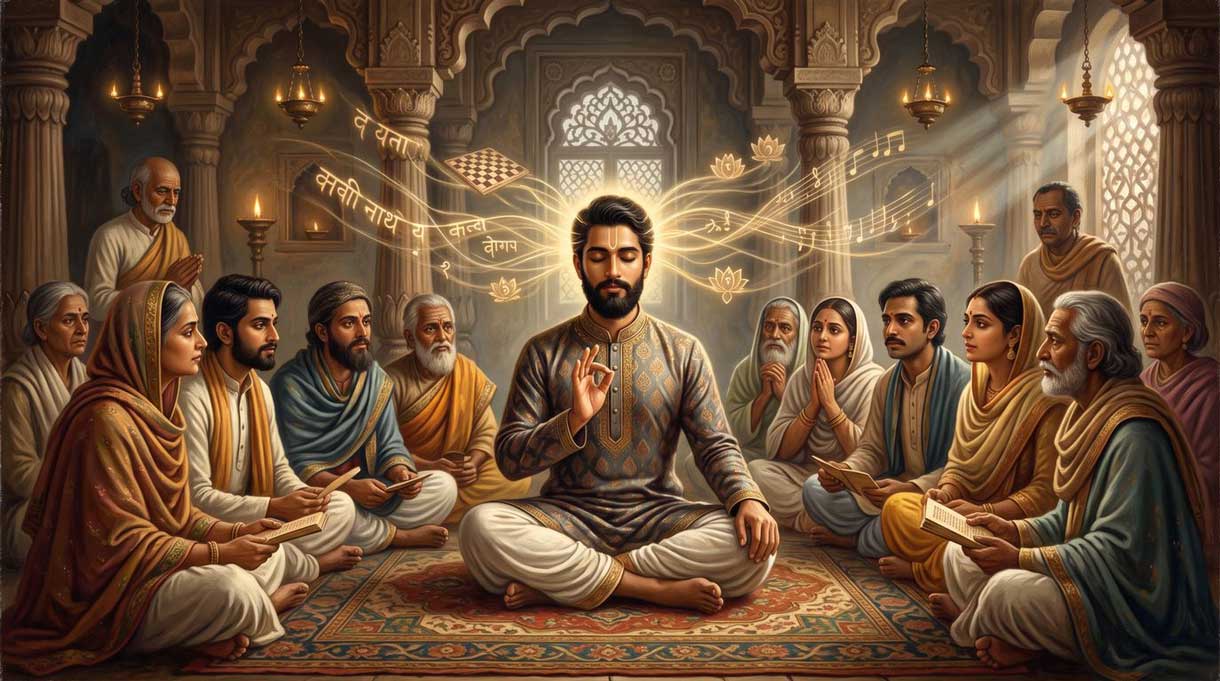
Avadhānam is a sophisticated literary and intellectual performance requiring extraordinary powers of attention, memory, retrieval, improvisation, linguistic mastery, reasoning, and creativity. | Image via Synaptic Image / For Patheos.
What is Avadhānam?
In the summer of 2015, during a three-day Sanskrit camp organized by Samskrit Bharati in Michigan, I attended a guest lecture by Dr. R. Ganesh, a distinguished scholar visiting the United States from India. He was introduced as a scholar conversant with eighteen languages, including Greek and Latin, and, intriguingly, as a Śatāvadhāni. It was the first time I had encountered the term.
Soon thereafter, I watched a video of a young Jain muni (monk) performing Sahasrāvadhāna. What I initially regarded with astonishment gradually led me into a deeper exploration of one of India’s most remarkable and little-known intellectual traditions. Avadhānam is an ancient Indian art of simultaneous literary and intellectual multitasking, in which a performer responds to multiple challenges at once while maintaining flawless recall of several tasks from different knowledge streams in the same sequence of being asked
- Ganesh and Shashi Kiran B. N., in The Art and Science of Avadhānam in Sanskrit (p. 1), describe avadhānam through such meanings as attention, attentiveness, intentness, carefulness, devotion, concentration, and composure: [1]
Avadhānam is a sophisticated literary and intellectual performance requiring extraordinary powers of attention, memory, retrieval, improvisation, linguistic mastery, reasoning, and creativity. The performer, called avadhāni, must maintain several independent streams of intellectual activity, repeatedly shifting among them while preserving the constraints, context, and unfinished structure of each. Challenges may involve spontaneous poetry, prosody, literary interpretation, numerical tracking, riddles, memory, wit, and deliberate distractions. No external memory aid is normally used during the performance. [1][3]
Those who pose the challenges are pṛcchakas (questioners). A pṛcchaka may prescribe a theme, meter, words, letters to be avoided, or other constraints, and the avadhāni must respond while retaining the unfinished demands of the other pṛcchakas. [1][2]
Types and Core Components
Avadhāna performances are commonly distinguished by scale. An Aṣṭāvadhāna involves eight principal challenges or streams of attention; a Śatāvadhāna expands the format dramatically involving one hundred challenges; still larger performances are known as Sahasrāvadhāna where Avadhani faces one thousand challenges and, in exceptional cases, five thousand of them are faced by the Pañca-sahasrāvadhāna. [1][2][3]
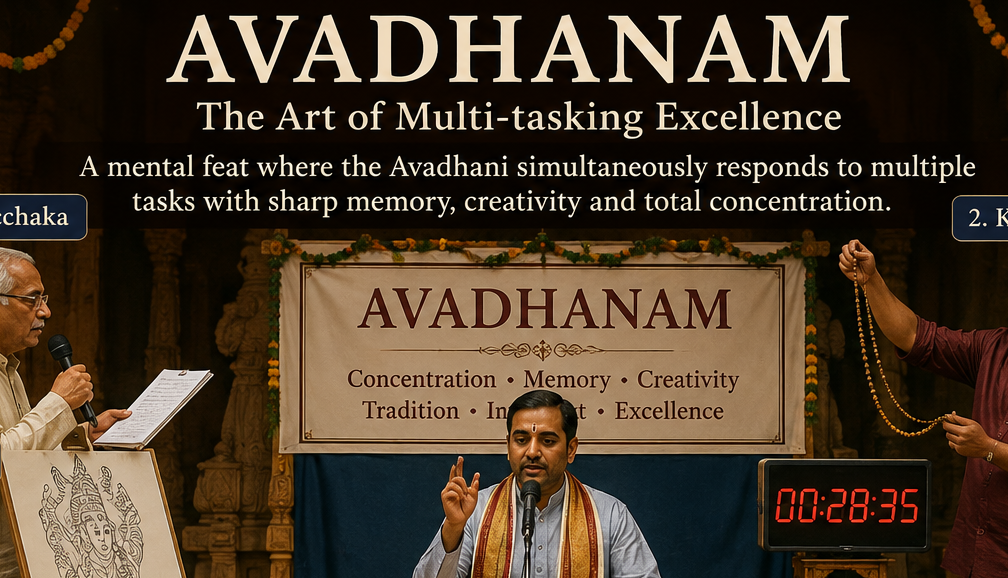 Eight Core Components of Aṣṭāvadhāna
- Niṣiddhākṣarī (Forbidden Letter): compose while avoiding specified letters.
- Samasyā-pūraṇa (Problem Completion): complete a puzzling line so the full verse becomes meaningful.
- Dattapadī (Given Words): incorporate prescribed words into a metrical composition.
- Āśukavitva (Extempore Poetry): spontaneously compose under thematic or metrical constraints.
- Kāvyavācana (Poetry Recitation/Reference): identify, interpret, or engage with a classical verse.
- Ghaṇṭā-gaṇana / Numerical Tracking: count irregular distractions while continuing other tasks.
- Aprastutaprasaṅga (Irrelevant Conversation): respond wittily to deliberate distraction without losing other threads.
- Vastu-varṇana (Description): compose descriptive verse on an assigned object or theme.
The exact set of eight components can vary by regional and performance tradition; this list represents a commonly used literary Aṣṭāvadhāna configuration. [1][3]
From Eight to Hundreds and Beyond
The intellectual difficulty of avadhāna does not lie merely in answering many questions. In larger formats, the avadhāni must preserve numerous incomplete literary structures across repeated rounds. A line or portion may be supplied by one pṛcchaka, after which the avadhāni moves through many other challenges before returning to continue the earlier composition. This requires sustained retention of meter, theme, vocabulary, constraints, sequence, and context while new material is continually generated. [1][2]
The concluding dhāraṇā (retention and recall) can be particularly striking: the avadhāni reconstructs and recites the completed compositions without relying on written notes. Larger forms therefore represent an escalation not simply in quantity but in the demands placed upon attention, memory, retrieval, improvisation, and composure. [1][3]
The Origin and Historical Development of Avadhāna
The developed literary performance known today as avadhāna crystallized over centuries, but Ganesh and Shashi Kiran trace important foundations to Vedāvadhāna, Aṣṭabhāṣāvadhāna, caturvidha-kavitva, the sixty-four arts, and demanding literary disciplines. They suggest that avadhāna entered royal courts and scholarly assemblies around the sixth century CE and gradually emerged as an independent art form, becoming firmly established in the literary world by about the eleventh century. [1]
Vedic oral disciplines provide an important background to this culture of trained attention. Exact recitation demanded simultaneous fidelity to syllable, sequence, accent, and prescribed patterns. The Kāmasūtra’s catalog of the sixty-four kalās likewise includes several arts that Ganesh and Shashi Kiran connect with later avadhāna practices. The traditional account of Vyāsa dictating the Mahābhārata to Gaṇeśa has also sometimes been invoked as an illustrative antecedent of āśukavitā (extempore composition). [1]
Epigraphic Evidence for the Antiquity of Avadhāna
942–943 CE — An inscription from the reign of Kṛṣṇa III of the Rāṣṭrakūṭa Empire, found at Vallimalai in present-day Tamil Nadu, records that King Akālavarṣa-deva Kannara-deva granted the village of Mahendra-pāḍi to Diśe Iḍaṅga Appayya after he performed a Vikaṭa-kavitā-avadhāna at Kāñcī. It provides datable epigraphic evidence that a recognized form of avadhāna was publicly performed and received royal patronage more than a thousand years ago. [1, pp. 74–75][2]
1053 CE — The Nandampudi Grant refers to Nārāyaṇa Bhaṭṭa as aṣṭādaśa-avadhāna-cakravartī, indicating mastery of an eighteenfold form of avadhāna. [1, pp. 75–76][2]
1172 CE — An inscription records a scholar named Devaśarmā who performed Aṣṭāvadhāna in Sanskrit. Ganesh and Shashi Kiran cite this as the earliest available inscriptional evidence specifically for Sanskrit avadhāna. [1, p. 75][2]
Hermina Cielas, in Attentive Minds: A History of the Indian Performative Art of Avadhāna from the Origin to Modern Times, extends this epigraphic inquiry and situates the art in its wider social, literary, and regional history. [2]
Remarkable Avadhānis of the Past
Kanti (c. 1010 CE): A Jain poetess renowned for extempore composition. Sources cited by Ganesh and Shashi Kiran attribute to her responses involving samasyā-pūraṇa, dattapadī, prahelikā, and citra-kavitva. Her example is especially noteworthy as evidence of a woman participating in a sophisticated culture of literary improvisation more than a millennium ago. [1, p. 77]
Mallikārjuna Bhaṭṭa, also known as Mallideva (c. 1080 CE): An accomplished extempore poet with exceptional memory and melodious recitation, associated with Vedāvadhāna, Sāhityāvadhāna, Saṅgītāvadhāna, and Gaṇitāvadhāna. He is described as composing spontaneously while debating scholars, recalling four different stories narrated by four people, mentally solving mathematical problems, and performing demanding feats of writing. [1, pp. 76–77]
Kavi Kāma (c. 1200 CE): Described as perhaps the first poet in Indian literary history to document Sāhityāvadhāna. His Aṣṭāvadhāna included impromptu verse, chess, critical listening, literary explanation, singing newly composed verses, and humorous repartee. The authors note that his format closely resembles Aṣṭāvadhāna as practiced today. [1, pp. 77–78]
Other noteworthy examples include Śrīkaraṇada Viśvanātha (1234 CE), titled avadhāna-cakravartī; Soma (1370 CE), who could compose in eight languages; and the thirteenth-century Amara-candra Sūri, reported to have solved 108 poetic challenges at the court of Viśaladeva. [1, p. 79]
The Tradition Continues
Contemporary practitioners demonstrate that avadhāna remains a living intellectual art.
Dr. Garikāpati Narasimha Rao: Biographical accounts document his Mahāsahasrāvadhāna at Kakinada in 1996 involving 1,116 pṛcchakas over twenty-one days. The Government of India awarded him the Padma Shri in 2022 for Literature and Education and identifies him as an eminent Telugu author known for performing Avadhānams. [4][5]
Dr. Medasāni Mohan (b. 1955): A distinguished modern exponent recognized as a Pañca-sahasrāvadhāni. Contemporary reporting records that his 2007 Pañca-sahasrāvadhāna ran for about a month and involved 5,000 poems. Vignan University’s 2016–17 Annual Report records that it conferred an honorary D.Sc. upon him and identifies him as a Pancha Sahasra Avadhani. [6][7]
Dr. R. Ganesh: A leading contemporary Śatāvadhāni, scholar, author, and exponent of the tradition. In a 2015 interview, Ganesh stated that he had performed around 1,016 Aṣṭāvadhānas (including related formats), five Śatāvadhānas, and five Guṇitāvadhānas; other profiles likewise record more than a thousand performances. His scholarship has contributed substantially to documenting the history, theory, and practice of avadhāna. [1][8]
Śrī Vaddiparti Padmakar (b. 1966): A scholar of Telugu, Sanskrit, and Hindi celebrated as a Tribhasha Mahāsahasrāvadhāni. His foundation’s official biography records one trilingual Mahāsahasrāvadhāna, 24 Śatāvadhānas, 1,258 Aṣṭāvadhānas, and a continuous dhāraṇā of 756 poems in 207 minutes. [9]
Emerging Talent
Śrī Gannavaram Lalith Adithya represents a younger generation combining modern technical education with classical intellectual disciplines. His profile records that he began Avadhānam at sixteen, performed Telugu–Sanskrit Aṣṭāvadhānas and a Śatāvadhāna before the age of twenty, pursued aeronautical engineering in the United States, and performed in India, the United States, and Canada. [10]
A Remarkable Illustration
In The Wonder That Is Avadhānam (pp. 69–70), Sampadananda Mishra recounts a striking performance in which a scholar challenged a muni-avadhāni to express his views on poetry in the Vasantatilaka meter. A grid of fifty-six squares—corresponding to the fifty-six syllables of the four quarters—was used, and the scholar pointed to the squares in random order. The muni supplied the corresponding syllables as each square was indicated, and when finally assembled, they formed a coherent metrical verse. [3, pp. 69–70]
The resulting Vasantatilakam verse is:
प्रीतिं ददाति विपुलां श्रियमातनोति निर्माति नूतनसमयं दुरितं धुनोति ।
आर्द्रीकरोति हृदयान्नपि देवतानां कस्मै शुभाय न भवेत् कविता विदोषा ॥
prītiṃ dadāti vipulāṃ śriyamātanoti nirmāti nūtnasamayaṃ duritaṃ dhunoti |
ārdrīkaroti hṛdayānyapi devatānāṃ kasmai śubhāya na bhavet kavitā vidoṣā ||
Poetry, free from all blemishes, bestows immense joy, grants profound prosperity, heralds a new era, and dispels all difficulties. It can even melt the hearts of the gods. To whom does such flawless poetry not prove auspicious?
What Faculties Does Avadhāna Exercise?
The practice of avadhāna exercises an unusual combination of cognitive faculties: sustained attention, memory, rapid retrieval, linguistic precision, creative improvisation, task-switching, numerical tracking, listening, reasoning, and composure under distraction. These are observable demands of the performance itself; describing them does not require speculative neurological claims. Modern scholarly and educational descriptions of avadhāna likewise emphasize attention, memory, multitasking/task-switching, creativity, and intellectual agility. [2][3]
A Timeless Path: What This Evidence Tells Us About Education in India
These records should not be read to imply that such extraordinary abilities were universal. Their deeper significance is educational. They reveal a culture in which memory, concentration, spontaneous composition, mathematical reasoning, multilingual competence, listening, debate, musicality, wit, and the ability to manage several intellectual demands were cultivated and publicly valued. [1][2]
The existence of exceptional avadhānis therefore tells us something about the ecosystem that produced them. The achievement of the exceptional individual presupposes a surrounding culture of teachers, texts, methods, audiences, patrons, scholarly assemblies, and intellectual challenges capable of recognizing and nurturing such talent. Not everyone would become an avadhāni, just as not everyone in a modern educational system becomes a great scientist, chief executive officer, or national leader. What matters is that the pathway existed for those with the aptitude and determination to pursue it.
At the heart of avadhāna lies not merely memory but disciplined attention. Śrī Aurobindo described the possibility of developing “double concentration, triple concentration, multiple concentration”—the capacity to distribute attention across several circumstances while observing and remembering each accurately. Significantly, he maintained that such capacities could be developed through abhyāsa (steady practice). [11]
These faculties need not be regarded merely as mysterious gifts possessed by a fortunate few. The tradition demonstrates that attention, memory, linguistic command, creativity, and mental discipline are capacities that can be systematically cultivated, although individuals will naturally attain different levels of mastery.
The ancient Indian educational tradition therefore deserves to be understood not merely as a system for transmitting information, but as a sophisticated culture for cultivating the capacities of the human mind. The avadhānis—past and present—are not merely curiosities or relics of another age. They are living evidence of what disciplined attention, memory, linguistic mastery, creativity, and sustained practice can make possible. In an age increasingly concerned about distraction and diminishing attention, this ancient discipline invites us to reconsider an extraordinary educational question: not merely how much information the human mind can acquire, but how fully the human mind itself can be cultivated.
Selected References and Documentation
[1] R. Ganesh and Shashi Kiran B. N., The Art and Science of Avadhānam in Sanskrit. Especially p. 1 and Chapter 4, pp. 74–79. Rashtrotthana Sahitya.
[2] Hermina Cielas, Attentive Minds: A History of the Indian Performative Art of Avadhāna from the Origin to Modern Times. Brill, 2024. Brill’s Indological Library, vol. 58. ISBN 9789004685611.
[3] Sampadananda Mishra, The Wonder That Is Avadhānam. Indian Knowledge Systems Division, Ministry of Education, Government of India / Khanna Publishing House, 2025. DOI: 10.71412/iks0004. Especially pp. 53, 55, 69–70, 82.
[4] Government of India, MyGov, Padma Awards 2022: Dr. Garikipati V. B. Narasimha Rao — Literature and Education; described as an eminent Telugu author known for performing Avadhanams.
[5] Biographical documentation on Garikipati Narasimha Rao concerning the 1996 Kakinada Mahāsahasrāvadhāna with 1,116 pṛcchakas over twenty-one days; Government of India/President of India documentation independently confirms his Padma Shri and recognition as a Maha Sahasravadham.
[6] UNI/OneIndia, “Medasani Mohan completes ‘Pancha Sahasravadhanam’,” 19 March 2007 — reports the month-long 2007 performance and 5,000 poems.
[7] Vignan University, Annual Report 2016–17, p. 99 — records the conferral of an honorary D.Sc. on Dr. Medasani Mohan and identifies him as “Pancha Sahasra Avadhani.”
[8] Nithin Sridhar, Concentration combines with entertainment to become Avadhaanam: Shataavadhaani R Ganesh, NewsGram, 26 November 2015 — interview in which Ganesh gives his performance totals at that time.
[9] Vaddiparti Padmakar Foundation, official biography of Brahmasri Vaddiparti Padmakar — records his trilingual Mahāsahasrāvadhāna, 24 Śatāvadhānas, 1,258 Aṣṭāvadhānas, and dhāraṇā of 756 poems in 207 minutes.
[10] SanskritFromHome, teacher profile, “Shri Gannavaram Lalith Adithya” — records his training, entry into Avadhānam at sixteen, Telugu–Sanskrit performances, Śatāvadhāna before twenty, and aeronautical-engineering studies.
[11] Śrī Aurobindo, The Complete Works of Sri Aurobindo (CWSA), Vol. 1, Early Cultural Writings, “A System of National Education,” pp. 403–404 in the edition cited by the author. The passage describes “double concentration, triple concentration, multiple concentration” and states that it can be developed through abhyāsa or steady practice.
Online Verification Links
https://sahityabooks.com/product/the-art-and-science-of-avadhanam-in-sanskrit/
https://www.degruyterbrill.com/document/isbn/9789004687622/html
https://khannabooks.com/product/the-wonder-that-is-avadhanam/
https://vignan.ac.in/pdf/16-17%20Annual%20Report.pdf
https://www.oneindia.com/2007/03/19/mohan-completes-pancha-sahasravadhanam.html
https://vaddipartipadmakar.org/about/
https://www.sanskritfromhome.org/teacher-profile/Shri.-Gannavaram-Lalith-Adithya-79988439
Editorial note: Where exact performance totals differ among biographical sources, the text either cites the practitioner’s own statement/official biography or explicitly flags the variation. Epigraphic and early historical claims are anchored primarily in Ganesh & Shashi Kiran and Cielas rather than in general-interest webpages.
Udit Shah
[email protected]
25th August 2026
About Udit Shah
He has completed multiple Samskrit programs through Samskrit Bharati, including Pravesha and advanced certification courses in collaboration with academic institutions. For the past five years, he has also been teaching introductory Sanskrit classes. Udit has contributed extensively as a volunteer with Infinity Foundation, including translating the book 'Breaking India' into Gujarati, creating educational media content, and making presentations on the books by Rajiv Malhotra such as 'Snakes in the Ganga','Being Different' and 'WHO is Raising Your Children'. He also served as editor for Educating the Americans (2025) for the Infinity Foundation publication. Deeply engaged in community service, he runs Bala Vihar programs, organizes cultural and educational activities, and has been conducting children’s classes since 2009. He is also the author of the set of books ‘My Roots, My Culture and My World’, aimed at helping families stay connected to their language, dharma, and heritage. You can read more about the author here.
Previous Post

March 5, 2026
GM Food Studies: Health Risks and How to Protect Yourself
Recent Comments
"Great read and really important for us to act and I wish and hope Bharat ..."
Aum flute Bamboo flute tutoria
Indian Manuscripts: Advantage World
"Thank you this was a very interesting article."
Indian Manuscripts: Advantage World
"Thanks for this amazing post . e-zpassnj"
Delinking, Digesting and Appropriating Bharata Natyam
Browse Our Archives
Select a Category Ayurved Hospital Ayurveda Eye Hopsital GMO-1 GMO-2 Health Mahabharata Sanskrit Manuscripts Uncategorized Why Does Sanskrit Matter for the World?
Select a Month August 2026 March 2026 December 2025 November 2025 October 2025 July 2025 May 2025 April 2025 March 2025 February 2025 October 2024
TAKE THE
Religious Wisdom Quiz
Which major prophet book is directly after Isaiah?
Select your answer to see how you score.
Lamentations Ezekiel Jeremiah Daniel
Related posts from Freedom of Thoughts

GM Food Studies: Health Risks and How to...
Did Shri Ram Really Reject Sita? A Quest...

GMO: Trojan Horse in our Dinner Plate
Chiquita Movie: Whispers of Devi in a Western...
TRENDING AT PATHEOS Hindu
‘Ramayana’ Gives India’s Epic a Hollywood-Scale Makeover
For centuries, the Ramayana has been far more than an ancient...

Does One of Us Have to Change Religions...
Twenty Years of Listening to Interfaith Couples A couple can spend years...

10% or 38%? Counting Hindu - American Interfaith...
Are 10% or 38% of American Hindus Marrying Outside Faith? What two...

Indian Hindu pilot’s valor in line of duty...
There is a hoary maritime tradition that the captain of the...

Movie on Neem Karoli Baba’s life is a...
Neem Karoli Baba’s life (1900-1973) is associated with miracles he made in...

20 Questions to Ask Before an Interfaith Marriage,...
Four questions every interfaith couple should discuss before marriage: Conversion. Will either...
view all Hindu blogs
What Are Your Thoughts?leave a comment
Ad-Free & Subscriber Log-In Subscription Support
- About Us
- 2026 Calendar
- Videos
- Podcasts
- Library of World Religions
- Faith In Media Tracker
- Advertise With Us
- Write for Us
- Privacy Policy
- Terms of Service
- Do Not Sell My Data
- Contact Us
- Radiant Digital
- Manage Newsletter Subscriptions
- Unsubscribe From Notifications
- Sitemap
Copyright 2008-2026, Patheos, part of the Radiant Digital network of media brands. All rights reserved.
Subscription Support Ad-Free & Subscriber Log-In
Follow Patheos