
BuddhistCatholicContemplativeEvangelicalGeneral ChristianHinduJewishLatter-day SaintMuslimNew VisionsProgressive Christian
Beliefs
- Buddhist
- Catholic
- Contemplative
- Evangelical
- General Christian
- Hindu
- Jewish
- Latter-day Saint
- More Voices
- Muslim
- New Visions
- Pagan
- Progressive Christian
Topics
- Religion News
- Food and Religion
- Sports and Religion
- Religious Art
- Religious Music and Entertainment
- Religious Events
- History and Religion
- Style and Religion
- Politics and Religion
- Women in Religion
- Recreation Outdoors and Religion
- Business Finance and Religion
- Careers Workplace and Religion
- Education and Religion
- Family Parenting and Religion
- Health Fitness and Religion
- Home and Religion
- Relationships and Religion
- Technology and Religion
- Travel and Religion
Columnists
- Buddhist Columnists
- Business Finance and Religion Columnists
- Careers Workplace and Religion Columnists
- Catholic Columnists
- Contemplative Columnists
- Education and Religion Columnists
- Evangelists Columnists
- Family Parenting and Religion Columnists
- General Christian Columnists
- Health Fitness and Religion Columnists
- Hindu Columnists
- History and Religion Columnists
- Home and Religion Columnists
- Jewish Columnists
- More Voices Columnists
- Latter Day Columnists
- Muslim Columnists
- New Visions Columnists
- Nonreligious Columnists
- Pagan Columnists
- Politics and Religion Columnists
- Progressive Columnists
- Recreation Outdoors and Religion Columnists
- Relationships and Religion Columnists
- Religion News Columnists
- Religious Art Columnists
- Religious Events Columnists
- Religious Music and Entertainment Columnists
- Sports and Religion Columnists
- Style and Religion Columnists
- Technology and Religion Columnists
- Travel and Religion Columnists
- Women in Religion Columnists
Resource Library
- 2026 Calendar
- Library of World Religions
- The 100 Most Holy Places on Earth
- Patheos Answers
- Podcasts
- Videos
- Faith Leaders Database
- Anglican Episcopalian
- Bahai
- Baptist
- Buddhism
- Christianity
- Confucianism
- Eastern Orthodoxy
- Hinduism
- Holiness and Pentecostal
- ISKCON
- Islam
- Judaism
- Lutheran
- Methodist
- The Church of Jesus Christ of Latter-day Saints
- New Age
- Paganism
- Presbytarian and Reformed
- Protestantism
- Religion Behind the Scenes
- Roman Catholic
- Scientology
- Shia Islam
- Sikhism
- Sufism
- Sunni Islam
- Taoism
- Zen
- See all religions
Research Tools
 Ad-Free & Subscriber Log-In Subscription Support
Ad-Free & Subscriber Log-In Subscription Support
Follow Patheos 

- Trending:
- Forgiveness
- |
- Marriage
- |
- Consciousness
- |
- Death Penalty
- |
- Election
- |
- Halloween

-
More
- Home
- Progressive Christian
- Serving in the Army as a Queer Black Man Opened My Eyes to Racism in America
Serving in the Army as a Queer Black Man Opened My Eyes to Racism in America
Last updated on: June 17, 2020 at 1:59 pm by Susan Cottrell
Serving in the Army as a Queer Black Man Opened My Eyes to Racism in America 2020-06-17T13:59:13-05:00 Susan Cottrell
Patheos Explore the world's faith through different perspectives on religion and spirituality! Patheos has the views of the prevalent religions and spiritualities of the world.
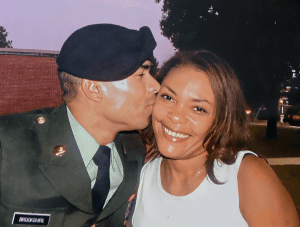
“I started filming the protests in New York so I could draw attention to the realities of black America that I was first exposed to during my military service.”
As part of #sharethemicnow we are honored to re-post this June 4th article by Richard Brookshire as told to John Ismay in the New York Times – unedited and in its entirety. You can read the original article here. The above photo is of the author, Richard Brookshire, with his mother, Natacha, at his graduation from Army basic training at Fort Leonard Wood in Missouri in 2009. Credit…via Richard Brookshire
I’m in film school, using the last bit of my G.I. Bill, and have been shooting a short film about five black artists surviving Covid-19. We wrapped shooting on the morning of Memorial Day, and that afternoon George Floyd was killed. A few days later, one of the artists I’m profiling headed to the streets in Brooklyn to protest, and it just felt like the responsible thing to show up with my camera and capture the stories.
We were trying to cross the Manhattan Bridge, and at that point the demonstrations had been nothing but peaceful. Hundreds of police officers were in a line and trying to break up the crowd. These officers were treating the Manhattan Bridge like the Edmund Pettus Bridge in Selma, you know? The black organizers were begging protesters to be nonviolent, but a water bottle flew out of nowhere. The cops rushed the crowd. About 10 or 12 protesters were tackled, and I was able to get it on video. The police were saying someone threw tear gas at them. It was very clear from the video that it was just a water bottle.
I could see in the faces of officers — especially in the faces of the black officers — the internal conflict. I recognized that from Afghanistan. The tension they were navigating themselves: having to look other black people in the eye and let them know that they couldn’t cross the bridge, that they couldn’t scream, that they couldn’t express the deep trauma of the fact that we’ve been living through this kind of racial terrorism for the better part of 400 years. But here they were with their paychecks, with their stability and their ability to feed their family and their kids. They’re making that same kind of compromise I did when I was carrying a rifle in Afghanistan. I felt morally and ethically compromised when I was deployed there, being a tool of the state in a way, but that was the sacrifice I had to make in order to get an education. It’s a compromise I had to make to get stability and a sense of economic security.
Both my mother, who immigrated from Haiti, and my father, who is white, had been in the Army. My mom is a nurse, and she convinced me that medical training was important. I decided that if I was going to war, I wanted to be someone who helps people. Those things led me to becoming a combat medic. I went off to Army basic training in April 2009. I thought I was going to be stationed stateside and continue my education, but I was sent to the 170th Infantry Brigade in Germany instead and soon after went to Afghanistan.

Brookshire during an Army National Guard training exercise in upstate New York in 2015. Credit…via Richard Brookshire
Not only was I closeted because the “don’t ask, don’t tell” policy was still in effect, but I was one of just a few black people in my platoon of 40 soldiers. I think my company of a couple of hundred had maybe 10 black soldiers — most of the others were Midwestern white guys. There were so many microaggressions and so much racism and homophobia. A gay soldier had been discovered in the unit before I got there, and he was beaten with a bat in the shower. And there was the lieutenant colonel who erupted when he saw the Rev. Dr. Martin Luther King Jr. on TV, telling me to turn it off, because “I don’t want to see that troublemaker.” You just let it roll off your back, because you’re getting ready to go to war with these people, and short of fighting people every day, you just become numb to it. It begins to chip away at your sense of self. I was under constant pressure to hide in plain sight as a black queer person in a mostly all-white infantry unit getting ready to go to Afghanistan. I managed to build a somewhat close relationship with my fellow soldiers anyway.
I started reading a lot while I was over there. Specifically, I read “The New Jim Crow,” and it helped me see more directly the connection between slavery and modern-day racial inequity. Two months after I got back from Afghanistan, Trayvon Martin was killed in Sanford, Fla. — the same town in which I interned for Barack Obama in back in 2008. That was the arc for me: joining the military on the heels of the first black president, going off to war, dealing with all the overt aggressions, trying to hold onto a sense of who I was, being completely disconnected from everyone I knew and loved.
I came back and took advantage of what I’d worked for, which was school — and within a year of graduation, I finally had a chance to breathe and think of all that had happened over the past eight years. I fell into a deep depression that led to a suicide attempt — because I no longer fully understood the America that existed, and I no longer recognized the America I lived in. And that created an existential crisis for me. It was my mother and other black folk who cared for me, who listened and helped me find who I was again.
In 2016, I started to get involved in the Black Lives Matter movement and joined the local chapter in New York. It was composed of mostly young black queer people who were doing a lot of work with families who were victims of police violence.
I remember one day I saw an article about a black man who had been stabbed with a sword by a crazed white nationalist who drove to New York with the explicit intent of killing a black person. And then I read that the killer had served in the same brigade as me in Afghanistan, that we deployed together. And I was like, “Wow, these were the kinds of men I was serving alongside.” It made me recognize that I wasn’t fabricating the racism I bore witness to while I was in the Army. There was a deep fascination with Nazism that was so pervasive in the unit I served in, deep fascination with Hitler and with the swastika. There were young men who were reading “Mein Kampf.” I was 23. I didn’t necessarily have the kind of awareness I do now about where that kind of indoctrination can lead people.

Brookshire being interviewed recently at a protest at the Manhattan Bridge. Credit…Dexter Philips
The summer I got out of the military, there was an onslaught of black men killed on video, like Philando Castile, Alton Sterling and Delrawn Small, all within three days of each other. Then last November, it almost happened to my sister. She was thrown to the ground by white police officers in West Memphis, Ark., handcuffed and put into a squad car just for standing outside the hotel we were staying in. She had even shown the cops her room key and explained that her daughter had died the day before in a car crash. My sister called me and screamed as these two cops surrounded her. By the time I got downstairs, I was running. I’d never run so fast in my life — not even in war. I saw this officer with his knee in my sister’s back, close to her neck. And I just remember screaming. Finally they let her go. But imagine what that does to a person, especially when they’re grieving. The cops said she had a hoodie on; she looked suspicious.
These stories aren’t going to disappear in a year; injustices are going to be ever-present in some ways. As a filmmaker, I need to be as useful as I can to the movement. I also want to capture black joy and the black creative imagination that continues to defy the pitfalls of the American project.
I plan to be on the streets again for Juneteenth — a day that should be America’s most important holiday — for a show of solidarity with my community. Violence and poverty are an ever-present reality for black America, and some believe they’ll never have access to the American dream. That’s an awakening that white America needs to contend with. When people talk about looting and property damage, it’s a distraction from the real issues. People who choose to turn a blind eye to the grievances propelling the protests are part of the problem. Because they don’t recognize the way human beings, and black people specifically, who were once considered property, are in many ways still denied full access to their humanity in America.
By Richard Brookshire as told to John Ismay
Richard Brookshire is a former U.S. Army sergeant and combat medic, a documentary filmmaker and a founder of the Black Veterans Project. John Ismay covers armed conflict for The New York Times Magazine from the Washington bureau.

About Richard Brookshire as told to John Ismay
Richard Brookshire is a former U.S. Army sergeant and combat medic, a documentary filmmaker and a founder of the Black Veterans Project. John Ismay covers armed conflict for The New York Times Magazine from the Washington bureau. You can read more about the author here.

Next Post

July 26, 2020 Conversion Therapy’s Deadly Little Secret
Browse Our Archives
Select a Category Church & Religion Dear Susan Family Support Gay Weddings & Marriage GCN Conference Jesus Blog LGBTQ Support Parenting Personal Stories Suicide The Real Jesus Theology Transgender Uncategorized X Archived Posts
Select a Month August 2026 July 2026 June 2026 May 2026 February 2026 January 2026 December 2025 November 2025 October 2025 September 2025 August 2025 July 2025 May 2025 April 2025 March 2025 January 2025 November 2024 October 2024 September 2024 August 2024 July 2024 June 2024 May 2024 April 2024 March 2024 February 2024 January 2024 November 2023 October 2023 September 2023 August 2023 July 2023 June 2023 May 2023 April 2023 March 2023 June 2022 December 2021 May 2021 February 2021 November 2020 August 2020 July 2020 June 2020 May 2020 December 2019 November 2019 October 2019 May 2019 March 2019 January 2019 November 2018 March 2018 January 2018 October 2017 September 2017 August 2017 July 2017 June 2017 May 2017 April 2017 March 2017 February 2017 January 2017 December 2016 November 2016 October 2016 September 2016 August 2016 July 2016 June 2016 May 2016 April 2016 March 2016 February 2016 January 2016 December 2015 November 2015 October 2015 September 2015 August 2015 July 2015 June 2015 May 2015 April 2015 March 2015 February 2015 January 2015 December 2014 November 2014 October 2014 September 2014 August 2014 July 2014 June 2014 May 2014 April 2014 March 2014 February 2014 January 2014 December 2013 November 2013 October 2013 September 2013 August 2013 July 2013 June 2013 May 2013 April 2013 March 2013 February 2013 January 2013 December 2012 November 2012 October 2012 September 2012 August 2012 July 2012 June 2012 May 2012 April 2012 March 2012 February 2012 January 2012
Follow Us!
TAKE THE
Religious Wisdom Quiz
Why was Moses placed in a basket in the Nile?
Select your answer to see how you score.
To save him from Pharaoh’s decree As part of a religious ritual To send him to another land To hide him from Egyptian soldiers
Support this
Column


Related posts from FreedHearts

We’re Straight & Queer. Why It Matters.
Queer. Why It Matters Now More Than Ever.
The Lie Religion Told You About God —...

We Are Not the Resistance — We Are...
TRENDING AT PATHEOS Progressive Christian

Top Three Anti-Catholic Lies About Catholicism
This is my initial transcript for the video, "THE 3 WORST...

Pope Leo Celebrates Mass for Nurses & Docs...
I don't have any idea how he did it, but Pope Leo...

The Sermon on the Mount, Part I: Matthew...
The Sermon on the Mount, Part I (Matthew 4:12-5:12) St. Matthew moves...

What's up from Crossway: Reviewing some of their latest A few weeks...

Janie Learns the Way of the Cross: A...
Teaching children about Jesus' Passion can be challenging. Many parents and educators...

Looking For Good Catholic Writing - October 2026
He alone extends the heavens, and he walks upon the waves of...
view all Progressive Christian blogs
Ad-Free & Subscriber Log-In Subscription Support
- About Us
- 2026 Calendar
- Videos
- Podcasts
- Library of World Religions
- Faith In Media Tracker
- Advertise With Us
- Write for Us
- Privacy Policy
- Terms of Service
- Do Not Sell My Data
- Contact Us
- Radiant Digital
- Manage Newsletter Subscriptions
- Unsubscribe From Notifications
- Sitemap
Copyright 2008-2026, Patheos. All rights reserved.
Subscription Support Ad-Free & Subscriber Log-In
Follow Patheos