
BuddhistCatholicContemplativeEvangelicalGeneral ChristianHinduJewishLatter-day SaintMuslimNew VisionsProgressive Christian
Beliefs
- Buddhist
- Catholic
- Contemplative
- Evangelical
- General Christian
- Hindu
- Jewish
- Latter-day Saint
- More Voices
- Muslim
- New Visions
- Pagan
- Progressive Christian
Topics
- Religion News
- Food and Religion
- Sports and Religion
- Religious Art
- Religious Music and Entertainment
- Religious Events
- History and Religion
- Style and Religion
- Politics and Religion
- Women in Religion
- Recreation Outdoors and Religion
- Business Finance and Religion
- Careers Workplace and Religion
- Education and Religion
- Family Parenting and Religion
- Health Fitness and Religion
- Home and Religion
- Relationships and Religion
- Technology and Religion
- Travel and Religion
Columnists
- Buddhist Columnists
- Business Finance and Religion Columnists
- Careers Workplace and Religion Columnists
- Catholic Columnists
- Contemplative Columnists
- Education and Religion Columnists
- Evangelists Columnists
- Family Parenting and Religion Columnists
- General Christian Columnists
- Health Fitness and Religion Columnists
- Hindu Columnists
- History and Religion Columnists
- Home and Religion Columnists
- Jewish Columnists
- More Voices Columnists
- Latter Day Columnists
- Muslim Columnists
- New Visions Columnists
- Nonreligious Columnists
- Pagan Columnists
- Politics and Religion Columnists
- Progressive Columnists
- Recreation Outdoors and Religion Columnists
- Relationships and Religion Columnists
- Religion News Columnists
- Religious Art Columnists
- Religious Events Columnists
- Religious Music and Entertainment Columnists
- Sports and Religion Columnists
- Style and Religion Columnists
- Technology and Religion Columnists
- Travel and Religion Columnists
- Women in Religion Columnists
Resource Library
- 2026 Calendar
- Library of World Religions
- The 100 Most Holy Places on Earth
- Patheos Answers
- Podcasts
- Videos
- Faith Leaders Database
- Anglican Episcopalian
- Bahai
- Baptist
- Buddhism
- Christianity
- Confucianism
- Eastern Orthodoxy
- Hinduism
- Holiness and Pentecostal
- ISKCON
- Islam
- Judaism
- Lutheran
- Methodist
- The Church of Jesus Christ of Latter-day Saints
- New Age
- Paganism
- Presbytarian and Reformed
- Protestantism
- Religion Behind the Scenes
- Roman Catholic
- Scientology
- Shia Islam
- Sikhism
- Sufism
- Sunni Islam
- Taoism
- Zen
- See all religions
Research Tools
 Ad-Free & Subscriber Log-In Subscription Support
Ad-Free & Subscriber Log-In Subscription Support
Follow Patheos 

- Trending:
- Forgiveness
- |
- Marriage
- |
- Consciousness
- |
- Death Penalty
- |
- Election
- |
- Halloween

- Home
- Evangelical
- Words Are Not Enough
Words Are Not Enough
Last updated on: September 18, 2024 at 7:33 am by Frank Viola
Words Are Not Enough 2024-09-17T07:39:31-04:00 Frank Viola
Patheos Explore the world's faith through different perspectives on religion and spirituality! Patheos has the views of the prevalent religions and spiritualities of the world.
Words Are Not Enough: Paratexts, Manuscripts, and the Real New Testament is a new book by Garrick Allen.
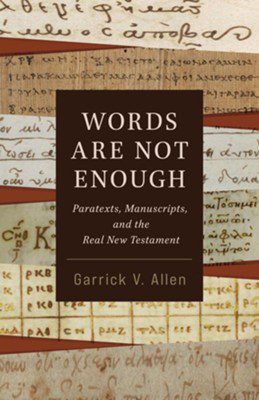
The book explores the question, “How did Scripture come to be?”
This volume is short and easy to read, though parts of it are technical.
If you are interested in the subject of paratexts, this is a book you want to add to your library.
This is from the publisher.
Allen’s innovative study of manuscript history explores the paratexts—titles, cross-references, prefaces, marginalia, and such—revealing how anonymous scribes contributed to our framing, and thereby our understanding, of the New Testament. He argues that this messy process of change is itself sacred—that on the handwritten page, Scripture and tradition meet.
An innovative study of the manuscript history of the New Testament, encompassing its paratexts—titles, cross-references, prefaces, marginalia, and more.
How did the Christian scriptures come to be? In Words Are Not Enough, Garrick V. Allen argues that our exploration of the New Testament’s origins must take account of more than just the text on the page. Where did the titles, verses, and chapters come from? Why do these extras, the paratexts, matter?
Allen traces the manuscript history of scripture from our earliest extant texts through the Middle Ages to illuminate the origins of the printed Bibles we have today. Allen’s research encompasses formatting, titles, prefaces, subscriptions, cross-references, marginalia, and illustrations. Along the way, he explains how anonymous scribes and scholars contributed to our framing—and thereby our understanding—of the New Testament.
But Allen does not narrate this history to try to unearth a pristine authorial text. Instead, he argues that this process of change is itself sacred. On the handwritten page, scripture and tradition meet. Students, scholars, and any curious reader will learn how the messy, human transmission of the sacred text can enrich our biblical interpretation.Garrick V. Allen is professor of divinity and biblical criticism at the University of Glasgow. He has written dozens of academic articles, popular pieces, and multiple award-winning monographs, including The Book of Revelation and Early Jewish Textual Culture, which won a Manfred Lautenschlaeger Award for Theological Promise, and Manuscripts of the Book of Revelation, which won the Paul J. Achtemeier Award for New Testament Scholarship.
Editorial Reviews
“In this compelling and significant contribution, Garrick Allen provides an accessible guide to the fascinating materials that survive in New Testament manuscripts but that are systematically left out of modern critical editions. Allen’s three-dimensional approach to the texts of the New Testament reconnects the texts with the world of the manuscripts. Get acquainted with the gems hiding in the critical apparatus, learn about the features that frame the text, and catch glimpses of the lives of readers who pondered the New Testament before you. Your reading of the New Testament will never be the same again.”
—Liv Ingeborg Lied, Norwegian School of Theology“This book is a game changer! As exegetes we are mainly interested in what we call the New Testament text(s). But a Bible is so much more—material, binding, titles, introductions, images, and marginalia—and all this influences our reading and understanding. It is time to change the field of biblical studies. Garrick Allen’s fascinating and very readable book opens the door.”
—Tobias Nicklas, University of Regensburg
“The increased attention given in recent decades to the documents that convey the text of the New Testament is most welcome. In this book, one of the leaders in this area of research makes clear the significance of paratextual features of manuscripts for a better understanding of the history of both text and canon of the New Testament.”
—Michael Holmes, Bethel University
“In an age of abundant digital texts, we need to go back to the manuscripts, their materiality and aesthetics, and their surprising features to get a realistic sense of the time in which biblical texts were created and first transmitted. Based on several major research projects, Garrick Allen presents fascinating insights into the changing design of biblical manuscripts, their layout and paratexts, titles, prefaces, prologues, cross-references. The book is well written and entertaining, and may change the way readers see the Bible.”
—Jörg Frey, University of Zurich
“In Words Are Not Enough, Garrick Allen brings the thrilling results of manuscript studies to a broad audience of students and scholars. As he shows, the New Testament is a material object that human communities continuously make and remake. With clarity and grace, he teaches readers what attending to manuscripts and their paratexts can offer while also showing, step by step, how to go about this work. This book performs a valuable service that will benefit anyone interested in the New Testament, early Christian history, and the history of the book. Highly recommended.”
—Jennifer Wright Knust, Duke University
“Brimming with knowledge, this invaluable introduction will intrigue, surprise, and—most importantly—educate anyone who wants to understand the manuscripts and physical reality of the New Testament.”
—Candida Moss, University of Birmingham, UK
“The Bible is often imagined as a kind of monument, a fixed point in an ever-changing world. In his new book, Garrick Allen argues persuasively that this model overlooks the Bible’s materiality: the Bible is always more than the sum of its texts, and—precisely because it is valued so highly—it changes constantly as its formatting and packaging changes.”
—Francis Watson, Durham University
“This important and engaging book draws our attention to everything that is usually left unscrutinized on the pages of a Bible or manuscript. Allen shows us, through his sensitive analysis, how paratexts shape biblical interpretation in profound and unexpected ways.”
—Yii-Jan Lin, Yale Divinity School
“This book demonstrates with admirable clarity the multiple ways in which material philology can shed light on the transmission and reception of the New Testament. Focusing on the frames and margins of the biblical texts, Allen shows how people in various ways have engaged with the New Testament and its manuscripts, and why it is not enough to simply study the words of the biblical texts by themselves to understand its historical significance and impact.”
—Hugo Lundhaug, University of Oslo
Previous Post
September 17, 2024
Jesus and Divine Christology
Next Post
September 19, 2024 Studies in Luke, Acts, and Paul
Recent Comments
"I get, the more I see that every attempt to debunk it leaves the Shroud ..."
Interview with Leonard Sweet – More ..."
"You're referring to the way things happen in the Industrial Religious Complex. I'm speaking about ..."
"Another insight is that young people want to start their own ministry and are not ..."
"You’re challenging the usual narratives and pointing us toward deeper, more nuanced perspectives. This is ..."
The Origins of Human Government and ..."
Browse Our Archives
Select a Category Uncategorized
Select a Month October 2026 September 2026 August 2026 July 2026 June 2026 May 2026 April 2026 March 2026 February 2026 January 2026 December 2025 November 2025 October 2025 September 2025 August 2025 July 2025 June 2025 May 2025 April 2025 March 2025 February 2025 January 2025 December 2024 November 2024 October 2024 September 2024 August 2024 July 2024 June 2024 May 2024 April 2024 March 2024 February 2024 January 2024 December 2023 November 2023 October 2023 September 2023 August 2023 July 2023 June 2023 May 2023 April 2023 March 2023 February 2023 January 2023 December 2022 November 2022 October 2022 September 2022 August 2022 July 2022 June 2022 May 2022 April 2022 March 2022 February 2022 January 2022 December 2021 November 2021 October 2021 September 2021 August 2021 July 2021 June 2021 May 2021 April 2021 March 2021 February 2021 January 2021 December 2020 November 2020 October 2020 September 2020 August 2020 July 2020 June 2020 May 2020 April 2020 March 2020 February 2020 January 2020 December 2019 November 2019 October 2019 September 2019 August 2019 July 2019 June 2019 May 2019 April 2019 March 2019 February 2019 January 2019 December 2018 November 2018 October 2018 September 2018 August 2018 July 2018 June 2018 May 2018 April 2018 March 2018 February 2018 January 2018 December 2017 November 2017 October 2017 September 2017 August 2017 July 2017 June 2017 May 2017 April 2017 March 2017 February 2017 January 2017 December 2016 November 2016 October 2016 September 2016 August 2016 July 2016 June 2016 May 2016 April 2016 March 2016 February 2016 January 2016 December 2015 November 2015 October 2015 September 2015 August 2015 July 2015 June 2015 May 2015 April 2015 March 2015 February 2015 January 2015 December 2014 November 2014 October 2014 September 2014 August 2014 July 2014 June 2014 May 2014 April 2014 March 2014 February 2014 January 2014 December 2013 November 2013 October 2013 September 2013 August 2013 July 2013 June 2013 May 2013 April 2013 March 2013 February 2013 January 2013 December 2012 November 2012 October 2012
TAKE THE
Religious Wisdom Quiz
I destroyed the world but saved eight people and many animals in a floating vessel. What am I?
Select your answer to see how you score.
A great storm God's judgment The deluge The flood
Related posts from The Deeper Journey


What Was Jesus’ Central Message?
Can Genuine Christians Learn From the Pagans?

Deconversion From Christianity
TRENDING AT PATHEOS Evangelical

The First Eucharistic Controversy: Christ’s Real Presence
For Catholics, the Eucharist is the source and summit of the Christian...

What a Stop Sign Can Teach Us About...
How to Make a Decision When You Can't Hear God Main point:...

Archdiocese Hosts Military Marriage Retreat in Germany
RASTATT, Germany — The transient military lifestyle, with its frequent deployments and...

Nearly every morning, I make the drive to Detroit with my high-school-age...

The Real AI Story Is Adoption Without Trust
Artificial intelligence has crossed a political threshold. It is no longer a...

A new article, written by Jeff Lindsay and Gale L. Pooley,...
view all Evangelical blogs
What Are Your Thoughts?leave a comment
Ad-Free & Subscriber Log-In Subscription Support
- About Us
- 2026 Calendar
- Videos
- Podcasts
- Library of World Religions
- Faith In Media Tracker
- Advertise With Us
- Write for Us
- Privacy Policy
- Terms of Service
- Do Not Sell My Data
- Contact Us
- Radiant Digital
- Manage Newsletter Subscriptions
- Unsubscribe From Notifications
- Sitemap
Copyright 2008-2026, Patheos. All rights reserved.
Subscription Support Ad-Free & Subscriber Log-In
Follow Patheos