
BuddhistCatholicContemplativeEvangelicalGeneral ChristianHinduJewishLatter-day SaintMuslimNew VisionsProgressive Christian
Beliefs
- Buddhist
- Catholic
- Contemplative
- Evangelical
- General Christian
- Hindu
- Jewish
- Latter-day Saint
- More Voices
- Muslim
- New Visions
- Pagan
- Progressive Christian
Topics
- Religion News
- Food and Religion
- Sports and Religion
- Religious Art
- Religious Music and Entertainment
- Religious Events
- History and Religion
- Style and Religion
- Politics and Religion
- Women in Religion
- Recreation Outdoors and Religion
- Business Finance and Religion
- Careers Workplace and Religion
- Education and Religion
- Family Parenting and Religion
- Health Fitness and Religion
- Home and Religion
- Relationships and Religion
- Technology and Religion
- Travel and Religion
Columnists
- Buddhist Columnists
- Business Finance and Religion Columnists
- Careers Workplace and Religion Columnists
- Catholic Columnists
- Contemplative Columnists
- Education and Religion Columnists
- Evangelists Columnists
- Family Parenting and Religion Columnists
- General Christian Columnists
- Health Fitness and Religion Columnists
- Hindu Columnists
- History and Religion Columnists
- Home and Religion Columnists
- Jewish Columnists
- More Voices Columnists
- Latter Day Columnists
- Muslim Columnists
- New Visions Columnists
- Nonreligious Columnists
- Pagan Columnists
- Politics and Religion Columnists
- Progressive Columnists
- Recreation Outdoors and Religion Columnists
- Relationships and Religion Columnists
- Religion News Columnists
- Religious Art Columnists
- Religious Events Columnists
- Religious Music and Entertainment Columnists
- Sports and Religion Columnists
- Style and Religion Columnists
- Technology and Religion Columnists
- Travel and Religion Columnists
- Women in Religion Columnists
Resource Library
- 2026 Calendar
- Library of World Religions
- The 100 Most Holy Places on Earth
- Patheos Answers
- Podcasts
- Videos
- Faith Leaders Database
- Anglican Episcopalian
- Bahai
- Baptist
- Buddhism
- Christianity
- Confucianism
- Eastern Orthodoxy
- Hinduism
- Holiness and Pentecostal
- ISKCON
- Islam
- Judaism
- Lutheran
- Methodist
- The Church of Jesus Christ of Latter-day Saints
- New Age
- Paganism
- Presbytarian and Reformed
- Protestantism
- Religion Behind the Scenes
- Roman Catholic
- Scientology
- Shia Islam
- Sikhism
- Sufism
- Sunni Islam
- Taoism
- Zen
- See all religions
Research Tools
 Ad-Free & Subscriber Log-In Subscription Support
Ad-Free & Subscriber Log-In Subscription Support
Follow Patheos 

- Trending:
- Forgiveness
- |
- Marriage
- |
- Consciousness
- |
- Death Penalty
- |
- Election
- |
- Halloween

- Home
- Evangelical
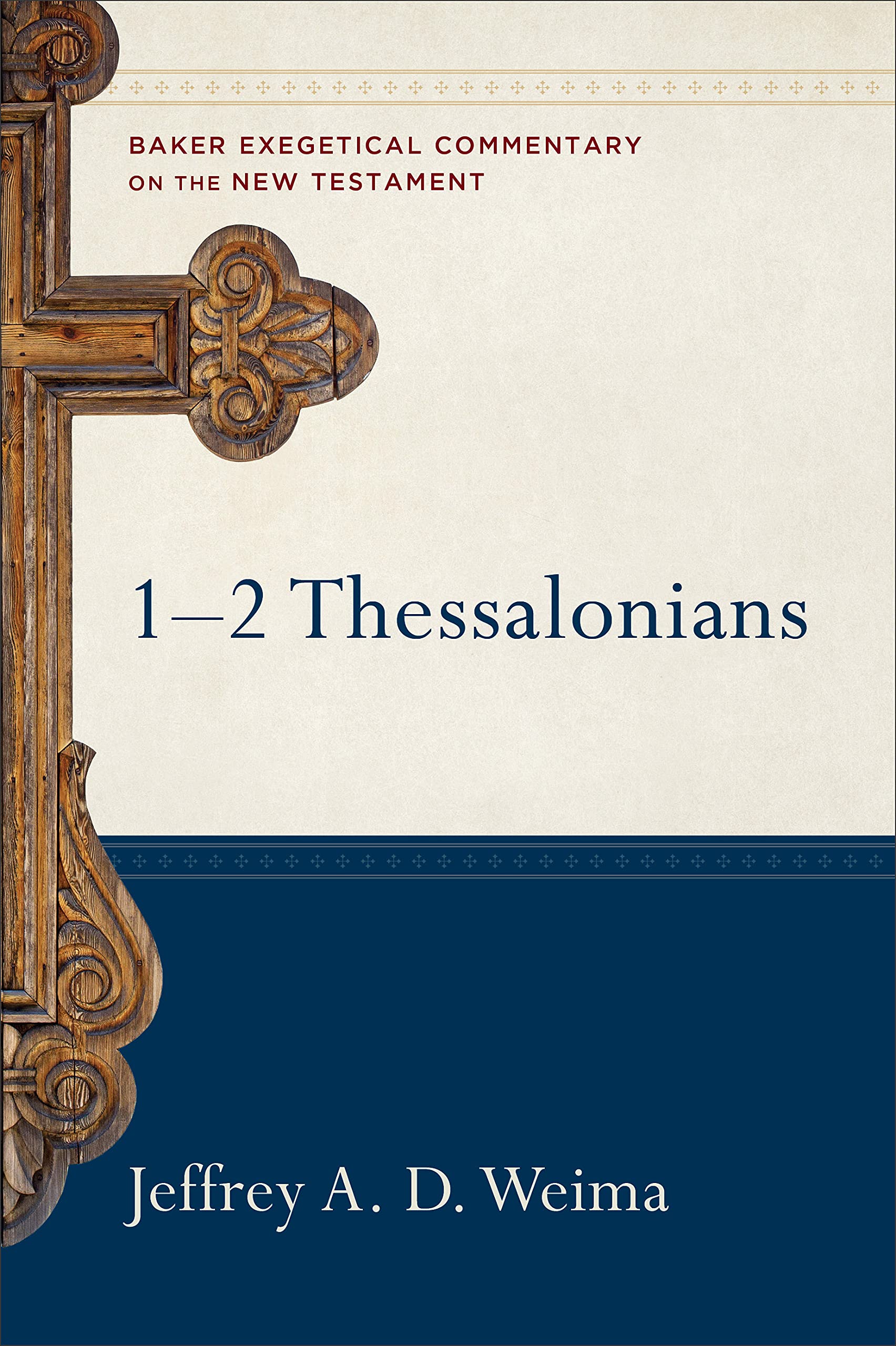
- 1 & 2 Thessalonians: Baker Exegetical Commentary on the New Testament
1 & 2 Thessalonians: Baker Exegetical Commentary on the New Testament
Last updated on: April 25, 2022 at 11:52 am by Frank Viola
1 & 2 Thessalonians: Baker Exegetical Commentary on the New Testament 2022-04-25T11:52:22-04:00 Frank Viola
Patheos Explore the world's faith through different perspectives on religion and spirituality! Patheos has the views of the prevalent religions and spiritualities of the world.
Jeffrey Weima is the author of 1 & 2 Thessalonians: Baker Exegetical Commentary on the New Testament.
This commentary, hands down, is the best treatment of Paul’s letters to the Thessalonians in print.
I caught up with Jeffrey recently to discuss his commentary.
Enjoy!
How long did it take you to write this commentary from beginning to end?
The truth is that I am scared to figure this out with precision, since the number will be unbelievably high! I worked on the commentary on and off over a period of more than 15 years. There are 722 pages in the commentary and I spent about one full day (8+ hours) to write one published page, so that means over 700 full days of work. And this doesn’t include the time spent on research.
Based on your research, how large (meaning, how many people) made up of the church in Thessalonica during Paul’s day? And what is the rationale for this estimate?
There is very little information available to determine the size of any early Christian church. But these house congregations were not very large. For the church of Corinth, for example, the Bible mentions the names of 14 men connected with this congregation. If we assume that most, if not all, like Aquila were married (his wife was Priscilla), that makes 28 members.
Three members of this church were wealthy such that they had “households”—not only children but also slaves and freedpersons (former slaves who were freed around 30 years old but continued to live and work in the same household). Thus, an educated guess for the Corinthian church is 40-50 members. The meager evidence available about the Thessalonian church suggests that it was about the same size.
Give us two “aha” moments that shed light on 1 and 2 Thessalonians as you were doing the research for them. Meaning, two things that opened up these letters for you.
There were many “aha” moments over the many years that I spent wrestling with these two letters.
A number of these moments highlighted for me what a skilled letter writer Paul was—that he wrote his letters with great care and precision. Take, for example, 1 Thess1:10 which reads: “to wait for his Son from heaven, whom he raised from the dead—Jesus, who rescues us from the coming wrath.” There are three parts to this verse: first, a reference to the second coming of Jesus; second, a reference to the resurrection of Jesus; and third, a reference to the final judgment that takes place at the end of time when Jesus comes again. Commentators have long noted that the second part seems out of place: why is a reference to the resurrection sandwiched between two references to the return of Jesus? Some scholars refer to the reference to the resurrection as a “digression” and that Paul seems to get off topic from the main subject of Christ’s return.
But looking at the letter as a whole more carefully reveals the impressive logic of Paul’s thinking here and the skill with which he wrote the letter. Firstof all, the first and third references to Christ’s return are intended to foreshadow the lengthy treatment of the second coming of Jesus that Paul takes up later in the letter in 4:13-18 and 5:1-11. The reference to “wrath” in the third part also foreshadows Paul’s comment in 5:9 that God did not destine believers on that future day to suffer “wrath” but to “obtain salvation.”
Second, the reference in the second part of 1:10 to the resurrection also looks ahead to Paul’s argumentation in 4:13-18. Here in 4:14 Paul specifically appeals to the resurrection (“Since we believe that Jesus died and rose again …”) as the grounds for his comforting words that the Christians in Thessalonica who have already died will, in fact, be alive and present at Christ’s return and consequently will participate in the glory of that future event. Thus, far from the reference in 1:10 to the resurrection being a “digression” where Paul seemingly drifts away from the main topic of Christ’s return, it is now clear that the apostle in 1:10 not only skillfully foreshadows the topic of Christ’s return in 4:13-18 but even more impressively also foreshadows one of the key arguments he will later use in 4:13-18. Paul obviously wrote his letters with much forethought, precision and talent.
A different kind of “aha” moment involves Paul’s use of a powerful family metaphor in 1Thess 2:7b-8a where the apostle states: “Just like a nursing mother cares for her own children, so we cared for you.” In the male dominated, patriarchal world of the first century, no man would ever compare himself to a woman. But Paul here not only compares himself to a woman but more surprisingly compares himself to a mother and even more powerfully yet compares himself to a breast-feeding, nursing mother! Too many Christians have a negative image of Paul as a domineering, opinionated, bossy guy who runs around telling everyone what to do. Here we have a powerful counter image of Paul who loved and cared for his spiritual sons and daughters in Thessalonica with the same intense love and compassion that a nursing mother has for her own children.
In 1 Thessalonians 4, Paul addresses the problem of sexual immorality. How was the Greco-Roman world of Paul’s day the same as well as different from 21st century America in the area of sexual immorality and the sexual practices that are approved by the society?
1 Thessalonians 4:1-8 is an important passage where Paul speaks at some length about the “sanctity of sex.” The Greco-Roman world of Paul’s day can be justly called a “sex saturated society” in which the attitudes and practices towards sexual conduct were very tolerant and permissible.
For example, men in their 20’s were typically in an arranged marriage involving a woman in her teens, and given the arrangement and the difference in age, men were expected to have a sexual relationship with someone other than their wife. Moralists of that day encouraged men not to sleep with another man’s wife but to satisfy their sexual desires with a prostitute instead. There was no shame connected with prostitution and many leading figures of that day made money from the sexual services of their male and female slaves. Oil lamps in the shape of the male sex organ were extremely common. Roman dining parties typically included entertainment by women, which often involved sex.
The 21st century world in which we live can also be justly called a “sex saturated society.” This means that Paul’s call to the Thessalonian Christians to be “holy” in their sexual conduct involved a radical break with the attitudes and practices of their day that is very similar to the radical break that Jesus followers today ought to have with our culture which reflects an “anything goes” attitude and practice with regard to sex. Paul encourages believers, both then and now, with the good news that God has given us his Spirit who is “holy” (1Thess 4:8), and it is the Holy Spirit who empowers us to be holy in every area of our life, including our sex life.
How did Paul’s letter (1 Thessalonians) get to the Thessalonians? If we don’t know, who may he have sent (educated guess)? Perhaps Timothy again or someone else?
There was no mail service in the ancient world, and so all letters—including those of Paul–had to be hand delivered. The apostle had to find someone who not only had the financial means to travel but also who could be trusted with his valuable letters and ensure that they would reach their intended audience. Three of Paul’s letters provide the name of the letter carrier at the end of the document in keeping with the letter writing practice of that day.
His letter to the Romans was delivered by the wealthy woman from the port city and church of Cenchrea, Phoebe (Rom 16:1-2), while Ephesians and Colossians were delivered by Tychicus (Eph 6:21-22; Col 4:7-9), otherwise known as “Mr. Lucky” (Tychicus means “luck, fortune”). We don’t know for certain who delivered either one of the two Thessalonian letters. Timothy is a good candidate, since Paul sent him to Thessalonica to minister to the “newbie” Christians there (1Thess 3:1-2, 5), after Paul and Silas were run out of town (Acts 17:10), and Timothy later reported back to the apostle all that was happening in the Thessalonian congregation (1 Thess 3:6).
You have a smaller commentary on 1 & 2 Thessalonians put out by Zondervan. Tell us about that one.
My Zondervan commentary on 1 & 2 Thessalonians is indeed quite a bit shorter (only 41 pages) and much more “user friendly,” since it contains color pictures, bullet points and sidebars. It also reflects my earlier and less mature thinking about these two letters. I would thus encourage people to spend the extra money on the larger commentary and also spend the extra time working through that Baker commentary.
What else would you like readers to know about the big Baker commentary?
Although my Baker commentary is long and detailed, it is nevertheless very readable! That is not only my (admittedly biased) opinion but also that of many who have used this commentary and taken the time to send me a note of appreciation for it. The big Baker commentary also provides the reader with the most detailed explanation of 1 and 2 Thessalonians available in print, and one that is also decidedly conservative and evangelical in perspective.
Previous Post

April 19, 2022
The CSB Verse-by-Verse Premium Reference Bible
Next Post
May 4, 2022 The NIV Wide Margin Side-Column Premium Reference Bible
Browse Our Archives
Select a Category Uncategorized
Select a Month October 2026 September 2026 August 2026 July 2026 June 2026 May 2026 April 2026 March 2026 February 2026 January 2026 December 2025 November 2025 October 2025 September 2025 August 2025 July 2025 June 2025 May 2025 April 2025 March 2025 February 2025 January 2025 December 2024 November 2024 October 2024 September 2024 August 2024 July 2024 June 2024 May 2024 April 2024 March 2024 February 2024 January 2024 December 2023 November 2023 October 2023 September 2023 August 2023 July 2023 June 2023 May 2023 April 2023 March 2023 February 2023 January 2023 December 2022 November 2022 October 2022 September 2022 August 2022 July 2022 June 2022 May 2022 April 2022 March 2022 February 2022 January 2022 December 2021 November 2021 October 2021 September 2021 August 2021 July 2021 June 2021 May 2021 April 2021 March 2021 February 2021 January 2021 December 2020 November 2020 October 2020 September 2020 August 2020 July 2020 June 2020 May 2020 April 2020 March 2020 February 2020 January 2020 December 2019 November 2019 October 2019 September 2019 August 2019 July 2019 June 2019 May 2019 April 2019 March 2019 February 2019 January 2019 December 2018 November 2018 October 2018 September 2018 August 2018 July 2018 June 2018 May 2018 April 2018 March 2018 February 2018 January 2018 December 2017 November 2017 October 2017 September 2017 August 2017 July 2017 June 2017 May 2017 April 2017 March 2017 February 2017 January 2017 December 2016 November 2016 October 2016 September 2016 August 2016 July 2016 June 2016 May 2016 April 2016 March 2016 February 2016 January 2016 December 2015 November 2015 October 2015 September 2015 August 2015 July 2015 June 2015 May 2015 April 2015 March 2015 February 2015 January 2015 December 2014 November 2014 October 2014 September 2014 August 2014 July 2014 June 2014 May 2014 April 2014 March 2014 February 2014 January 2014 December 2013 November 2013 October 2013 September 2013 August 2013 July 2013 June 2013 May 2013 April 2013 March 2013 February 2013 January 2013 December 2012 November 2012 October 2012
TAKE THE
Religious Wisdom Quiz
Who lamented Saul and Jonathan's death with a song?
Select your answer to see how you score.
Samuel David Abiathar Nathan
Related posts from The Deeper Journey

Emotion in Early Christianity by Andrew Crislip

Letters on Living the Faith by C.S. Lewis


TRENDING AT PATHEOS Evangelical
Emotion in Early Christianity by Andrew Crislip
Andrew Crislip’s Emotion in Early Christianity examines an often overlooked dimension of...

16 Spiritual Touchstones for a More Grounded Life
After decades of spiritual study, here are 16 principles I try...

Catholic Evangelization: Sharing Your Faith Every Day
Welcome back to the Graceful Awakening mini-series called, “From Faith to Mission.” ...

The Pillar of the Boatmen: the Ancient Monument...
The Pillar of the Boatmen is a Romano-Gaulish sculpture that dates from...

In one sense walking into Westminster Abbey is like walking down the...

'Super Scam Me' Exposes AI Jon Bon Jovi...
Leslie Pickett believed she was in a relationship with Jon Bon Jovi....
view all Evangelical blogs
Ad-Free & Subscriber Log-In Subscription Support
- About Us
- 2026 Calendar
- Videos
- Podcasts
- Library of World Religions
- Faith In Media Tracker
- Advertise With Us
- Write for Us
- Privacy Policy
- Terms of Service
- Do Not Sell My Data
- Contact Us
- Radiant Digital
- Manage Newsletter Subscriptions
- Unsubscribe From Notifications
- Sitemap
Copyright 2008-2026, Patheos. All rights reserved.
Subscription Support Ad-Free & Subscriber Log-In
Follow Patheos