
BuddhistCatholicContemplativeEvangelicalGeneral ChristianHinduJewishLatter-day SaintMuslimNew VisionsProgressive Christian
Beliefs
- Buddhist
- Catholic
- Contemplative
- Evangelical
- General Christian
- Hindu
- Jewish
- Latter-day Saint
- More Voices
- Muslim
- New Visions
- Pagan
- Progressive Christian
Topics
- Religion News
- Food and Religion
- Sports and Religion
- Religious Art
- Religious Music and Entertainment
- Religious Events
- History and Religion
- Style and Religion
- Politics and Religion
- Women in Religion
- Recreation Outdoors and Religion
- Business Finance and Religion
- Careers Workplace and Religion
- Education and Religion
- Family Parenting and Religion
- Health Fitness and Religion
- Home and Religion
- Relationships and Religion
- Technology and Religion
- Travel and Religion
Columnists
- Buddhist Columnists
- Business Finance and Religion Columnists
- Careers Workplace and Religion Columnists
- Catholic Columnists
- Contemplative Columnists
- Education and Religion Columnists
- Evangelists Columnists
- Family Parenting and Religion Columnists
- General Christian Columnists
- Health Fitness and Religion Columnists
- Hindu Columnists
- History and Religion Columnists
- Home and Religion Columnists
- Jewish Columnists
- More Voices Columnists
- Latter Day Columnists
- Muslim Columnists
- New Visions Columnists
- Nonreligious Columnists
- Pagan Columnists
- Politics and Religion Columnists
- Progressive Columnists
- Recreation Outdoors and Religion Columnists
- Relationships and Religion Columnists
- Religion News Columnists
- Religious Art Columnists
- Religious Events Columnists
- Religious Music and Entertainment Columnists
- Sports and Religion Columnists
- Style and Religion Columnists
- Technology and Religion Columnists
- Travel and Religion Columnists
- Women in Religion Columnists
Resource Library
- 2026 Calendar
- Library of World Religions
- The 100 Most Holy Places on Earth
- Patheos Answers
- Podcasts
- Videos
- Faith Leaders Database
- Anglican Episcopalian
- Bahai
- Baptist
- Buddhism
- Christianity
- Confucianism
- Eastern Orthodoxy
- Hinduism
- Holiness and Pentecostal
- ISKCON
- Islam
- Judaism
- Lutheran
- Methodist
- The Church of Jesus Christ of Latter-day Saints
- New Age
- Paganism
- Presbytarian and Reformed
- Protestantism
- Religion Behind the Scenes
- Roman Catholic
- Scientology
- Shia Islam
- Sikhism
- Sufism
- Sunni Islam
- Taoism
- Zen
- See all religions
Research Tools
 Ad-Free & Subscriber Log-In Subscription Support
Ad-Free & Subscriber Log-In Subscription Support
Follow Patheos 

- Trending:
- Forgiveness
- |
- Marriage
- |
- Consciousness
- |
- Death Penalty
- |
- Election
- |
- Halloween

- Home
- Evangelical
- Strange Religion
Strange Religion
Last updated on: March 21, 2024 at 8:03 am by Frank Viola
Strange Religion 2024-03-21T08:03:00-04:00 Frank Viola
Patheos Explore the world's faith through different perspectives on religion and spirituality! Patheos has the views of the prevalent religions and spiritualities of the world.
Nijay Gupta has written a new book. It’s called Strange Religion: How the First Christians Were Weird, Dangerous, and Compelling.
I liked the book so much I reached out to Nijay to interview him about it.
Enjoy!
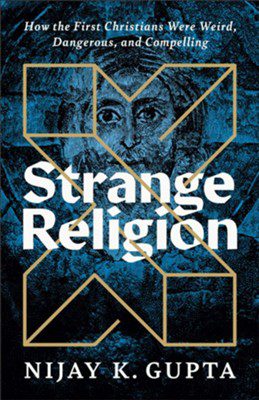
Writing a book is a difficult task. What specific change were you intending to make among Christians (and perhaps non-Christians) by writing this book?
This is an ad fontes (“back to the origins”) kind of book—inspiring Christians today by going back to the foundations of the Christian faith in the culturally distinct and deviant ideas, practices, and lifestyle of our spiritual ancestors. I want Christians today to ask: would our Christian ancestors recognize us as their true descendants?
Most readers want to know the answer to this question when they consider buying a book – what’s in it for me? Why do I want to spend the money and time on buying your book? What am I going to get out of it? What is your answer to this question?
We tend to read the Bible in a “timeless” sense, like reading a fortune cookie message. But the apostolic writings were written a certain time and place and culture, and I argue that really understanding Roman religion (the state religion of the time) helps to draw out the distinctiveness of Jesus and his people. I talk about my book as 1/3 Christian origins, 1/3 New Testament theology, and 1/3 “weird history”!
Share 3 “aha” moments that struck you the most when you were doing research for your book.
- Rome was polytheistic and allowed many gods, even foreign gods, but for a non-Roman god to be “accepted” in the Roman pantheon, they had to be Romanized, conformed to Roman hierarchy and power. Christians refused to conform in that way, and that is one reason they were called atheoi – “the godless.”
- Romans believed to truly worship a god, it was best to be a special place (a temple), with a special person (a priest), bringing a special item (a sacrifice). Christians believed, because of Christ and the Spirit, you could worship God fully anywhere, without human mediators, and you don’t need special equipment—how weird!
- Roman society was designed according to a great pyramid of power, with the Olympians at the top, then other deities, then the emperor, the elites, and then far down below are commoners, slaves, criminals, and immigrants. In society you tried to move up that pyramid (most tried and failed), but in the Incarnation, Jesus Christ willingly moved down. Who would do that?
For those who don’t read too many books, give us a two or three paragraph summary of the key points you make in the book.
Roman religion was focused on keeping peace with the gods (like Jupiter/Zeus), and promoting favor from them. The Olympians were seen as celestial overlords to appease and please. This was not a personal religion or a “religion of the heart.” This was politics and power, survival and conquest.
When Jesus and his followers came along, they turned all of this upside down. They preached that God is not a demanding overlord, he is more like a loving parent. And you don’t need rituals of appeasement, because God is gracious, and because of the self-giving work of the Son, God is favorable even towards sinners and those who made themselves enemies of God.
The early Jesus followers believed that Christianity is not just another religious option on a menu. Jesus ushered in the true “Kingdom of God,” which reflects a good and righteous King, and the culture and way of the King. The early Christians didn’t directly oppose Caesar or Jupiter, but the way they talked, thought, worshipped, and lived made it clear this Kingdom of God was meant to threaten any and all other kingdoms of the world, not with weapons of war, but the power of love, justice, and the Spirit.
Today’s Christianity is so diverse and very different from what it was in the first century. Therefore, in what ways are Christians strange and dangerous in our time?
When I use the language of “strange” in my book, I am especially talking about cultural deviance. And when we are at our best today, we are getting into all kinds of “good trouble,” not to stand out for the sake of standing out, but because we are marching to the beat of Jesus’ drumbeat alone, and following him like the pied piper, regardless of what the wider culture is doing.
One example: joy. Christians are given tools to experience the range of human emotions (anger, grief, fear), but the place we live is “joy,” because of the gospel. In an often dark, cruel, and hopeless world, we live in joy, we have a spiritual anchor that grounds us, and we can share that joy with others.
On pg. 56, you say the term “Christian” emerged between A.D. 80-90. But wasn’t that term used decades before in Acts 11 and 1 Peter?
The dating of 1 Peter is complex, and yes Acts makes reference a few times to “Christians.” The odd thing is no other NT writer uses this language, Paul doesn’t. You’d think if it was common parlance, it would appear in Paul. The term Christianos in Greek means “Christ-supporter” or “Christ-devotee.” Many scholars think it was perhaps how non-Christians started to refer to these Christ people, but it probably didn’t catch on amongst Christians until the end of the first century. The second century Christian text Epistle to Diognetus uses the term frequently.
The early Christians were derogatorily called atheists, cannibals, and subversives (to the Empire). What, in your view and observation, are they called today?
Hypocrites, and people who are arrogant, close-minded, intolerant, anti-science. If I could wave a magic wand and make something true of Christians in the eyes of wider America (where I live), I would want people to say, “Those Christians are compassionate.” I think that would do make Jesus proud!
In today’s culture, Jesus is no longer seen as a criminal as He was in the first century. Why do you think that is?
In popular culture, Jesus is known as a teacher of good morals, like things in the Sermon on the Mount. He taught love and mercy. But people don’t really understand for him to be crucified, he had to have been considered a threat to the political order. We have often detached Jesus’s words from his context.
What do you say to the skeptic who says that Jesus is the imaginary friend that Christians believe, but there’s no evidence He is still alive today.
Well, historically there is no reason to doubt Jesus was a historical figure, and I suggest an intelligent skeptic read N.T. Wright’s Jesus and the Victory of God and his Resurrection of the Son of God. But generally, I would say, “faith” means I can’t see Jesus with my physical eyes and his presence is experienced spiritually and existentially; if the person needs a brick-and-mortar Jesus, that’s not going to happen (right now). But to say God doesn’t exist or isn’t important because my sense can’t confirm him, well that’s an odd way for a creature to react to God. I’m with C.S. Lewis on this: either you know your need for God or you don’t; either you are sick and need a Great Physician, or you think you’re “fine.” Well, I say, call me when you are sick, we’ll talk!
In the book, you talk about the day of Christ as a time where God will sent all things right. Do you believe the day of Christ is the same as the Day of the Lord mentioned in both OT and NT? Make a list of some of things that will happen on the day of Christ?
Yes, I would put these things together: that Great Big Day (Day of the Lord, Day of Christ) is a mixture of several things at once (and it might not all happen in a 24-hour day): exposing everything in the dark to light, vindication for some, condemnation for others, and the renewal and consummation of God’s plan for the world.
Based on the feedback so far, what are readers saying about the book?
I think it’s accomplishing what I hoped for—inspiration, clarity of understanding of what the early Christians thought and did in context. Some critics feel like I overgeneralized or lack nuance. Fair enough, it’s a book for pastors, students, and laypeople. Some have said they wanted it to get into practicals for today. I had originally intended to do that, but I wrote it first as a history of earliest Christianity in religious context, and then I sat back and thought: “It’s done.” I wanted to enchant the disenchanted by dropping them into ancient Christianity. To then give a set of practices for today felt counter-productive. I highly recommend that when folks read my book and want advice, they should check out John Mark Comer’s book Practicing the Way of Jesus.
What else would you like readers to know about your book?
It’s got pictures!
Previous Post
March 20, 2024
Paul Barnett on Paul of Tarsus
Next Post
March 25, 2024 An Introduction to the Making and Meaning of the Bible
Recent Comments
"I get, the more I see that every attempt to debunk it leaves the Shroud ..."
Interview with Leonard Sweet – More ..."
"You're referring to the way things happen in the Industrial Religious Complex. I'm speaking about ..."
"Another insight is that young people want to start their own ministry and are not ..."
"You’re challenging the usual narratives and pointing us toward deeper, more nuanced perspectives. This is ..."
The Origins of Human Government and ..."
Browse Our Archives
Select a Category Uncategorized
Select a Month October 2026 September 2026 August 2026 July 2026 June 2026 May 2026 April 2026 March 2026 February 2026 January 2026 December 2025 November 2025 October 2025 September 2025 August 2025 July 2025 June 2025 May 2025 April 2025 March 2025 February 2025 January 2025 December 2024 November 2024 October 2024 September 2024 August 2024 July 2024 June 2024 May 2024 April 2024 March 2024 February 2024 January 2024 December 2023 November 2023 October 2023 September 2023 August 2023 July 2023 June 2023 May 2023 April 2023 March 2023 February 2023 January 2023 December 2022 November 2022 October 2022 September 2022 August 2022 July 2022 June 2022 May 2022 April 2022 March 2022 February 2022 January 2022 December 2021 November 2021 October 2021 September 2021 August 2021 July 2021 June 2021 May 2021 April 2021 March 2021 February 2021 January 2021 December 2020 November 2020 October 2020 September 2020 August 2020 July 2020 June 2020 May 2020 April 2020 March 2020 February 2020 January 2020 December 2019 November 2019 October 2019 September 2019 August 2019 July 2019 June 2019 May 2019 April 2019 March 2019 February 2019 January 2019 December 2018 November 2018 October 2018 September 2018 August 2018 July 2018 June 2018 May 2018 April 2018 March 2018 February 2018 January 2018 December 2017 November 2017 October 2017 September 2017 August 2017 July 2017 June 2017 May 2017 April 2017 March 2017 February 2017 January 2017 December 2016 November 2016 October 2016 September 2016 August 2016 July 2016 June 2016 May 2016 April 2016 March 2016 February 2016 January 2016 December 2015 November 2015 October 2015 September 2015 August 2015 July 2015 June 2015 May 2015 April 2015 March 2015 February 2015 January 2015 December 2014 November 2014 October 2014 September 2014 August 2014 July 2014 June 2014 May 2014 April 2014 March 2014 February 2014 January 2014 December 2013 November 2013 October 2013 September 2013 August 2013 July 2013 June 2013 May 2013 April 2013 March 2013 February 2013 January 2013 December 2012 November 2012 October 2012
TAKE THE
Religious Wisdom Quiz
Who prepared spices for Jesus' burial?
Select your answer to see how you score.
Mary Mary Magdalene Salome Martha
Related posts from The Deeper Journey

Letters on Living the Faith by C.S. Lewis



What Was Jesus’ Central Message?
TRENDING AT PATHEOS Evangelical

Letters on Living the Faith by C.S. Lewis
Most of us met C.S. Lewis as a public intellectual. Mere Christianity....

When Halloween Unmasks Married Hearts
Written by Dr. David K. Ewen from Eternal Truth Bible College Behind...

Aristotle. He’s been called the father of logic, the father of the...

Methodist Central Hall and Westminster Abbey
Situated on the same square is Methodist Central Hall and Westminster Abbey. ...

57th Dove Awards Honor Dolly Parton, Crown New...
On gospel music’s biggest night, the 57th annual GMA Dove Awards honored...

The First Eucharistic Controversy: Christ’s Real Presence
For Catholics, the Eucharist is the source and summit of the Christian...
view all Evangelical blogs
What Are Your Thoughts?leave a comment
Ad-Free & Subscriber Log-In Subscription Support
- About Us
- 2026 Calendar
- Videos
- Podcasts
- Library of World Religions
- Faith In Media Tracker
- Advertise With Us
- Write for Us
- Privacy Policy
- Terms of Service
- Do Not Sell My Data
- Contact Us
- Radiant Digital
- Manage Newsletter Subscriptions
- Unsubscribe From Notifications
- Sitemap
Copyright 2008-2026, Patheos. All rights reserved.
Subscription Support Ad-Free & Subscriber Log-In
Follow Patheos