
BuddhistCatholicContemplativeEvangelicalGeneral ChristianHinduJewishLatter-day SaintMuslimNew VisionsProgressive Christian
Beliefs
- Buddhist
- Catholic
- Contemplative
- Evangelical
- General Christian
- Hindu
- Jewish
- Latter-day Saint
- More Voices
- Muslim
- New Visions
- Pagan
- Progressive Christian
Topics
- Religion News
- Food and Religion
- Sports and Religion
- Religious Art
- Religious Music and Entertainment
- Religious Events
- History and Religion
- Style and Religion
- Politics and Religion
- Women in Religion
- Recreation Outdoors and Religion
- Business Finance and Religion
- Careers Workplace and Religion
- Education and Religion
- Family Parenting and Religion
- Health Fitness and Religion
- Home and Religion
- Relationships and Religion
- Technology and Religion
- Travel and Religion
Columnists
- Buddhist Columnists
- Business Finance and Religion Columnists
- Careers Workplace and Religion Columnists
- Catholic Columnists
- Contemplative Columnists
- Education and Religion Columnists
- Evangelists Columnists
- Family Parenting and Religion Columnists
- General Christian Columnists
- Health Fitness and Religion Columnists
- Hindu Columnists
- History and Religion Columnists
- Home and Religion Columnists
- Jewish Columnists
- More Voices Columnists
- Latter Day Columnists
- Muslim Columnists
- New Visions Columnists
- Nonreligious Columnists
- Pagan Columnists
- Politics and Religion Columnists
- Progressive Columnists
- Recreation Outdoors and Religion Columnists
- Relationships and Religion Columnists
- Religion News Columnists
- Religious Art Columnists
- Religious Events Columnists
- Religious Music and Entertainment Columnists
- Sports and Religion Columnists
- Style and Religion Columnists
- Technology and Religion Columnists
- Travel and Religion Columnists
- Women in Religion Columnists
Resource Library
- 2026 Calendar
- Library of World Religions
- The 100 Most Holy Places on Earth
- Patheos Answers
- Podcasts
- Videos
- Faith Leaders Database
- Anglican Episcopalian
- Bahai
- Baptist
- Buddhism
- Christianity
- Confucianism
- Eastern Orthodoxy
- Hinduism
- Holiness and Pentecostal
- ISKCON
- Islam
- Judaism
- Lutheran
- Methodist
- The Church of Jesus Christ of Latter-day Saints
- New Age
- Paganism
- Presbytarian and Reformed
- Protestantism
- Religion Behind the Scenes
- Roman Catholic
- Scientology
- Shia Islam
- Sikhism
- Sufism
- Sunni Islam
- Taoism
- Zen
- See all religions
Research Tools
 Ad-Free & Subscriber Log-In Subscription Support
Ad-Free & Subscriber Log-In Subscription Support
Follow Patheos 

- Trending:
- Forgiveness
- |
- Marriage
- |
- Consciousness
- |
- Death Penalty
- |
- Election
- |
- Halloween

- Home
- Evangelical
- A Word to Those Who Have Made “Social Justice” Everything
A Word to Those Who Have Made “Social Justice” Everything
Last updated on: January 7, 2021 at 12:08 pm by Frank Viola
A Word to Those Who Have Made “Social Justice” Everything 2021-01-07T12:08:24-04:00 Frank Viola
Patheos Explore the world's faith through different perspectives on religion and spirituality! Patheos has the views of the prevalent religions and spiritualities of the world.
One of the things that I’ve railed against for years is the common penchant for Christians to make some “thing” about Jesus Christ and the kingdom of God the “whole thing.” That was the message of Jesus Manifesto.
I’ve also made no small ruckus about how important the ekklesia is to God and His Eternal Purpose.
I’m happy to say that I’ve found a kindred soul on some of this in Old Testament scholar John Nugent.
Today, I interview John on his superb book Endangered Gospel, which takes dead aim at the idea that the main objective for Christians is to make the world a better place by engaging in works of social justice and other noble endeavors.
A lot of books pass through my hands each year, and John’s book is the best I’ve come across in a very long time. He articulates some of the same ideas that I’ve sketched out in past books as well as in my upcoming book on the kingdom of God. (For that reason, I will be quoting him in one of my chapters.)
John and I have been dialoguing about Endangered Gospel for several weeks, discussing where we agree and the few places where we diverge. Here’s part of that conversation where I ask him to share some of the basic ideas from his book.
Every Christian who has made social justice the driving force of the gospel and the kingdom should read Nugent’s book. If you are such a person, I encourage you to read this interview. And if you have friends who fit that description, send them the link to this interview.
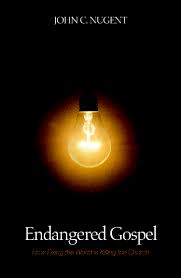
Frank Viola: Authors usually write a book out of a certain event which provoked it. Something they read, a discussion they had, an event they witnessed, etc. What specifically provoked you to write Endangered Gospel?
John Nugent: As I indicate in the introduction, Endangered Gospel grows out of our life together in Delta Community Christian Church. Our faithful moments help me see and experience the kingdom, and our unfaithful moments generate a greater longing for it. Our willingness to try and fail when we believe the Spirit may be leading us in a direction has been eye-opening and life-giving. I have had many friends and teachers along the way who have shown me truths in the Scriptures and helped me test the consistency of my ideas and my interpretations of the Scriptures.
I am grateful to the Ekklesia Project, which is a gathering of believers from diverse traditions whose testimonies have broadened my horizons and expanded my imagination. John Howard Yoder is, by far, the scholar who has made the biggest impact on my thinking. Gerhard Lohfink occupies a distant, but important second place when it comes to the ideas presented in this specific book. I’ve met neither of them personally.
That said, there is a sort of cultural tide shift in today’s church that has ignited my flame for writing this book at this time. For far too long many believers behaved as if the gospel had no social implications—as if it were all about spiritual salvation in the afterlife and had no significant bearing on life in this world.
Then, thankfully, because of the teaching of many scholars and pastors, the church in the last 50 years has awakened to the social significance of the gospel for the here and now. Yet recently it seems that people are so socially-aware and this-worldly in their concern that they risk embracing modern western liberal versions of social concern and world reform and then reframing the gospel in light of them.
As a result, missions has become less about filling every nook and cranny of this world with churches that embrace, display, and proclaim God’s kingdom and more about starting humanitarian organizations that somehow help to right all societal wrongs, independent of the life together of a kingdom-witnessing congregation. This is good and important work and I applaud it, but it simply does not square with the biblical vision for the church.
And then I run into Christians who find their true fulfillment in life in their jobs where they do good in the world by educating children, repairing falling infrastructures, and counseling those who are hurt. Yet church for them is just a scheduled event on their calendar of responsibilities. There are pastors who preach and writers who write as if kingdom work happens when we leave the assembly of faith and do something to improve the world around them. And people believe this because they are told by those who should know.
On top of that, it squares nicely with modern western politics and media, so they are affirmed and congratulated wherever they go about participating in worthy humanitarian causes. Their minds, energies, and passions have been captivated by a kingdom different from the one that Jesus inaugurated—and they don’t even realize it. For them, the two are one in the same. It is in this sense that the gospel is in danger and efforts to fix the world are killing the church.
The turning point for me was when, in preparation for a church retreat, I meditated upon all the NT passages that speak about the “nowness” of salvation/the kingdom/new life. The findings of that study are on pages 79-84 of Endangered Gospel. It dawned upon me with greater clarity and urgency than ever before that the reason God has not asked us to fix the world is because his strategy for his people is not to fix this world but to plant a new world right in the midst of the old one and to woo the old world to himself through it.
As followers of Jesus, the body of Christ, the new humanity—the new creation is us. We are the new world that has already broken into the old, and the conversion of those who are still enslaved to the old orders that are passing away is riding on our living out God’s new world in the here and now. Our life together is the only evidence God has left in this world that he has inaugurated a new world through Jesus.
So the church is not simply the sponsor/recruiter/financier/booster club for God’s kingdom work; the church IS God’s kingdom work. I think the early church understood that and so their lives overflowed with the joy of new life together in the kingdom. Somewhere along the way, many of us lost that. And while it seems like that last 50 years was bringing us back to it, instead it is increasingly being coopted by generic good-intentioned humanitarianism.
But I don’t want to squelch the fire, energy, and passion that this generation has for this world. I simply want to anchor it more firmly in the gospel of Jesus Christ, which means integrating it more fully into the people movement that has always stood at the center of God’s kingdom work in Scripture.
Frank Viola: Regarding the critics, what has their specific push-back been to the book and what has been your response?
John Nugent: The biggest criticism I have received is actually a misunderstanding of what I am saying. Some have assumed I am advocating withdrawal from this world. I am not. I am advocating active engagement with this world in the specific way God has asked us to engage it. Others have assumed I think churches should sever all ties with efforts to improve local neighborhoods in concrete ways.
Again, I am not. I am asking them to anchor those efforts in a robust life together as the body of Christ in ways that gives those neighborhoods a glimpse at the new creation into which God is inviting them. So I often tell stories of how our church actively engages our unbelieving neighbors in ways that showcase God’s kingdom. I also tell how Englewood Christian Church (Indianapolis, IN) is doing similar things as a church with paid staff, a building, and church-generated business ventures. It then usually becomes clear to critics that I am not advocating withdrawal or decrying all efforts to improve society.
Other criticisms have actually been compliments. I root my vision too much in the Bible. I assume too much that Paul and Jesus were about the same thing. I assume too much that God has one overarching plan that spans OT and NT. What I am calling people to is more than many will be willing to accept. Many have said, “I think you’re right, I’m just not willing to do it.” In such cases, I try to be pastorally sensitive. I did not change overnight. My church did not become what we are overnight, and we are not done becoming what God is making of us. God is patient. We all need to start where we are and take the next step forward toward God’s kingdom vision.
The Appendix of Endangered Gospel (203-220) is actually a compilation of real and anticipated criticisms. That’s a good place to go for more responses to different forms of push-back. I also have a Q&A section on my Endangered Gospel website where I answer two questions/criticisms—one having to do with my failure to discuss the implications of my thesis for Christian engagement with the environment and another with my suggestion that when the Bible commands us to love, it is mostly concerned that we love fellow believers and is not commanding a universal love for all people.
Frank Viola: A blogger once wrote me that they were disinterested in anything related to growing in Christ, knowing Him, and learning to live by His indwelling life because they were “hungry for justice.” Social justice was their driving motive for living the Christian life. Everything else was a matter of disinterest for them. This blogger went on to say that if someone is going to reach Millennial, they must focus on social justice. (That’s actually not true because many of my readers are Millennials, but there are a large number of Millennials who fit the description of this blogger.) What would you say to this blogger and those who would agree with their statement?
John Nugent: I would cite Matthew 6:33 “Strive first for God’s kingdom and God’s righteousness/justice.” God’s kingdom vision is a social justice vision. It is about filling this world with communities that reflect God’s economics/politics/justice. If they are truly hungry for justice and they truly believe that God is the authority on justice, then they should really fall in-line with God’s social justice vision.
But they should be warned: God’s global approach involves two different groups of leading agents. (1) He uses the powers and principalities to keep order in this world and maintain some semblance of justice among unredeemed people. But the order they keep is passing away and will ultimately be destroyed. Those who seek that order will inherit its future.
(2) God uses his kingdom community, the church, to exemplify the new social order inaugurated by Jesus. This order requires our full commitment because it totally rearranges our lives and priorities. It must come first. Christians are those who love this community above all others and strive grow into the fullness of Christ in every way. If a champion of justice doesn’t want to have anything to do with Christ’s body, then they need to think long and hard about whether they want to be Christian after all. I agree with what you say about millennials. They are not opposed to church rooted social justice, they just need a vision for it. Many who imitate the world’s form in Jesus’ name often end up getting burned out after a while.
That said, and I talk about this in my chapter on vocation, many Christians need to find employment. It helps them earn funds to pay their bills, provide for their families, and care for needy fellow believers. If someone has a passion for social justice beyond the church, I would recommend that they find their employment in some agency that does just that. But they must be careful not to confuse that work with kingdom work and then use their job to meet their need to feel important and socially engaged.
They should find that first and foremost in the church family. Their job must not come first. God will not be deceived. He knows where our passions really are and he will not admit into his kingdom those who seek his kingdom second, which ultimately means serving another master.
The good news is that one can serve in social justice fields in ways that grow out of, build upon, and point back to the justice of God they experience as a part of the new humanity. Some churches take this so far that they start community development organizations that are church run and staffed. These organizations grow out of the church’s life, are held accountable to the church, and are driven by kingdom principles learned together as the church.
They’re simply a vocational extension of the church’s life together. That’s one way to pay the bills and engage one’s neighbors in ways that give them a glimpse of the kingdom. Yet the kingdom they glimpse is not the social service that is rendered (e.g., clean water), but the community of faith serving together and loving one another in kingdom ways as they carried out their water purification practices.
Click here to order Endangered Gospel on discount (the book comes in paperback, hardcover, and Kindle).
UPDATE: John is my conversation partner in many of the episodes of the Insurgence podcast. We go into more depth on this subject.
Previous Post

December 13, 2016
Agree With Your Adversaries
Next Post
January 11, 2017 Post Expired
Browse Our Archives
Select a Category Uncategorized
Select a Month October 2026 September 2026 August 2026 July 2026 June 2026 May 2026 April 2026 March 2026 February 2026 January 2026 December 2025 November 2025 October 2025 September 2025 August 2025 July 2025 June 2025 May 2025 April 2025 March 2025 February 2025 January 2025 December 2024 November 2024 October 2024 September 2024 August 2024 July 2024 June 2024 May 2024 April 2024 March 2024 February 2024 January 2024 December 2023 November 2023 October 2023 September 2023 August 2023 July 2023 June 2023 May 2023 April 2023 March 2023 February 2023 January 2023 December 2022 November 2022 October 2022 September 2022 August 2022 July 2022 June 2022 May 2022 April 2022 March 2022 February 2022 January 2022 December 2021 November 2021 October 2021 September 2021 August 2021 July 2021 June 2021 May 2021 April 2021 March 2021 February 2021 January 2021 December 2020 November 2020 October 2020 September 2020 August 2020 July 2020 June 2020 May 2020 April 2020 March 2020 February 2020 January 2020 December 2019 November 2019 October 2019 September 2019 August 2019 July 2019 June 2019 May 2019 April 2019 March 2019 February 2019 January 2019 December 2018 November 2018 October 2018 September 2018 August 2018 July 2018 June 2018 May 2018 April 2018 March 2018 February 2018 January 2018 December 2017 November 2017 October 2017 September 2017 August 2017 July 2017 June 2017 May 2017 April 2017 March 2017 February 2017 January 2017 December 2016 November 2016 October 2016 September 2016 August 2016 July 2016 June 2016 May 2016 April 2016 March 2016 February 2016 January 2016 December 2015 November 2015 October 2015 September 2015 August 2015 July 2015 June 2015 May 2015 April 2015 March 2015 February 2015 January 2015 December 2014 November 2014 October 2014 September 2014 August 2014 July 2014 June 2014 May 2014 April 2014 March 2014 February 2014 January 2014 December 2013 November 2013 October 2013 September 2013 August 2013 July 2013 June 2013 May 2013 April 2013 March 2013 February 2013 January 2013 December 2012 November 2012 October 2012
TAKE THE
Religious Wisdom Quiz
Who saw a vision of a pot boiling toward the north?
Select your answer to see how you score.
Habakkuk Zechariah Isaiah Jeremiah
Related posts from The Deeper Journey

Letters on Living the Faith by C.S. Lewis



What Was Jesus’ Central Message?
TRENDING AT PATHEOS Evangelical

'Super Scam Me' Exposes AI Jon Bon Jovi...
Leslie Pickett believed she was in a relationship with Jon Bon Jovi....

The Brazilian Remake of Kendricks' 'Flywheel' Opens in...
“Flywheel,” the story that launched the Kendrick Brothers’ filmmaking career is getting...

The Dangers of Gradual Accommodation (Winking at Sin)
Recently, the “law of gradualness” resurfaced during the opening of a weeklong,...

The Iron Gates and the Lion of the...
Yesterday, I didn't finish my report about, well, yesterday. So I'll...

The Image: On the Horror of Capitalism and...
The Image Then went the Pharisees, and took counsel how they might...

We are approaching the date of our new American national holiday: October...
view all Evangelical blogs
Ad-Free & Subscriber Log-In Subscription Support
- About Us
- 2026 Calendar
- Videos
- Podcasts
- Library of World Religions
- Faith In Media Tracker
- Advertise With Us
- Write for Us
- Privacy Policy
- Terms of Service
- Do Not Sell My Data
- Contact Us
- Radiant Digital
- Manage Newsletter Subscriptions
- Unsubscribe From Notifications
- Sitemap
Copyright 2008-2026, Patheos. All rights reserved.
Subscription Support Ad-Free & Subscriber Log-In
Follow Patheos