
BuddhistCatholicContemplativeEvangelicalGeneral ChristianHinduJewishLatter-day SaintMuslimNew VisionsProgressive Christian
Beliefs
- Buddhist
- Catholic
- Contemplative
- Evangelical
- General Christian
- Hindu
- Jewish
- Latter-day Saint
- More Voices
- Muslim
- New Visions
- Pagan
- Progressive Christian
Topics
- Religion News
- Food and Religion
- Sports and Religion
- Religious Art
- Religious Music and Entertainment
- Religious Events
- History and Religion
- Style and Religion
- Politics and Religion
- Women in Religion
- Recreation Outdoors and Religion
- Business Finance and Religion
- Careers Workplace and Religion
- Education and Religion
- Family Parenting and Religion
- Health Fitness and Religion
- Home and Religion
- Relationships and Religion
- Technology and Religion
- Travel and Religion
Columnists
- Buddhist Columnists
- Business Finance and Religion Columnists
- Careers Workplace and Religion Columnists
- Catholic Columnists
- Contemplative Columnists
- Education and Religion Columnists
- Evangelists Columnists
- Family Parenting and Religion Columnists
- General Christian Columnists
- Health Fitness and Religion Columnists
- Hindu Columnists
- History and Religion Columnists
- Home and Religion Columnists
- Jewish Columnists
- More Voices Columnists
- Latter Day Columnists
- Muslim Columnists
- New Visions Columnists
- Nonreligious Columnists
- Pagan Columnists
- Politics and Religion Columnists
- Progressive Columnists
- Recreation Outdoors and Religion Columnists
- Relationships and Religion Columnists
- Religion News Columnists
- Religious Art Columnists
- Religious Events Columnists
- Religious Music and Entertainment Columnists
- Sports and Religion Columnists
- Style and Religion Columnists
- Technology and Religion Columnists
- Travel and Religion Columnists
- Women in Religion Columnists
Resource Library
- 2026 Calendar
- Library of World Religions
- The 100 Most Holy Places on Earth
- Patheos Answers
- Podcasts
- Videos
- Faith Leaders Database
- Anglican Episcopalian
- Bahai
- Baptist
- Buddhism
- Christianity
- Confucianism
- Eastern Orthodoxy
- Hinduism
- Holiness and Pentecostal
- ISKCON
- Islam
- Judaism
- Lutheran
- Methodist
- The Church of Jesus Christ of Latter-day Saints
- New Age
- Paganism
- Presbytarian and Reformed
- Protestantism
- Religion Behind the Scenes
- Roman Catholic
- Scientology
- Shia Islam
- Sikhism
- Sufism
- Sunni Islam
- Taoism
- Zen
- See all religions
Research Tools
 Ad-Free & Subscriber Log-In Subscription Support
Ad-Free & Subscriber Log-In Subscription Support
Follow Patheos 

- Trending:
- Forgiveness
- |
- Marriage
- |
- Consciousness
- |
- Death Penalty
- |
- Election
- |
- Halloween

- Home
- Evangelical
- New Commentary on Romans
New Commentary on Romans
Last updated on: December 1, 2022 at 7:00 am by Frank Viola
New Commentary on Romans 2022-11-30T09:07:21-04:00 Frank Viola
Patheos Explore the world's faith through different perspectives on religion and spirituality! Patheos has the views of the prevalent religions and spiritualities of the world.
Stephen Westerholm has just released an interesting new commentary on the book of Romans. It’s called Romans: Text, Readers, and the History of Interpretation.
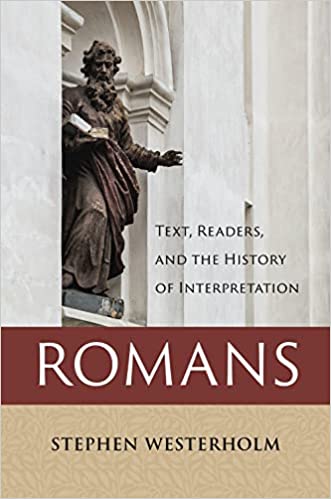
I caught up with Stephen to discuss his new book.
Enjoy!
There are countless books on Romans. Why did you choose to take the time to write yours?
That’s a very good question! I was writing a book on important figures in the history of biblical interpretation (Reading Sacred Scripture, to which my son Martin also contributed) when I was asked to contribute the volume on Romans for a new series of commentaries: the “Illuminations” series, to be published by Eerdmans.
I had never thought I would write a commentary on Romans (many good ones are already available), but the emphasis of this new series on the history of interpretation intrigued me, partly because it overlapped with what I was already doing, partly because it struck me that a commentary with this focus would indeed represent a distinct and important contribution to the literature on Romans.
So when I completed the first project, I began work on the second by studying important interpreters of Romans, from Origen to Barth. Although I originally intended the review of these interpreters to be included in the introduction to the commentary, it grew to such a length that I decided (together with Eerdmans) to make it a separate publication.
What’s unique about your book from that of others on Romans?
The commentary will be different from other commentaries in the importance it places on the history of interpretation. And although there are other books discussing how Romans has been interpreted over the centuries, I have included in my study a number of interesting figures generally overlooked in such studies.
In some cases, it is fascinating to see how people famous for other reasons read the epistle: people like Philipp Jakob Spener, the “father” of the Pietist movement; John Locke, the philosopher; Cotton Mather, minister at Boston’s Second Church from 1685-1728; and John William Colenso, who drew upon his experience as Bishop of Natal and his familiarity with the Zulu people in his interpretation of Paul. But since Paul was not writing for scholars, and the overwhelming majority of his readers are not scholars either, I have included more popular interpreters of Romans as well (such as Richard Baxter and Martyn Lloyd-Jones). I looked as well at early translations of Romans into English—and found it a fascinating study.
For non-scholars, what is the significance of the manuscript textual data that you write about in Part 1?
Of course, readers of Romans should focus, first and foremost, on the content of the letter, not on different readings found in the early manuscripts (they are almost always very minor in character). Indeed, most readers—including some of the epistle’s most important interpreters—simply ignore these variants. So a study of the textual history of Romans is not for everybody.
Nonetheless, consciously or unconsciously, all readers of Romans depend on the work of textual scholars who furnish the text they read (if they read the letter in Greek) or the text on which their English translations are based. It is only natural, then, that at least some readers of Romans will want to learn about the evidence that lies behind these Greek texts, and how the evidence is evaluated. For such readers, I have attempted to provide an accessible introduction to the textual history of Romans.
What exactly is the “Paul within Judaism” school?
“Paul within Judaism” scholars see Paul as living all his days “within Judaism,” observing even the “ritual” aspects of Jewish law, and never critiquing Judaism as such. They see his concern, in Romans as in Galatians, as limited to the issue how gentile “sinners” could become righteous and enjoy salvation; and any negative comments Paul makes about the Mosaic law are thought to reflect its effects solely on gentiles. Such a reading of the apostle only becomes possible if we understand his intended first readers, in Romans as in his other epistles, as exclusively gentile—and “Paul within Judaism” scholars insist on that point.
Why is understanding this “school” important for those who teach Romans?
That, of course, depends on the context in which they are teaching; but in contexts where students expect to learn about recent scholarship on Paul, this “school” should be included. And we all need to remember that, even as an apostle of Jesus Christ, Paul worshiped Israel’s God, studied the Jewish scriptures, and saw Jesus as the fulfillment of Israel’s hopes. His problem with Jews who did not believe in Christ was not that they were following the wrong “religion,” but that they failed to acknowledge recent crucial developments in the redemptive work of their God.
Summarize the interpretation of Romans during the patristic period.
I’m not sure that that can be done concisely. The three most significant patristic interpreters were Origen, Chrysostom, and Augustine—and each was very different from the other two. Of course, Romans was sacred scripture for them all, so they naturally looked to the letter for answers to issues in their own times: for example, how to respond to Marcion, the gnostics, and (in Augustine’s case) the Pelagians. But it should also be said that these three (and a number of other patristic interpreters) were serious students of Paul; and they were much closer to his world than we are. They may certainly be read with profit even today.
Summarize the interpretation of Romans during themedieval period.
The two medieval interpreters at whom I looked in some detail were Abelard and Aquinas; they are both worthy of study in their own right. But, as with Origen, Chrysostom, and Augustine, so Abelard and Aquinas were too different from each other to permit much in the way of generalizations.
Indeed, Abelard was too idiosyncratic, and Aquinas too brilliant, to be regarded as representative of their period in any case. Broadly speaking, however, the period was more concerned with preserving patristic interpretations than with advancing new (and therefore suspect!) interpretations. It is also important to note that, in western Europe during this period, the Bible was being studied almost exclusively in Latin, not Hebrew or Greek.
Summarize the interpretation of Romans during the 16th century.
It was first in the 16th century that the New Testament was published in Greek, and Protestant interpreters in particular based their study of Romans on the Greek text. Of course, the religious controversies of the period profoundly affected biblical interpretation—and Romans was a major battlefield!
But, again, serious students of Romans today can learn much from the theological insights of a Luther (however colored they were by conditions in his time) and the disciplined attention to the text of a Calvin. And (as noted above) early translations of the New Testament from Greek into English, and even from Latin into English, provide a fascinating subject for study. The achievements of William Tyndale in particular, under conditions of extreme duress and, ultimately, at the cost of his life, are simply astonishing.
Out of all the interpreters you feature during the Modern period, which one do you believe understood the true meaning of Romans the best?
That’s not an easy question to answer. I would say that Heinrich August Wilhelm Meyer was the most careful exegete—and that Karl Barth was far from it! On the other hand, there is a reason why Barth’s commentary is so famous; and no other commentator can match Barth inconveying Paul’s sense of what it means for a human being to live before God. And without that sense, one cannot understand Romans.
Why didn’t you cover the commentators of the 20th and 21st centuries like F. F. Bruce, Witherington, N. T. Wright, Longenecker, etc.?
Well, I did have to draw a line somewhere if I was ever to finish the project! But my survey was meant in the first place to prepare myself for writing, and my readers for appreciating, a commentary on Romans that places great emphasis on the history of interpretation. Most commentators engage with other interpreters from the 20th and 21st centuries, so there was no need to draw attention to them.But most of the interpreters at whom I have looked are passed over where the history of interpretation is not a focus; and I hope to draw on them in writing the commentary.
In your opinion, what are the 2 best books unveiling Romans written to the left brain?
The commentaries of Aquinas and Cranfield come immediately to mind!
In your opinion, what are the 2 best books unveiling Romans written to the heart/spirit?
That’s tricky; perhaps Luther’s various treatments of Romans (not just his commentary) and Barth’s commentary—though some will say that those choices reveal more about me than about Luther and Barth!
During the writing of your book list three “aha” moments that opened your eyes to see Romans like you hadn’t previously.
I don’t know if these qualify as “aha” moments, but I was particularly impressed by Aquinas’s disciplined approach to unfolding Paul’s argument; by Luther’s personal engagement and wrestling with the text; and by Barth’s insistence that we come to Romans not to learn about Paul, but to learn about the God of whom he writes.
I can only hope and pray for grace and strength to complete the commentary I have begun, and that I and my readers will gain a better grasp of Paul’s argument, will wrestle seriously with its implications, and will come to know better what it means to live before God as followers of Jesus Christ.
Previous Post

November 30, 2022
Breaking News: 3 Important Updates
Browse Our Archives
Select a Category Uncategorized
Select a Month October 2026 September 2026 August 2026 July 2026 June 2026 May 2026 April 2026 March 2026 February 2026 January 2026 December 2025 November 2025 October 2025 September 2025 August 2025 July 2025 June 2025 May 2025 April 2025 March 2025 February 2025 January 2025 December 2024 November 2024 October 2024 September 2024 August 2024 July 2024 June 2024 May 2024 April 2024 March 2024 February 2024 January 2024 December 2023 November 2023 October 2023 September 2023 August 2023 July 2023 June 2023 May 2023 April 2023 March 2023 February 2023 January 2023 December 2022 November 2022 October 2022 September 2022 August 2022 July 2022 June 2022 May 2022 April 2022 March 2022 February 2022 January 2022 December 2021 November 2021 October 2021 September 2021 August 2021 July 2021 June 2021 May 2021 April 2021 March 2021 February 2021 January 2021 December 2020 November 2020 October 2020 September 2020 August 2020 July 2020 June 2020 May 2020 April 2020 March 2020 February 2020 January 2020 December 2019 November 2019 October 2019 September 2019 August 2019 July 2019 June 2019 May 2019 April 2019 March 2019 February 2019 January 2019 December 2018 November 2018 October 2018 September 2018 August 2018 July 2018 June 2018 May 2018 April 2018 March 2018 February 2018 January 2018 December 2017 November 2017 October 2017 September 2017 August 2017 July 2017 June 2017 May 2017 April 2017 March 2017 February 2017 January 2017 December 2016 November 2016 October 2016 September 2016 August 2016 July 2016 June 2016 May 2016 April 2016 March 2016 February 2016 January 2016 December 2015 November 2015 October 2015 September 2015 August 2015 July 2015 June 2015 May 2015 April 2015 March 2015 February 2015 January 2015 December 2014 November 2014 October 2014 September 2014 August 2014 July 2014 June 2014 May 2014 April 2014 March 2014 February 2014 January 2014 December 2013 November 2013 October 2013 September 2013 August 2013 July 2013 June 2013 May 2013 April 2013 March 2013 February 2013 January 2013 December 2012 November 2012 October 2012
TAKE THE
Religious Wisdom Quiz
Who was the strongest man in the Bible?
Select your answer to see how you score.
Samson David Adam John
Related posts from The Deeper Journey

Letters on Living the Faith by C.S. Lewis



What Was Jesus’ Central Message?
TRENDING AT PATHEOS Evangelical

In one sense walking into Westminster Abbey is like walking down the...

'Super Scam Me' Exposes AI Jon Bon Jovi...
Leslie Pickett believed she was in a relationship with Jon Bon Jovi....

The Brazilian Remake of Kendricks' 'Flywheel' Opens in...
“Flywheel,” the story that launched the Kendrick Brothers’ filmmaking career is getting...

The Dangers of Gradual Accommodation (Winking at Sin)
Recently, the “law of gradualness” resurfaced during the opening of a weeklong,...

The Iron Gates and the Lion of the...
Yesterday, I didn't finish my report about, well, yesterday. So I'll...

The Image: On the Horror of Capitalism and...
The Image Then went the Pharisees, and took counsel how they might...
view all Evangelical blogs
Ad-Free & Subscriber Log-In Subscription Support
- About Us
- 2026 Calendar
- Videos
- Podcasts
- Library of World Religions
- Faith In Media Tracker
- Advertise With Us
- Write for Us
- Privacy Policy
- Terms of Service
- Do Not Sell My Data
- Contact Us
- Radiant Digital
- Manage Newsletter Subscriptions
- Unsubscribe From Notifications
- Sitemap
Copyright 2008-2026, Patheos. All rights reserved.
Subscription Support Ad-Free & Subscriber Log-In
Follow Patheos