
BuddhistCatholicContemplativeEvangelicalGeneral ChristianHinduJewishLatter-day SaintMuslimNew VisionsProgressive Christian
Beliefs
- Buddhist
- Catholic
- Contemplative
- Evangelical
- General Christian
- Hindu
- Jewish
- Latter-day Saint
- More Voices
- Muslim
- New Visions
- Pagan
- Progressive Christian
Topics
- Religion News
- Food and Religion
- Sports and Religion
- Religious Art
- Religious Music and Entertainment
- Religious Events
- History and Religion
- Style and Religion
- Politics and Religion
- Women in Religion
- Recreation Outdoors and Religion
- Business Finance and Religion
- Careers Workplace and Religion
- Education and Religion
- Family Parenting and Religion
- Health Fitness and Religion
- Home and Religion
- Relationships and Religion
- Technology and Religion
- Travel and Religion
Columnists
- Buddhist Columnists
- Business Finance and Religion Columnists
- Careers Workplace and Religion Columnists
- Catholic Columnists
- Contemplative Columnists
- Education and Religion Columnists
- Evangelists Columnists
- Family Parenting and Religion Columnists
- General Christian Columnists
- Health Fitness and Religion Columnists
- Hindu Columnists
- History and Religion Columnists
- Home and Religion Columnists
- Jewish Columnists
- More Voices Columnists
- Latter Day Columnists
- Muslim Columnists
- New Visions Columnists
- Nonreligious Columnists
- Pagan Columnists
- Politics and Religion Columnists
- Progressive Columnists
- Recreation Outdoors and Religion Columnists
- Relationships and Religion Columnists
- Religion News Columnists
- Religious Art Columnists
- Religious Events Columnists
- Religious Music and Entertainment Columnists
- Sports and Religion Columnists
- Style and Religion Columnists
- Technology and Religion Columnists
- Travel and Religion Columnists
- Women in Religion Columnists
Resource Library
- 2026 Calendar
- Library of World Religions
- The 100 Most Holy Places on Earth
- Patheos Answers
- Podcasts
- Videos
- Faith Leaders Database
- Anglican Episcopalian
- Bahai
- Baptist
- Buddhism
- Christianity
- Confucianism
- Eastern Orthodoxy
- Hinduism
- Holiness and Pentecostal
- ISKCON
- Islam
- Judaism
- Lutheran
- Methodist
- The Church of Jesus Christ of Latter-day Saints
- New Age
- Paganism
- Presbytarian and Reformed
- Protestantism
- Religion Behind the Scenes
- Roman Catholic
- Scientology
- Shia Islam
- Sikhism
- Sufism
- Sunni Islam
- Taoism
- Zen
- See all religions
Research Tools
 Ad-Free & Subscriber Log-In Subscription Support
Ad-Free & Subscriber Log-In Subscription Support
Follow Patheos 

- Trending:
- Forgiveness
- |
- Marriage
- |
- Consciousness
- |
- Death Penalty
- |
- Election
- |
- Halloween

- Home
- Evangelical
- A Week in the Life of Rome
A Week in the Life of Rome
Last updated on: August 16, 2022 at 12:01 am by Frank Viola
A Week in the Life of Rome 2022-08-15T09:15:59-04:00 Frank Viola
Patheos Explore the world's faith through different perspectives on religion and spirituality! Patheos has the views of the prevalent religions and spiritualities of the world.
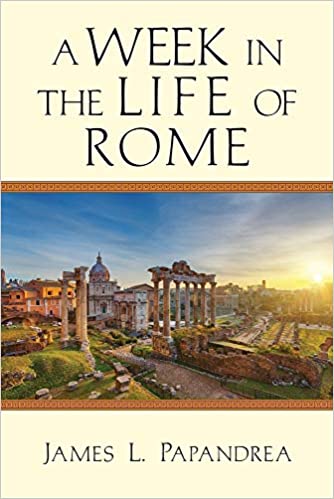
James L. Papandrea has written a book entitled A Week in the Life of Rome (Downers Grove, IL: InterVarsity Press, 2019).
Recently, I caught up with James to discuss the book.
Enjoy!
How long did it take you to write this book?
Well, in one sense it took me my whole career, since I think everything I’ve ever studied has prepared me to write this book.
My PhD is in the history and theology of the early Church, as well as New Testament interpretation, and the history of the Roman Empire, so this book is really the combination of those three fields. But to answer the question more precisely, I think with the research and writing, I spent over a year on this book.
List 3 “aha” moments that shed light on the New Testament as you did your research.
I think the greatest “aha” moments for me were in connecting what we see in the text of the New Testament with the actual places in Rome.
So when I was figuring out where to place the house churches in the story, they each correspond to a real place where we know some of the earliest Christian worship took place – and these are places where I have been, places where I have prayed.
So now when I lead pilgrimages to Rome, I can show people who have read the book – this is where Stachys and Maria’s house was in the story. This is where Pudens’ house was in the story, etc.
Another “aha” moment was when I did the math and realized that Clement of Rome, the author of one of our earliest patristic documents outside of the New Testament, was actually still a slave while he was the bishop of Rome! That debunks a lot of misconceptions about the hierarchy of the Church.
So when I wrote A Week in the Life of Rome, which takes place in the year 50 AD, I made the future Pope Clement a young slave boy, tugging at the sleeves of the apostles.
And then I guess there’s the realization that people back then didn’t have forks or minutes.
I’ve read that the population of Rome in Paul’s day was around one million. I believe in your book you say it was 500,000. Why the discrepancy and what do you consider to be the best source for the population?
The truth is, we don’t really know for sure what the population was. There are historians who work on those things more specifically, and I surveyed their books, but even they are making their best guesses.
So the estimates range from less than half a million, up to one million. If I remember right, I made the decision to go with the lower end of the range because when I had done my research for my doctoral dissertation, I had come to the conclusion that the population of Rome was a million in the third century, and so I decided it must have been less in the first century.
I think it’s fair to assume the population of Rome increased from the first to the third century.
Share the context and setting of the book.
The story takes place in the year 50 AD, which is about seven years before Paul wrote his letter to the Romans.
We know that there was a house church meeting in the home of Priscilla and Aquila.
In Romans 16:3, Paul says that Priscilla and Aquila “risked their necks” for him. Giving it your best educated guess (as we can’t be sure), what do you think this COULD have referred to? How might have they risked their necks for him and when?
If I had to guess, maybe they protected him or hid him when someone was after him to try to arrest him or something.
It is an intriguing question. The interesting thing is that, for all we know about Paul, I found myself writing a story in which Paul doesn’t even enter the picture, because I was writing the story of the church at Rome, at a time before Paul had even been to Rome.
Also, can you share a few examples of why Seneca and Juvenal felt this way about the city? They said things like it was a cesspool of iniquity and a filthy sewer.
Juvenal was a kind of a moralist, so even though he was a pagan, he wants to hold people to a certain standard of ethics.
I think they are both philosophically-minded enough to believe that truly enlightened people do not necessarily just indulge their baser appetites, and I think this is what they saw happening in Rome.
Juvenal even criticized abortion – not because he thought abortion was morally wrong, but because he thought women who had abortions were too vain and too lazy to want to carry children, and he thought it was good for Rome to have more children, or at least sons.
Can you give us some examples of how your book sheds light on the New Testament story in the book of Acts?
The last time we see Peter in Acts (chapter 12), he has miraculously escaped from prison, and made his way to the house of Mary, the mother of Mark, where Rhoda is their servant.
What happened to Peter? How did Mark get to Rome? I answered these questions by speculating that Mary smuggled Peter out of Judea to Rome, bringing her son (who would later write the Gospel According to Mark) and her servant with her.
Also, there are a lot of cultural concepts that are mentioned in the New Testament as though the reader should know what they are or what they mean, but we live two thousand years removed from that world.
So this book bridges the gap by explaining things that allow the non-scholar to really understand what’s going on. Things like the way people counted time and the hours of the day, coins and money, Roman marriage, houses and apartments, Roman baths, pagan religion, what Roman meals were like, games and circuses, etc. All of this and more is explained in the book.
Finally, I use all the results of my research into the early Church to shed light on the state of Christian belief and practice in the first century. Readers will really see the first century Church, “from the inside” as it were.
What else would you like potential readers to know about your book?
On the one hand, I think that too many people read the New Testament as though all you need to study the New Testament is what’s in the New Testament.
That’s a grave error, because there is a lot of the context that you can’t really understand without also studying the Roman Empire, and the Early Church.
This book brings together all of that, to give a more complete picture of what’s behind the New Testament, and what kind of life the early Christians lived.
On the other hand, it can’t be emphasized enough that we find ourselves in a very similar situation to the early Christians, in that we live in a culture that is constantly forcing us to choose between Christ and Caesar.
I think the example of the early Christians is invaluable for anyone who wants to follow Christ today.
Previous Post

August 15, 2022
WISDOM: CAPTURING THE POWER OF OUR WORDS
Next Post
September 15, 2022 The CSB Spurgeon Study Bible
Browse Our Archives
Select a Category Uncategorized
Select a Month October 2026 September 2026 August 2026 July 2026 June 2026 May 2026 April 2026 March 2026 February 2026 January 2026 December 2025 November 2025 October 2025 September 2025 August 2025 July 2025 June 2025 May 2025 April 2025 March 2025 February 2025 January 2025 December 2024 November 2024 October 2024 September 2024 August 2024 July 2024 June 2024 May 2024 April 2024 March 2024 February 2024 January 2024 December 2023 November 2023 October 2023 September 2023 August 2023 July 2023 June 2023 May 2023 April 2023 March 2023 February 2023 January 2023 December 2022 November 2022 October 2022 September 2022 August 2022 July 2022 June 2022 May 2022 April 2022 March 2022 February 2022 January 2022 December 2021 November 2021 October 2021 September 2021 August 2021 July 2021 June 2021 May 2021 April 2021 March 2021 February 2021 January 2021 December 2020 November 2020 October 2020 September 2020 August 2020 July 2020 June 2020 May 2020 April 2020 March 2020 February 2020 January 2020 December 2019 November 2019 October 2019 September 2019 August 2019 July 2019 June 2019 May 2019 April 2019 March 2019 February 2019 January 2019 December 2018 November 2018 October 2018 September 2018 August 2018 July 2018 June 2018 May 2018 April 2018 March 2018 February 2018 January 2018 December 2017 November 2017 October 2017 September 2017 August 2017 July 2017 June 2017 May 2017 April 2017 March 2017 February 2017 January 2017 December 2016 November 2016 October 2016 September 2016 August 2016 July 2016 June 2016 May 2016 April 2016 March 2016 February 2016 January 2016 December 2015 November 2015 October 2015 September 2015 August 2015 July 2015 June 2015 May 2015 April 2015 March 2015 February 2015 January 2015 December 2014 November 2014 October 2014 September 2014 August 2014 July 2014 June 2014 May 2014 April 2014 March 2014 February 2014 January 2014 December 2013 November 2013 October 2013 September 2013 August 2013 July 2013 June 2013 May 2013 April 2013 March 2013 February 2013 January 2013 December 2012 November 2012 October 2012
TAKE THE
Religious Wisdom Quiz
What does "Bethany" mean in Hebrew?
Select your answer to see how you score.
House of affliction House of mercy House of stone House of bread
Related posts from The Deeper Journey

Letters on Living the Faith by C.S. Lewis



What Was Jesus’ Central Message?
TRENDING AT PATHEOS Evangelical

'Super Scam Me' Exposes AI Jon Bon Jovi...
Leslie Pickett believed she was in a relationship with Jon Bon Jovi....

The Brazilian Remake of Kendricks' 'Flywheel' Opens in...
“Flywheel,” the story that launched the Kendrick Brothers’ filmmaking career is getting...

The Dangers of Gradual Accommodation (Winking at Sin)
Recently, the “law of gradualness” resurfaced during the opening of a weeklong,...

The Iron Gates and the Lion of the...
Yesterday, I didn't finish my report about, well, yesterday. So I'll...

The Image: On the Horror of Capitalism and...
The Image Then went the Pharisees, and took counsel how they might...

We are approaching the date of our new American national holiday: October...
view all Evangelical blogs
Ad-Free & Subscriber Log-In Subscription Support
- About Us
- 2026 Calendar
- Videos
- Podcasts
- Library of World Religions
- Faith In Media Tracker
- Advertise With Us
- Write for Us
- Privacy Policy
- Terms of Service
- Do Not Sell My Data
- Contact Us
- Radiant Digital
- Manage Newsletter Subscriptions
- Unsubscribe From Notifications
- Sitemap
Copyright 2008-2026, Patheos. All rights reserved.
Subscription Support Ad-Free & Subscriber Log-In
Follow Patheos