
BuddhistCatholicContemplativeEvangelicalGeneral ChristianHinduJewishLatter-day SaintMuslimNew VisionsProgressive Christian
Beliefs
- Buddhist
- Catholic
- Contemplative
- Evangelical
- General Christian
- Hindu
- Jewish
- Latter-day Saint
- More Voices
- Muslim
- New Visions
- Pagan
- Progressive Christian
Topics
- Religion News
- Food and Religion
- Sports and Religion
- Religious Art
- Religious Music and Entertainment
- Religious Events
- History and Religion
- Style and Religion
- Politics and Religion
- Women in Religion
- Recreation Outdoors and Religion
- Business Finance and Religion
- Careers Workplace and Religion
- Education and Religion
- Family Parenting and Religion
- Health Fitness and Religion
- Home and Religion
- Relationships and Religion
- Technology and Religion
- Travel and Religion
Columnists
- Buddhist Columnists
- Business Finance and Religion Columnists
- Careers Workplace and Religion Columnists
- Catholic Columnists
- Contemplative Columnists
- Education and Religion Columnists
- Evangelists Columnists
- Family Parenting and Religion Columnists
- General Christian Columnists
- Health Fitness and Religion Columnists
- Hindu Columnists
- History and Religion Columnists
- Home and Religion Columnists
- Jewish Columnists
- More Voices Columnists
- Latter Day Columnists
- Muslim Columnists
- New Visions Columnists
- Nonreligious Columnists
- Pagan Columnists
- Politics and Religion Columnists
- Progressive Columnists
- Recreation Outdoors and Religion Columnists
- Relationships and Religion Columnists
- Religion News Columnists
- Religious Art Columnists
- Religious Events Columnists
- Religious Music and Entertainment Columnists
- Sports and Religion Columnists
- Style and Religion Columnists
- Technology and Religion Columnists
- Travel and Religion Columnists
- Women in Religion Columnists
Resource Library
- 2026 Calendar
- Library of World Religions
- The 100 Most Holy Places on Earth
- Patheos Answers
- Podcasts
- Videos
- Faith Leaders Database
- Anglican Episcopalian
- Bahai
- Baptist
- Buddhism
- Christianity
- Confucianism
- Eastern Orthodoxy
- Hinduism
- Holiness and Pentecostal
- ISKCON
- Islam
- Judaism
- Lutheran
- Methodist
- The Church of Jesus Christ of Latter-day Saints
- New Age
- Paganism
- Presbytarian and Reformed
- Protestantism
- Religion Behind the Scenes
- Roman Catholic
- Scientology
- Shia Islam
- Sikhism
- Sufism
- Sunni Islam
- Taoism
- Zen
- See all religions
Research Tools
 Ad-Free & Subscriber Log-In Subscription Support
Ad-Free & Subscriber Log-In Subscription Support
Follow Patheos 

- Trending:
- Forgiveness
- |
- Marriage
- |
- Consciousness
- |
- Death Penalty
- |
- Election
- |
- Halloween

- Home
- Evangelical
- Interview with Leonard Sweet – More Jesus Books
Interview with Leonard Sweet – More Jesus Books
Last updated on: October 12, 2025 at 8:15 am by Frank Viola
Interview with Leonard Sweet – More Jesus Books 2025-10-12T08:15:17-04:00 Frank Viola
Patheos Explore the world's faith through different perspectives on religion and spirituality! Patheos has the views of the prevalent religions and spiritualities of the world.
As most of you know, Leonard Sweet and I teamed up to launch four cornerstone resources for the body of Christ. They are:
A Jesus Manifesto for the 21st Century (online document)
Jesus Manifesto (book by Thomas Nelson)
Jesus: A Theography (book by Thomas Nelson)
Jesus Speaks (book by Thomas Nelson)
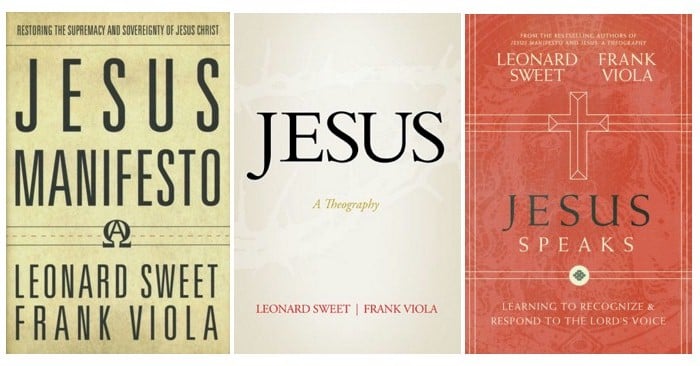
In all of these works, Sweet and I take what I have coined as a “Christopheric” approach by exalting Jesus beyond the stratosphere and addressing a glaring problem that has plagued the body of Christ for centuries.
The “Christopheric” view goes beyond Christocentricity. For sure, Christ is central. But He’s also in the circumference. And on the edges and margins.
He fills the entire picture. Not just in the Bible, but in the cosmos.
The “Christopheric” perspective is prominent in Pauline theology, where Christ is described as the one “in whom all things hold together” (Colossians 1:17) and who is “all in all” (Colossians 3:11).
The language of “Christ as everything” suggests that all of creation is oriented toward, sustained by, and ultimately fulfilled in Christ. In spiritual terms, Christ can be seen as the blueprint and unifying center for the universe, with God’s purpose culminating in and through the incarnation and ongoing presence of Christ in all things.
In light of that staggering view of Christ, Jesus has been relegated to a footnote or a mascot in much of Christianity today. His greatness has been diminished and dismissed and His all-inclusiveness ignored.
The above works by Sweet and me, and a large number of resources related to them can be found on the Jesus Trilogy website at frankviola.org/jesustrilogy
Jesus Christ is the center of the universe, the origin and destiny of all creation, and the meaning of all Scripture (not just the Gospels).
Since Len and I released these four resources together, we have continued to exalt and unveil Christ through our work independently.
For instance, my entire book catalog pulls out some of the threads in our “Jesus Trilogy” and expands them into full-orbed, stand-alone treatments. (Examples: Jesus Now, God’s Favorite Place on Earth, The Day I Met Jesus, etc.)
Len has done the same in his works, something I applaud.
For us, Jesus isn’t just a fad that we’ve moved on from to other things. There’s NOTHING outside of Christ in the Christian faith or the biblical lexicon.
On this score, Sweet has recently released two books on Jesus. One is called Jesus Human. The other Jesus Design.
I caught up with Len recently to discuss these two companion volumes.
Enjoy!
Jesus Human: Primer for a Common Humanity
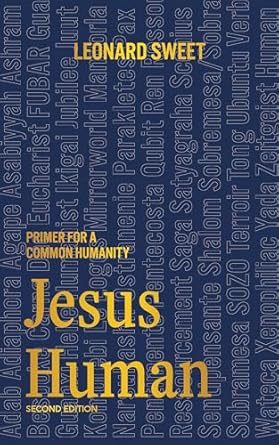
Every book has a big idea. What is the big idea behind Jesus Human?
The big idea is this: we are in an anthropological emergency. The world no longer knows what it means to be human. The ultimate pandemic is not COVID but dehumanization. Jesus Human argues that Jesus—the “Human One”—is the consummate human being, the prototype Adam of a new humanity. He shows us how to be fully alive, fully human, and fully God-reflecting.
David Livingstone Smith (in Less Than Human) shows how dehumanization fuels atrocities. Do you agree with his take that elites spread these ideologies intentionally?
Smith’s brilliance is in showing that dehumanization is less cloak-and-dagger conspiracy and more systemic contagion. Those in power deploy propaganda, rhetoric, and cultural scripts that strip people of dignity so they can be exploited or eliminated. But underneath psychology and politics lies the deeper root: sin. The twentieth century alone birthed a “new species of sub-humanity”—over 108 million killed in its wars. Dehumanization is humanity’s oldest heresy and deadliest addiction.
You’ve reframed the word “humanist,” often seen as anti-Christian. Explain.
The incarnation is the most “humanist” act in history. God honored humanity by becoming human, by choosing the title “The Human One.” Christianity at its core is not anti-humanist but radically pro-human. Jesus is God’s vote of confidence in human life. To follow him is to recover—not abandon—our humanity.
You ask, “What if Jesus is the new Adam, the image-bearer of a new humanity?” Why does this matter?
Because if Jesus is the archetype of true humanity, then our identity crisis ends in him. Pilate got it right when he said, “Behold, the Human.” Jesus is not just our way to God; he is God’s way to show us ourselves. In him we learn not just who God is, but who we are meant to be.
In your chapter Becoming a Jesus Human, you say Jesus is the flowering of God’s dream for humanity—the dream of Jubilee. What does that mean?
Jubilee is God’s rhythm of restoration: debts canceled, slaves freed, land returned, lives reset. Jesus embodies Jubilee. He is our release, our reset, our restoration. In him God’s dream of humanity—whole, reconciled, liberated—takes root and blossoms. Jesus is not just our Sabbath; he is our Jubilee.
The carol asks the shepherds, “Why this jubilee? Why your joyous strains prolong?” The answer is found not only in the manger but in the mission. When Jesus later preached his first sermon in Nazareth, he unfurled a five-point manifesto that climaxed with Jubilee: “to proclaim the year of the Lord’s favor.” The “gladsome tidings” sung over Bethlehem’s fields were not just angelic harmonies; they were prophetic announcements. The angels sang Jubilee into the world, and Jesus lived Jubilee into existence.
Christmas carols ask the question. Jesus gives the answer. The shepherds heard it in song; we see it in his life: debts forgiven, captives freed, creation restored. The Gloria of heaven becomes the Jubilee of earth. Christmas sang Jubilee, the Cross sealed Jubilee, Pentecost spread Jubilee, and the Table lets us taste Jubilee.
Part Two is entitled You Need the Divine to Be Human. What do you mean?
It takes God to make us human. Humanity is not self-generated; it’s a gift of relationship. God breathed life into dust, and only that breath makes us human. To be human is to participate in the triune life of God. So the call is not to transcend our humanity but to receive it back from Jesus, renewed and rehumanized.
In your We Dream section, you argue that the kingdom of God is not politics, which is “downstream of culture.” Expand this.
Politics rearranges the furniture; the kingdom renovates the house. Culture is the riverbed; politics is the water that runs through it. Jesus goes deeper than ballots and borders—he addresses the imaginations, the loves, the dreams that drive culture. Until those are transformed, politics will always be downstream, never upstream.
You list 11 rules of “adiaphoric human engagement.” First, what does adiaphora mean, and how does it apply to the internet age?
Adiaphora means “things indifferent”—matters not essential to salvation but vital to civility. My 11 rules are practices for how to disagree without dehumanizing. In today’s toxic online world, especially among Christians, we need them more than ever: resist demonizing, listen before labeling, refuse click-bait cruelty. The internet doesn’t need more warriors; it needs more Jesus humans.
Designer Jesus: The Lifestory of a Disciple
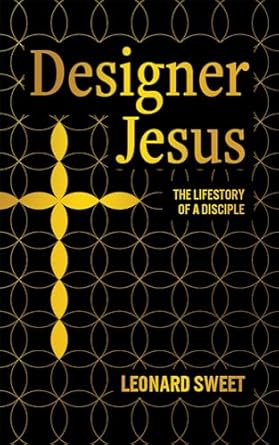
What is the big idea behind Designer Jesus?
The big idea is this: Jesus is not only Savior; he is the designer of our humanity. He is the model of authentic discipleship and the blueprint for a flourishing life. The title is a double entendre—our culture wants a “designer Jesus” tailored to our tastes, but in reality Jesus is the true designer, shaping us into a beautiful, bespoke humanity. In sum, discipleship formation is really nothing more nor less than Christ formation or human formation. In the 21st century, the ultimate apologetics is aesthetics.
You contrast human “blueprints” for renewal with “God’s fingerprints” and “the tracks of the Spirit.” How so?
Our blueprints are rigid—cookie-cutter strategies, one-size-fits-all programs. God’s fingerprints are unique, intimate, always personal. The Spirit leaves tracks, not templates. Renewal isn’t manufactured; it’s Spirit-streamed. Discipleship formation is not us fitting into a program but Christ being formed in us.
You write, “For Christians to be anti-aesthetic is to be anti-human.” What do you mean?
Beauty is not decoration; it’s vocation. We were created in the image of a Creator. To dull our aesthetic senses is to dull our moral senses. To numb beauty is to numb conscience. To be human is to be art in God’s gallery. Heaven is the ultimate art gallery.
What’s your take on the Shroud of Turin?
I’ve gone hot and cold on it. Part of me doesn’t want it to be authentic—because faith doesn’t need proof. Yet the older I get, the more I see that every attempt to debunk it leaves the Shroud more resilient. I now lean toward believing it may be authentic. But whether or not it is “real,” it certainly is true.
You end each chapter with “Studio Life.” Why?
Because discipleship is artistry. “Studio Life” is where I invite readers to take the material off the page and into the studio of their lives. The questions are prompts, not prescriptions—designed to help readers sketch their own canvas of Christ-formation.
If someone reads the book cover to cover, what do you hope will change in them?
That they’ll move beyond status-quo Christianity into Jesus-streamed living. That they’ll stop trying to fit Jesus into their life and start letting Jesus design their life. I want them to close the book saying: “I want to live a designer life, not a default life. I want a life that does more than look like Jesus. I want Jesus to live in and through me and share his resurrection life with me.”
What were some “aha” moments for you while researching?
One big “aha” was rediscovering that Jesus is not anti-world but pro-life—life in all its color, texture, and creativity. Another was realizing that discipleship is less about information and more about imagination. Following Jesus is not primarily a classroom but a studio, where life is designed, shaped, and beautified by the hands of the Master Artist. One more “aha?” That heaven is an art gallery.
Previous Post
October 6, 2025
Rethinking Pacifism
Next Post

October 27, 2025 Beyond the Political Binary: Restoring the Kingdom Message
Recent Comments
"I get, the more I see that every attempt to debunk it leaves the Shroud ..."
Interview with Leonard Sweet – More ..."
"You're referring to the way things happen in the Industrial Religious Complex. I'm speaking about ..."
"Another insight is that young people want to start their own ministry and are not ..."
"You’re challenging the usual narratives and pointing us toward deeper, more nuanced perspectives. This is ..."
The Origins of Human Government and ..."
Browse Our Archives
Select a Category Uncategorized
Select a Month October 2026 September 2026 August 2026 July 2026 June 2026 May 2026 April 2026 March 2026 February 2026 January 2026 December 2025 November 2025 October 2025 September 2025 August 2025 July 2025 June 2025 May 2025 April 2025 March 2025 February 2025 January 2025 December 2024 November 2024 October 2024 September 2024 August 2024 July 2024 June 2024 May 2024 April 2024 March 2024 February 2024 January 2024 December 2023 November 2023 October 2023 September 2023 August 2023 July 2023 June 2023 May 2023 April 2023 March 2023 February 2023 January 2023 December 2022 November 2022 October 2022 September 2022 August 2022 July 2022 June 2022 May 2022 April 2022 March 2022 February 2022 January 2022 December 2021 November 2021 October 2021 September 2021 August 2021 July 2021 June 2021 May 2021 April 2021 March 2021 February 2021 January 2021 December 2020 November 2020 October 2020 September 2020 August 2020 July 2020 June 2020 May 2020 April 2020 March 2020 February 2020 January 2020 December 2019 November 2019 October 2019 September 2019 August 2019 July 2019 June 2019 May 2019 April 2019 March 2019 February 2019 January 2019 December 2018 November 2018 October 2018 September 2018 August 2018 July 2018 June 2018 May 2018 April 2018 March 2018 February 2018 January 2018 December 2017 November 2017 October 2017 September 2017 August 2017 July 2017 June 2017 May 2017 April 2017 March 2017 February 2017 January 2017 December 2016 November 2016 October 2016 September 2016 August 2016 July 2016 June 2016 May 2016 April 2016 March 2016 February 2016 January 2016 December 2015 November 2015 October 2015 September 2015 August 2015 July 2015 June 2015 May 2015 April 2015 March 2015 February 2015 January 2015 December 2014 November 2014 October 2014 September 2014 August 2014 July 2014 June 2014 May 2014 April 2014 March 2014 February 2014 January 2014 December 2013 November 2013 October 2013 September 2013 August 2013 July 2013 June 2013 May 2013 April 2013 March 2013 February 2013 January 2013 December 2012 November 2012 October 2012
TAKE THE
Religious Wisdom Quiz
Who was Isaac's wife?
Select your answer to see how you score.
Rachel Sarah Rebekah Leah
Related posts from The Deeper Journey


What Was Jesus’ Central Message?

Can Genuine Christians Learn From the Pagans?

Deconversion From Christianity
TRENDING AT PATHEOS Evangelical

Janie Learns the Way of the Cross: A...
Teaching children about Jesus' Passion can be challenging. Many parents and educators...

Looking For Good Catholic Writing - October 2026
He alone extends the heavens, and he walks upon the waves of...

In "Irreplaceable," our book on vocation and technology, Trevor Sutton and I...

I was strolling through the top floor of the brand new Parthenon...

What Does Gêvâh Mean For Kimberley Guifoyle &...
This week, a lot of the news is focused on Kimberly Guilfoyle....

INNER CIRCLE: Profound Mystery (Of Christ In All...
Ephesians 5:31-32 “For this reason, a man will leave his father and...
view all Evangelical blogs
What Are Your Thoughts?leave a comment
Ad-Free & Subscriber Log-In Subscription Support
- About Us
- 2026 Calendar
- Videos
- Podcasts
- Library of World Religions
- Faith In Media Tracker
- Advertise With Us
- Write for Us
- Privacy Policy
- Terms of Service
- Do Not Sell My Data
- Contact Us
- Radiant Digital
- Manage Newsletter Subscriptions
- Unsubscribe From Notifications
- Sitemap
Copyright 2008-2026, Patheos. All rights reserved.
Subscription Support Ad-Free & Subscriber Log-In
Follow Patheos