
BuddhistCatholicContemplativeEvangelicalGeneral ChristianHinduJewishLatter-day SaintMuslimNew VisionsProgressive Christian
Beliefs
- Buddhist
- Catholic
- Contemplative
- Evangelical
- General Christian
- Hindu
- Jewish
- Latter-day Saint
- More Voices
- Muslim
- New Visions
- Pagan
- Progressive Christian
Topics
- Religion News
- Food and Religion
- Sports and Religion
- Religious Art
- Religious Music and Entertainment
- Religious Events
- History and Religion
- Style and Religion
- Politics and Religion
- Women in Religion
- Recreation Outdoors and Religion
- Business Finance and Religion
- Careers Workplace and Religion
- Education and Religion
- Family Parenting and Religion
- Health Fitness and Religion
- Home and Religion
- Relationships and Religion
- Technology and Religion
- Travel and Religion
Columnists
- Buddhist Columnists
- Business Finance and Religion Columnists
- Careers Workplace and Religion Columnists
- Catholic Columnists
- Contemplative Columnists
- Education and Religion Columnists
- Evangelists Columnists
- Family Parenting and Religion Columnists
- General Christian Columnists
- Health Fitness and Religion Columnists
- Hindu Columnists
- History and Religion Columnists
- Home and Religion Columnists
- Jewish Columnists
- More Voices Columnists
- Latter Day Columnists
- Muslim Columnists
- New Visions Columnists
- Nonreligious Columnists
- Pagan Columnists
- Politics and Religion Columnists
- Progressive Columnists
- Recreation Outdoors and Religion Columnists
- Relationships and Religion Columnists
- Religion News Columnists
- Religious Art Columnists
- Religious Events Columnists
- Religious Music and Entertainment Columnists
- Sports and Religion Columnists
- Style and Religion Columnists
- Technology and Religion Columnists
- Travel and Religion Columnists
- Women in Religion Columnists
Resource Library
- 2026 Calendar
- Library of World Religions
- The 100 Most Holy Places on Earth
- Patheos Answers
- Podcasts
- Videos
- Faith Leaders Database
- Anglican Episcopalian
- Bahai
- Baptist
- Buddhism
- Christianity
- Confucianism
- Eastern Orthodoxy
- Hinduism
- Holiness and Pentecostal
- ISKCON
- Islam
- Judaism
- Lutheran
- Methodist
- The Church of Jesus Christ of Latter-day Saints
- New Age
- Paganism
- Presbytarian and Reformed
- Protestantism
- Religion Behind the Scenes
- Roman Catholic
- Scientology
- Shia Islam
- Sikhism
- Sufism
- Sunni Islam
- Taoism
- Zen
- See all religions
Research Tools
 Ad-Free & Subscriber Log-In Subscription Support
Ad-Free & Subscriber Log-In Subscription Support
Follow Patheos 

- Trending:
- Forgiveness
- |
- Marriage
- |
- Consciousness
- |
- Death Penalty
- |
- Election
- |
- Halloween

- Home
- Evangelical
- The Four in One Gospel of Jesus
The Four in One Gospel of Jesus
Last updated on: September 30, 2017 at 5:00 am by Frank Viola
The Four in One Gospel of Jesus 2017-09-26T10:52:17-04:00 Frank Viola
Patheos Explore the world's faith through different perspectives on religion and spirituality! Patheos has the views of the prevalent religions and spiritualities of the world.
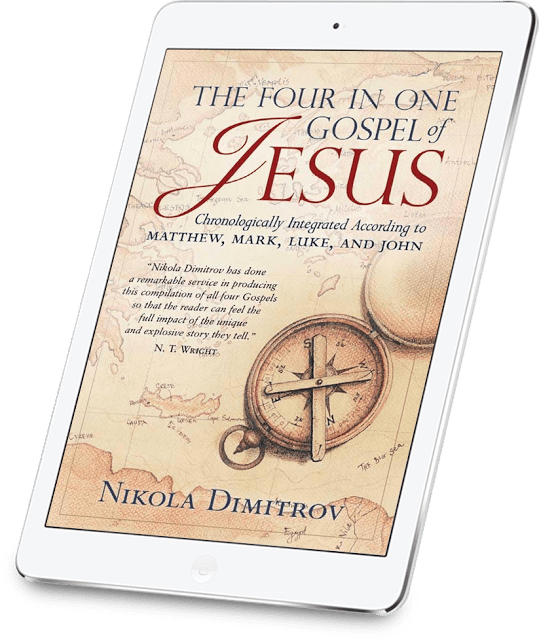
Nikola Dimitrov has joined the ranks of those who have put together a chronological integration (harmony) of the four Gospels.
I caught up with Nikola recently to talk to him about his new Gospel harmony, The Four in One Gospel of Jesus.
Enjoy!
Frank Viola: Tell us about your education, teaching history, and your work as a New Testament translator.
Nikola Dimitrov: My professional education is in the area of the English language. As soon as I graduated, I started translating audios, videos and books, of famous English speaking preachers and teachers. It was 1992 when I started, just 3 years after Communism fell in Bulgaria, and there was an enormous spiritual hunger for Christian materials. Almost nobody knew English at the time, so access to these materials was restricted for the church people. For the past 25 years I’ve translated nearly 1000 audio and video teachings, as well as more than 40 books, in the area of prayer, intercession, the Church as the Body of Christ, Christian history and theology, family, education, etc.
Along with my translations, as of 1994, I felt the call of God upon my life, to dig deeper into the Word of God and to start preaching and teaching it to the people the Lord would send me to. Doors started opening and I started a couple of churches, travelled around the country, helped with a Prison ministry and volunteered in a Charity, preaching a total of more than 1000 public sermons and lectures, as well as translating live for many foreign missionaries that would come to Bulgaria.
Since the year 2000, I assumed the responsibility of a Media ministry that would translate, publish and distribute Christian materials in Bulgaria, as well as I started teaching in an improvised Bible school in our mother church center. Today I lead two churches in two different locations and continue teaching, preaching, educating, translating and writing at full speed.
Frank Viola: A number of people have compiled books that compiled the Gospels together to create one cohesive story. One was Johnston M. Cheney (The Life of Christ in Stereo), and another is Robert Mounce (Jesus, In His Own Words). How is your book different?
Nikola Dimitrov: There are many similar attempts to make a Gospel Harmony, which are very nicely done, including the ones You are mentioning. The differences between them, and mine are:
1). All similar materials I have seen mix the stories that are the same in more than one Gospel in a selective fashion, using only the most important facts of a given story, to provide its essence. The Four in one Gospel of Jesus contains every single word and punctuation that is part of at least one of the Gospels. You get the fullness of each story, without missing the slightest detail. There is nothing added by me, nor there is anything taken out. If it is somewhere in one of the Gospels, it is also a part of The Four in One Gospel of Jesus – word for word.
2). Mine has full reference of every sentence, word and comma used, within the text itself, while all others I have seen are partial, putting their references at the end or beginning of each paragraph or even a number of paragraphs (like Robert Mounce), or use a very complicated structure of reference (like Johnston M. Cheney). With The Four in One Gospel of Jesus, every time a word or a phrase from another Gospel is used, there is a reference within the text itself, so, at any given point, one can put their finger somewhere in the text and immediately check from which Gospel that specific word, phrase or sentence comes.
3). The chronology I have used, to depict all events in the life of our Lord, is consistent with the most recognized sources in this area – Matthew Henry’s Tabular Harmony of the Gospels, The Orthodox Bible Harmony Chart, The International Standard Bible Encyclopedia and many others. The similar materials I have come in contact with either use a chart format, or, if in a Novel type of a free flow of text, have not included every single chronological event, but are combining events for deductive purposes.
4). Finally, my material underwent 15 cover to cover revisions by a whole team of professional editors, most of whom also recognized theologians and historians themselves. That’s why the book received the endorsements of people like Professor N.T. Wright, Dr. Kenneth Boa, Dr. William Murray, Dr. Jerry Newcombe, Dr. Sean McDowel (son of Josh McDowell) and that’s why the book has already become part of the Oxford Centre for Christian Apologetics Library.
Frank Viola: For readers who aren’t familiar with your book, share with us what it is and how it’s different from other Bibles.
Nikola Dimitrov: The Four in One Gospel of Jesus is a chronological and contextual blending of the four Gospels in the Bible. It’s fully referenced, meaning little numbers and Gospel names unobtrusively show where each blending comes from, and at the same time, it’s in a Novel format, allowing for a smooth reading.
Here’s a quick example:
The Gospel of Matthew says that Jesus touched the hand of Peter’s mother-in-law, and the fever left her (Matthew 8:15). Mark says this was not just a simple touch, but Jesus actually took her by the hand, and lifted her up; and immediately the fever left her (Mark 1:31). Luke adds something that is missing in both Matthew and Mark, namely that Jesus stood over her, and rebuked the fever; and it left her (Luke 4:39). The fact that the fever left Peter’s mother-in-law is the same, while each Gospel writer adds a new element to the “process” of her healing and thus, to the whole picture.
In The Four in One Gospel of Jesus this passage would look like this:
“Jesus came, stood over her, rebuked the fever, touched her hand, took her by the hand, and lifted her up; and immediately the fever left her”.
So, we get the complete picture by adding and mixing all the words and details that are unique in each of the four Gospels. When the chronology is applied to the whole story of the life of Jesus, The Four in One Gospel of Jesus emerges.
Frank Viola: What inspired the idea to create this particular book? And who is the primary audience?
Nikola Dimitrov: Ever since I became a believer and read for the first time Matthew, Mark, Luke and John, I couldn’t but notice some stories were repeated in more than one Gospel, but each one would use additional details not present in the former one. So, the idea came to me to combine the Gospels chronologically and contextually, so that the fullness of each story is accomplished, without the repetitions and without adding or taking away anything from the Bible text itself.
The second reason was that no unbeliever would read Matthew, Mark, Luke and John one right after another, but why not reading one whole story in a Novel format, so I just wanted to produce a material that could be used for a successful evangelism.
Finally, in a predominantly secular country, many people argue that the four gospels contradict each other and that disqualifies the credibility of the Bible. Some Christians even like to say that contradictions from different sources, when it comes to the same story, are actually proof of the credibility of that story. I do NOT believe that. That’s why, I wanted to combine the Gospels, so I could prove beyond any shadow of a doubt, that all these seeming “contradictions” are actually beautiful complementations, revealing the fullness of each story.
My primary audience is pastors, leaders, preachers, history lovers and everyday Bible readers, as well as unbelievers who get the book as a gift from their Christian relatives or friends.
Frank Viola: If someone were to ask you, “I’m a Christian who reads my Bible regularly. Why would I want to read your book? What benefit would I have in doing so?” How would you respond?
Nikola Dimitrov: Reading your Bible is an absolute must. Keep doing that. The Four in One Gospel of Jesus is NOT a substitute for the 4 gospels. Each of them has a specific purpose, because it was written to a specific audience. My material is rather an additional help material, which provides clarity and fullness to each story that repeats itself in more than one Gospel. And if You are like most readers of the Bible, You would read a story in Matthew and You would NOT go immediately to find the same story in Mark and Luke, You would continue reading Matthew until You reach Mark naturally, and then Luke, but by the time You reach the same story in Mark and Luke, which You read initially in Matthew, You would for sure have forgotten ALL the details in Matthew. The Four in One Gospel of Jesus fixes that.
Also, when You get to a more complicated story, like the story of the Resurrection, how do You decide which comes after which? Who saw Jesus first, after the Resurrection, who saw Him second, third, fourth, etc.? How many times people entered the tomb? How many times angels came and was it one angel, two angels or more? The Four in One Gospel of Jesus incorporates a unique chronology system, which puts everything in perspective, in a very easy to understand format. For example, the above story of the Resurrection follows the following logic:
- Early in the morning Mary Magdalene visits the tomb with some other women. They enter in and see that the body of Jesus is not there.
- Mary Magdalene runs to tell Peter and John, while the other women remain at the tomb and experience the two angels, who tell them Jesus has risen, so they are to go and tell the disciples. The women leave the tomb and on their way to the disciples they see Jesus. Mary Magdalene couldn’t have been with them, because when she goes to Peter and John, she tells them somebody has taken the Lord and she has no idea where they put Him. Moreover, when she sees Jesus, before recognizing Him, she thinks He is the gardener. So, at that point, she couldn’t have seen the angels the other women saw, or she would know Jesus had risen.
- When the other women leave the tomb, Mary Magdalene arrives with Peter and John. They both see the tomb empty and return home, while Mary stays and sees Jesus. She then goes to the disciples too and along with the other women, they tell the disciples.
Frank Viola: What do you say to those who would criticize your book, alleging that the Gospels were never meant to be compiled together. But instead, read as stand-alone documents.
Nikola Dimitrov: The Gospels are indeed to be read as separate documents, to get the four different perspectives of the writers, in proper context.
On the other hand, the word “Gospel” simply means “Good news”, so the New Testament does NOT reveal 4 different Good news. The Gospel is actually one – the proclamation of the Good news that Jesus is the King of kings and Lord of lords, the Messiah, the Representative of Israel and humankind, Who came to defeat death, hell and the grave, and Who gives us victory over the powers of darkness, by translating us into His marvelous kingdom of Light. So, in that sense there’s not such a big issue to have One Composite Gospel, blended from the four gospels, to depict the whole story of the life of that King and Lord, and do it in a chronological and contextual fashion, for a simplified, bird’s eye view of the four accounts in the New Testament.
I would also counter any critics by saying that attempts for similar Gospel Harmony have been done by far more prominent apologists and theologians than me, some of them coming from as early as the II century, like Tatian’s Diatesseron. Also, The Four in One Gospel of Jesus does NOT have ANY pretense to take the place of the Gospels – on the contrary – it’s main idea is to make the Gospels more understandable by providing a different approach to uncover their full meaning.
Previous Post

September 24, 2017
Loving God, Loving Myself
Next Post
October 8, 2017 An Open Letter to Pastors by Mark DeJesus
Browse Our Archives
Select a Category Uncategorized
Select a Month October 2026 September 2026 August 2026 July 2026 June 2026 May 2026 April 2026 March 2026 February 2026 January 2026 December 2025 November 2025 October 2025 September 2025 August 2025 July 2025 June 2025 May 2025 April 2025 March 2025 February 2025 January 2025 December 2024 November 2024 October 2024 September 2024 August 2024 July 2024 June 2024 May 2024 April 2024 March 2024 February 2024 January 2024 December 2023 November 2023 October 2023 September 2023 August 2023 July 2023 June 2023 May 2023 April 2023 March 2023 February 2023 January 2023 December 2022 November 2022 October 2022 September 2022 August 2022 July 2022 June 2022 May 2022 April 2022 March 2022 February 2022 January 2022 December 2021 November 2021 October 2021 September 2021 August 2021 July 2021 June 2021 May 2021 April 2021 March 2021 February 2021 January 2021 December 2020 November 2020 October 2020 September 2020 August 2020 July 2020 June 2020 May 2020 April 2020 March 2020 February 2020 January 2020 December 2019 November 2019 October 2019 September 2019 August 2019 July 2019 June 2019 May 2019 April 2019 March 2019 February 2019 January 2019 December 2018 November 2018 October 2018 September 2018 August 2018 July 2018 June 2018 May 2018 April 2018 March 2018 February 2018 January 2018 December 2017 November 2017 October 2017 September 2017 August 2017 July 2017 June 2017 May 2017 April 2017 March 2017 February 2017 January 2017 December 2016 November 2016 October 2016 September 2016 August 2016 July 2016 June 2016 May 2016 April 2016 March 2016 February 2016 January 2016 December 2015 November 2015 October 2015 September 2015 August 2015 July 2015 June 2015 May 2015 April 2015 March 2015 February 2015 January 2015 December 2014 November 2014 October 2014 September 2014 August 2014 July 2014 June 2014 May 2014 April 2014 March 2014 February 2014 January 2014 December 2013 November 2013 October 2013 September 2013 August 2013 July 2013 June 2013 May 2013 April 2013 March 2013 February 2013 January 2013 December 2012 November 2012 October 2012
TAKE THE
Religious Wisdom Quiz
What did the devil tempt Jesus to turn into bread?
Select your answer to see how you score.
Fish Wood Sand Stones
Related posts from The Deeper Journey

Emotion in Early Christianity by Andrew Crislip

Letters on Living the Faith by C.S. Lewis


TRENDING AT PATHEOS Evangelical
Emotion in Early Christianity by Andrew Crislip
Andrew Crislip’s Emotion in Early Christianity examines an often overlooked dimension of...

16 Spiritual Touchstones for a More Grounded Life
After decades of spiritual study, here are 16 principles I try...

Catholic Evangelization: Sharing Your Faith Every Day
Welcome back to the Graceful Awakening mini-series called, “From Faith to Mission.” ...

The Pillar of the Boatmen: the Ancient Monument...
The Pillar of the Boatmen is a Romano-Gaulish sculpture that dates from...

In one sense walking into Westminster Abbey is like walking down the...

'Super Scam Me' Exposes AI Jon Bon Jovi...
Leslie Pickett believed she was in a relationship with Jon Bon Jovi....
view all Evangelical blogs
Ad-Free & Subscriber Log-In Subscription Support
- About Us
- 2026 Calendar
- Videos
- Podcasts
- Library of World Religions
- Faith In Media Tracker
- Advertise With Us
- Write for Us
- Privacy Policy
- Terms of Service
- Do Not Sell My Data
- Contact Us
- Radiant Digital
- Manage Newsletter Subscriptions
- Unsubscribe From Notifications
- Sitemap
Copyright 2008-2026, Patheos. All rights reserved.
Subscription Support Ad-Free & Subscriber Log-In
Follow Patheos