
BuddhistCatholicContemplativeEvangelicalGeneral ChristianHinduJewishLatter-day SaintMuslimNew VisionsProgressive Christian
Beliefs
- Buddhist
- Catholic
- Contemplative
- Evangelical
- General Christian
- Hindu
- Jewish
- Latter-day Saint
- More Voices
- Muslim
- New Visions
- Pagan
- Progressive Christian
Topics
- Religion News
- Food and Religion
- Sports and Religion
- Religious Art
- Religious Music and Entertainment
- Religious Events
- History and Religion
- Style and Religion
- Politics and Religion
- Women in Religion
- Recreation Outdoors and Religion
- Business Finance and Religion
- Careers Workplace and Religion
- Education and Religion
- Family Parenting and Religion
- Health Fitness and Religion
- Home and Religion
- Relationships and Religion
- Technology and Religion
- Travel and Religion
Columnists
- Buddhist Columnists
- Business Finance and Religion Columnists
- Careers Workplace and Religion Columnists
- Catholic Columnists
- Contemplative Columnists
- Education and Religion Columnists
- Evangelists Columnists
- Family Parenting and Religion Columnists
- General Christian Columnists
- Health Fitness and Religion Columnists
- Hindu Columnists
- History and Religion Columnists
- Home and Religion Columnists
- Jewish Columnists
- More Voices Columnists
- Latter Day Columnists
- Muslim Columnists
- New Visions Columnists
- Nonreligious Columnists
- Pagan Columnists
- Politics and Religion Columnists
- Progressive Columnists
- Recreation Outdoors and Religion Columnists
- Relationships and Religion Columnists
- Religion News Columnists
- Religious Art Columnists
- Religious Events Columnists
- Religious Music and Entertainment Columnists
- Sports and Religion Columnists
- Style and Religion Columnists
- Technology and Religion Columnists
- Travel and Religion Columnists
- Women in Religion Columnists
Resource Library
- 2026 Calendar
- Library of World Religions
- The 100 Most Holy Places on Earth
- Patheos Answers
- Podcasts
- Videos
- Faith Leaders Database
- Anglican Episcopalian
- Bahai
- Baptist
- Buddhism
- Christianity
- Confucianism
- Eastern Orthodoxy
- Hinduism
- Holiness and Pentecostal
- ISKCON
- Islam
- Judaism
- Lutheran
- Methodist
- The Church of Jesus Christ of Latter-day Saints
- New Age
- Paganism
- Presbytarian and Reformed
- Protestantism
- Religion Behind the Scenes
- Roman Catholic
- Scientology
- Shia Islam
- Sikhism
- Sufism
- Sunni Islam
- Taoism
- Zen
- See all religions
Research Tools
 Ad-Free & Subscriber Log-In Subscription Support
Ad-Free & Subscriber Log-In Subscription Support
Follow Patheos 

- Trending:
- Forgiveness
- |
- Marriage
- |
- Consciousness
- |
- Death Penalty
- |
- Election
- |
- Halloween

- Home
- Evangelical
- Beyond Awkward
Beyond Awkward
Last updated on: May 24, 2018 at 12:29 pm by Frank Viola
Beyond Awkward 2018-05-24T12:29:13-04:00 Frank Viola
Patheos Explore the world's faith through different perspectives on religion and spirituality! Patheos has the views of the prevalent religions and spiritualities of the world.

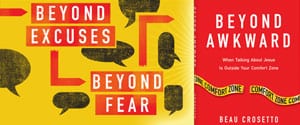
Beau Crosetto has just released a new book on evangelism called Beyond Awkward: When Talking About Jesus is Outside Your Comfort Zone.
Recently, I caught up with Beau to talk about his new book. Enjoy!
Instead of asking, “what is your book about,” I’m going to ask the question that’s behind that question. And that unspoken question is, “how are readers going to benefit from reading your book?”
Beau Crosetto: Readers are going to benefit from reading my book in three main ways.
1) I am going to help them understand that awkwardness is part of evangelism no matter how gifted you are. I like to say, “awkwardness precedes breakthrough in evangelism.” Most breakthroughs come after some tension that most of us run from. So in this book I help us name the tensions and then move through and beyond them.
All of us have people around us that are open to Jesus but we aren’t talking to them because we are nervous about the tensions (what if I am pushy? What if I don’t have the right words? What if they actually want Jesus and I don’t know how to lead them?). Instead of just telling you it will be ok, I help you name them, move through them and then beyond into breakthrough.
2) One fourth of the book is on the role of the Holy Spirit in witness. So many evangelism books focus on what we need to do, but so much of effective evangelism is about the Holy Spirit and how we interact with him. He is the sender. I think you’ll find a refreshing, yet challenging push to press into the Spirit further.
3) I actually show you how to navigate the conversation. One pastor has told me that this book is one of his favorites on evangelism because I actually show you how to have the conversation – from beginning to end. I don’t just tell you the right words, or the proper mechanics, I actually walk you through step by step from beginning to end of having the conversation about Jesus. How do you start one, how do you navigate the tensions, how do you get to Jesus and how do you actually lead someone to faith – in your authentic way without being cookie cutter with the gospel.
Tell us a bit about the experiences that shaped the insights in the book.
Beau Crosetto: I grew up in a non-religious home and didn’t become a Christian until college. I know what it is like to grow up not having Jesus and wishing someone had talked to me about him before I was 19. I went 19 years without the gospel? That stinks. I also know what it is like to be around many people that are not Christian – most of my family is not. So over the last 14 years as Christian I have learned a ton about effectively sharing Jesus with others. I have seen a handful of family members come to faith, a few neighbors, and many on the college campus.
I share a ton of these stories in the book. But undergirding all of this is a constant fire/burden that many people around us don’t know Jesus and they need an authentic witness in their life. Everyday normal people like our neighbors, coworkers, family members and classmates. If we don’t learn how to effectively build relationships and talk about Jesus in our authentic ways, then they wont be reached. These people I am talking about aren’t going to go to church most likely and they need me and you to show up and have the conversations they so badly want to have. People like my 52-year-old neighbor who told me last year he has never been to church and no one has ever shared the gospel with him. That stinks! 52 years! This cannot go on, so I wrote this book to help you get beyond those nerves so you can have that conversation in relational authentic ways.
How is your book different from the many other books on evangelism? In other words, what new contributions have you brought to the conversation?
Beau Crosetto: A couple different ways. One, I work hard in this book to name the tensions we face and help you move through and beyond them. I don’t try and paint evangelism as something we must do therefore try this and everything will be ok. I help you see that evangelism is awkward but worth it. Yes it is. I don’t try and convince you that if you have a few tricks up your sleeve, then everything will be ok. No, it is awkward and we have to own that, and realize that God sends us into the awkward many times and he will also lead us out and into breakthrough.
Less “evangelistically” inclined people that have read my book really appreciated I did this because they said it really helped them see they are normal and can actually embrace the tension and move forward. Secondly, like I said earlier, one fourth of the book is on the role of the Holy Spirit. I don’t know many books on evangelism that focus that much on God’s role. Like I said, most evangelism books are about what we need to do or say as the witness.
Thirdly, I show you how to have the conversation from beginning to end – I don’t just tell you what to say. I walk you step by step through my process and attempt to practically break down for you what has been very intuitive for me. Fourth, I have eight testimonies of everyday people laced throughout the book telling about how they share Jesus in their sphere (E.R. Dr., stay at home mom, president of a Fortune 500 company, a sports broadcaster, a fraternity guy, etc.). I really want you to see how you can be a tremendous witness where you are.
Give us two or three insights from the book that would be helpful to Christians who feel awkward sharing the gospel with those who don’t know Christ.
Beau Crosetto: First, most of us have a theology of comfort and we think that any situation that arises that is awkward or uncomfortable must not be from God. We have believed this lie. When we start to realize that God sends and sets up many awkward moments in the Bible (Woman at the well, Philip and the Ethiopian, Peter and Cornelius, etc) we can start to embrace some of the tension that comes up in conversation or relationships instead of running from them. When we start to embrace them and ask God “what are you doing here?” some amazing breakthroughs are allowed to happened. Secondly, the pressure is not on us to make things happen.
Witness starts and ends with the Holy Spirit. What I love to help people see from the encounter with Philip and the Ethiopian in Acts 8 is that the seeker (Ethiopian) didn’t show up until Philip had engaged with and followed the Spirit a few times. So many of us believe that we have to “make something” happen in evangelism and therefore we just need more gumption and zeal. But I spend a great deal of time in the book helping you see how important it is to hear from God, follow him, and then engage what he sets up. Many of us are not seeing breakthrough in evangelism because we have an obedience problem, while we are thinking it is a training problem.
Thirdly, I help you discern what is the difference between “God awkward” and “Bad Awkward”. Of course annoying witnesses cause some awkwardness in evangelism. I am not suggesting that all tension is from God. I help you understand how to be bold but not pushy, and how to wait patiently when necessary. Not all moments are “God Moments”. I like to say, “we need to be as bold as we can be but as patient as we need to be.”
Unlike the 1960s and 1970s, many people in the 21st-century West are disinterested in Christianity, Jesus, and the gospel. What do you say to a Christians who wants to evangelize, but every time they try to even broach the subject with someone, the other individual shows disinterest or even disdain.
Beau Crosetto: Great question. I have a whole chapter addressing this issue. How do we reach experience-based people? The reality is now in the 21st-century, most people are experienced based and not reason based. What that means is that people today are asking, “is this real and does it work?” while people a couple decades before – reason based – were asking “Is this true?” The question has changed. I think many people are open to God and Jesus today but we are trying to answer the wrong question in evangelism.
We are still trying to answer today’s seeker’s questions with “evidence for the resurrection” or “why is Jesus the only way to God?” or “the Romans Road” and while those things are fantastic, they help people who are asking “what is true?” People who are asking from the start, “What is real and working?” are going to turn off to a witness coming at them with reason-based answers. There is a time for reason based discussion but not at the start. We have to start at a better place with stories – stories of our transformation and stories of transformation from the gospels.
If people want to know what is real, then we need to show them how Jesus changes lives – ours and people in the gospels. So start sharing those. Then as they become open and curious we can move them more “truth” based answers and theology. Again, I unpack this in detail in my book by suggesting a helpful model of evangelism to serve experience-based people better.
Give some very practical ideas of how a Christian can bring up the gospel to people he/she doesn’t know without sounding pushy or socially awkward.
Beau Crosetto: When I am inside of relationship with someone I quickly ask them if they have a spiritual background. I think this is open enough to talk about a wide array of topics and it allows for people who are dabbling in any form of spirituality to talk safely. After discussing that for a bit I then would share what I think about Jesus, probably share a story of Jesus working in my life, and then ask them what they think about him?
How does he fit inside of their idea of spirituality. Depending on how open they are to this discussion will depend on how far I take the conversation. But most importantly I am trying to keep the conversation on Jesus, not truths about Christianity. I am not trying to argue them, but trying to have a conversation and learn what they think about Jesus.
If I am newly inside of a relationship, say with a buddy at work or in the neighborhood, one of my favorite lines is this:
“Hey, Joe, I know you know that I am a Christian. I want you to know that I love talking about my faith and I love helping people figure out how to have a relationship with God. You know this is important to me. I also know that many people have questions about God, but don’t know where to go for help. Most people who don’t go to church don’t have a lot of friends they can talk to about God. And it can be embarrassing to bring that up or have to break the ice. So I want you to know that if you ever want to talk about faith, I would love it. Any time. Seriously.
I love helping people with their questions and it won’t be a burden to me at all. I am telling you this because I am not going to be that annoying Christian that keeps bringing it up. I am not going to bug you. But you can know, if you ever have the desire to talk, I am here for you and would be glad to do it.”
This allows for me to break the ice, bring up the topic of Jesus, but then leave it in their court. It also helps me gauge their curiosity level or what I like to call their “spiritual pulse”. Often times people will say to me, “I would love that!” and it tells me I can follow up with them later and its not pushy. Sometimes, I get the awkwardness from them and they kind of say, “ok, thanks” and I can tell they aren’t very open.
So I leave it and pray and wait. I don’t keep bringing up Jesus. But many times that person will come back to me and say, “you know that one day when you said I could come to you if I had questions? Well I was thinking…”
Because of the influence of people like D.L. Moody and other evangelists in the past, many Christians have been put under a pile of guilt, feeling that they must evangelize to make God happy and be accepted by Him. The result is that they evangelize out of religious duty or to alleviate condemnation. Or (in most cases), they just live in complete guilt for not “doing enough” to make God happy. This is a huge problem in the body of Christ today. For the early Christians, evangelism wasn’t a burden nor a religious obligation. It was the instinct of divine life which indwelt them. And for the church, evangelism came in seasons. Do you talk address this issue at all in your book?
Beau Crosetto: Yes I do and you are right. In the second chapter of my book “Is it worth it?” I address this very thing. Jesus has to be worth it for us to move out and share our faith. I really work hard to get at the root of the issue. If Jesus is good news and we are experiencing this living news, then out of that relationship we should be sharing freely and openly with those around us. Think about it: when we love something we talk about it. I don’t care how introverted or shy you are. You may only tell one or two people but you tell someone when you love something (a new book, tv show, meal, person).
So instead of heaping more guilt onto us about not sharing Jesus, chapter two is designed to help us fall in love with the gospel (good news) again as well as become self aware about it being good news to us or not. If Jesus is not good news to us and we aren’t experiencing it regularly, then we wont share it. And the last thing I would want for you, is to go out and share something that is forced and not personally experienced as good. I am confident that not only in the second chapter, but throughout the whole book, you will feel and energy and tone from me that is compelling you to step into something that is so good vs. heaping guilt onto you that you are so bad.
The spiritual giant and seer A.W. Tozer once made this remark,
The popular notion that the first obligation of the church is to spread the gospel to the uttermost parts of the earth is false. Her first obligation is to be spiritually worthy to spread it. Our Lord said “Go,” but He also said “Wait,” and the waiting had to come before the going. Had the disciples gone forth as missionaries before the day of Pentecost, it would have been an overwhelming spiritual disaster, for they could have done no more than make converts after their own likeness, and this would have altered for the worse the whole history of the Western world and had consequences throughout the ages to come.
To spread an effete, degenerate brand of Christianity to pagan lands is not to fulfill the commandment of Christ or to discharge our obligation to the heathen. These terrible words of Jesus haunt my soul: “You travel over land and sea to win a single convert, and when he becomes one, you make him twice as much a son of hell as you are” (Matthew 23:15).
I believe Tozer is absolutely correct in his assessment. I’d even say that today the situation is worst, meaning, less Christians know what the gospel actually is today than they it did in Tozer’s time. Does your book address Tozer’s concern at all?
Beau Crosetto: I love that from Tozer. Continuing from what I was saying in the question before, I think we don’t have a full view of the gospel and many of us are not living inside the good news of Jesus. In chapter two I unpack my favorite Jesus story and help us get back to the lavishing and overflowing good news that Jesus and his Kingdom coming entails. It is out of this posture that I move us through the rest of the book. So on one hand I don’t address the idea of making converts in our own image, but on the other hand I work hard to help us encounter the good news early in the book, so we are compelled to share and live that.

Previous Post

October 24, 2014
Don't Confuse Me With the Facts
Next Post
October 27, 2014 Post Expired
Browse Our Archives
Select a Category Uncategorized
Select a Month October 2026 September 2026 August 2026 July 2026 June 2026 May 2026 April 2026 March 2026 February 2026 January 2026 December 2025 November 2025 October 2025 September 2025 August 2025 July 2025 June 2025 May 2025 April 2025 March 2025 February 2025 January 2025 December 2024 November 2024 October 2024 September 2024 August 2024 July 2024 June 2024 May 2024 April 2024 March 2024 February 2024 January 2024 December 2023 November 2023 October 2023 September 2023 August 2023 July 2023 June 2023 May 2023 April 2023 March 2023 February 2023 January 2023 December 2022 November 2022 October 2022 September 2022 August 2022 July 2022 June 2022 May 2022 April 2022 March 2022 February 2022 January 2022 December 2021 November 2021 October 2021 September 2021 August 2021 July 2021 June 2021 May 2021 April 2021 March 2021 February 2021 January 2021 December 2020 November 2020 October 2020 September 2020 August 2020 July 2020 June 2020 May 2020 April 2020 March 2020 February 2020 January 2020 December 2019 November 2019 October 2019 September 2019 August 2019 July 2019 June 2019 May 2019 April 2019 March 2019 February 2019 January 2019 December 2018 November 2018 October 2018 September 2018 August 2018 July 2018 June 2018 May 2018 April 2018 March 2018 February 2018 January 2018 December 2017 November 2017 October 2017 September 2017 August 2017 July 2017 June 2017 May 2017 April 2017 March 2017 February 2017 January 2017 December 2016 November 2016 October 2016 September 2016 August 2016 July 2016 June 2016 May 2016 April 2016 March 2016 February 2016 January 2016 December 2015 November 2015 October 2015 September 2015 August 2015 July 2015 June 2015 May 2015 April 2015 March 2015 February 2015 January 2015 December 2014 November 2014 October 2014 September 2014 August 2014 July 2014 June 2014 May 2014 April 2014 March 2014 February 2014 January 2014 December 2013 November 2013 October 2013 September 2013 August 2013 July 2013 June 2013 May 2013 April 2013 March 2013 February 2013 January 2013 December 2012 November 2012 October 2012
TAKE THE
Religious Wisdom Quiz
Where did David hide from Saul for many years?
Select your answer to see how you score.
The wilderness Jerusalem Jericho Philistine camp
Related posts from The Deeper Journey

Letters on Living the Faith by C.S. Lewis



What Was Jesus’ Central Message?
TRENDING AT PATHEOS Evangelical

The Iron Gates and the Lion of the...
Yesterday, I didn't finish my report about, well, yesterday. So I'll...

Dolly Parton’s Last Song Wins Dove Award with...
Bluegrass band The Grascals, speaking on the red carpet at the 57th...

The Image: On the Horror of Capitalism and...
The Image Then went the Pharisees, and took counsel how they might...

We are approaching the date of our new American national holiday: October...

Letters on Living the Faith by C.S. Lewis
Most of us met C.S. Lewis as a public intellectual. Mere Christianity....

When Halloween Unmasks Married Hearts
Written by Dr. David K. Ewen from Eternal Truth Bible College Behind...
view all Evangelical blogs
Ad-Free & Subscriber Log-In Subscription Support
- About Us
- 2026 Calendar
- Videos
- Podcasts
- Library of World Religions
- Faith In Media Tracker
- Advertise With Us
- Write for Us
- Privacy Policy
- Terms of Service
- Do Not Sell My Data
- Contact Us
- Radiant Digital
- Manage Newsletter Subscriptions
- Unsubscribe From Notifications
- Sitemap
Copyright 2008-2026, Patheos. All rights reserved.
Subscription Support Ad-Free & Subscriber Log-In
Follow Patheos