
BuddhistCatholicContemplativeEvangelicalGeneral ChristianHinduJewishLatter-day SaintMuslimNew VisionsProgressive Christian
Beliefs
- Buddhist
- Catholic
- Contemplative
- Evangelical
- General Christian
- Hindu
- Jewish
- Latter-day Saint
- More Voices
- Muslim
- New Visions
- Pagan
- Progressive Christian
Topics
- Religion News
- Food and Religion
- Sports and Religion
- Religious Art
- Religious Music and Entertainment
- Religious Events
- History and Religion
- Style and Religion
- Politics and Religion
- Women in Religion
- Recreation Outdoors and Religion
- Business Finance and Religion
- Careers Workplace and Religion
- Education and Religion
- Family Parenting and Religion
- Health Fitness and Religion
- Home and Religion
- Relationships and Religion
- Technology and Religion
- Travel and Religion
Columnists
- Buddhist Columnists
- Business Finance and Religion Columnists
- Careers Workplace and Religion Columnists
- Catholic Columnists
- Contemplative Columnists
- Education and Religion Columnists
- Evangelists Columnists
- Family Parenting and Religion Columnists
- General Christian Columnists
- Health Fitness and Religion Columnists
- Hindu Columnists
- History and Religion Columnists
- Home and Religion Columnists
- Jewish Columnists
- More Voices Columnists
- Latter Day Columnists
- Muslim Columnists
- New Visions Columnists
- Nonreligious Columnists
- Pagan Columnists
- Politics and Religion Columnists
- Progressive Columnists
- Recreation Outdoors and Religion Columnists
- Relationships and Religion Columnists
- Religion News Columnists
- Religious Art Columnists
- Religious Events Columnists
- Religious Music and Entertainment Columnists
- Sports and Religion Columnists
- Style and Religion Columnists
- Technology and Religion Columnists
- Travel and Religion Columnists
- Women in Religion Columnists
Resource Library
- 2026 Calendar
- Library of World Religions
- The 100 Most Holy Places on Earth
- Patheos Answers
- Podcasts
- Videos
- Faith Leaders Database
- Anglican Episcopalian
- Bahai
- Baptist
- Buddhism
- Christianity
- Confucianism
- Eastern Orthodoxy
- Hinduism
- Holiness and Pentecostal
- ISKCON
- Islam
- Judaism
- Lutheran
- Methodist
- The Church of Jesus Christ of Latter-day Saints
- New Age
- Paganism
- Presbytarian and Reformed
- Protestantism
- Religion Behind the Scenes
- Roman Catholic
- Scientology
- Shia Islam
- Sikhism
- Sufism
- Sunni Islam
- Taoism
- Zen
- See all religions
Research Tools
 Ad-Free & Subscriber Log-In Subscription Support
Ad-Free & Subscriber Log-In Subscription Support
Follow Patheos 

- Trending:
- Forgiveness
- |
- Marriage
- |
- Consciousness
- |
- Death Penalty
- |
- Election
- |
- Halloween
 Why I Still Talk to Jesus -- In Spite of Everything
- Home
- Politics and Religion
- The SOJO Review of ‘Why I am an Atheist Who Believes in God’
The SOJO Review of ‘Why I am an Atheist Who Believes in God’
Last updated on: March 12, 2015 at 5:41 pm by Frank Schaeffer
The SOJO Review of ‘Why I am an Atheist Who Believes in God’ 2015-03-12T17:41:04-06:00 Frank Schaeffer
Patheos Explore the world's faith through different perspectives on religion and spirituality! Patheos has the views of the prevalent religions and spiritualities of the world.

The God-Believing Atheist: A Q&A with Frank Schaeffer
by Christian Piatt 05-13-2014 | 9:44am
Share on email Share on twitter Share on facebook
One phrase comes to mind, time and again, when I think of Frank Schaeffer: “THINK AGAIN.” Any time I think I have a handle on things theological, he seems to find the thread, hanging from the edges, and gives it a good, solid yank.
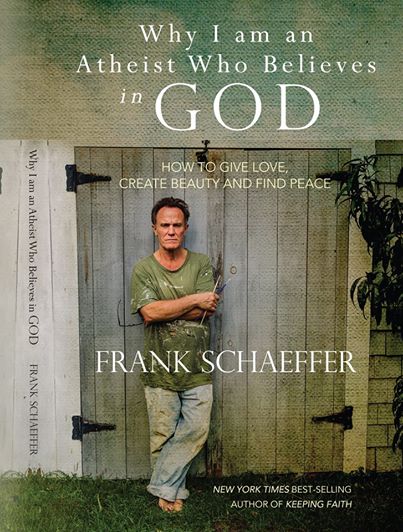
Such is the case once again with his newest book, Why I am an Atheist Who Believes in God: How to give love, create beauty and find peace . Just when it seems the delineations between theism and atheism, between believers and nonbelievers, is sufficiently clear, Schaeffer blurs even those lines, leaving us to wonder what it is any of us actually believes and why.
Frank Schaeffer is not one to deconstruct theology (or even the lack thereof) with some kind of sadistic joy, leaving us to sort through the pieces. Rather he explores what I might call trans-theism, offering us practices, a vocabulary, and a worldview that take us far beyond belief toward a deeply human – and yet inexplicably transcendent – experience.
I asked Frank several questions about his new project; here is what he had to say.
Q: The title of your new book is obviously controversial. Why did you choose it?
A: I’d like to change the debate on religion, actually I’d like to finish off BOTH the New Atheist movement and the religious fundamentalists! I think by introducing a note of paradox, both sets of absolutists can be vanquished. After all this is supposed to be the postmodern age. Certainty is so has been!
Q: Who is the audience for this book? Christians? Atheists?
A: All of the above, especially people burnt out on both religion and the hubris of some atheists.
Q: What do you see as the primary takeaway from this book?
A: I do not always believe, let alone know, if God exists. I do not always know he, she, or it does not exist either, though there are long patches in my life when it seems God never did exist. What I know is that I see the Creator in Jesus or nowhere. What I know is that I see Jesus in my children and grandchildren’s love. What I know is that I rediscover hope again and again through my wife Genie’s love. What I know is that Mother Maria loved unto death. What I know is that sometimes something too good to be true, is true.
Q: You talk about grief in this book. Do you find that difficult moments, or even suffering, help you feel more in tune with the spiritual, or less?
A: Christ’s love unto death and resurrection — however we interpret those words — is a means of freeing us from the anguish of mortality. Our desire for some sort of guarantee of eternal life and all fundamentalist attempts to describe it are self-defeating. Trying to nail down theological certainties is putting faith in our imagination rather than in God’s.
A: The “God” you refer to in your book is found in both creative and natural beauty. Is this different than pantheism?
A: Yes. Maybe we need a new category other than theism, atheism, or agnosticism that takes paradox and unknowing into account. I believe that life evolved by natural selection. I believe that evolutionary psychology explains away altruism and debunks love and that brain chemistry undermines my illusion of free will and personhood. I also believe that the spiritual reality hovering over, in, and through me calls me to love, trust, and hear the voice of my Creator. It seems to me that there is an off-stage and an on-stage quality to my existence. I live on-stage, but I sense another crew working off stage. Sometimes I hear their voices singing in a way that’s as eerily beautiful as the off-stage chorus in an opera.
A: Do you find the same “God” in ugly places? Like where?
Q: There would be no Holocaust museums chronicling horror unless there was a sense that horror is abnormal and, therefore, preventable. Yet, if we insist on a material-universe-only view of ourselves, we have to admit that the story of evolution proves that suffering, death, and extinction are inevitable. Yet, we impose a human ethical standard on the material world. This imposition is not fact-based if we insist on understanding that facts relate only to the material universe.
Most people don’t really want to live only according to narrowly defined material facts. Most of us try to direct our human primate evolutionary process along ethical non-material lines. We impose standards that do not come from nature. Nature is cruel, yet we try not to be. We prosecute people for war crimes that are no more destructive than what happens every day in the churning cauldron of life where everything is eaten and where death is the only incubator of life. We call murder wrong although it’s the most natural thing on earth.
We’ve decided to let an imagined utopian ideal, a future Eden if you will, rule our present despite this being a spiritual non-material-universe-based choice that flies in the face of natural selection. We impose ethics that exist only in our heads upon the material universe. We are part of nature yet we have decided to be nicer than nature. There would be no war crimes trials unless our ethically evolved selves questioned the method of evolution itself.
Q: Do you hope for believers and nonbelievers to engage in more constructive dialogue, and if so, what might that look like?
A: We need to accept the fact our brains did not evolve to do theology or philosophy! We evolved to find patterns in reality to survive. This isn’t truth. Less certainty, more humility. A spiritual non-material-based way of life turns out to be the actual way we live no matter what we say we believe. We live by ethics not found in nature and we enrich our lives with art. That says something to me. Maybe a purely material view of the universe and of ourselves is not in fact a fact.
Q: You’re a painter; do you see your artwork as the byproduct of a spiritual practice?
A: Yes. I sell my work as a vocation. We need art. We need beauty. I need to paint. I want to share that, sort of like saying “I’ll pray for you.” I say, “I’ll paint for you.” It’s all about the soul. The humanities are about one thing: the soul. Declare the soul dead or mere brain chemistry and the humanities die. Declare culture nothing but a contest between men and women or all about politics or elites and you suck the life out of human aspiration.
So what are we left with? “It all comes back to stories,” says Schaeffer. “We are living a story.
“Art, like religion, is harder to kill off than the religiously dedicated secularists of the twentieth century imagined.” And yet, perhaps, rather than seeking God principally in our sanctuaries and holy books, Schaeffer suggests we should be haunting galleries and museums seeking to rebuild our art literacy amid the ashes of detached artistic irony.
“Camille Paglia,” who Schaeffer notes is a self-identified atheist, “writes that ‘a culture can only be dismantled once. Then something must be built or art falls silent.’ Irony about irony is a dead-end, she says. Parody has led to (in Paglia’s words) ‘a narcissistic art form that could be mistaken for a prank.’ I’m trying to do my bit of rebuilding.”
Christian Piatt is a Sojourners Featured Writer and an author, editor, speaker, musician, and spoken word artist. He is director of church growth and development at First Christian Church in Portland, Ore. Christian is the creator and editor of Banned Questions About The Bible and Banned Questions About Jesus. His memoir on faith, family and parenting is called PREGMANCY: A Dad, a Little Dude and a Due Date.
Sojourners
3333 14th Street NW, Suite 200 | Washington, DC 20010 | Phone  202.328.8842 | Fax 202.328.8757 | [email protected]
Unless otherwise noted, all material © Sojourners 2014
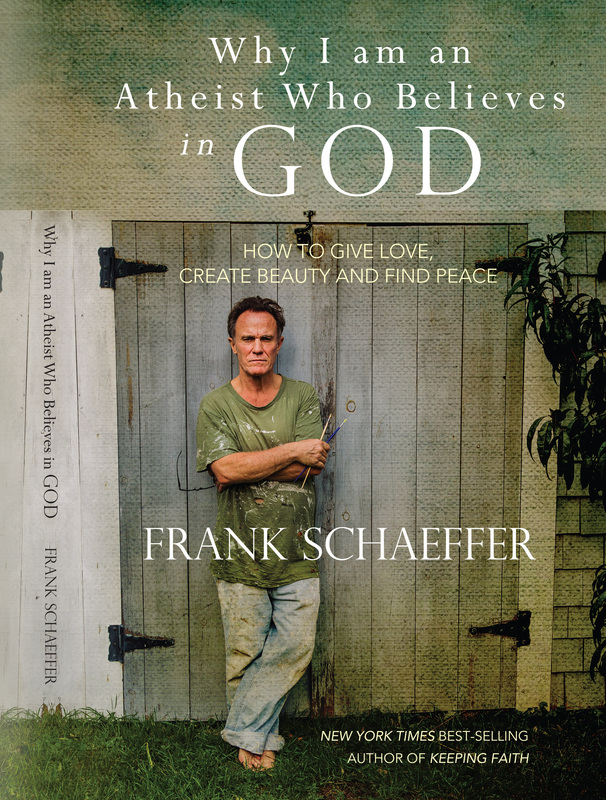
Frank Schaeffer is a writer his new book is:
WHY I AM AN ATHEIST WHO BELIEVES IN GOD How to Create Beauty, Give Love and Find Peace )
… in paperback everywhere
Available Now on Amazon

Follow Frank on Twitter www.twitter.com/frank_schaeffer
See Frank’s paintings http://www.frankschaefferart.com/
Follow Frank on Facebook https://www.facebook.com/frank.schaeffer.16
Contact Frank at http://www.frankschaeffer.com/
Frank Schaeffer is a writer. His latest book — WHY I’M AN ATHEIST WHO BELIEVES IN GOD
WHY I AM AN ATHEIST WHO BELIEVES IN GOD
Previous Post

May 11, 2014
One Reason Atheism Doesn't Really Answer Anything
Next Post
May 17, 2014 10 Dumbest Religious Billboards Ever?
Browse Our Archives
Select a Category Art children Christmas family parenting political humor politics religion sex Uncategorized
Select a Month May 2017 April 2017 March 2017 February 2017 January 2017 December 2016 November 2016 October 2016 September 2016 August 2016 July 2016 June 2016 May 2016 April 2016 March 2016 February 2016 January 2016 December 2015 November 2015 October 2015 September 2015 August 2015 July 2015 June 2015 May 2015 April 2015 March 2015 February 2015 January 2015 December 2014 November 2014 October 2014 September 2014 August 2014 July 2014 June 2014 May 2014 April 2014 March 2014 February 2014 January 2014 December 2013 November 2013 October 2013 September 2013 August 2013 July 2013 June 2013 May 2013 April 2013 March 2013 February 2013 January 2013 December 2012 November 2012 October 2012 September 2012
Follow Us!
TAKE THE
Religious Wisdom Quiz
Who died at the end of Genesis?
Select your answer to see how you score.
Joseph Reuben Simeon Jacob
Related posts from Why I Still Talk to Jesus -- In Spite of Everything

The Terrifying Truth about the USA (And All...
Why I Still Talk to Jesus -- In Spite of Everything

Does U2's Bono Support Donald Trump?
Why I Still Talk to Jesus -- In Spite of Everything

As we watch Trump abuse and debase the...
Why I Still Talk to Jesus -- In Spite of Everything

If Trump Was Your Cousin Would You Ever...
Why I Still Talk to Jesus -- In Spite of Everything
TRENDING AT PATHEOS Politics and Religion

Did Prayer Cure His Cancer? Or Was It...
At 4 AM one morning, Joshua W. Brown’s wife awoke to a...

8 Ways a Near-Death Experience Rewires the Soul
Does Consciousness Survive Physical Death? After 50 Years of Research, Dr. Raymond...

Holy Longing: What Our Restlessness Is Telling Us
“One can find so many pains when the rain is falling.” -John...

What this is NOT about. This blog is definitely not about...

Who said the Israelites were God’s chosen? That’s right, they did. Who...

The Spirit World Is the Real World: God...
A Monk’s Wisdom on Body and Spirit I sit with Brother Martin...
view all Politics and Religion blogs
Ad-Free & Subscriber Log-In Subscription Support
- About Us
- 2026 Calendar
- Videos
- Podcasts
- Library of World Religions
- Faith In Media Tracker
- Advertise With Us
- Write for Us
- Privacy Policy
- Terms of Service
- Do Not Sell My Data
- Contact Us
- Radiant Digital
- Manage Newsletter Subscriptions
- Unsubscribe From Notifications
- Sitemap
Copyright 2008-2026, Patheos. All rights reserved.
Subscription Support Ad-Free & Subscriber Log-In
Follow Patheos