
BuddhistCatholicContemplativeEvangelicalGeneral ChristianHinduJewishLatter-day SaintMuslimNew VisionsProgressive Christian
Beliefs
- Buddhist
- Catholic
- Contemplative
- Evangelical
- General Christian
- Hindu
- Jewish
- Latter-day Saint
- More Voices
- Muslim
- New Visions
- Pagan
- Progressive Christian
Topics
- Religion News
- Food and Religion
- Sports and Religion
- Religious Art
- Religious Music and Entertainment
- Religious Events
- History and Religion
- Style and Religion
- Politics and Religion
- Women in Religion
- Recreation Outdoors and Religion
- Business Finance and Religion
- Careers Workplace and Religion
- Education and Religion
- Family Parenting and Religion
- Health Fitness and Religion
- Home and Religion
- Relationships and Religion
- Technology and Religion
- Travel and Religion
Columnists
- Buddhist Columnists
- Business Finance and Religion Columnists
- Careers Workplace and Religion Columnists
- Catholic Columnists
- Contemplative Columnists
- Education and Religion Columnists
- Evangelists Columnists
- Family Parenting and Religion Columnists
- General Christian Columnists
- Health Fitness and Religion Columnists
- Hindu Columnists
- History and Religion Columnists
- Home and Religion Columnists
- Jewish Columnists
- More Voices Columnists
- Latter Day Columnists
- Muslim Columnists
- New Visions Columnists
- Nonreligious Columnists
- Pagan Columnists
- Politics and Religion Columnists
- Progressive Columnists
- Recreation Outdoors and Religion Columnists
- Relationships and Religion Columnists
- Religion News Columnists
- Religious Art Columnists
- Religious Events Columnists
- Religious Music and Entertainment Columnists
- Sports and Religion Columnists
- Style and Religion Columnists
- Technology and Religion Columnists
- Travel and Religion Columnists
- Women in Religion Columnists
Resource Library
- 2026 Calendar
- Library of World Religions
- The 100 Most Holy Places on Earth
- Patheos Answers
- Podcasts
- Videos
- Faith Leaders Database
- Anglican Episcopalian
- Bahai
- Baptist
- Buddhism
- Christianity
- Confucianism
- Eastern Orthodoxy
- Hinduism
- Holiness and Pentecostal
- ISKCON
- Islam
- Judaism
- Lutheran
- Methodist
- The Church of Jesus Christ of Latter-day Saints
- New Age
- Paganism
- Presbytarian and Reformed
- Protestantism
- Religion Behind the Scenes
- Roman Catholic
- Scientology
- Shia Islam
- Sikhism
- Sufism
- Sunni Islam
- Taoism
- Zen
- See all religions
Research Tools
 Ad-Free & Subscriber Log-In Subscription Support
Ad-Free & Subscriber Log-In Subscription Support
Follow Patheos 

- Trending:
- Forgiveness
- |
- Marriage
- |
- Consciousness
- |
- Death Penalty
- |
- Election
- |
- Halloween
 Four Feminisms
- Home
- Women in Religion
- The Importance of Feminist Men
The Importance of Feminist Men
Last updated on: March 7, 2017 at 10:42 am by Four Feminists
The Importance of Feminist Men 2017-03-07T10:42:42-05:00 Four Feminists
Patheos Explore the world's faith through different perspectives on religion and spirituality! Patheos has the views of the prevalent religions and spiritualities of the world.
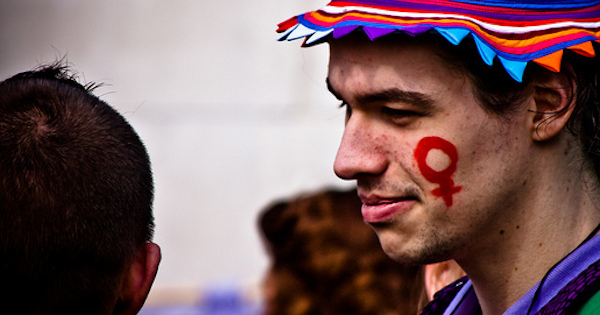
REBECCA BRATTEN WEISS, blogger at Suspended in her Jar (Catholic): I am still riding a rage-wave after reading so many defenses of the indefensible from people who ought to know better, maybe it would be good for the soul to talk about male allies, because it’s a positive topic?
SAMAR KAUKAB, executive director of Arete at the University of Chicago (Muslim): Let’s do that. :- ) I feel you on the riding a rage wave. Have been on a continuous reel of that so perhaps a dose of positivity might be good for me as well. Maybe a good place to start might be would be regarding what models of male allyship have you seen that worked really well?
Rebecca: Interestingly enough, I think Millennials are often really good at this. And I think this is a testament to the positive effects of feminist ethics: young men who have started off early understanding things like the importance of consent and the inherent stupidity of masculinity politics are already primed to notice injustice, as well as to listen when women talk about our experiences. Some of my male students model this really well. There’s a respect, and a willingness to hear what their female counterparts have to say, rather than talking over them and defining them.
Samar: That’s so interesting — I guess I’ve never thought about this as a generational thing, but perhaps this is one of the gains of feminism becoming more mainstreamed. It’s fascinating to me to think about how men are now starting to invest in feminism not only because it is reflective of a desire to live in a more just world, but also because they see an expansion to their own understanding of what masculinity is and is not. Or in other words, that being a male feminist can expand or remove constraints that might have been imposed on their (or society’s) conceptions of masculinity otherwise. I think when men — and more particularly male allies — begin to see their lives as being inextricably tied to the goals of feminism, it makes for a much more robust and meaningful conversation about the promises of feminism.
Rebecca: Yes, definitely, to the mainstreaming! That’s why it’s important to stress that feminism isn’t JUST academic, or activist. It’s daily life. And in this case, I think practicing it makes us all realize what we have to gain. On a practical level, having male allies is huge. But on a theoretic level, it finally gives us this opportunity to get answers to those questions that keep coming up, in all the foundational feminist texts: Why did this “battle of the sexes” start anyway? Why was there oppression instead of equality, when everyone benefits from equality? Once we get the male perspective on how masculinity constructs demand certain behaviors, we can see how oppression of women didn’t come about because men are meanies. It was connected with military and imperialist action, and with various cultural codes for male identity. And men who realize those codes are depersonalizing and oppressive for themselves, too — they have so much to gain from this conversation, both practically and theoretically, also.
Samar: Absolutely. I find that to be one of the most exciting aspects and opportunities as it relates to bringing more male allies into conversations, in addition to seeing more men realize this for themselves. From your experiences, if you have seen any, what are the practical ways in which men — your students or otherwise — are changing the ways in which they interact with women and each other as well as the ways in which they interact with feminism as a more theoretical framework?
Rebecca: I think it makes a difference when men (and women) learn to look at one another as persons, not as walking archetypes of The Feminine or The Masculine. Because until men learn to see us as individuals, they impose so many expectations on us. That we’re emotional. Irrational. Need physical assistance all the time. That we don’t know our own minds. That “no” means “yes.” That we need to have everything explained to us, as though we were little children. Whether it’s a positive or a negative feminine construct imposed on us, it means we’re not really being SEEN. This can range from minor irritations, such as men assuming that women always want to drink fruity drinks or eat sweets, to huge injustices, like workplace discrimination or even sexual assault.
How about you? What models have you seen, for being a male ally in a good way?
Samar: This concept of being seen is something I’ve been thinking a lot about lately. I’m fascinated by how often even “allies” who seem to broadly understand basic principles miss the boat entirely as it relates to individual interactions. And as you pointed out, these seemingly “minor” infractions also are the same root of issues such as rape culture tolerance, for instance.
In terms of models, I think one of the things I’ve been most excited about occurred recently. I spoke at a conference about current relationships between American Muslim and American Jewish communities on a panel that included both Muslim and Jewish feminists. In that conversation, the issue of toxic masculinity and the way that is particularly expressed in our faith communities was a common theme in much of our discussion. While the conversation itself was of course in of itself interesting what I found to be most interesting were the responses afterwards from men who were in the audience. Several men, many who are well versed in the basics of feminism, said that it was interesting for them (what was for a few of them the first time) to consider the impacts and opportunities yielded by feminism upon the practical ways in which masculinity is expressed. This hasn’t happened yet as a follow up but what I would love to now see is an engagement of men in that follow up conversation.
Rebecca: One of the biggest issues I see among Christians is this odd fetishizing of “the feminine” and “the masculine,” with seminars on “Christian manhood” or “true femininity.” I know the people behind this mean well, and want to emphasize the need to pursue virtue, but what ends up happening is this construction of very narrow, gendered ideals for virtue, with an emphasis on certain virtues being specially masculine, others being specially feminine. This of course ties in with the double standard topic, too: if some virtues are presumed to come more naturally to women, we get more severely punished for violating them. I think a wholesome feminism is necessary to counter this tendency, but it’s sometimes hard for men to accept, because within existing constructs this might mean other men would judge them for being less masculine.
Do you see something like this playing out in Muslim communities, too? Obstacles to allyhood set up through well-meaning attempts to protect virtue or tradition?
Samar: Yes, definitely. For many Muslims and in many Muslim communities, the ways in which one expresses virtue is explicitly (and implicitly) tied to gender. Women express their faith, belief in God, and ties to the community in particularly gendered practices. Similarly, men do the same. And so, to deconstruct or even consider some of these notions and practices and the ways in which they might reinforce double standards is very, very difficult to address and talk about. There are many cases in which people from the outside, or even people who have left the community behind, address these topics but these are very outsider reflected conversations. People who identify more strongly with these faith traditions tend to dismiss their points naturally because it feels like an outsider’s judgment. I agree with that. However, to be from within the community and to talk about these constraints and challenges openly is an uphill battle to say the least. Even women find it hard to talk about this because it challenges notions of piety, so male allies often completely neglect these topics too.
Rebecca: It’s certainly threatening, even on a market level, if people have a “brand” associated with defending gendered virtue constructs, and along come these uppity feminists saying “actually, this just isn’t true.” And it’s perhaps more challenging if we’re saying it from within a faith community, and posing that this approach, this feminist take on faith, could be a MORE fruitful way of living one’s beliefs and pursuing virtue.
And this is one reason why younger men are so valuable as allies. Because this means we can look to a future in which they won’t be holding onto their stake in perpetuating cultural artifices. Men and women can both work together in growing a faith culture that values persons as persons.
Samar: I agree with that. An example of where I see the promise of that occurring being actualized within the Muslim community is with respect to a recent social media campaign centering around #NoAllMalePanels. This campaign was initiated by Muslim women to express we’ve had enough of our religious spaces and educational opportunities being almost exclusively male-centric . However, in the past few months I’ve seen many male Muslim allies listen and now react in way that a) calls out all male panels before women even have to, or, b) refuse to speak on all male panels. Its been a wonderful instance of the ways in which male allies can listen and then use their privilege to advance what their female counterparts are asking for.
Rebecca: My children are shouting for me, but before I go, I wonder what you think the biggest hurdle is that we have to face, in working with male allies?
Samar: I think the point you raised regarding how to get past the ‘piety restraints’ is to me the biggest challenge yet. How do you divorce the exercise of moral principles from a very male-centric, patriarchal expression to one that is more expansive and inclusive of the entire congregation?
I feel you on the yelling children. Do what you need to do! It was so great to talk to you and I feel like there is so much more to dig into on this topic — particularly with respect to the challenges. Even though this was a nice dose or attempted dose of positivity.
Rebecca: Thanks for a great conversation, Samar! And I agree, there is much more we can say on this. Perhaps segue into next week? Peace!
Image by Garry Knight via Flickr | CC 2.0
Previous Post

February 1, 2017
'This is What a Real Culture of Life Looks Like'
Next Post

March 9, 2017 Patriarchy Started with Adam
Browse Our Archives
Select a Category Activism Agency Atheism Atheist community Catholicism Evangelical Christianity Gender roles Islam Male feminists Politics Pro-Choice Pro-Life Race Religious communities Sexual assault Sexuality Sin Uncategorized Women in leadership
Select a Month March 2017 February 2017 January 2017 November 2016 October 2016
TAKE THE
Religious Wisdom Quiz
What was stored inside the Ark of the Covenant?
Select your answer to see how you score.
Sand Stone tablets, manna, Aaron's rod Incense The golden calf
Related posts from Four Feminisms

Am I Still a Feminist If I Worked...
'This is What a Real Culture of Life...

What Are We 'Allowed' To Speak About?

TRENDING AT PATHEOS Women in Religion

How Far Is Too Far? On Bill Maher,...
Is the outrage over statements by Kathy Griffin and Bill Maher an...

Refilling the Cup: A Conversation on Self-Care
In these troubled times, self-care is needed now more than ever.
There Is No Courage to Be Bipartisan Anymore...Except...
Health care developments have deepened the divide. It's SCHAEFFER & MOON.

What about Some Solid Outrage from Fox News?...
Scalp-taking and salvation. It's SCHAEFFER & MOON.
Am I Still a Feminist If I Worked...
Does all-or-nothing activism separate women by race, ethnicity, and class?
Why does Eve take the blame when Adam was right there the...
view all Women in Religion blogs
Ad-Free & Subscriber Log-In Subscription Support
- About Us
- 2026 Calendar
- Videos
- Podcasts
- Library of World Religions
- Faith In Media Tracker
- Advertise With Us
- Write for Us
- Privacy Policy
- Terms of Service
- Do Not Sell My Data
- Contact Us
- Radiant Digital
- Manage Newsletter Subscriptions
- Unsubscribe From Notifications
- Sitemap
Copyright 2008-2026, Patheos. All rights reserved.
Subscription Support Ad-Free & Subscriber Log-In
Follow Patheos