
BuddhistCatholicContemplativeEvangelicalGeneral ChristianHinduJewishLatter-day SaintMuslimNew VisionsProgressive Christian
Beliefs
- Buddhist
- Catholic
- Contemplative
- Evangelical
- General Christian
- Hindu
- Jewish
- Latter-day Saint
- More Voices
- Muslim
- New Visions
- Pagan
- Progressive Christian
Topics
- Religion News
- Food and Religion
- Sports and Religion
- Religious Art
- Religious Music and Entertainment
- Religious Events
- History and Religion
- Style and Religion
- Politics and Religion
- Women in Religion
- Recreation Outdoors and Religion
- Business Finance and Religion
- Careers Workplace and Religion
- Education and Religion
- Family Parenting and Religion
- Health Fitness and Religion
- Home and Religion
- Relationships and Religion
- Technology and Religion
- Travel and Religion
Columnists
- Buddhist Columnists
- Business Finance and Religion Columnists
- Careers Workplace and Religion Columnists
- Catholic Columnists
- Contemplative Columnists
- Education and Religion Columnists
- Evangelists Columnists
- Family Parenting and Religion Columnists
- General Christian Columnists
- Health Fitness and Religion Columnists
- Hindu Columnists
- History and Religion Columnists
- Home and Religion Columnists
- Jewish Columnists
- More Voices Columnists
- Latter Day Columnists
- Muslim Columnists
- New Visions Columnists
- Nonreligious Columnists
- Pagan Columnists
- Politics and Religion Columnists
- Progressive Columnists
- Recreation Outdoors and Religion Columnists
- Relationships and Religion Columnists
- Religion News Columnists
- Religious Art Columnists
- Religious Events Columnists
- Religious Music and Entertainment Columnists
- Sports and Religion Columnists
- Style and Religion Columnists
- Technology and Religion Columnists
- Travel and Religion Columnists
- Women in Religion Columnists
Resource Library
- 2026 Calendar
- Library of World Religions
- The 100 Most Holy Places on Earth
- Patheos Answers
- Podcasts
- Videos
- Faith Leaders Database
- Anglican Episcopalian
- Bahai
- Baptist
- Buddhism
- Christianity
- Confucianism
- Eastern Orthodoxy
- Hinduism
- Holiness and Pentecostal
- ISKCON
- Islam
- Judaism
- Lutheran
- Methodist
- The Church of Jesus Christ of Latter-day Saints
- New Age
- Paganism
- Presbytarian and Reformed
- Protestantism
- Religion Behind the Scenes
- Roman Catholic
- Scientology
- Shia Islam
- Sikhism
- Sufism
- Sunni Islam
- Taoism
- Zen
- See all religions
Research Tools
 Ad-Free & Subscriber Log-In Subscription Support
Follow Patheos 

- Trending:
- Advent
- |
- Forgiveness
- |
- Thanksgiving
- |
- Election
- |
- Seasonal Holidays
- |
- Marriage
 The Official Blog of Benjamin L. Corey
- Home
- Progressive Christian
- Things You (Might) Mistakenly Believe About The Book of Revelation
Things You (Might) Mistakenly Believe About The Book of Revelation
Last updated on: March 11, 2019 at 10:53 am by Benjamin L. Corey
Things You (Might) Mistakenly Believe About The Book of Revelation 2019-03-11T10:53:59-05:00 Benjamin L. Corey
Patheos Explore the world's faith through different perspectives on religion and spirituality! Patheos has the views of the prevalent religions and spiritualities of the world.

If you grew up in Evangelicalism/Fundamentalism, you probably grew up with a doom-and-gloom view of the future and “end times.”
Me? I grew up with the whole deal: raptures, tribulations, the Antichrist, and even warnings that those things we first called “barcodes” might actually be the mark of the beast.
End times belief is so much more than an area of theology. It is a complex world-view that shapes every single aspect of our faith and the way we see the world, whether we’re able to recognize it or not.
The book of Revelation– the last book in the Bible– is perhaps the most complex book in Scripture. It is also in this obscure and highly symbolic book that much of the doom-and-gloom end times world-view is planted and watered.
There’s just one problem with building an entire world-view off the book of Revelation: it is a book that is notoriously difficult to understand or interpret. While it would be impossible for anyone to truly understand the book without sitting down for an interview with the author, John, there are some things we do know about it. In light of the few things we know for certain, here are a few corrections to things we were mistakenly taught to believe about the book of Revelation:
The Book of Revelation is not about the “end times.”
John’s Revelation was not something intended to be put in a time capsule and opened 2000 years later. Instead, it was a letter written to very specific churches and was addressing imminent events that directly impacted the people it was written to. John repeatedly uses terms like “soon”, “quickly” and “shortly” in reference to his prophesy– he goes out of his way to make it clear that he is writing about soon-to-happen-events, not ones distant in the future.
Simplified version: It was a letter written by one man to a handful of churches about imminent matters that were relevant to them. For us, this means that Revelation is mostly a book about past events.
Revelation is not a fear-based book of doom-and-gloom.
The book of Revelation isn’t a doom-and-gloom book at all, but rather is a very specific genre of Jewish literature where the main goal is to encourage the readers. Any interpretation that falls outside of encouraging the specific recipients of the letter, is an interpretation that is inconsistent with this literary genre.
It is a letter from one person to a handful of churches, addressing imminent events, and the entire purpose is to encourage them in the midst of these events.
The book of Revelation does not teach a secret “rapture” of the Church.
If I could count the times someone has told me to go back to Revelation to read about the rapture, the number would be considerable. The reality is however, that Revelation doesn’t teach in a rapture at all. It’s simply not in the book. (It’s not even in the Bible.)
Those who believe in the rapture will argue that it’s “implied”, since the Church is only discussed in the first part of the book, but that’s silly. We can’t just make stuff up, but when we say that Revelation teaches the rapture we actually *are* just making stuff up. Rapture theology wasn’t developed for another 1500 years after John wrote this letter.
(Same is true for the Anti-christ, which is a figure from the earlier letters from John and is not in Revelation.)
No one knows exactly what all if it means, and if they claim to, they’re lying.
Since Revelation is apocalyptic literature, it is by nature massively symbolic. Throughout the book we find symbols, numbers, and all sorts of other interesting stuff. While some of it can have an obvious meaning because of themes in the rest of Scripture (such as a symbolic lamb, which is obviously Jesus), much of what is found in this book has been endlessly debated with no clear way to determine a “correct” interpretation.
The reality is that without the ability to travel back in time and talk to the author who wrote it, and the recipients of this letter, we’ll never know the full and correct meaning of everything. While this doesn’t mean we shouldn’t try, it does mean you should be ultra skeptical of end-times preachers who claim to have it down to a science.
…
The book of Revelation is certainly interesting and filled with wonderful lessons to be gleaned, but it is notoriously misunderstood. It is not a book about the “end times.” It does not hold more news than your local newspaper, and it has very little to do with the future.
Instead, it’s a letter John wrote to several churches when he was exiled on Patmos. It was a letter he wrote in the Jewish apocalyptic genre, which was intended to foretell events to immediately occur, and which was designed to encourage those churches as they experienced the turbulent times of the mid first century.
The book of Revelation is a lot of things– but it’s not what your childhood pastor told you it was.
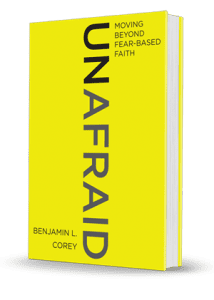 Dr. Benjamin L. Corey is a public theologian and cultural anthropologist who is a two-time graduate of Gordon-Conwell Theological Seminary with graduate degrees in the fields of Theology and International Culture, and holds a doctorate in Intercultural Studies from Fuller Theological Seminary. He is also the author of the new book, Unafraid: Moving Beyond Fear-Based Faith, which is available wherever good books are sold. www.Unafraid-book.com.
Be sure to check out his new blog, right here, and follow on Facebook:
Previous Post

March 1, 2017
Yes, What Israel Is Doing To Palestinians Is Actually Genocide.
Next Post

March 3, 2017 The Wicked Idolatry of Pat Robertson (Jesus, and ONLY Jesus, Is Our Hope)
Browse Our Archives
Select a Category Abuse Adoption Asked & Answered Atheism Atonement Bible Book Calvinism Christian Culture Christian Nonviolence Christmas Church Church Killing Lies Community Creation Care Creationism End Times Evergreen Forgiveness Fundamentalism Gender Gender Equality Ghosting Grief Guns Healthcare Hell Hermeneutics Holy Land Human Trafficking Hunger Immigration Islam Israel Jesus Justice Lent Letting Go Of Hell Series LGBT Life Mark Driscoll Missiology Most Popular Posts Nationalism Old Testament Open Theism Parenting Persecution Political Poverty Prayer Pro-Life Pro-llife ethic Progressive Christianity Prosperity Gospel Put It To Bed Series Race Sincere Questions Suicide Prevention That God Show Theology To Those Christians Who Say Travel Unafraid Uncategorized War What Franklin Graham Is Wrong About Today
Select a Month October 2018 July 2018 June 2018 May 2018 April 2018 March 2018 February 2018 January 2018 December 2017 November 2017 October 2017 September 2017 August 2017 July 2017 June 2017 May 2017 April 2017 March 2017 February 2017 January 2017 December 2016 November 2016 October 2016 September 2016 August 2016 July 2016 June 2016 May 2016 April 2016 March 2016 February 2016 January 2016 December 2015 November 2015 October 2015 September 2015 August 2015 July 2015 June 2015 May 2015 April 2015 March 2015 February 2015 January 2015 December 2014 November 2014 October 2014 September 2014 August 2014 July 2014 June 2014 May 2014 April 2014 March 2014 February 2014 January 2014 December 2013 November 2013 October 2013 September 2013 August 2013 July 2013 June 2013
Follow Us!
TAKE THE
Religious Wisdom Quiz
How many years between Abraham and David?
Select your answer to see how you score.
1000 years 1200 years 800 years 600 years
Books by This Author Books by Benjamin L. Corey
Related posts from The Official Blog of Benjamin L. Corey

Don't Worry Folks, the Great Tribulation Isn't Happening...
The Official Blog of Benjamin L. Corey

No, Natural Disasters Are Not Signs We're in...
The Official Blog of Benjamin L. Corey

Blood Moon Abomination: Why Christians Shouldn't Buy What...
The Official Blog of Benjamin L. Corey

The Gospel Isn't About Escaping This World, It's...
The Official Blog of Benjamin L. Corey
TRENDING AT PATHEOS Progressive Christian

Personal Devotion After Deconstruction
It’s pretty standard for progressive believers to reject aspects of their religious...

The Secret behind A Charlie Brown Thanksgiving
Where Franklin Sat at Charlie Brown's Thanksgiving Table Sparky was sticking to...

Bridging the Gap Between God and Man
From Far Off to the Ultimate Embrace “God is a Spirit: and...

Let Matthew 25 Guide You to a Greater...
With the crisp feel of fall in the air, our minds quickly...

Can a Chatbot Touch Your Soul?
Can a chatbot offer genuine spiritual counsel? One conversation brought me to...

Religion and Politics: How Should We Then Live?
Two cultural axioms get repeated in polite company. Don't mix religion and...
view all Progressive Christian blogs
Ad-Free & Subscriber Log-In Subscription Support
- About Us
- 2026 Calendar
- Videos
- Podcasts
- Library of World Religions
- Faith In Media Tracker
- Advertise With Us
- Write for Us
- Privacy Policy
- Terms of Service
- Do Not Sell My Data
- Contact Us
- Radiant Digital
- Manage Newsletter Subscriptions
- Unsubscribe From Notifications
- Sitemap
Copyright 2008-2026, Patheos, part of the Radiant Digital network of media brands. All rights reserved.
Subscription Support Ad-Free & Subscriber Log-In
Follow Patheos