
BuddhistCatholicContemplativeEvangelicalGeneral ChristianHinduJewishLatter-day SaintMuslimNew VisionsProgressive Christian
Beliefs
- Buddhist
- Catholic
- Contemplative
- Evangelical
- General Christian
- Hindu
- Jewish
- Latter-day Saint
- More Voices
- Muslim
- New Visions
- Pagan
- Progressive Christian
Topics
- Religion News
- Food and Religion
- Sports and Religion
- Religious Art
- Religious Music and Entertainment
- Religious Events
- History and Religion
- Style and Religion
- Politics and Religion
- Women in Religion
- Recreation Outdoors and Religion
- Business Finance and Religion
- Careers Workplace and Religion
- Education and Religion
- Family Parenting and Religion
- Health Fitness and Religion
- Home and Religion
- Relationships and Religion
- Technology and Religion
- Travel and Religion
Columnists
- Buddhist Columnists
- Business Finance and Religion Columnists
- Careers Workplace and Religion Columnists
- Catholic Columnists
- Contemplative Columnists
- Education and Religion Columnists
- Evangelists Columnists
- Family Parenting and Religion Columnists
- General Christian Columnists
- Health Fitness and Religion Columnists
- Hindu Columnists
- History and Religion Columnists
- Home and Religion Columnists
- Jewish Columnists
- More Voices Columnists
- Latter Day Columnists
- Muslim Columnists
- New Visions Columnists
- Nonreligious Columnists
- Pagan Columnists
- Politics and Religion Columnists
- Progressive Columnists
- Recreation Outdoors and Religion Columnists
- Relationships and Religion Columnists
- Religion News Columnists
- Religious Art Columnists
- Religious Events Columnists
- Religious Music and Entertainment Columnists
- Sports and Religion Columnists
- Style and Religion Columnists
- Technology and Religion Columnists
- Travel and Religion Columnists
- Women in Religion Columnists
Resource Library
- 2026 Calendar
- Library of World Religions
- The 100 Most Holy Places on Earth
- Patheos Answers
- Podcasts
- Videos
- Faith Leaders Database
- Anglican Episcopalian
- Bahai
- Baptist
- Buddhism
- Christianity
- Confucianism
- Eastern Orthodoxy
- Hinduism
- Holiness and Pentecostal
- ISKCON
- Islam
- Judaism
- Lutheran
- Methodist
- The Church of Jesus Christ of Latter-day Saints
- New Age
- Paganism
- Presbytarian and Reformed
- Protestantism
- Religion Behind the Scenes
- Roman Catholic
- Scientology
- Shia Islam
- Sikhism
- Sufism
- Sunni Islam
- Taoism
- Zen
- See all religions
Research Tools
 Ad-Free & Subscriber Log-In Subscription Support
Ad-Free & Subscriber Log-In Subscription Support
Follow Patheos 

- Trending:
- Forgiveness
- |
- Marriage
- |
- Consciousness
- |
- Death Penalty
- |
- Election
- |
- Halloween
 The Official Blog of Benjamin L. Corey
- Home
- Progressive Christian
- The Cross Is… (Philosophical Reflections on Calvary)
The Cross Is… (Philosophical Reflections on Calvary)
Last updated on: February 16, 2019 at 3:51 pm by Guest Contributor
The Cross Is… (Philosophical Reflections on Calvary) 2019-02-16T15:51:48-05:00 Guest Contributor
Patheos Explore the world's faith through different perspectives on religion and spirituality! Patheos has the views of the prevalent religions and spiritualities of the world.
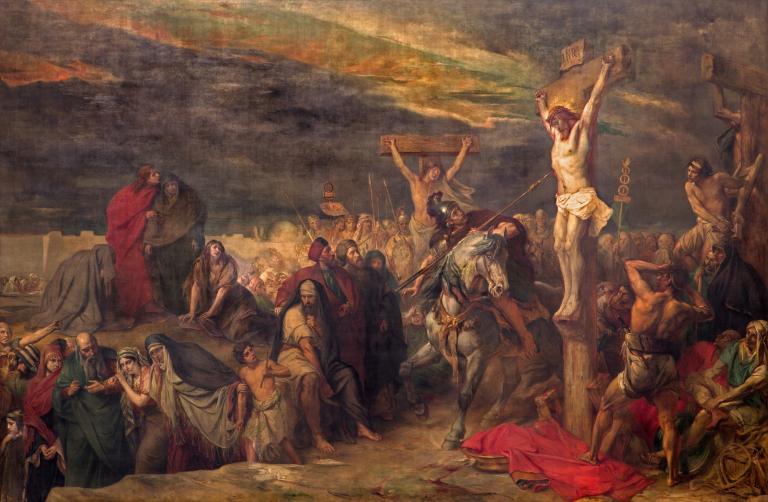
This is post 2 of 3 on philosophical reflections on the cross by pastor and philosopher, Jeff Cook
…
How we see the cross matters.
Benjamin L. Corey here wrote, “the character of God we think we see on the cross becomes our foundation of understanding who God is.” Is the cross required to keep an enraged Father from unleashing his wrath on dysfunctional humanity? Is the cross a method of appeasing a blood thirsty deity? Is God unable to forgive without blood?
Take this a step further. The message we believe the cross conveys will tells us not only who we believe God is, but also who we think we are. Are human beings scum which God would be pleased to annihilate, a loathsome spider dangling over an eternal fire? Are human beings an after thought for a deity powerful enough to create nebula and eco-systems? Are human beings a failed experiment? How we interpret the crucifixion of Jesus will be a mirror for how we see ourselves.
Augustine argued that, given God’s power, God could have redeemed humanity in many possible ways, but that the crucifixion of Jesus was “both good and befitting the divine dignity.” God could have created any possible world with countless different redemption stories (if necessary) and countless forms and paths for humanity—but God choose us, and God chose this world, and at histories center he placed the cross.
Perhaps the most invigorating of meditations is to simply ask, “why?”
When we do a swell of answers begin to arise. No matter which way we turn the cross, we see new and surprising beauties—because … The cross is a diamond. The cross kaleidoscopically unveils the character of God in a “rich variety” of ways that are “beauty ancient yet ever new” (Augustine).
Consider a few.
The cross is a sacrifice. Jesus spoke of a man who entered a field and found a treasure within and in his joy he went and sold everything he had to buy that field. The man in the story is Jesus. The field is the world and in this world Jesus has found a treasure—and that treasure is you, that treasure is me. And through the cross Jesus has given everything he had to purchase the field so he might return and embrace that for which he gave everything he had.
The cross is the way to the best possible life. We are told in order to be a healthy human being we must “love God with all our heart and soul and mind and strength.” Nothing encourages this more than being loved by God with all His heart and soul and mind and strength—and we experience that ever pursuing love through Jesus’ self-chosen crucifixion.
The cross enflames our hope. We find in ourselves a strange double truth: we long to become like God—merciful, just, courageous, wise, alive—and yet the closer we get to God the more insignificant and inadequate we appear to be. The cross alone overcomes this. The cross tells us that we have unsurpassable value, that our many sins have been eliminated in the body of Christ, and that we are radically invited to embrace all that God offers. Because of Jesus death, we may “approach God without pride and humble ourselves without despair” (Pascal).
The cross changes the nature of suffering and death. “When Christ was baptized, it was He who changed the water (giving it the power to give new spiritual life) rather than the water that changed Him. So too when Jesus suffered and died He changed suffering and death rather than suffering and death changing Him … Jesus entered death, and conquered it. Death did not enter and conquer him” (Peter Kreeft). Because of Christ, we may live—freed from every fear, risen above the shame the world would cast on those who suffer.
The cross is a throne. The Gospel is the royal announcement that Jesus is king. Each of the four biographies of Jesus display what it looks like for all authority in heaven and on earth to be given to Christ, and they each end with a coronation.
They tell us that in the last week of his life, Jesus entered the capital city on a colt as a royal figure. He judged the temple as a failure, something only the king could do. He was anointed with oil. On Thursday night he was escorted by a military procession to stand before the people’s representatives: the religious elite said, “You are the Son of God?” and the spokesperson for Rome said, “You are the King of the Jews?” Jesus received them, not as questions, but as declarations.
Pilate then sent Jesus to be crowned and robed by the decommissioned king over Israel and his men. They escorted Jesus out before the masses who cried for him and no other to take the throne. A royal parade led Jesus to the highest point in the land where he took his seat on the sedile of a cross. Finally enthroned and surrounded by family and priests, scriptures were shared, wine drank, songs sung, and pardons offered as the great languages of the day proclaimed over his head, “This is Jesus of Nazareth, the King of the Jews.”
The cross is a door leading to a new kingdom. When Adam and Eve ate from the tree, “their eyes were opened” (Gen 3.7), and they entered a new reality. So too those who eat from the Jesus-tree through the Eucharist have “their eyes opened” (Luke 24). Paul wrote of his vocation that he was sent “to open eyes so that they may turn from the power of darkness to light” (Acts 26.17). The cross then awakens us to the rehumanizing alternative to the reign of sin and death. We need not serve the self-destructive, creation-corroding, knee-jerk rule of sin. We may serve the crucified and risen one knowing we have been “rescued from the power of darkness and transferred into the kingdom of God’s beloved Son” (Col 1.12-13).
Because we see that God positioned Christ “above all rule and authority and power and dominion,” we likewise know that his Power is at work within us. As such we are his people, citizens of heaven who—despite the apparent power of sin—may live boldly in the power of his Spirit with unwavering confidence.
The cross is the only source of humanizing equality. We are equal before the law, but the law makes us equals in failure, shame and death. Conversely, the cross makes us equal through grace. The cross unveils the unsurpassable worth of every human soul, and as such all people have a new, beautifully-equivalent human worth, for “the ground is level before the cross.”
The cross deconstructs everything. In all these ways and more we not only see God through the cross, we see ourselves through the cross. We see human dignity and freedom through the cross. We see the meaning of pain, the triumph of good over evil, and the purpose of our very universe through the cross. Apart from the cross we would not know the meaning of life or death or pain or God or ourselves. The cross has a breath-taking, paradigmatic power to unveil and define the hidden nature of reality.
And what shall we say about the cross’s ability to heal, its transformation of all anthropology and the nature of power? What shall we say of the cross’s ability to renew our relationship with God and others, of the ineffectiveness of violence, or the nature of the New Creation?
The cross is “the wisdom of God in its rich variety,” and its depths are apparently never-ending.
JEFF COOK teaches philosophy at the University of Northern Colorado and pastors Atlas Church in Greeley, Colorado. He is the author of Everything New: Reimagining Heaven and Hell and Seven: the Deadly Sins and the Beatitudes. He will release his third book, Small Batch Church, in 2017. Connect with him @jeffvcook or www.everythingnew.org
Previous Post

March 22, 2016
God, The Cross, and the Problem of Evil (Jeff Cook)
Next Post

March 24, 2016 5 Serious Questions I Have For Christians Who Support Donald Trump
Browse Our Archives
Select a Category Abuse Adoption Asked & Answered Atheism Atonement Bible Book Calvinism Christian Culture Christian Nonviolence Christmas Church Church Killing Lies Community Creation Care Creationism End Times Evergreen Forgiveness Fundamentalism Gender Gender Equality Ghosting Grief Guns Healthcare Hell Hermeneutics Holy Land Human Trafficking Hunger Immigration Islam Israel Jesus Justice Lent Letting Go Of Hell Series LGBT Life Mark Driscoll Missiology Most Popular Posts Nationalism Old Testament Open Theism Parenting Persecution Political Poverty Prayer Pro-Life Pro-llife ethic Progressive Christianity Prosperity Gospel Put It To Bed Series Race Sincere Questions Suicide Prevention That God Show Theology To Those Christians Who Say Travel Unafraid Uncategorized War What Franklin Graham Is Wrong About Today
Select a Month October 2018 July 2018 June 2018 May 2018 April 2018 March 2018 February 2018 January 2018 December 2017 November 2017 October 2017 September 2017 August 2017 July 2017 June 2017 May 2017 April 2017 March 2017 February 2017 January 2017 December 2016 November 2016 October 2016 September 2016 August 2016 July 2016 June 2016 May 2016 April 2016 March 2016 February 2016 January 2016 December 2015 November 2015 October 2015 September 2015 August 2015 July 2015 June 2015 May 2015 April 2015 March 2015 February 2015 January 2015 December 2014 November 2014 October 2014 September 2014 August 2014 July 2014 June 2014 May 2014 April 2014 March 2014 February 2014 January 2014 December 2013 November 2013 October 2013 September 2013 August 2013 July 2013 June 2013
Follow Us!
TAKE THE
Religious Wisdom Quiz
Who was the villain plotting to destroy the Jews in Esther?
Select your answer to see how you score.
Sanballat Ben-Hadad Tobiah Haman
Books by This Author Books by Benjamin L. Corey
Related posts from The Official Blog of Benjamin L. Corey

God Can't Be In The Presence of Sin?...
The Official Blog of Benjamin L. Corey
Some Problems I Have With Penal Substitution Theology...
The Official Blog of Benjamin L. Corey

No, Jesus Wasn't Born To Die (The Part...
The Official Blog of Benjamin L. Corey
God, The Cross, and the Problem of Evil...
The Official Blog of Benjamin L. Corey
TRENDING AT PATHEOS Progressive Christian

Why Christians Have a Sacred Duty to Vote:...
The Bible offers strong support for the sacred duty to vote. Here...

What Being a Modern-Day Apostle Means to Me
In my last column, I discussed the ins and outs of modern-day...

Did Ancient China Once Worship the God of...
Across human history, a common thread weaves through the origins of the...

Love Your Neighbor – Including Earth-Kin: Lev. 19,...
God’s command to love your neighbor means acting in an ethical and...

Lead a Church Study of “Jesus and Lao...
Guest writer Jack Thomas (The Irreverent Reverend) reflects on leading his church...

Principles for Understanding the Apostolic Ministry Today
Whenever people discover that my formal ministry title is "apostle," as in...
view all Progressive Christian blogs
Ad-Free & Subscriber Log-In Subscription Support
- About Us
- 2026 Calendar
- Videos
- Podcasts
- Library of World Religions
- Faith In Media Tracker
- Advertise With Us
- Write for Us
- Privacy Policy
- Terms of Service
- Do Not Sell My Data
- Contact Us
- Radiant Digital
- Manage Newsletter Subscriptions
- Unsubscribe From Notifications
- Sitemap
Copyright 2008-2026, Patheos. All rights reserved.
Subscription Support Ad-Free & Subscriber Log-In
Follow Patheos