
BuddhistCatholicContemplativeEvangelicalGeneral ChristianHinduJewishLatter-day SaintMuslimNew VisionsProgressive Christian
Beliefs
- Buddhist
- Catholic
- Contemplative
- Evangelical
- General Christian
- Hindu
- Jewish
- Latter-day Saint
- More Voices
- Muslim
- New Visions
- Pagan
- Progressive Christian
Topics
- Religion News
- Food and Religion
- Sports and Religion
- Religious Art
- Religious Music and Entertainment
- Religious Events
- History and Religion
- Style and Religion
- Politics and Religion
- Women in Religion
- Recreation Outdoors and Religion
- Business Finance and Religion
- Careers Workplace and Religion
- Education and Religion
- Family Parenting and Religion
- Health Fitness and Religion
- Home and Religion
- Relationships and Religion
- Technology and Religion
- Travel and Religion
Columnists
- Buddhist Columnists
- Business Finance and Religion Columnists
- Careers Workplace and Religion Columnists
- Catholic Columnists
- Contemplative Columnists
- Education and Religion Columnists
- Evangelists Columnists
- Family Parenting and Religion Columnists
- General Christian Columnists
- Health Fitness and Religion Columnists
- Hindu Columnists
- History and Religion Columnists
- Home and Religion Columnists
- Jewish Columnists
- More Voices Columnists
- Latter Day Columnists
- Muslim Columnists
- New Visions Columnists
- Nonreligious Columnists
- Pagan Columnists
- Politics and Religion Columnists
- Progressive Columnists
- Recreation Outdoors and Religion Columnists
- Relationships and Religion Columnists
- Religion News Columnists
- Religious Art Columnists
- Religious Events Columnists
- Religious Music and Entertainment Columnists
- Sports and Religion Columnists
- Style and Religion Columnists
- Technology and Religion Columnists
- Travel and Religion Columnists
- Women in Religion Columnists
Resource Library
- 2026 Calendar
- Library of World Religions
- The 100 Most Holy Places on Earth
- Patheos Answers
- Podcasts
- Videos
- Faith Leaders Database
- Anglican Episcopalian
- Bahai
- Baptist
- Buddhism
- Christianity
- Confucianism
- Eastern Orthodoxy
- Hinduism
- Holiness and Pentecostal
- ISKCON
- Islam
- Judaism
- Lutheran
- Methodist
- The Church of Jesus Christ of Latter-day Saints
- New Age
- Paganism
- Presbytarian and Reformed
- Protestantism
- Religion Behind the Scenes
- Roman Catholic
- Scientology
- Shia Islam
- Sikhism
- Sufism
- Sunni Islam
- Taoism
- Zen
- See all religions
Research Tools
 Ad-Free & Subscriber Log-In Subscription Support
Ad-Free & Subscriber Log-In Subscription Support
Follow Patheos 

- Trending:
- Forgiveness
- |
- Marriage
- |
- Consciousness
- |
- Death Penalty
- |
- Election
- |
- Halloween
 The Official Blog of Benjamin L. Corey
- Home
- Progressive Christian
- The Critical Part Of Orphan Care That Adoption Culture Totally Missed
The Critical Part Of Orphan Care That Adoption Culture Totally Missed
Last updated on: February 17, 2019 at 10:14 am by Benjamin L. Corey
The Critical Part Of Orphan Care That Adoption Culture Totally Missed 2019-02-17T10:14:49-05:00 Benjamin L. Corey
Patheos Explore the world's faith through different perspectives on religion and spirituality! Patheos has the views of the prevalent religions and spiritualities of the world.

Matthew Paul Turner Photo
For the past twenty years or so, adoption has grown to become a staple of much of Christian culture in America. So much so, that one could actually argue that adoption has become trendy within Evangelical circles. As I’ve said before, if something were to become trendy, I’m glad that helping kids in need is one of them- though the trendiness of adoption has certainly led to some negative outcomes as well. While I won’t get into all of the aspects where adoption culture has gone wrong (that could take a series of posts) I do want to address what I feel is the most critical oversight we have made, and how we begin to fix it.
First, orphan care is critical to the life of a Christian whether one is called to adopt or not (and trust me, not everyone is called to adopt- it’s not all rainbows and sunshine kisses). Yet, caring for orphans is something we see consistently expressed in both the Old and New Testaments. In fact, James goes as far as saying that caring for widows and orphans is the only religion that God finds acceptable. While Christian culture for the past few decades has certainly taken that calling seriously, I think it is time for adoption culture to shift its focus in order to take the issue more seriously and to more effectively address the real issue at hand.
How did we miss the most important aspect of orphan care? This stems from a misunderstanding and misdiagnosis of the problem. Much of adoption culture has been led to believe that there is an orphan crisis in the world today with somewhere around 153 million children being orphaned. On the surface, this number of 153 million (provided by UNICEF) understandably leads one to believe that tonight there will be 153 million children who will go without the loving embrace of their parents. It’s a number so staggering that one can easily understand why culture mobilized and began adopting these children at rapid pace.
Unfortunately, the UNICEF number is somewhat deceptive. The 153 million orphan statistic is not referring to the number of children world-wide who are sitting in orphanages because their parents are dead or unable to care for them- the number simply refers to the number of children in the world who have lost at least one parent. Out of the 153 million, there’s an estimated 13-17 million who are actually living in orphanages without parents. Still a staggering number, but is significantly less than what we are often led to believe. Because the 153 million figure has been so misunderstood, culture has been almost exclusively focused on adoption as a solution even though adoption only addresses the minority in that figure, and almost completely ignores the plight of the 136 million children included in that statistic but who still live at home with one parent.
Yes, adoption will always be an important aspect of orphan care, but here’s the critical aspect that adoption culture has missed: orphan prevention (or better stated, preventing kids from ending up in orphanages). The 136 million kids who have already lost one parent often face high risk of ending up in an institution such as an orphanage. As someone who has spent considerable time in orphanages around the world, I’ve often seen orphanages full of children who come from the 136 side of the equation and who have ended up institutionalized in an orphanage not because of lack of family, but because the remaining parent (or relative) doesn’t have the means to raise them at home. These kids aren’t eligible for adoption (much of the time), and so they just spend their lives in an institution until they age out of the system- and from there they face high risk of suicide or exploitation. A key example was when I adopted my girls from Peru: they were in an orphanage of approximately 74 girls, yet only five or so were actually eligible for adoption. The rest? They had relatives or a parent, but not relatives or parents with the means to care for them. Not able to live at home, not able to be adopted, many of these kids just get absorbed into institutions.
If we’re truly going to honor the calling to defend the cause of the fatherless and encourage the oppressed, we need to move beyond an adoption culture that is short sighted in its approach. Yes, adoption is both necessary and beautiful, but adoption alone is failing to actually address the problem. The key issue that needs to be addressed is, “how do we help to keep children with their biological families when at all possible?”
Matthew Paul Tuner Photo
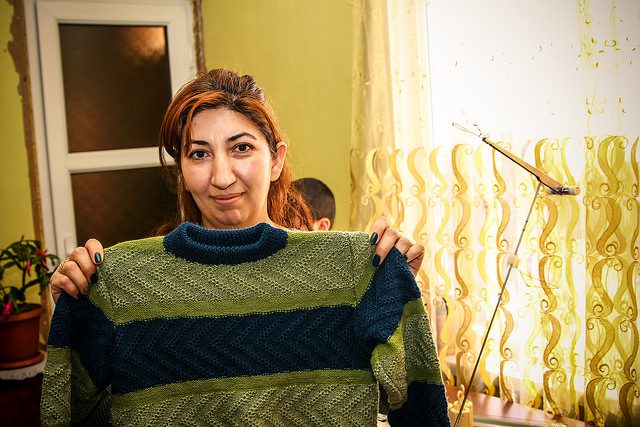
Recently I was in Armenia with World Vision and saw beautiful examples of this first hand- beautiful stories of redemption and prevention. One of those stories involved the children in the image at the top of this post. Due to extreme poverty, the older children were all removed from their home and placed in an institution- they were functionally orphans, but not because of a lack of family, just a family who lacked means. Because of World Vision sponsors they were able to equip the parents with some farm animals, the mother received tools to start her own business making clothing, and the father was given construction tools to both construct a home and earn income doing odd jobs. The end result? The kids didn’t have to languish permanently in an orphanage- they have now been reunited with their family.
And this is precisely the direction we must take adoption culture. We must no longer see adoption alone as a viable solution, but need to shift gears and start finding ways to help children remain in, or return to, their biological families if possible and appropriate. Seeing the joy on the faces of children who once were institutionalized but who have now been reunified with their families was all it took for me to realize that the time is now.
We can no longer overlook the critical aspect of orphan care we’ve been missing, which is preventing it from occurring in the first place.
How can you help? For starters, you can join me in partnering with World Vision to sponsor a child. Your $35 a month just might be all it takes to prevent a child from spending their lives in an institution– it was for the kids in the picture above.
On April 26 I’ll turn 39, and I’m inviting 39 people to partner with me in sponsoring a child through World Vision– let’s join forces together and see what a difference we can make. You can sponsor your child at the link, right here.
Previous Post

March 10, 2015
I'm Not Scared of Muslims, I'm Scared of White Guys With Guns
Next Post

March 18, 2015 5 Reasons Why Reading Charisma News Might Be Toxic For Your Faith
Browse Our Archives
Select a Category Abuse Adoption Asked & Answered Atheism Atonement Bible Book Calvinism Christian Culture Christian Nonviolence Christmas Church Church Killing Lies Community Creation Care Creationism End Times Evergreen Forgiveness Fundamentalism Gender Gender Equality Ghosting Grief Guns Healthcare Hell Hermeneutics Holy Land Human Trafficking Hunger Immigration Islam Israel Jesus Justice Lent Letting Go Of Hell Series LGBT Life Mark Driscoll Missiology Most Popular Posts Nationalism Old Testament Open Theism Parenting Persecution Political Poverty Prayer Pro-Life Pro-llife ethic Progressive Christianity Prosperity Gospel Put It To Bed Series Race Sincere Questions Suicide Prevention That God Show Theology To Those Christians Who Say Travel Unafraid Uncategorized War What Franklin Graham Is Wrong About Today
Select a Month October 2018 July 2018 June 2018 May 2018 April 2018 March 2018 February 2018 January 2018 December 2017 November 2017 October 2017 September 2017 August 2017 July 2017 June 2017 May 2017 April 2017 March 2017 February 2017 January 2017 December 2016 November 2016 October 2016 September 2016 August 2016 July 2016 June 2016 May 2016 April 2016 March 2016 February 2016 January 2016 December 2015 November 2015 October 2015 September 2015 August 2015 July 2015 June 2015 May 2015 April 2015 March 2015 February 2015 January 2015 December 2014 November 2014 October 2014 September 2014 August 2014 July 2014 June 2014 May 2014 April 2014 March 2014 February 2014 January 2014 December 2013 November 2013 October 2013 September 2013 August 2013 July 2013 June 2013
Follow Us!
TAKE THE
Religious Wisdom Quiz
Who said, "To the pure, all things are pure"?
Select your answer to see how you score.
James John Paul Peter
Books by This Author Books by Benjamin L. Corey
Related posts from The Official Blog of Benjamin L. Corey

No, This Isn't All Part Of God's Plan...
The Official Blog of Benjamin L. Corey

What To Do When You're Not Going To...
The Official Blog of Benjamin L. Corey

When We'll Finally Care About Michael Brown
The Official Blog of Benjamin L. Corey
If You Wouldn't Ask It About A Boob...
The Official Blog of Benjamin L. Corey
TRENDING AT PATHEOS Progressive Christian

Why Christians Have a Sacred Duty to Vote:...
The Bible offers strong support for the sacred duty to vote. Here...

What Being a Modern-Day Apostle Means to Me
In my last column, I discussed the ins and outs of modern-day...

Did Ancient China Once Worship the God of...
Across human history, a common thread weaves through the origins of the...

Love Your Neighbor – Including Earth-Kin: Lev. 19,...
God’s command to love your neighbor means acting in an ethical and...

Lead a Church Study of “Jesus and Lao...
Guest writer Jack Thomas (The Irreverent Reverend) reflects on leading his church...

Principles for Understanding the Apostolic Ministry Today
Whenever people discover that my formal ministry title is "apostle," as in...
view all Progressive Christian blogs
Ad-Free & Subscriber Log-In Subscription Support
- About Us
- 2026 Calendar
- Videos
- Podcasts
- Library of World Religions
- Faith In Media Tracker
- Advertise With Us
- Write for Us
- Privacy Policy
- Terms of Service
- Do Not Sell My Data
- Contact Us
- Radiant Digital
- Manage Newsletter Subscriptions
- Unsubscribe From Notifications
- Sitemap
Copyright 2008-2026, Patheos. All rights reserved.
Subscription Support Ad-Free & Subscriber Log-In
Follow Patheos