
BuddhistCatholicContemplativeEvangelicalGeneral ChristianHinduJewishLatter-day SaintMuslimNew VisionsProgressive Christian
Beliefs
- Buddhist
- Catholic
- Contemplative
- Evangelical
- General Christian
- Hindu
- Jewish
- Latter-day Saint
- More Voices
- Muslim
- New Visions
- Pagan
- Progressive Christian
Topics
- Religion News
- Food and Religion
- Sports and Religion
- Religious Art
- Religious Music and Entertainment
- Religious Events
- History and Religion
- Style and Religion
- Politics and Religion
- Women in Religion
- Recreation Outdoors and Religion
- Business Finance and Religion
- Careers Workplace and Religion
- Education and Religion
- Family Parenting and Religion
- Health Fitness and Religion
- Home and Religion
- Relationships and Religion
- Technology and Religion
- Travel and Religion
Columnists
- Buddhist Columnists
- Business Finance and Religion Columnists
- Careers Workplace and Religion Columnists
- Catholic Columnists
- Contemplative Columnists
- Education and Religion Columnists
- Evangelists Columnists
- Family Parenting and Religion Columnists
- General Christian Columnists
- Health Fitness and Religion Columnists
- Hindu Columnists
- History and Religion Columnists
- Home and Religion Columnists
- Jewish Columnists
- More Voices Columnists
- Latter Day Columnists
- Muslim Columnists
- New Visions Columnists
- Nonreligious Columnists
- Pagan Columnists
- Politics and Religion Columnists
- Progressive Columnists
- Recreation Outdoors and Religion Columnists
- Relationships and Religion Columnists
- Religion News Columnists
- Religious Art Columnists
- Religious Events Columnists
- Religious Music and Entertainment Columnists
- Sports and Religion Columnists
- Style and Religion Columnists
- Technology and Religion Columnists
- Travel and Religion Columnists
- Women in Religion Columnists
Resource Library
- 2026 Calendar
- Library of World Religions
- The 100 Most Holy Places on Earth
- Patheos Answers
- Podcasts
- Videos
- Faith Leaders Database
- Anglican Episcopalian
- Bahai
- Baptist
- Buddhism
- Christianity
- Confucianism
- Eastern Orthodoxy
- Hinduism
- Holiness and Pentecostal
- ISKCON
- Islam
- Judaism
- Lutheran
- Methodist
- The Church of Jesus Christ of Latter-day Saints
- New Age
- Paganism
- Presbytarian and Reformed
- Protestantism
- Religion Behind the Scenes
- Roman Catholic
- Scientology
- Shia Islam
- Sikhism
- Sufism
- Sunni Islam
- Taoism
- Zen
- See all religions
Research Tools
 Ad-Free & Subscriber Log-In Subscription Support
Ad-Free & Subscriber Log-In Subscription Support
Follow Patheos 

- Trending:
- Forgiveness
- |
- Marriage
- |
- Consciousness
- |
- Death Penalty
- |
- Election
- |
- Halloween
 The Official Blog of Benjamin L. Corey
- Home
- Progressive Christian
- The Prosperity Gospel vs. Jesus: Why These Two Things Are Not the Same
The Prosperity Gospel vs. Jesus: Why These Two Things Are Not the Same
Last updated on: March 11, 2019 at 10:41 am by Benjamin L. Corey
The Prosperity Gospel vs. Jesus: Why These Two Things Are Not the Same 2019-03-11T10:41:38-05:00 Benjamin L. Corey
Patheos Explore the world's faith through different perspectives on religion and spirituality! Patheos has the views of the prevalent religions and spiritualities of the world.
I believe that Christianity is a religion founded upon the life, teachings, and example of Jesus of Nazareth. Any version of Christianity that is built on a different foundation– whether it’s founded upon “following the Bible” or some foundation other than “be like Jesus,” isn’t really Christianity at all, even if it tries to go by the same name.
Christianity, by definition, is supposed to mean “like Christ.” There are some Christian traditions that highlight certain parts of Jesus at the expense of others, and this is understandable– we’re human and and we make mistakes. However, there are some Christian expressions that simply don’t line up with Jesus at all– and how we continue to recognize them as Christian is beyond me.
The prosperity gospel is one of those “expressions” of Christianity that is at complete and total odds with what Jesus said, and how Jesus lived. Here’s 5 critical aspects of how these two differ:
5. The prosperity gospel is a gospel that associates the rich with being “blessed” instead of the poor.
In the prosperity gospel being “blessed” by God is associated with being on a path of increased abundance; God’s blessing results in the accumulation of more and more. However, this is the complete and total opposite of the *actual* Gospel.
If you read the Gospel of Luke, we see John the Baptist set the stage for Jesus. As people ask him how their lives should reflect repentance he answers them three different times, each answer reflecting that repentance is marked by rejecting the concept of having an “abundance” while others do not have enough (Luke 3:10-14). Just a few pages later we find Jesus begin his public ministry, and one of the first things he says is that the poor are blessed, but the rich are not. In fact, Jesus says “What sorrow awaits you who are rich!” (Luke 6:24).
Let’s just say that the prosperity gospel begins on a foundation that literally reverses what Jesus actually said.
4. The prosperity gospel is premised on the idea that obeying God results in a “good” life by worldly standards.
Does obeying God’s way result in good things? Well, that all depends on how one defines “good” and whether or not you’re talking in terms of temporal or eternal.
In the prosperity gospel, being obedient and faithful results in comfort and abundance now– but that’s not what Jesus taught. Jesus taught that being obedient and faithful results in denying yourself and becoming willing to give up everything– even your very life! In fact, some of the most faithful, obedient Christians in all of history have been those whose lives ended far before their natural time– all for the sake of following Jesus.
Jesus doesn’t invite us into our best life, or a materially abundant life– he invites us to join his movement and to become willing to give up everything, even our very lives, to this life-long calling.
3. The prosperity gospel can’t explain why bad things happen to faithful people– because that screws with the premise of it all.
If being obedient and faithful results in increased abundance, why do tornadoes, hurricanes, earthquakes, illnesses, and car accidents happen to obedient and faithful people?
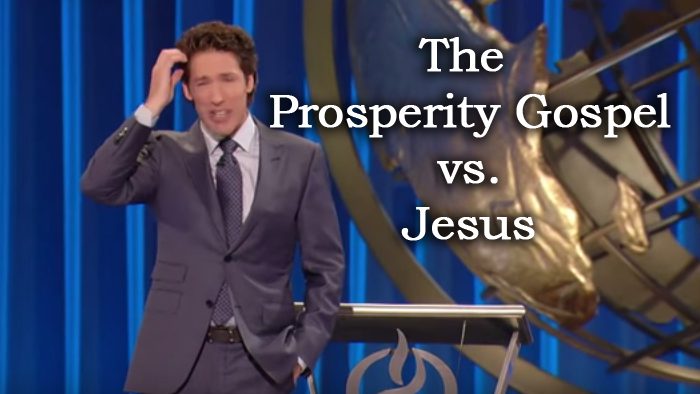
The prosperity gospel doesn’t have a compelling answer to this, other than “God is mysteriously doing something good for you.” Case in point: Joel Osteen recently told hurricane victims that they should “take it as a compliment“ as if losing your house is somehow a sign of coming favor from God.
Jesus, of course, doesn’t have this conundrum– he simply taught that “the rain falls on the just and the unjust” meaning that good things can happen to bad people, and bad things can happen to good people, and that this is just part of the randomness of life. He also taught that “in this world we will have many troubles” but to take heart, because he has overcome the world.
The idea that God rewards our faithfulness by good things, or that God will protect us from bad things, isn’t what Jesus taught.
2. It creates ministers who are detached from the people they minister to.
At the core or what following Jesus looks like is the calling to go out and make more disciples– it’s how the movement not only stays alive, but grows and spreads in hopes of transforming the entire world. We are called to build intimate community and to walk side by side with others as we navigate both learning ourselves, and helping others, discover how we might best follow Jesus through the joys and struggles of life.
But ministers of the prosperity gospel? They are often detached from those they minister to– and that’s not how Jesus modeled discipleship. How does one who lives in a multi-million dollar mansion and who has a private yacht, truly minister and walk with someone who is homeless, someone who doesn’t know where food money is going to come from this week, or someone whose car is broken down and preventing them from getting to work?
In the prosperity gospel, ministers get rich while those they minister to get “hope that one day they might be rich too” and that’s not how Jesus lived.
1. It teaches people to put their hopes in the wrong place.
The prosperity gospel is one where your hopes and dreams are placed in having material abundance right now, in this temporal world. However, that is not what Jesus calls us to– Jesus calls us to lives of sacrifice and obedience knowing that we are laying for ourselves “treasures in heaven.”
The true Gospel is not about what we’re building for ourselves in this world, but is about self-sacrificially investing in helping to build the next.
The true Christian hope is that we labor not in vain, that death will not be the end, and that living lives of sacrifice will not be for nothing in the end. Our hope is in the power of God to use what we offer up to him, to create something far bigger and beautiful than anything we’ll ever know in this present life.
The hope Jesus offers us, and the hope the prosperity gospel offers us, is not the same hope.
…
It’s true– there are many different expressions of Christianity.
It’s also true that I believe we can often find tremendous value in those various expressions, whether we belong to that tradition, or not.
But it’s also true that the foundation of the prosperity gospel is so at odds with Jesus, that I honestly don’t know how it can be recognized as a legitimate expression of the Christian faith.
 Dr. Benjamin L. Corey is a public theologian and cultural anthropologist who is a two-time graduate of Gordon-Conwell Theological Seminary with graduate degrees in the fields of Theology and International Culture, and holds a doctorate in Intercultural Studies from Fuller Theological Seminary. He is also the author of the new book, Unafraid: Moving Beyond Fear-Based Faith, which is available wherever good books are sold. www.Unafraid-book.com.
Be sure to check out his new blog, right here, and follow on Facebook:
Previous Post

August 23, 2017
Pope Francis Is NOT A Champion Of The Marginalized
Next Post

September 12, 2017 No, Natural Disasters Are Not Signs We're in the "End Times"
Browse Our Archives
Select a Category Abuse Adoption Asked & Answered Atheism Atonement Bible Book Calvinism Christian Culture Christian Nonviolence Christmas Church Church Killing Lies Community Creation Care Creationism End Times Evergreen Forgiveness Fundamentalism Gender Gender Equality Ghosting Grief Guns Healthcare Hell Hermeneutics Holy Land Human Trafficking Hunger Immigration Islam Israel Jesus Justice Lent Letting Go Of Hell Series LGBT Life Mark Driscoll Missiology Most Popular Posts Nationalism Old Testament Open Theism Parenting Persecution Political Poverty Prayer Pro-Life Pro-llife ethic Progressive Christianity Prosperity Gospel Put It To Bed Series Race Sincere Questions Suicide Prevention That God Show Theology To Those Christians Who Say Travel Unafraid Uncategorized War What Franklin Graham Is Wrong About Today
Select a Month October 2018 July 2018 June 2018 May 2018 April 2018 March 2018 February 2018 January 2018 December 2017 November 2017 October 2017 September 2017 August 2017 July 2017 June 2017 May 2017 April 2017 March 2017 February 2017 January 2017 December 2016 November 2016 October 2016 September 2016 August 2016 July 2016 June 2016 May 2016 April 2016 March 2016 February 2016 January 2016 December 2015 November 2015 October 2015 September 2015 August 2015 July 2015 June 2015 May 2015 April 2015 March 2015 February 2015 January 2015 December 2014 November 2014 October 2014 September 2014 August 2014 July 2014 June 2014 May 2014 April 2014 March 2014 February 2014 January 2014 December 2013 November 2013 October 2013 September 2013 August 2013 July 2013 June 2013
Follow Us!
TAKE THE
Religious Wisdom Quiz
What language was the New Testament originally written in?
Select your answer to see how you score.
Latin Greek Hebrew Syriac
Books by This Author Books by Benjamin L. Corey
Related posts from The Official Blog of Benjamin L. Corey

5 Reasons The "Prosperity Gospel" Is Actually A...
The Official Blog of Benjamin L. Corey

What 30 Pieces of Silver Can Buy In...
The Official Blog of Benjamin L. Corey

No, Franklin Graham, God Didn't Destroy Sodom &...
The Official Blog of Benjamin L. Corey

Who Would YOU Have Been in Nazi Germany?...
The Official Blog of Benjamin L. Corey
TRENDING AT PATHEOS Progressive Christian

What Being a Modern-Day Apostle Means to Me
In my last column, I discussed the ins and outs of modern-day...

Did Ancient China Once Worship the God of...
Across human history, a common thread weaves through the origins of the...

Love Your Neighbor – Including Earth-Kin: Lev. 19,...
God’s command to love your neighbor means acting in an ethical and...

Lead a Church Study of “Jesus and Lao...
Guest writer Jack Thomas (The Irreverent Reverend) reflects on leading his church...

Pastoral Wisdom for Responding to Sermon Pushback
Getting sermon pushback on your social justice sermon? Learn practical, Proverbs-based strategies...

Principles for Understanding the Apostolic Ministry Today
Whenever people discover that my formal ministry title is "apostle," as in...
view all Progressive Christian blogs
Ad-Free & Subscriber Log-In Subscription Support
- About Us
- 2026 Calendar
- Videos
- Podcasts
- Library of World Religions
- Faith In Media Tracker
- Advertise With Us
- Write for Us
- Privacy Policy
- Terms of Service
- Do Not Sell My Data
- Contact Us
- Radiant Digital
- Manage Newsletter Subscriptions
- Unsubscribe From Notifications
- Sitemap
Copyright 2008-2026, Patheos. All rights reserved.
Subscription Support Ad-Free & Subscriber Log-In
Follow Patheos