
BuddhistCatholicContemplativeEvangelicalGeneral ChristianHinduJewishLatter-day SaintMuslimNew VisionsProgressive Christian
Beliefs
- Buddhist
- Catholic
- Contemplative
- Evangelical
- General Christian
- Hindu
- Jewish
- Latter-day Saint
- More Voices
- Muslim
- New Visions
- Pagan
- Progressive Christian
Topics
- Religion News
- Food and Religion
- Sports and Religion
- Religious Art
- Religious Music and Entertainment
- Religious Events
- History and Religion
- Style and Religion
- Politics and Religion
- Women in Religion
- Recreation Outdoors and Religion
- Business Finance and Religion
- Careers Workplace and Religion
- Education and Religion
- Family Parenting and Religion
- Health Fitness and Religion
- Home and Religion
- Relationships and Religion
- Technology and Religion
- Travel and Religion
Columnists
- Buddhist Columnists
- Business Finance and Religion Columnists
- Careers Workplace and Religion Columnists
- Catholic Columnists
- Contemplative Columnists
- Education and Religion Columnists
- Evangelists Columnists
- Family Parenting and Religion Columnists
- General Christian Columnists
- Health Fitness and Religion Columnists
- Hindu Columnists
- History and Religion Columnists
- Home and Religion Columnists
- Jewish Columnists
- More Voices Columnists
- Latter Day Columnists
- Muslim Columnists
- New Visions Columnists
- Nonreligious Columnists
- Pagan Columnists
- Politics and Religion Columnists
- Progressive Columnists
- Recreation Outdoors and Religion Columnists
- Relationships and Religion Columnists
- Religion News Columnists
- Religious Art Columnists
- Religious Events Columnists
- Religious Music and Entertainment Columnists
- Sports and Religion Columnists
- Style and Religion Columnists
- Technology and Religion Columnists
- Travel and Religion Columnists
- Women in Religion Columnists
Resource Library
- 2026 Calendar
- Library of World Religions
- The 100 Most Holy Places on Earth
- Patheos Answers
- Podcasts
- Videos
- Faith Leaders Database
- Anglican Episcopalian
- Bahai
- Baptist
- Buddhism
- Christianity
- Confucianism
- Eastern Orthodoxy
- Hinduism
- Holiness and Pentecostal
- ISKCON
- Islam
- Judaism
- Lutheran
- Methodist
- The Church of Jesus Christ of Latter-day Saints
- New Age
- Paganism
- Presbytarian and Reformed
- Protestantism
- Religion Behind the Scenes
- Roman Catholic
- Scientology
- Shia Islam
- Sikhism
- Sufism
- Sunni Islam
- Taoism
- Zen
- See all religions
Research Tools
 Ad-Free & Subscriber Log-In Subscription Support
Ad-Free & Subscriber Log-In Subscription Support
Follow Patheos 

- Trending:
- Forgiveness
- |
- Marriage
- |
- Consciousness
- |
- Death Penalty
- |
- Election
- |
- Halloween
 The Official Blog of Benjamin L. Corey
- Home
- Progressive Christian
- God Can’t Be In The Presence of Sin? (And Other Crap About God We Mindlessly Repeat)
God Can’t Be In The Presence of Sin? (And Other Crap About God We Mindlessly Repeat)
Last updated on: March 11, 2019 at 10:51 am by Benjamin L. Corey
God Can’t Be In The Presence of Sin? (And Other Crap About God We Mindlessly Repeat) 2019-03-11T10:51:23-05:00 Benjamin L. Corey
Patheos Explore the world's faith through different perspectives on religion and spirituality! Patheos has the views of the prevalent religions and spiritualities of the world.
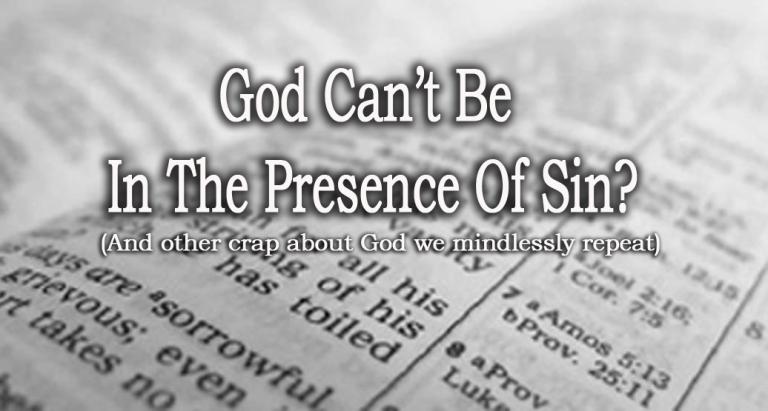
Growing up evangelical, you’ve probably heard this answer to the question, “Why did Jesus have to die on the cross?”
“Well, Johnny or Susie, it’s because God can’t be in the presence of sin.”
They will often go on to explain how sin is so intolerable to God, that he can’t be anywhere near it. To be able to pull close to God, somehow we must be completely free and cleansed of sin first. It’s also why we’re often told that we can’t go to heaven if our sins have not been forgiven: because– here it is again– God can’t be in the presence of sin. One website describes it this way, which is quite similar to the answer I received growing up:
“[T]he God of the Bible requires cleansing for the purpose of relationship, because He wants to be with us. Much like a parent welcoming home a child after a summer’s day at the park—a child who is probably hot, sweaty and dirty—God wants us to be clean because He wants to enjoy our company. Our impurity is not something God permits in His presence. And so, He says to us much the same thing a parent would say to that child—go wash up before you come to the table to eat because I want a person who is clean at my table.”
(Side note: I don’t need my kids to shower before I’m willing to be close to them, so this is messed up on multiple levels.)
This notion that God cannot be in the presence of sin is a classic case of what I have come to call “generational theology.” Generational theology encompasses a host of things we believe and repeat without ever deeply questioning them. They get passed on to generation to generation not because they’re true, but because that’s what our well-meaning but uninformed Sunday School teacher, grandparents, or parents taught us. Reader’s digest version: Generational theology is crap we believe about God and mindlessly repeat without even thinking about whether or not it’s true.
But let me be clear: The idea that God cannot be in the presence of sin is unbiblical nonsense.
Where did this belief come from? My best guess is that it comes from Habakkuk 1:13 where the prophet writes, “Your eyes are too pure to look on evil.” What people miss, however, is the rest of the passage. As soon as he writes this he essentially goes on to ask, “So why do you do it all the time????” It’s as if he’s questioning and trying to work out his own understanding of God– he’s trying to develop his theology, but like most of us, doesn’t have it all worked out cleanly. On one hand, he believes God cannot look upon evil. On the other, he recognize that he does it. Thus, he’s trying to work out tension in his beliefs.
However, the complete narrative of Scripture answers his question and proves this generational theology to be misguided and false: When people say it’s impossible for God to be in the presence of sin, such a statement is totally false.
Just think about the biblical narrative for a minute…
The Bible only has two chapters before sin becomes part of the deal. The Adam and Eve figures sin, become ashamed, and flee from God. They hide from God’s presence because of sin, but God doesn’t– God’s response is to pull close to them, to clothe them, and to help them feel restored. The Bible opens not with God fleeing from the presence of sin, but running to be present in it.
Then, of course, there is the rest of the Old Testament narrative which is a long story of Israel trying to get to know God. And, good grief, do they commit a lot of sins along the way. Their relationship with God is a rocky one– at times he allows them to go off into captivity, at one point God gets pissed and says he’s divorcing them (but yet he keeps hanging around), and then he sends a bunch of prophets to tell them how much they need to change.
God repeatedly shows Israel that while he certainly doesn’t like sin, he doesn’t have to run away every time he sees it.
And then, of course, there’s the ultimate evidence that God is not afraid to be in the presence of sin: Jesus himself.
To hold the belief that God cannot be in the presence of sin, one would have to first deny trinitarian theology and the divinity of Jesus– there’s no legitimate way around that.
One of the reasons Jesus was so unpopular with the religious elite was because of his preference to build his inner circle with those considered the worst, most unclean sinners of society. Jesus took this so far that the Bible tells us during his ministry he had the public reputation of being an alcoholic (Matthew 11:19, Luke 7:34). In fact, one of the nicknames Jesus eared was Friend of Sinners.
Thus, if it is impossible for God to be in the presence of sin, it is not possible that Jesus was God-incarnate– because Jesus spent the majority of his time in the presence of sin.
In fact, the New Testament goes on to say that Jesus actually became sin on our behalf– that’s about as an extreme opposite statement as the premise that God can’t be near sin.
On this one you’ll have to pick between believing in the divinity of Jesus, or believing what your childhood pastor told you about God’s inability or refusal to be in the presence of sin– because you can’t have both.
Does God like or approve of sin? Of course not. But is sin some magical kryptonite where God is blinded and has to run the other way?
Not at all.
The fact that when God became flesh he became know as the “Friend of Sinners” should be enough to remind us of this truth. God doesn’t run from us in the midst of our flaws and brokenness, or even our sin. Instead, God is a friend who sits down beside us and offers to help us get our shit back together.
 Dr. Benjamin L. Corey is a public theologian and cultural anthropologist who is a two-time graduate of Gordon-Conwell Theological Seminary with graduate degrees in the fields of Theology and International Culture, and holds a doctorate in Intercultural Studies from Fuller Theological Seminary. He is also the author of the new book, Unafraid: Moving Beyond Fear-Based Faith, which is available wherever good books are sold. www.Unafraid-book.com.
Be sure to check out his new blog, right here, and follow on Facebook:
Previous Post
April 3, 2017
Some Problems I Have With Penal Substitution Theology of Atonement
Next Post

April 7, 2017 Principles Christians Should Remember In A World At The Brink Of War
Browse Our Archives
Select a Category Abuse Adoption Asked & Answered Atheism Atonement Bible Book Calvinism Christian Culture Christian Nonviolence Christmas Church Church Killing Lies Community Creation Care Creationism End Times Evergreen Forgiveness Fundamentalism Gender Gender Equality Ghosting Grief Guns Healthcare Hell Hermeneutics Holy Land Human Trafficking Hunger Immigration Islam Israel Jesus Justice Lent Letting Go Of Hell Series LGBT Life Mark Driscoll Missiology Most Popular Posts Nationalism Old Testament Open Theism Parenting Persecution Political Poverty Prayer Pro-Life Pro-llife ethic Progressive Christianity Prosperity Gospel Put It To Bed Series Race Sincere Questions Suicide Prevention That God Show Theology To Those Christians Who Say Travel Unafraid Uncategorized War What Franklin Graham Is Wrong About Today
Select a Month October 2018 July 2018 June 2018 May 2018 April 2018 March 2018 February 2018 January 2018 December 2017 November 2017 October 2017 September 2017 August 2017 July 2017 June 2017 May 2017 April 2017 March 2017 February 2017 January 2017 December 2016 November 2016 October 2016 September 2016 August 2016 July 2016 June 2016 May 2016 April 2016 March 2016 February 2016 January 2016 December 2015 November 2015 October 2015 September 2015 August 2015 July 2015 June 2015 May 2015 April 2015 March 2015 February 2015 January 2015 December 2014 November 2014 October 2014 September 2014 August 2014 July 2014 June 2014 May 2014 April 2014 March 2014 February 2014 January 2014 December 2013 November 2013 October 2013 September 2013 August 2013 July 2013 June 2013
Follow Us!
TAKE THE
Religious Wisdom Quiz
How old was Jesus when He started His public ministry?
Select your answer to see how you score.
About 50 About 30 About 12 About 21
Books by This Author Books by Benjamin L. Corey
Related posts from The Official Blog of Benjamin L. Corey

What 30 Pieces of Silver Can Buy In...
The Official Blog of Benjamin L. Corey

If You Think Trump Was Picked By God,...
The Official Blog of Benjamin L. Corey

The *Actual* Persecution of Christians In Trump's America
The Official Blog of Benjamin L. Corey

Dear Evangelicals: Is Trump Still "Pro-Life" If He...
The Official Blog of Benjamin L. Corey
TRENDING AT PATHEOS Progressive Christian

What Being a Modern-Day Apostle Means to Me
In my last column, I discussed the ins and outs of modern-day...

Did Ancient China Once Worship the God of...
Across human history, a common thread weaves through the origins of the...

Love Your Neighbor – Including Earth-Kin: Lev. 19,...
God’s command to love your neighbor means acting in an ethical and...

Lead a Church Study of “Jesus and Lao...
Guest writer Jack Thomas (The Irreverent Reverend) reflects on leading his church...

Pastoral Wisdom for Responding to Sermon Pushback
Getting sermon pushback on your social justice sermon? Learn practical, Proverbs-based strategies...

Principles for Understanding the Apostolic Ministry Today
Whenever people discover that my formal ministry title is "apostle," as in...
view all Progressive Christian blogs
Ad-Free & Subscriber Log-In Subscription Support
- About Us
- 2026 Calendar
- Videos
- Podcasts
- Library of World Religions
- Faith In Media Tracker
- Advertise With Us
- Write for Us
- Privacy Policy
- Terms of Service
- Do Not Sell My Data
- Contact Us
- Radiant Digital
- Manage Newsletter Subscriptions
- Unsubscribe From Notifications
- Sitemap
Copyright 2008-2026, Patheos. All rights reserved.
Subscription Support Ad-Free & Subscriber Log-In
Follow Patheos