
BuddhistCatholicContemplativeEvangelicalGeneral ChristianHinduJewishLatter-day SaintMuslimNew VisionsProgressive Christian
Beliefs
- Buddhist
- Catholic
- Contemplative
- Evangelical
- General Christian
- Hindu
- Jewish
- Latter-day Saint
- More Voices
- Muslim
- New Visions
- Pagan
- Progressive Christian
Topics
- Religion News
- Food and Religion
- Sports and Religion
- Religious Art
- Religious Music and Entertainment
- Religious Events
- History and Religion
- Style and Religion
- Politics and Religion
- Women in Religion
- Recreation Outdoors and Religion
- Business Finance and Religion
- Careers Workplace and Religion
- Education and Religion
- Family Parenting and Religion
- Health Fitness and Religion
- Home and Religion
- Relationships and Religion
- Technology and Religion
- Travel and Religion
Columnists
- Buddhist Columnists
- Business Finance and Religion Columnists
- Careers Workplace and Religion Columnists
- Catholic Columnists
- Contemplative Columnists
- Education and Religion Columnists
- Evangelists Columnists
- Family Parenting and Religion Columnists
- General Christian Columnists
- Health Fitness and Religion Columnists
- Hindu Columnists
- History and Religion Columnists
- Home and Religion Columnists
- Jewish Columnists
- More Voices Columnists
- Latter Day Columnists
- Muslim Columnists
- New Visions Columnists
- Nonreligious Columnists
- Pagan Columnists
- Politics and Religion Columnists
- Progressive Columnists
- Recreation Outdoors and Religion Columnists
- Relationships and Religion Columnists
- Religion News Columnists
- Religious Art Columnists
- Religious Events Columnists
- Religious Music and Entertainment Columnists
- Sports and Religion Columnists
- Style and Religion Columnists
- Technology and Religion Columnists
- Travel and Religion Columnists
- Women in Religion Columnists
Resource Library
- 2026 Calendar
- Library of World Religions
- The 100 Most Holy Places on Earth
- Patheos Answers
- Podcasts
- Videos
- Faith Leaders Database
- Anglican Episcopalian
- Bahai
- Baptist
- Buddhism
- Christianity
- Confucianism
- Eastern Orthodoxy
- Hinduism
- Holiness and Pentecostal
- ISKCON
- Islam
- Judaism
- Lutheran
- Methodist
- The Church of Jesus Christ of Latter-day Saints
- New Age
- Paganism
- Presbytarian and Reformed
- Protestantism
- Religion Behind the Scenes
- Roman Catholic
- Scientology
- Shia Islam
- Sikhism
- Sufism
- Sunni Islam
- Taoism
- Zen
- See all religions
Research Tools
 Ad-Free & Subscriber Log-In Subscription Support
Ad-Free & Subscriber Log-In Subscription Support
Follow Patheos 

- Trending:
- Forgiveness
- |
- Marriage
- |
- Consciousness
- |
- Death Penalty
- |
- Election
- |
- Halloween

- Home
- Catholic
- Religious Art
- Buddha versus Jesus: Comparing 4 Truths in Socrates’ Children
Buddha versus Jesus: Comparing 4 Truths in Socrates’ Children
Last updated on: June 15, 2023 at 5:45 am by Andrew Laflamme
Buddha versus Jesus: Comparing 4 Truths in Socrates’ Children 2023-06-15T00:13:49-05:00 Andrew Laflamme
Patheos Explore the world's faith through different perspectives on religion and spirituality! Patheos has the views of the prevalent religions and spiritualities of the world.
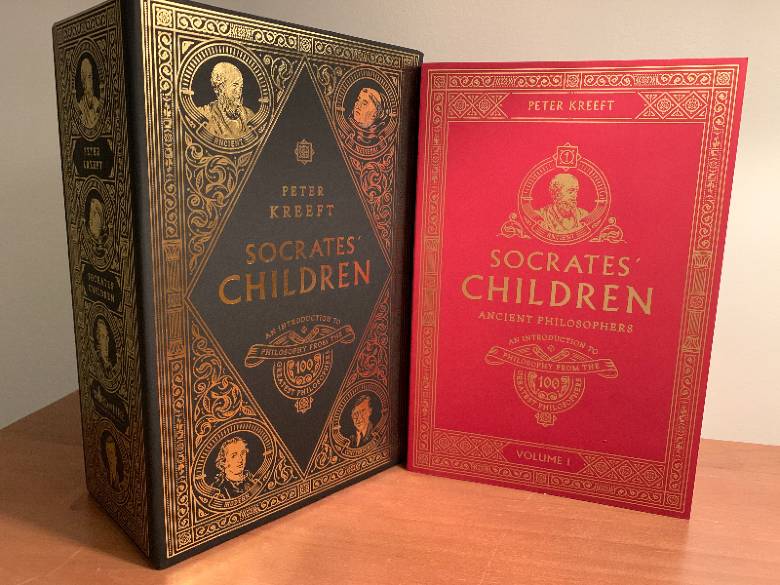
Socrates’ Children: Vol 1 – By Dr. Peter Kreeft (Photo by A. Laflamme)
Growing up, I never learned about Buddha, Buddhism, or the daily life of Buddhists beyond basic knowledge and seeing the occasional statue in a gift shop. One high school class on “India and Southeast Asia” covered the topic for a week or so, but I have never had a desire to truly investigate Eastern philosophies outside of basic awareness. I don’t think I shied away from Buddha out of fear of being swayed. Rather, I didn’t feel a need for Buddha. I had Jesus. But what if it’s not strictly Buddha versus Jesus.
Comparing Buddha versus Jesus
In Peter Kreeft’s first volume of Socrates’ Children, there is a brief overview of Buddha beginning with the fact that Buddha is not a name. Gotama would be the name, and Buddha would be the title. Gotama was called Buddha, meaning “awakened”, the way Jesus is called “Christ”, or “annointed”.
Four Truths
After an introduction to the person, Kreeft also lays out Buddha’s Four Nobel Truths:
- To live is to suffer
- Suffering is caused by desire
- The way to end suffering, is to end desire
- To remove desire, follow the Nobel Eightfold Path
Compare these four truths, Buddha vs. Jesus. Jesus’ truths have a similar structure:
-
The symptom is Death
-
Death is caused by sin
-
The way to end death, is to have Eternal Life
-
Eternal Life is possible by divine grace
- (Romans 6:23)
The structure here is similar in logic, but the biggest difference I see is the ending. Look at the two fourth truths: follow the eightfold path vs. divine grace. Buddha’s plan relies on our action, following the path. Sure, it also takes our participation to be open to God’s divine grace, but in the end we are reliant on God to do the heavy lifting.
“Following the Path” sounds similar to “Pick up your cross and follow me.” Yet, the key difference is that there is a person and relationship involved in the latter – “the Path” vs. “Me”.
The Path
That Buddhist fourth truth states to follow an Eightfold path. What is this Eightfold path? It is striving to be “right” in understanding, thought, speech, action, livelihood, effort, mindfulness, and concentration.
My first thought is that these almost sound like something out of the sermon on the mount! But what would Jesus say? Jesus tells us the greatest commandment: to love God with all your heart, soul, and mind. Then secondly, to love your neighbor as yourself.
Jesus replied: “‘Love the Lord your God with all your heart and with all your soul and with all your mind.’ This is the first and greatest commandment. And the second is like it: ‘Love your neighbor as yourself.’ Matthew 22:37-39
Will “right” in understanding, thought, speech, action, livelihood, effort, mindfulness, and concentration help us to love God and neighbor? I would say that they can, but only if we have the proper understanding of “right”.
In a secular or relativistic culture with many definitions of “right”, one could be led in any direction. However, rooted in the Tradition and teachings of the Church, we can learn what is “right” and pursue that life.
The Goal
I’d like to look back to our “4 truths”. The stated goal of the Buddhist philosophy is to end suffering. The goal of Christianity is rather different, to end death.
For comparison, it’s stated in a similar format as the Buddhist, “to end death“. Yet, I would argue it is more so about the positive, “to gain eternal life” which is actually possible through suffering and death.
Jesus even tells us in the Beatitudes “Blessed are those who are persecuted for righteousness’ sake, for theirs is the kingdom of heaven.” (Matthew 5:10), or “If any want to become my followers, let them deny themselves and take up their cross and follow me.” (Matthew 16:24).
Suffering for the Christian, is not the disease. Christians embrace suffering as a way of uniting our lived experience with Jesus. We “carry our cross” and even appreciate it as a means of growing closer in relationship with God who gives the divine grace.
Not “What” is the Goal, but “Who”?
The end goal is the major difference for Buddha versus Jesus. Buddha did not claim to be God or have a God. Instead he told of nirvana, a state of no more desires. Thus, no more suffering. For Jesus, he preached of a Kingdom, and a relationship with God in the Father, Son, and Holy Spirit.
Learning From Buddha to Know Jesus
I think in the end, we can learn from Buddha. We can use some of his insights, while remaining rooted in the Church, to grow closer to our end goal, Jesus.
Coincidentally, my brother recently gifted me a copy of The Mindful Catholic by Dr. Gregory Bottaro with a forward by Peter Kreeft. In the forward, Kreeft says “By the way, this is not a Buddhist book. It is a Christian and Catholic book. It does not lead you into nothingness or emptiness but into everything – especially into God.”
I am very aware that my brain is all over the place. So I look forward to diving into this book and learning what I can from this practice with the peace of being rooted in Catholic Tradition! Stay tuned for how that goes.
Read more Formed by a Flame or Subscribe to the Newsletter!
Buddhism
Education and Religion
Previous Post
June 9, 2023
Corpus Christi: Thanksgiving in June
Next Post

June 23, 2023 Source and Summit: The Mountain of Faith
Recent Comments
"Let us pray that all our fourth quarters are played against the NY Giants."
Fourth Quarters, October, and the Virtue ..."
"I'm a football fan. I root for a team, but I seldom go to any ..."
If NFL Was Religion, the Super ..."
"Woof! You nailed it. The parallels are haunting. Yet, it’s not surprising: Man will ALWAYS ..."
If NFL Was Religion, the Super ..."
"Thank you for reading and for the kind words!"
Blue August Moon Reminds Us of ..."
Browse Our Archives
Select a Category Feasts and Holy Days Music Review Parenting Reflection Uncategorized
Select a Month February 2026 December 2025 November 2025 October 2025 September 2025 August 2025 July 2025 June 2025 May 2025 April 2025 March 2025 February 2025 January 2025 September 2024 August 2024 May 2024 March 2024 February 2024 January 2024 December 2023 November 2023 October 2023 September 2023 August 2023 July 2023 June 2023 May 2023
TAKE THE
Religious Wisdom Quiz
Who was Elijah's successor, receiving a double portion of his spirit?
Select your answer to see how you score.
Samuel Micaiah Obadiah Elisha
Related posts from Formed by a Flame

Luke 20: Jesus is Questioned - Advent Day...

Luke 5: Obedience, Humility, Conversion - Advent Day...
100 Answers for Defending Mary this Feast of...
St. Joseph Novena Study - Day 8: Friend...
TRENDING AT PATHEOS Catholic

The Parable Of The Sower And The Word...
One of Christ’s most famous parables is that of the sower who...

Rejecting Doom: Christian Hope And Human Action
Christianity is a religion of hope. We are to have hope and...

Why I Choose the Eucharist Over the Sermon
Choose the Eucharist, Not the Sermon What are we supposed to get...

5 Design Elements Found in Spiritually Rooted Homes
Putting Spirituality Into Home Decor Our homes are more than our living...

Credo: A Story of God Told with the...
About 10 years ago, I began to imagine a personal "Credo" that...

The Anatomy of Divine Revelation in Catholic Thought
The claim that God has made Himself known to human beings is...
view all Catholic blogs
What Are Your Thoughts?leave a comment
Ad-Free & Subscriber Log-In Subscription Support
- About Us
- 2026 Calendar
- Videos
- Podcasts
- Library of World Religions
- Faith In Media Tracker
- Advertise With Us
- Write for Us
- Privacy Policy
- Terms of Service
- Do Not Sell My Data
- Contact Us
- Radiant Digital
- Manage Newsletter Subscriptions
- Unsubscribe From Notifications
- Sitemap
Copyright 2008-2026, Patheos. All rights reserved.
Subscription Support Ad-Free & Subscriber Log-In
Follow Patheos