
BuddhistCatholicContemplativeEvangelicalGeneral ChristianHinduJewishLatter-day SaintMuslimNew VisionsProgressive Christian
Beliefs
- Buddhist
- Catholic
- Contemplative
- Evangelical
- General Christian
- Hindu
- Jewish
- Latter-day Saint
- More Voices
- Muslim
- New Visions
- Pagan
- Progressive Christian
Topics
- Religion News
- Food and Religion
- Sports and Religion
- Religious Art
- Religious Music and Entertainment
- Religious Events
- History and Religion
- Style and Religion
- Politics and Religion
- Women in Religion
- Recreation Outdoors and Religion
- Business Finance and Religion
- Careers Workplace and Religion
- Education and Religion
- Family Parenting and Religion
- Health Fitness and Religion
- Home and Religion
- Relationships and Religion
- Technology and Religion
- Travel and Religion
Columnists
- Buddhist Columnists
- Business Finance and Religion Columnists
- Careers Workplace and Religion Columnists
- Catholic Columnists
- Contemplative Columnists
- Education and Religion Columnists
- Evangelists Columnists
- Family Parenting and Religion Columnists
- General Christian Columnists
- Health Fitness and Religion Columnists
- Hindu Columnists
- History and Religion Columnists
- Home and Religion Columnists
- Jewish Columnists
- More Voices Columnists
- Latter Day Columnists
- Muslim Columnists
- New Visions Columnists
- Nonreligious Columnists
- Pagan Columnists
- Politics and Religion Columnists
- Progressive Columnists
- Recreation Outdoors and Religion Columnists
- Relationships and Religion Columnists
- Religion News Columnists
- Religious Art Columnists
- Religious Events Columnists
- Religious Music and Entertainment Columnists
- Sports and Religion Columnists
- Style and Religion Columnists
- Technology and Religion Columnists
- Travel and Religion Columnists
- Women in Religion Columnists
Resource Library
- 2026 Calendar
- Library of World Religions
- The 100 Most Holy Places on Earth
- Patheos Answers
- Podcasts
- Videos
- Faith Leaders Database
- Anglican Episcopalian
- Bahai
- Baptist
- Buddhism
- Christianity
- Confucianism
- Eastern Orthodoxy
- Hinduism
- Holiness and Pentecostal
- ISKCON
- Islam
- Judaism
- Lutheran
- Methodist
- The Church of Jesus Christ of Latter-day Saints
- New Age
- Paganism
- Presbytarian and Reformed
- Protestantism
- Religion Behind the Scenes
- Roman Catholic
- Scientology
- Shia Islam
- Sikhism
- Sufism
- Sunni Islam
- Taoism
- Zen
- See all religions
Research Tools
 Ad-Free & Subscriber Log-In Subscription Support
Ad-Free & Subscriber Log-In Subscription Support
Follow Patheos 

- Trending:
- Forgiveness
- |
- Marriage
- |
- Consciousness
- |
- Death Penalty
- |
- Election
- |
- Halloween

- Home
- Catholic
- Politics and Religion
- Just Trying to Be Good
Just Trying to Be Good
Last updated on: October 27, 2025 at 11:08 pm by Fr. Nicholas Sheehy, LC
Just Trying to Be Good 2025-10-27T23:08:21-07:00 Fr. Nicholas Sheehy, LC
Patheos Explore the world's faith through different perspectives on religion and spirituality! Patheos has the views of the prevalent religions and spiritualities of the world.
Why is it so hard to be good? Don’t we sometimes have the impression that Christian life is like running on a treadmill and that no matter what we do, it is never enough?
Nature of Grace
Grace is not an abstract ideal, but a way of life to be actively lived. Jesus illustrates this truth in the parable of the Pharisee and the Tax Collector (cf. Lk. 18:9-14). The Pharisee could have defined grace, but his heart was hardened to the point that he could not receive grace. The Tax Collector, however, knew of his own sinfulness and opened his heart up to receive grace from God.
The Catechism of the Catholic Church reminds us that
Our justification comes from the grace of God. Grace is favor, the free and undeserved help that God gives us to respond to his call to become children of God, adoptive sons, partakers of the divine nature and of eternal life (Catechism of the Catholic Church, 1996).
A Lutheran Martyr?
Dietrich Bonhoeffer was a Lutheran pastor during the Second World War. He joined different resistance groups to try to stop Hitler. He reflected deeply on the meaning of the Christian message in a world torn apart by hate and war. The Cost of Discipleship is probably his most famous work, particularly through his reflection on cheap grace.
Cheap grace is the preaching of forgiveness without requiring repentance, baptism without church discipline. Communion without confession. Cheap grace is grace without discipleship, grace without the cross, grace without Jesus Christ, living and incarnate (Dietrich Bonhoeffer, Cost of Discipleship, p. 4).
Bonhoeffer’s words bring the parable into sharp relief: the Pharisee embodies cheap grace – religion without conversion – while the tax collector reveals costly grace – repentance that leads to life.
Not Sure How to Pray
When the Pharisee and the tax collector walk into the Temple, they face a difficulty that we all face at times. We are not quite sure what to say. We are not sure how to pray. They make up things according to what they have learned and experienced, but one does it better than the other. What can we learn from them?
The Pharisee looks inwardly at himself, but not honestly and sincerely. He brainstorms a list of his own qualities, but without a discerning mind. He believes all the good that he can think about himself. The tax collector looks at himself, but with humility and objectivity. He knows the ways he has fallen short of the ideal. He is ashamed and approaches God, knowing that he is unworthy of so great a God.
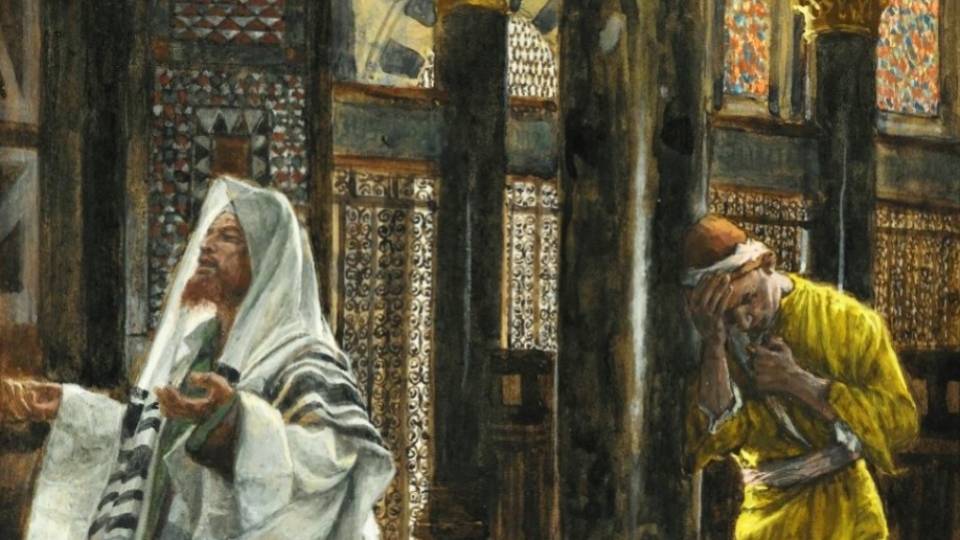
Two Men Pray in the Temple | Courtesy: Salt and Light Media
Self-Righteousness
The Pharisee judges himself to be righteous. St. Paul writes that “the one who is righteous by faith will live” (Rm. 1:17). The Pharisee assumes his own righteousness because he checks off all the boxes. He knows exactly what is required of him as far as religious duties. He does not seem to worry much, however, about what is going on with his heart. The tax collector approaches God from a different perspective. He does not assume that he is justified in his actions. He may have had reasons for his actions, even the immoral ones, but he never pretends it isn’t God’s place to judge him.
In one of his homilies, St. John Chrysostom offers a vivid image to help evaluate the two men. He compares it to a chariot race. Each chariot is being pulled by two horses. The Pharisee’s chariot is pulled by justice and arrogance. Meanwhile, the tax collector’s chariot is pulled by sin and humility. The chariot pulled by sin will win every time. This is not because of its own power, but by the other horse’s strength: humility. The Pharisee’s chariot falls behind, not because justice is weak, but because arrogance is heavy.
So, humility, by its surpassing loftiness, overcomes the heaviness of sin and is the first to rise up to God. In the same manner, because of its great weight and mass, pride can overcome the lightness of justice and easily drag it down to earth (St. John Chrysostom, Serm. De fariseo ed de publicano).
We Cannot Earn Heaven
The parable emphasizes the fact that we are saved by God’s grace and not merely through our own efforts. We cannot earn Heaven. This does not mean, however, that what we do in this life is unimportant. God invites us to collaborate in our own salvation through the good things that we do. Our justification comes from the grace of God. It is a free gift from him, but one which we must embrace and make our own.
When you interview for a job, are you like the Pharisee or the tax collector? Do you communicate a series of incredible qualities that you do not even fully possess, or are you able to communicate who you truly are? We can think about this from the other side of the table. Would I rather hire someone who can say good things about himself or herself, or someone who can connect deeply on a human level?
In our personal relationships, in our academic career, and even in our relationship with God, we can be like the Pharisee or the tax collector. What are we going to choose?
Maybe it would be good to take a piece of paper and divide it into four quadrants. Write down the names of the four horses in the example from St. John Chrysostom: justice, arrogance, sin, and humility. What in your life identifies with each of these areas? This can help you see where you want to invest your efforts to become holier and more united to Christ. Grace is God’s invitation – but humility is our way of opening the door. Seek justice, love humility, and God will transform your life.
Subscribe to the newsletter to never miss an article.
Check out my Substack.

About Fr. Nicholas Sheehy, LC
Fr. Nicholas Sheehy is Assistant Chaplain at the Duke Catholic Center. He was ordained a Catholic priest in 2013 for the Legionaries of Christ. You can read more about the author here.
Previous Post

October 17, 2025
Faith Beyond Fairness
Next Post

October 27, 2025 Contraception and Catholics
Recent Comments
"Peace is a precious resource. Humankind and Planet Earth are thirsting for peace. Long live ..."
The Man Who Taught Nagasaki to ..."
"Searching and finding truth and traveling from truth to Truth is an exciting journey. The ..."
Your Writing Makes the Pope Happy
"Rich or poor, we are all fellow pilgrims enthusiastically marching together to our cherished destination. ..."
"There's no moral difference between avoiding conception by using 'artificial' contraception and using a 'natural' ..."
Browse Our Archives
Select a Category Church News Education Eucharist Faith and Mental Health Family Living the Faith Marriage Relationships Spiritual Direction Uncategorized Vocations Women Young Adults
Select a Month October 2026 September 2026 August 2026 July 2026 June 2026 November 2025 October 2025 September 2025 August 2025 July 2025 May 2025 April 2025 March 2025 February 2025 January 2025 December 2024 November 2024 October 2024 September 2024 August 2024 July 2024 June 2024 May 2024 April 2024 March 2024 February 2024 January 2024 December 2023 November 2023
Follow Us!
TAKE THE
Religious Wisdom Quiz
True or False: The book of Lamentations contains seven chapters.
Select your answer to see how you score.
TRUE FALSE
Related posts from Formation Matters

The Big Opportunity for Bishops After the SSPX...

Let Freedom Ring: Truth and the American Soul

“Close the Door and Pray”: Creating a Place...

Lesson of Humility from a Styrofoam Cup
TRENDING AT PATHEOS Catholic

The Sermon on the Mount, Part I: Matthew...
The Sermon on the Mount, Part I (Matthew 4:12-5:12) St. Matthew moves...

What's up from Crossway: Reviewing some of their latest A few weeks...

Janie Learns the Way of the Cross: A...
Teaching children about Jesus' Passion can be challenging. Many parents and educators...

Looking For Good Catholic Writing - October 2026
He alone extends the heavens, and he walks upon the waves of...

In "Irreplaceable," our book on vocation and technology, Trevor Sutton and I...

I was strolling through the top floor of the brand new Parthenon...
view all Catholic blogs
What Are Your Thoughts?leave a comment
Ad-Free & Subscriber Log-In Subscription Support
- About Us
- 2026 Calendar
- Videos
- Podcasts
- Library of World Religions
- Faith In Media Tracker
- Advertise With Us
- Write for Us
- Privacy Policy
- Terms of Service
- Do Not Sell My Data
- Contact Us
- Radiant Digital
- Manage Newsletter Subscriptions
- Unsubscribe From Notifications
- Sitemap
Copyright 2008-2026, Patheos. All rights reserved.
Subscription Support Ad-Free & Subscriber Log-In
Follow Patheos