
BuddhistCatholicContemplativeEvangelicalGeneral ChristianHinduJewishLatter-day SaintMuslimNew VisionsProgressive Christian
Beliefs
- Buddhist
- Catholic
- Contemplative
- Evangelical
- General Christian
- Hindu
- Jewish
- Latter-day Saint
- More Voices
- Muslim
- New Visions
- Pagan
- Progressive Christian
Topics
- Religion News
- Food and Religion
- Sports and Religion
- Religious Art
- Religious Music and Entertainment
- Religious Events
- History and Religion
- Style and Religion
- Politics and Religion
- Women in Religion
- Recreation Outdoors and Religion
- Business Finance and Religion
- Careers Workplace and Religion
- Education and Religion
- Family Parenting and Religion
- Health Fitness and Religion
- Home and Religion
- Relationships and Religion
- Technology and Religion
- Travel and Religion
Columnists
- Buddhist Columnists
- Business Finance and Religion Columnists
- Careers Workplace and Religion Columnists
- Catholic Columnists
- Contemplative Columnists
- Education and Religion Columnists
- Evangelists Columnists
- Family Parenting and Religion Columnists
- General Christian Columnists
- Health Fitness and Religion Columnists
- Hindu Columnists
- History and Religion Columnists
- Home and Religion Columnists
- Jewish Columnists
- More Voices Columnists
- Latter Day Columnists
- Muslim Columnists
- New Visions Columnists
- Nonreligious Columnists
- Pagan Columnists
- Politics and Religion Columnists
- Progressive Columnists
- Recreation Outdoors and Religion Columnists
- Relationships and Religion Columnists
- Religion News Columnists
- Religious Art Columnists
- Religious Events Columnists
- Religious Music and Entertainment Columnists
- Sports and Religion Columnists
- Style and Religion Columnists
- Technology and Religion Columnists
- Travel and Religion Columnists
- Women in Religion Columnists
Resource Library
- 2026 Calendar
- Library of World Religions
- The 100 Most Holy Places on Earth
- Patheos Answers
- Podcasts
- Videos
- Faith Leaders Database
- Anglican Episcopalian
- Bahai
- Baptist
- Buddhism
- Christianity
- Confucianism
- Eastern Orthodoxy
- Hinduism
- Holiness and Pentecostal
- ISKCON
- Islam
- Judaism
- Lutheran
- Methodist
- The Church of Jesus Christ of Latter-day Saints
- New Age
- Paganism
- Presbytarian and Reformed
- Protestantism
- Religion Behind the Scenes
- Roman Catholic
- Scientology
- Shia Islam
- Sikhism
- Sufism
- Sunni Islam
- Taoism
- Zen
- See all religions
Research Tools
 Ad-Free & Subscriber Log-In Subscription Support
Ad-Free & Subscriber Log-In Subscription Support
Follow Patheos 

- Trending:
- Forgiveness
- |
- Marriage
- |
- Consciousness
- |
- Death Penalty
- |
- Election
- |
- Halloween

- Home
- Catholic
- Politics and Religion
- Re-Centering Worship: Liturgical Combat of Clericalism
Re-Centering Worship: Liturgical Combat of Clericalism
Last updated on: August 21, 2025 at 9:17 am by Fr. Nicholas Sheehy, LC
Re-Centering Worship: Liturgical Combat of Clericalism 2025-08-21T09:17:51-07:00 Fr. Nicholas Sheehy, LC
Patheos Explore the world's faith through different perspectives on religion and spirituality! Patheos has the views of the prevalent religions and spiritualities of the world.
If clericalism arises when priests become the focus of worship, then a liturgical orientation that places Christ, not the celebrant, at the visual and theological center of the Mass is a simple and powerful remedy.
The Second Vatican Council is the most important Church event of the 20th century. Bishops from around the world gathered at the beckoning of Pope John XXIII to renew the Church and face the unique difficulties of the modern world. One of the notable consequences is the effect on the liturgy as celebrated in the Latin Rite of the Roman Catholic Church. Particularly noticeable is the shift from the altar attached to the wall conducive to ad orientem celebration to the now ubiquitous free-standing altar that seems to invite the celebrant to celebrate the Mass versus populum, facing the people.
Vatican II
In the document on the liturgy, the Council Fathers determined that
the rite of the Mass is to be revised in such a way that the intrinsic nature and purpose of its several parts, as also the connection between them, may be more clearly manifested, and that devout and active participation by the faithful may be more easily achieved (Sacrosanctum Concilium, 50).
The primary purpose of liturgy is to give glory to God, to sanctify the faithful, and to build up the Church. The revisions of the Mass over the last 60 years ostensibly have the purpose of making these finalities more accessible to the “parishioners in the pews.”
Maybe there is room to consider liturgical modifications that could help with what apparently is such a large danger. The reforms to the liturgy with the 1970 missal sought to help bring the Mass closer to the people, especially through the use of the vernacular and increased participation by the lay faithful. Architectural modifications were also introduced, perhaps most noticeably the institution of free-standing altars that invited the celebrating priest to stand on one side of the “table” with the congregation situated on the opposite side.
Moving the Center back to what is Central
This has the perhaps unintended effect of placing the priest very much at the center of things. Yes, at the moment of consecration, the sacred species of bread and wine – the Body and Blood of Christ – are situated in between. Nevertheless, the visual focus of the people can be the priest instead of the consecrated host.
This places undue pressure on the priest to perform. He is celebrating the Mass, and he stamps his own character on his particular liturgical celebration. This has given rise to a plethora of liturgical abuses and too much of a focus on the priest. “I like the way Fr. Frederick celebrates Mass. Let’s go to his parish. I don’t like the way Fr. Bonaventure celebrates Mass. Let’s stay away.” Although I understand the sentiment and validate it to some extent, it seems so tremendously poor.
A similar phenomenon occurs when it is time to distribute Communion. If I am going to receive the Body and Blood of my Lord and Savior Jesus Christ from a priest or a lay extraordinary minister, the gift is so far above the minister that I kind of don’t care about the minister.
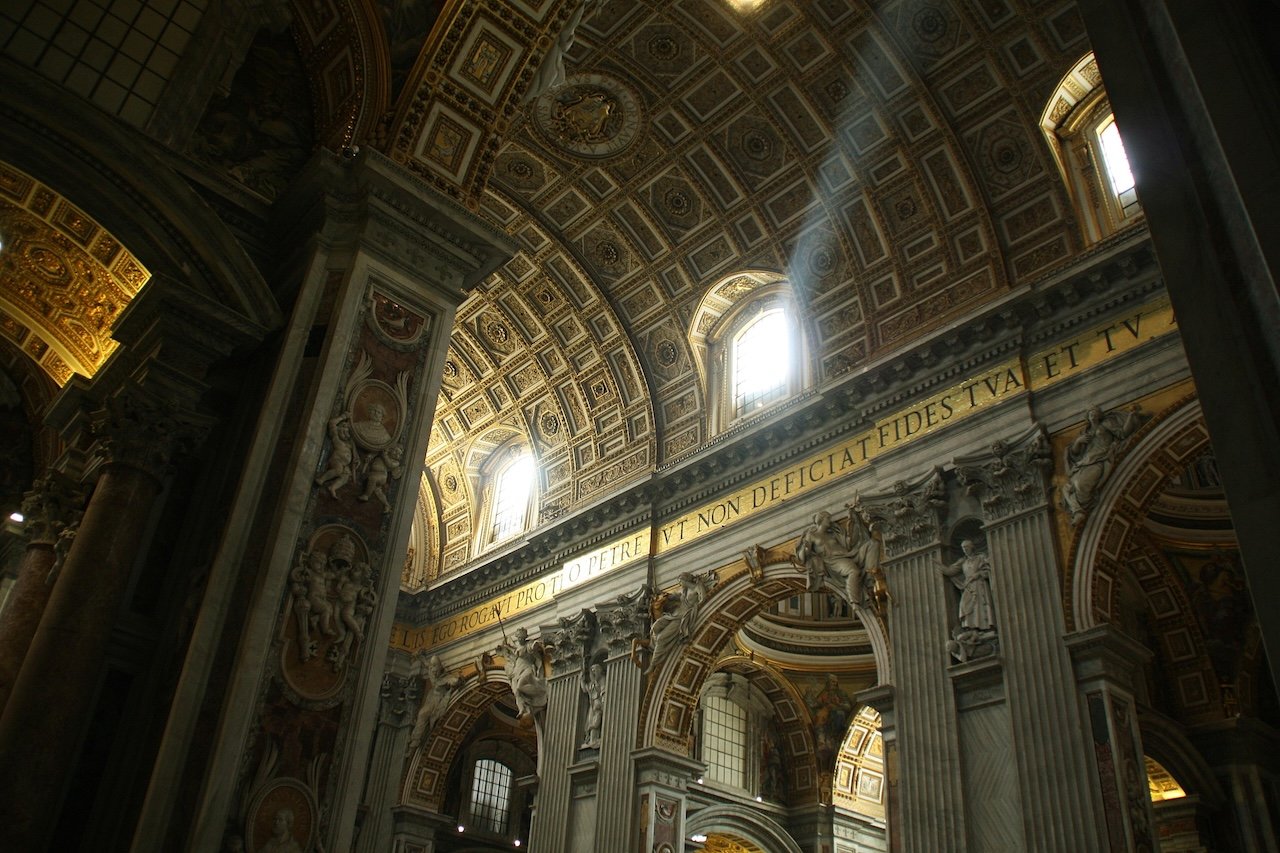
Basilica of St. Peter’s Rome | Courtesy: Pexels.com
Bishop from New Mexico
Bishop Wall of Gallup, New Mexico, advocated for his priests to take up the celebration of the Mass ad orientem in a pastoral letter in 2019. It is worthwhile reading the letter to understand the reasons that he gives. He gives a brief catechesis on the mass celebrated in this fashion.
Prayer and worship “toward the East” (ad orientem, oriented prayer) “is, first and foremost, a simple expression of looking to Christ as the meeting place between God and man. It expresses the basic christological form of our prayer. […] Praying toward the east means going to meet the coming Christ. The liturgy, turned toward the East, effects entry, so to speak, into the procession of history toward the future, the New Heaven and the New Earth, which we encounter in Christ” (Joseph Ratzinger,The Spirit of the Liturgy, p. 69-70). By facing Christ together at Mass, we can see how “[o]ur prayer is thus inserted into the procession of the nations to God” (ibid., p. 76) (Bishop James Wall, “Turning Towards God: Celebrating the Mass Ad Orientem”).
Would it not be worth trying something as simple as this? I am not advocating for a major upheaval and architectural redesign of our churches. The priest could simply stand on the same side of the altar as the congregation, facing the apse of the church with them. And I am also not saying it needs to be obligatory. I think even taking simple steps to make this practice more acceptable would go a long way.
If we believe that the Eucharist is “source and summit of the Christian life” (cf. Catechism of the Catholic Church, 1324) and we want the liturgy to be more accessible to the people, maybe we need to recapture some of the elements that transmit the mystery which we are actually celebrating. We do not come together on Sunday to celebrate a certain preacher’s prowess as a proclaimer of the Gospel, or an entertainer. Rather, we come before our Eucharistic Lord to be present at his once and for all sacrifice at Calvary. Let’s set it up so it is more accessible to penetrate the mystery and fall on our knees before the Eucharistic Lord!
This article continues the reflection of Beyond the Pulpit: Combating Clericalism Through Synodality
Subscribe to the newsletter to never miss an article.
Relationships and Religion

About Fr. Nicholas Sheehy, LC
Fr. Nicholas Sheehy is Assistant Chaplain at the Duke Catholic Center. He was ordained a Catholic priest in 2013 for the Legionaries of Christ. You can read more about the author here.
Previous Post

August 18, 2025
The Narrow Door and the Acquired Taste of Heaven
Next Post

August 25, 2025 Lesson of Humility from a Styrofoam Cup
Recent Comments
"Peace is a precious resource. Humankind and Planet Earth are thirsting for peace. Long live ..."
The Man Who Taught Nagasaki to ..."
"Searching and finding truth and traveling from truth to Truth is an exciting journey. The ..."
Your Writing Makes the Pope Happy
"Rich or poor, we are all fellow pilgrims enthusiastically marching together to our cherished destination. ..."
"There's no moral difference between avoiding conception by using 'artificial' contraception and using a 'natural' ..."
Browse Our Archives
Select a Category Church News Education Eucharist Faith and Mental Health Family Living the Faith Marriage Relationships Spiritual Direction Uncategorized Vocations Women Young Adults
Select a Month October 2026 September 2026 August 2026 July 2026 June 2026 November 2025 October 2025 September 2025 August 2025 July 2025 May 2025 April 2025 March 2025 February 2025 January 2025 December 2024 November 2024 October 2024 September 2024 August 2024 July 2024 June 2024 May 2024 April 2024 March 2024 February 2024 January 2024 December 2023 November 2023
Follow Us!
TAKE THE
Religious Wisdom Quiz
What did Jesus do for Lazarus?
Select your answer to see how you score.
Healed his eyes Raised him from the dead Fed him Made him king
Related posts from Formation Matters

Beyond Left and Right: Catholic Church on Immigration



TRENDING AT PATHEOS Catholic

Swimfan: Forgotten Aughts Pleasures
This is a recovery effort. In 2002, My Big Fat Greek Wedding...

Top Three Anti-Catholic Lies About Catholicism
This is my initial transcript for the video, "THE 3 WORST...

Pope Leo Celebrates Mass for Nurses & Docs...
I don't have any idea how he did it, but Pope Leo...

The Sermon on the Mount, Part I: Matthew...
The Sermon on the Mount, Part I (Matthew 4:12-5:12) St. Matthew moves...

What's up from Crossway: Reviewing some of their latest A few weeks...

Janie Learns the Way of the Cross: A...
Teaching children about Jesus' Passion can be challenging. Many parents and educators...
view all Catholic blogs
What Are Your Thoughts?leave a comment
Ad-Free & Subscriber Log-In Subscription Support
- About Us
- 2026 Calendar
- Videos
- Podcasts
- Library of World Religions
- Faith In Media Tracker
- Advertise With Us
- Write for Us
- Privacy Policy
- Terms of Service
- Do Not Sell My Data
- Contact Us
- Radiant Digital
- Manage Newsletter Subscriptions
- Unsubscribe From Notifications
- Sitemap
Copyright 2008-2026, Patheos. All rights reserved.
Subscription Support Ad-Free & Subscriber Log-In
Follow Patheos