
BuddhistCatholicContemplativeEvangelicalGeneral ChristianHinduJewishLatter-day SaintMuslimNew VisionsProgressive Christian
Beliefs
- Buddhist
- Catholic
- Contemplative
- Evangelical
- General Christian
- Hindu
- Jewish
- Latter-day Saint
- More Voices
- Muslim
- New Visions
- Pagan
- Progressive Christian
Topics
- Religion News
- Food and Religion
- Sports and Religion
- Religious Art
- Religious Music and Entertainment
- Religious Events
- History and Religion
- Style and Religion
- Politics and Religion
- Women in Religion
- Recreation Outdoors and Religion
- Business Finance and Religion
- Careers Workplace and Religion
- Education and Religion
- Family Parenting and Religion
- Health Fitness and Religion
- Home and Religion
- Relationships and Religion
- Technology and Religion
- Travel and Religion
Columnists
- Buddhist Columnists
- Business Finance and Religion Columnists
- Careers Workplace and Religion Columnists
- Catholic Columnists
- Contemplative Columnists
- Education and Religion Columnists
- Evangelists Columnists
- Family Parenting and Religion Columnists
- General Christian Columnists
- Health Fitness and Religion Columnists
- Hindu Columnists
- History and Religion Columnists
- Home and Religion Columnists
- Jewish Columnists
- More Voices Columnists
- Latter Day Columnists
- Muslim Columnists
- New Visions Columnists
- Nonreligious Columnists
- Pagan Columnists
- Politics and Religion Columnists
- Progressive Columnists
- Recreation Outdoors and Religion Columnists
- Relationships and Religion Columnists
- Religion News Columnists
- Religious Art Columnists
- Religious Events Columnists
- Religious Music and Entertainment Columnists
- Sports and Religion Columnists
- Style and Religion Columnists
- Technology and Religion Columnists
- Travel and Religion Columnists
- Women in Religion Columnists
Resource Library
- 2026 Calendar
- Library of World Religions
- The 100 Most Holy Places on Earth
- Patheos Answers
- Podcasts
- Videos
- Faith Leaders Database
- Anglican Episcopalian
- Bahai
- Baptist
- Buddhism
- Christianity
- Confucianism
- Eastern Orthodoxy
- Hinduism
- Holiness and Pentecostal
- ISKCON
- Islam
- Judaism
- Lutheran
- Methodist
- The Church of Jesus Christ of Latter-day Saints
- New Age
- Paganism
- Presbytarian and Reformed
- Protestantism
- Religion Behind the Scenes
- Roman Catholic
- Scientology
- Shia Islam
- Sikhism
- Sufism
- Sunni Islam
- Taoism
- Zen
- See all religions
Research Tools
 Ad-Free & Subscriber Log-In Subscription Support
Ad-Free & Subscriber Log-In Subscription Support
Follow Patheos 

- Trending:
- Forgiveness
- |
- Marriage
- |
- Consciousness
- |
- Death Penalty
- |
- Election
- |
- Halloween

- Home
- Catholic
- Politics and Religion
- Locked Doors to Open Hearts: Divine Mercy Sunday
Locked Doors to Open Hearts: Divine Mercy Sunday
Last updated on: April 26, 2025 at 12:13 pm by Fr. Nicholas Sheehy, LC
Locked Doors to Open Hearts: Divine Mercy Sunday 2025-04-26T12:13:13-07:00 Fr. Nicholas Sheehy, LC
Patheos Explore the world's faith through different perspectives on religion and spirituality! Patheos has the views of the prevalent religions and spiritualities of the world.
Did Pope John Paul II feel fear? One of the refrains of his papacy was “Be not afraid.”
Brothers and sisters, do not be afraid to welcome Christ and accept his power. Help the Pope and all those who wish to serve Christ and with Christ’s power to serve the human person and the whole of mankind. Do not be afraid. Open wide the doors for Christ. To his saving power open the boundaries of States, economic and political systems, the vast fields of culture, civilization and development. Do not be afraid. Christ knows “what is in man”. He alone knows it (John Paul II, 22 October 1978).
Feeling Fear
Of course, the Holy Father felt fear throughout his life. He had to face the Nazis and the Communists. When he arrived in Rome in 1978, he wanted to lead a procession through the streets for Corpus Christi. The authorities of the city did not want to let him do it, because they were dealing with a terrorist organization called the Brigate Rosse and had fears that a public procession would be a target for a violent attack. The Pope responded that he had led the procession in Communist Poland and that he was certainly not going to be deterred from doing it in Rome.
He made it clear that he was determined to do it and was happy to let them provide a police escort if they wished. All subsequent Popes have continued this tradition every year, going from St. John Lateran to St. Mary Major, carrying the Eucharist through the typical Italian neighborhood.
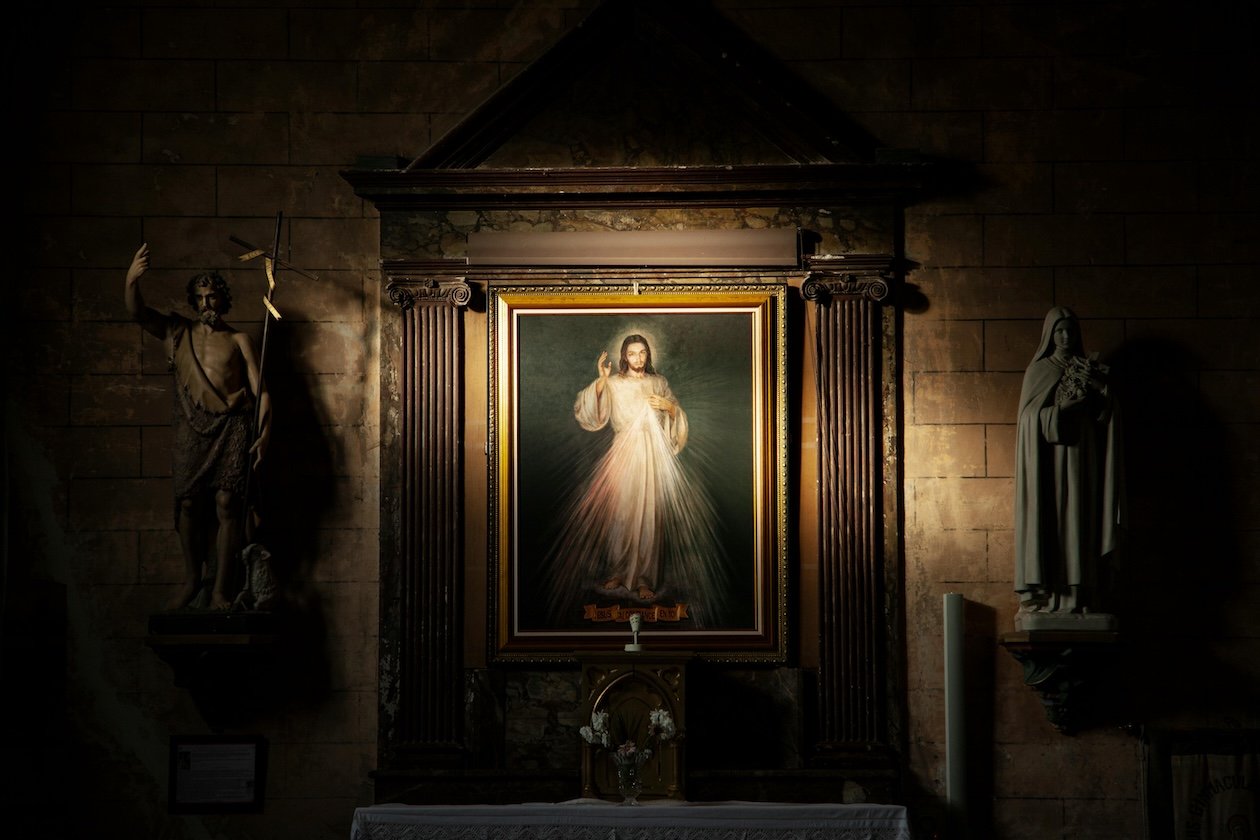
The image of Divine Mercy has gained followers in recent years. | Courtesy: Pexels.com
Courage of Pope John Paul II
We could describe Pope John Paul II as courageous–not because he felt no fear, but because he did brave things despite his fear. It is right to feel fear in the proper circumstances. What we must make sure of is that we respond with courage.
I remember a mission trip in Mexico near Cancun where we were swimming at a cenote. It was a big jump from a cliff to get into the water. I remember walking close to the edge a few times before finally taking the plunge. Other missionaries, however, were able to just walk up and jump. They had faced similar challenges before and were ready for this one. They reminded me that we overcome fear not by ignoring it but by improving our own capacity to face the danger. Have you ever faced a moment like that cenote jump – where fear made your knees shake, but something in you still said, “Go”?
Fear is physical
In today’s Gospel, we go back to the Resurrection event of Easter Sunday. The disciples are described as being afraid.
What does this emotion do to us? Let’s discuss a few things that you might not know about fear.
Fear is experienced in your mind, but it triggers a strong physical reaction in your body. As soon as you recognize fear, your amygdala goes to work. It alerts your nervous system, which sets your body’s fear response into motion. Stress hormones like cortisol and adrenaline are released. Your blood pressure and heart rate increase. You start breathing faster. Even your blood flow changes – blood actually flows away from your heart and into your limbs, making it easier for you to start throwing punches or run for your life” (Northwestern Medicine, “Understanding the Science of Fear”).
The first thing is that fear is physical. When fearful, our bodies prepare to react with fight or flight. It is no surprise that the disciples locked themselves in the Upper Room. They were terrified that they might be next in line for execution.
Fear Can Make You Foggy
When the amygdala senses fear, the cerebral cortex becomes impaired. We start to feel foggy. We don’t think quite as well, and it becomes more challenging to make good decisions. The movies praise those who feel no fear and can make snap decisions under any conditions. This does not, however, describe the reality that most of us deal with daily.
Dopamine Can Make You Feel Pleasure
Although it was not the apostles’ experience in this case, the dopamine released by the brain because of fear can cause pleasure. This explains why we might seek adventure as a way of provoking fear and experiencing this rush. This also explains why some people enjoy scary experiences.
Fear Is Not Phobia
Fears are common reactions to events or objects. But a fear becomes a phobia when it interferes with your ability to function and maintain a consistent quality of life (Northwestern Medicine, “Understanding the Science of Fear”).
Fear Keeps You Safe
Fear is a natural, biological condition that we all experience. It’s a complex emotion that can be either healthy or harmful, depending on how we respond to it. We also can’t get rid of fear just by someone saying, “Don’t be afraid.”
Bringing Peace
When Jesus walks into the Upper Room, he gives them his peace. This is not a mere suggestion. He says it as a command. It is also not an empty promise. He promises them peace because he has paid the price for peace. Jesus has given his life so that they could have peace. He proves this through signs.
Sign of Peace
At Mass, we think of the sign of peace as the moment before communion when we greet each other and desire peace for one another. We offer each other a sign of peace but in the Upper Room, Jesus offered his own wounds as a definitive sign of peace. The disciples saw the wounds in his hands, his feet, and his side.
So, what fear are you carrying into this Divine Mercy Sunday? What would it look like to place that fear into the hands of the Risen Christ? “Don’t be afraid” on its own can be an empty phrase. But united to the faith we have in the Resurrection, it gives us peace on this Divine Mercy Sunday. Mercy is not about ignoring reality, but about allowing reality to be transformed by the incredible power of the Death and Resurrection of Jesus Christ. Don’t pretend that the fear doesn’t exist. Instead of denying it – bring it to the Lord. Trust in his mercy, and let his peace take root in your heart.
Subscribe to the newsletter to never miss an article.

About Fr. Nicholas Sheehy, LC
Fr. Nicholas Sheehy is Assistant Chaplain at the Duke Catholic Center. He was ordained a Catholic priest in 2013 for the Legionaries of Christ. You can read more about the author here.
Previous Post
April 19, 2025
Heaven, Hope, and Holiness
Next Post

April 30, 2025 From the Pain of Betrayal to the Security of Love
Recent Comments
"Peace is a precious resource. Humankind and Planet Earth are thirsting for peace. Long live ..."
The Man Who Taught Nagasaki to ..."
"Searching and finding truth and traveling from truth to Truth is an exciting journey. The ..."
Your Writing Makes the Pope Happy
"Rich or poor, we are all fellow pilgrims enthusiastically marching together to our cherished destination. ..."
"There's no moral difference between avoiding conception by using 'artificial' contraception and using a 'natural' ..."
Browse Our Archives
Select a Category Church News Education Eucharist Faith and Mental Health Family Living the Faith Marriage Relationships Spiritual Direction Uncategorized Vocations Women Young Adults
Select a Month October 2026 September 2026 August 2026 July 2026 June 2026 November 2025 October 2025 September 2025 August 2025 July 2025 May 2025 April 2025 March 2025 February 2025 January 2025 December 2024 November 2024 October 2024 September 2024 August 2024 July 2024 June 2024 May 2024 April 2024 March 2024 February 2024 January 2024 December 2023 November 2023
Follow Us!
TAKE THE
Religious Wisdom Quiz
What church leader is called "the Bishop of Rome"?
Select your answer to see how you score.
The General Superintendent The Archbishop of Canterbury The Pope The Patriarch
Related posts from Formation Matters
Why Do We Build? Pope Leo XIV on...
Never Forget: What 9/11 Should Teach Us 25...
Why is there Catholic Education?

TRENDING AT PATHEOS Catholic

The First Eucharistic Controversy: Christ’s Real Presence
For Catholics, the Eucharist is the source and summit of the Christian...

How to Make a Decision When You Can't...
Main point: It’s much more valuable to stay close to God so...

Archdiocese Hosts Military Marriage Retreat in Germany
RASTATT, Germany — The transient military lifestyle, with its frequent deployments and...

Nearly every morning, I make the drive to Detroit with my high-school-age...

The Real AI Story Is Adoption Without Trust
Artificial intelligence has crossed a political threshold. It is no longer a...

A new article, written by Jeff Lindsay and Gale L. Pooley,...
view all Catholic blogs
What Are Your Thoughts?leave a comment
Ad-Free & Subscriber Log-In Subscription Support
- About Us
- 2026 Calendar
- Videos
- Podcasts
- Library of World Religions
- Faith In Media Tracker
- Advertise With Us
- Write for Us
- Privacy Policy
- Terms of Service
- Do Not Sell My Data
- Contact Us
- Radiant Digital
- Manage Newsletter Subscriptions
- Unsubscribe From Notifications
- Sitemap
Copyright 2008-2026, Patheos. All rights reserved.
Subscription Support Ad-Free & Subscriber Log-In
Follow Patheos