
BuddhistCatholicContemplativeEvangelicalGeneral ChristianHinduJewishLatter-day SaintMuslimNew VisionsProgressive Christian
Beliefs
- Buddhist
- Catholic
- Contemplative
- Evangelical
- General Christian
- Hindu
- Jewish
- Latter-day Saint
- More Voices
- Muslim
- New Visions
- Pagan
- Progressive Christian
Topics
- Religion News
- Food and Religion
- Sports and Religion
- Religious Art
- Religious Music and Entertainment
- Religious Events
- History and Religion
- Style and Religion
- Politics and Religion
- Women in Religion
- Recreation Outdoors and Religion
- Business Finance and Religion
- Careers Workplace and Religion
- Education and Religion
- Family Parenting and Religion
- Health Fitness and Religion
- Home and Religion
- Relationships and Religion
- Technology and Religion
- Travel and Religion
Columnists
- Buddhist Columnists
- Business Finance and Religion Columnists
- Careers Workplace and Religion Columnists
- Catholic Columnists
- Contemplative Columnists
- Education and Religion Columnists
- Evangelists Columnists
- Family Parenting and Religion Columnists
- General Christian Columnists
- Health Fitness and Religion Columnists
- Hindu Columnists
- History and Religion Columnists
- Home and Religion Columnists
- Jewish Columnists
- More Voices Columnists
- Latter Day Columnists
- Muslim Columnists
- New Visions Columnists
- Nonreligious Columnists
- Pagan Columnists
- Politics and Religion Columnists
- Progressive Columnists
- Recreation Outdoors and Religion Columnists
- Relationships and Religion Columnists
- Religion News Columnists
- Religious Art Columnists
- Religious Events Columnists
- Religious Music and Entertainment Columnists
- Sports and Religion Columnists
- Style and Religion Columnists
- Technology and Religion Columnists
- Travel and Religion Columnists
- Women in Religion Columnists
Resource Library
- 2026 Calendar
- Library of World Religions
- The 100 Most Holy Places on Earth
- Patheos Answers
- Podcasts
- Videos
- Faith Leaders Database
- Anglican Episcopalian
- Bahai
- Baptist
- Buddhism
- Christianity
- Confucianism
- Eastern Orthodoxy
- Hinduism
- Holiness and Pentecostal
- ISKCON
- Islam
- Judaism
- Lutheran
- Methodist
- The Church of Jesus Christ of Latter-day Saints
- New Age
- Paganism
- Presbytarian and Reformed
- Protestantism
- Religion Behind the Scenes
- Roman Catholic
- Scientology
- Shia Islam
- Sikhism
- Sufism
- Sunni Islam
- Taoism
- Zen
- See all religions
Research Tools
 Ad-Free & Subscriber Log-In Subscription Support
Ad-Free & Subscriber Log-In Subscription Support
Follow Patheos 

- Trending:
- Forgiveness
- |
- Marriage
- |
- Consciousness
- |
- Death Penalty
- |
- Election
- |
- Halloween

- Home
- Catholic
- Politics and Religion
- Does God Suffer? What the Cross Really Reveals
Does God Suffer? What the Cross Really Reveals
Last updated on: April 15, 2025 at 7:48 am by Fr. Nicholas Sheehy, LC
Does God Suffer? What the Cross Really Reveals 2025-04-15T07:48:09-07:00 Fr. Nicholas Sheehy, LC
Patheos Explore the world's faith through different perspectives on religion and spirituality! Patheos has the views of the prevalent religions and spiritualities of the world.
Does God Suffer?
Christ chose to suffer on the cross. This challenges our understanding of human existence since suffering challenges and changes our understanding of the world.
In July 1943, a terrified fourteen-year-old boy watched helplessly as thousands of bombs fell on his hometown. He and his friends had been conscripted only a few months earlier to operate an anti-aircraft battery built on a platform in the middle of a lake. With their radar jammed, their gun was useless against the hundreds of bombers flying over the city. The bombs ignited a firestorm that would burn at over 1,000°F and cast flames almost a thousand feet into the air. Nine nights of terror culminated in the loss of 37,000 lives, including the boy’s friend, who was decapitated by a bomb exploding at the battery. The horror of witnessing the deaths of thousands of people as whole neighborhoods were reduced to ash prompted the fourteen-year-old to ask questions. He said “My question was not, ‘Why does God allow this to happen?’ but, ‘My God, where are you?’ And there was the other question, the answer to which I am still looking for today: Why am I alive and not dead, too, like the friend at my side? I felt the guilt of survival and searched for the meaning of continued life” (Mark Giszczak, Suffering. What Every Catholic Should Know, p. 50).
Jurgen Moltmann, the frightened boy from the story, would go on to be one of the most prominent theological minds of the 20th century. This theologian proposed the doctrine of a suffering God, and many other German Lutheran theologians continued along the same line of reflection, deeply impacting the theological atmosphere of the century as a whole. Was he right to present a suffering God?
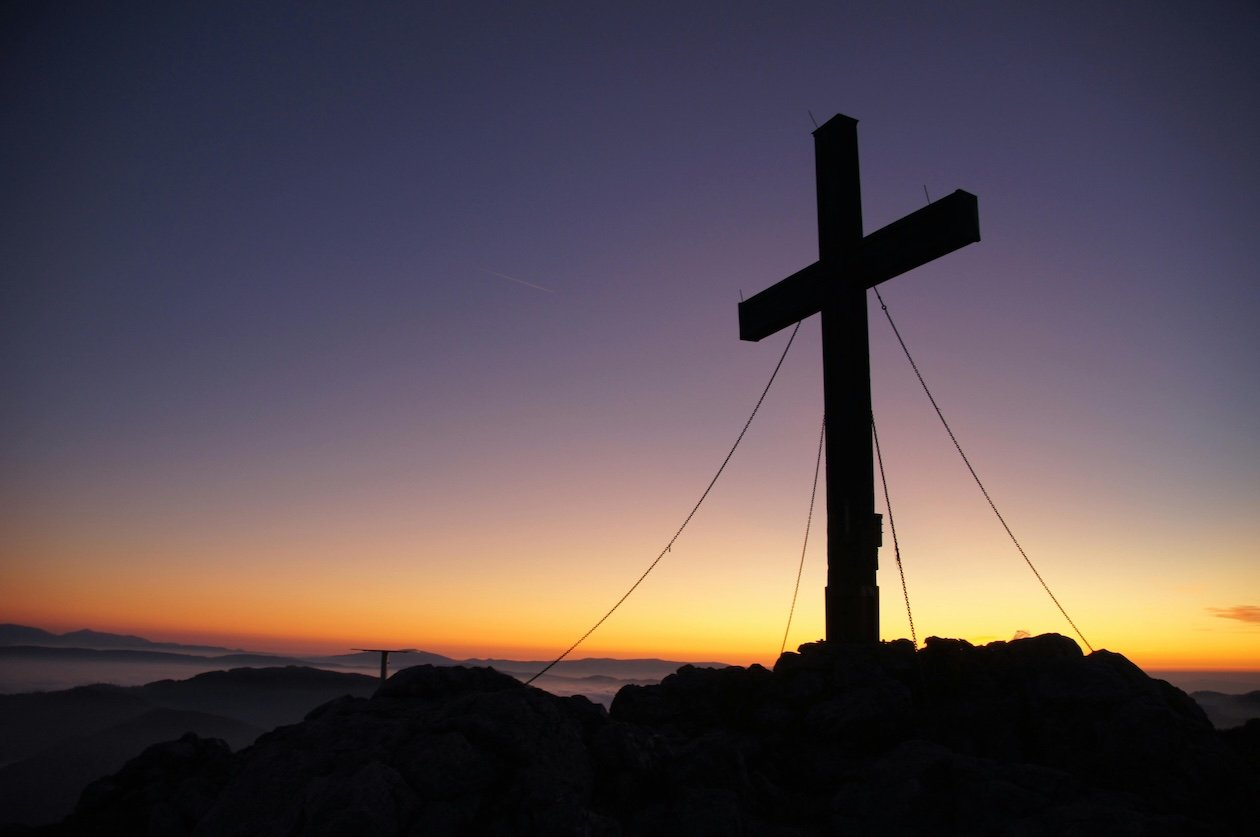
Though Jesus is also fully God, it is in his full humanity that he experiences suffering – real, excruciating, human suffering. | Lonely Cross on a Hill | Courtesy: Piexabay.com
A God Who Knows What It Is To Suffer?
Today, as we celebrate the mystery of the death of Christ on the Cross, we are faced with one whom we could call a suffering God. Yet, we must be careful, lest we fall into heresy. God certainly faces evil, and Jesus, in his humanity, certainly experienced suffering. However, we cannot truthfully say that God suffers.
Nevertheless, the Second Person of the Blessed Trinity, Jesus, suffered in his human body. It is truly Jesus who suffers. Though Jesus is also fully God, it is in his full humanity that he experiences suffering – real, excruciating, human suffering. This means that the one who holds the universe together also knows what it means to weep, to bleed, and to die.
Challenge to Suffer
Suffering challenges us. It can even distort our sense of what is good and evil. Extreme situations, such as World War II and the Holocaust, led many theologians to depict God as suffering – a view that, while powerful, risks distorting the traditional understanding of God’s nature. They miss something important about God, even as they portray the gravity of the situation. For us too, it is hard to deal with evil and suffering. It seems unnatural.
Indeed, suffering was not part of God’s original plan for humanity. Before the Fall, human beings did not suffer. This changed when,
as John Paul wrote in his Theology of the Body, self-assertion trumped self-gift as Adam and Eve ate of “the tree of the knowledge of good and evil” (Gen. 2:17). But the evil that entered creation did not cancel out the good that God had declared about the created order during the “six days” in which the Creator brought something out of nothing (Gen. 1:1–31) (George Weigel, “John Paul II: Knowing Suffering From Inside”).
With his cross, Jesus establishes limits as to how far evil can go. The Devil wants us to think that he is all-powerful, but he is subject to God. By Jesus’ crucifixion, the Devil wants to make us think that he has won. However, the cross conquers the Devil, death, and evil.
Christ Understands Our Suffering
The Cross shows us as well that Christ understands what it means to suffer. Suffering makes us feel isolated. Yet, because of his understanding of our suffering, we have the capacity to unite our suffering to Christ. Precisely when we feel most in pain and alone, Christ invites us to share in the mystery of his suffering and death. Rather than feeling excluded, we can be included in the mystery of the Cross. Christ does not want us to feel alone. He accompanies us in our darkest moments. Through his humanity, Christ gives value to all our emotions, even the most painful ones.
In the midst of what constitutes the psychological form of suffering, there is always an experience of evil, which causes the individual to suffer (St. John Paul II, Salvifici Doloris, 7).
In the Crucifixion of Christ, we have the most profound encounter with evil, and Christ’s suffering goes beyond anything we ourselves could ever know. This Holy Week, take some time to contemplate the Passion of Christ and to thank him for stemming the tide of evil in our world.
Subscribe to the newsletter to never miss an article.
General Christian
Religious Events

About Fr. Nicholas Sheehy, LC
Fr. Nicholas Sheehy is Assistant Chaplain at the Duke Catholic Center. He was ordained a Catholic priest in 2013 for the Legionaries of Christ. You can read more about the author here.
Previous Post

April 11, 2025
Suffering: It is Better to Cry than to Be Angry
Next Post

April 19, 2025 Heaven, Hope, and Holiness
Recent Comments
"Peace is a precious resource. Humankind and Planet Earth are thirsting for peace. Long live ..."
The Man Who Taught Nagasaki to ..."
"Searching and finding truth and traveling from truth to Truth is an exciting journey. The ..."
Your Writing Makes the Pope Happy
"Rich or poor, we are all fellow pilgrims enthusiastically marching together to our cherished destination. ..."
"There's no moral difference between avoiding conception by using 'artificial' contraception and using a 'natural' ..."
Browse Our Archives
Select a Category Church News Education Eucharist Faith and Mental Health Family Living the Faith Marriage Relationships Spiritual Direction Uncategorized Vocations Women Young Adults
Select a Month October 2026 September 2026 August 2026 July 2026 June 2026 November 2025 October 2025 September 2025 August 2025 July 2025 May 2025 April 2025 March 2025 February 2025 January 2025 December 2024 November 2024 October 2024 September 2024 August 2024 July 2024 June 2024 May 2024 April 2024 March 2024 February 2024 January 2024 December 2023 November 2023
Follow Us!
TAKE THE
Religious Wisdom Quiz
What does "Ebenezer" mean, as in the stone Samuel set up?
Select your answer to see how you score.
Stone of David Stone of help Stone of God Stone of Law
Related posts from Formation Matters

Beyond Left and Right: Catholic Church on Immigration

The Treasure Meant to Be Shared

TRENDING AT PATHEOS Catholic

The First Eucharistic Controversy: Christ’s Real Presence
For Catholics, the Eucharist is the source and summit of the Christian...

How to Make a Decision When You Can't...
Main point: It’s much more valuable to stay close to God so...

Archdiocese Hosts Military Marriage Retreat in Germany
RASTATT, Germany — The transient military lifestyle, with its frequent deployments and...

Nearly every morning, I make the drive to Detroit with my high-school-age...

The Real AI Story Is Adoption Without Trust
Artificial intelligence has crossed a political threshold. It is no longer a...

A new article, written by Jeff Lindsay and Gale L. Pooley,...
view all Catholic blogs
What Are Your Thoughts?leave a comment
Ad-Free & Subscriber Log-In Subscription Support
- About Us
- 2026 Calendar
- Videos
- Podcasts
- Library of World Religions
- Faith In Media Tracker
- Advertise With Us
- Write for Us
- Privacy Policy
- Terms of Service
- Do Not Sell My Data
- Contact Us
- Radiant Digital
- Manage Newsletter Subscriptions
- Unsubscribe From Notifications
- Sitemap
Copyright 2008-2026, Patheos. All rights reserved.
Subscription Support Ad-Free & Subscriber Log-In
Follow Patheos