
BuddhistCatholicContemplativeEvangelicalGeneral ChristianHinduJewishLatter-day SaintMuslimNew VisionsProgressive Christian
Beliefs
- Buddhist
- Catholic
- Contemplative
- Evangelical
- General Christian
- Hindu
- Jewish
- Latter-day Saint
- More Voices
- Muslim
- New Visions
- Pagan
- Progressive Christian
Topics
- Religion News
- Food and Religion
- Sports and Religion
- Religious Art
- Religious Music and Entertainment
- Religious Events
- History and Religion
- Style and Religion
- Politics and Religion
- Women in Religion
- Recreation Outdoors and Religion
- Business Finance and Religion
- Careers Workplace and Religion
- Education and Religion
- Family Parenting and Religion
- Health Fitness and Religion
- Home and Religion
- Relationships and Religion
- Technology and Religion
- Travel and Religion
Columnists
- Buddhist Columnists
- Business Finance and Religion Columnists
- Careers Workplace and Religion Columnists
- Catholic Columnists
- Contemplative Columnists
- Education and Religion Columnists
- Evangelists Columnists
- Family Parenting and Religion Columnists
- General Christian Columnists
- Health Fitness and Religion Columnists
- Hindu Columnists
- History and Religion Columnists
- Home and Religion Columnists
- Jewish Columnists
- More Voices Columnists
- Latter Day Columnists
- Muslim Columnists
- New Visions Columnists
- Nonreligious Columnists
- Pagan Columnists
- Politics and Religion Columnists
- Progressive Columnists
- Recreation Outdoors and Religion Columnists
- Relationships and Religion Columnists
- Religion News Columnists
- Religious Art Columnists
- Religious Events Columnists
- Religious Music and Entertainment Columnists
- Sports and Religion Columnists
- Style and Religion Columnists
- Technology and Religion Columnists
- Travel and Religion Columnists
- Women in Religion Columnists
Resource Library
- 2026 Calendar
- Library of World Religions
- The 100 Most Holy Places on Earth
- Patheos Answers
- Podcasts
- Videos
- Faith Leaders Database
- Anglican Episcopalian
- Bahai
- Baptist
- Buddhism
- Christianity
- Confucianism
- Eastern Orthodoxy
- Hinduism
- Holiness and Pentecostal
- ISKCON
- Islam
- Judaism
- Lutheran
- Methodist
- The Church of Jesus Christ of Latter-day Saints
- New Age
- Paganism
- Presbytarian and Reformed
- Protestantism
- Religion Behind the Scenes
- Roman Catholic
- Scientology
- Shia Islam
- Sikhism
- Sufism
- Sunni Islam
- Taoism
- Zen
- See all religions
Research Tools
 Ad-Free & Subscriber Log-In Subscription Support
Ad-Free & Subscriber Log-In Subscription Support
Follow Patheos 

- Trending:
- Forgiveness
- |
- Marriage
- |
- Consciousness
- |
- Death Penalty
- |
- Election
- |
- Halloween

- Home
- Catholic
- Politics and Religion
- More than Morality
More than Morality
Last updated on: November 1, 2024 at 6:39 pm by Fr. Nicholas Sheehy, LC
More than Morality 2024-11-01T18:39:19-07:00 Fr. Nicholas Sheehy, LC
Patheos Explore the world's faith through different perspectives on religion and spirituality! Patheos has the views of the prevalent religions and spiritualities of the world.
Christianity is about more than morality. Mahatma Gandhi was once asked about his thoughts on Christianity. In response, he drew a stone from the river next to him and broke it open. Inside, the rock was dry. He said, “I think Christians are kind of like this. You live in the midst of a wonderful set of teachings, but you do not let it penetrate your hearts. So, you live as if you were not Christians.”
First Commandments
In today’s Gospel (Mk. 12:28-34), we hear Jesus answer the scribe’s question about the first of all the commandments. In the time of Jesus, Jewish rabbis tried to summarize the Law. As there were 613 commandments, it was helpful to be able to come up with a shorter list. Jesus condensed the Law into these two expressions: “love God above all else,” and “love your neighbor as yourself.”
One mistake that many people make about Christianity is reducing it to a moral code. For some, today’s formulation to “love our neighbor” is seen more as a rule than a way of life. In reality, Jesus gives us these commandments because he invites us to a personal relationship with him. Christianity is not about being a good and moral person. Christianity is about growing in our relationship with God. He wants us to grow in our relationship with him because this is the path to beatitude, to true happiness.
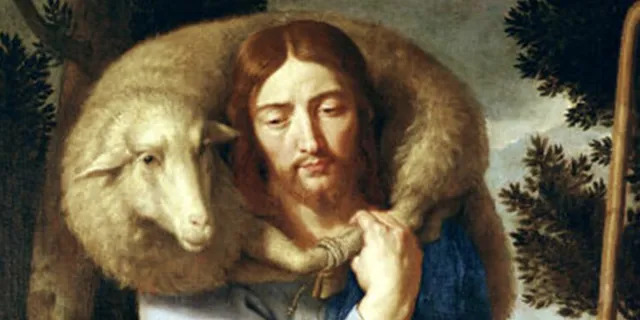
Jesus is the True Good Shepherd | Public Domain
Just a Moral Code?
The beatitude we are promised confronts us with decisive moral choices. It invites us to purify our hearts of bad instincts and to seek the love of God above all else. It teaches us that true happiness is not found in riches or well-being, in human fame or power, or in any human achievement (Catechism of the Catholic Church, 1723).
Christianity is not a moral code but it does contain a moral code. It is founded, however, in a relationship. This reminds me of how an individual changes when he or she enters a relationship. Friends always notice when someone from their friend group brings someone new into his or her life, often because a lot of things tend to change. Perhaps before, there was no problem coming up with spontaneous plans on a Saturday. But when there is commitment to a marriage, the spouse must be taken into account. That commitment, that relationship, has other implications for their lives.
Growing in Our Relationship with God
In the same way, when we grow in our relationship with God, we take on certain commitments due to the nature of the relationship. So, what are some ways to make sure that we love God above all else?
Sacraments
Let’s start with the sacraments. Through our baptism, we become adopted sons and daughters of God. We enter into relationship with God and the Church in a special way. Coming to Mass on Sunday is a core way in which we live out this relationship. This is why we need to do it every week. Sacramental confession is the main method by which we repair our relationship with God. Likewise, all the sacraments help us live out our commitment to God.
Prayer
Then, we can look at daily prayer. FOCUS talks about a simplified version of lectio divina which we can all do every day. You take a Gospel passage and look for a word to pop out at you. Hold on to that word and pray with it. Finally, ask God about something that needs to change in your life. If you do this every day for 5, 10, 15 minutes, your life will change for the better.
Service
Beyond living the sacraments and committing to daily prayer, we should make sure to serve others. This is part of what Christ commands when he says, “love your neighbor.” This is not something theoretical, but rather something that we are called to live out every day of our lives. We have plenty of opportunities to serve the poor. It’s also great to mentor somebody. Or, maybe for you it looks like something as simple as offering to cook dinner for the other people you live with. All of these can be acts of service and great ways to love our neighbor as ourselves.
Life Choices
Pope Francis reflects on the importance of making good choices in his recent encyclical, Dilexit Nos.
Instead of running after superficial satisfactions and playing a role for the benefit of others, we would do better to think about the really important questions in life. Who am I, really? What am I looking for? What direction do I want to give to my life, my decisions and my actions? Why and for what purpose am I in this world? How do I want to look back on my life once it ends? What meaning do I want to give to all my experiences? Who do I want to be for others? Who am I for God? All these questions lead us back to the heart (Pope Francis, Dilexit Nos, 8).
Christianity cannot be reduced to a set of moral precepts. Nevertheless, our relationship with Christ does call for a certain lifestyle. The way we love affects the way we live, just as the way we live affects the way we love. When we really love Jesus, it should affect every aspect of our lives.
Subscribe to the newsletter to never miss an article.
Hindu
Religion News

About Fr. Nicholas Sheehy, LC
Fr. Nicholas Sheehy is Assistant Chaplain at the Duke Catholic Center. He was ordained a Catholic priest in 2013 for the Legionaries of Christ. You can read more about the author here.
Previous Post
October 23, 2024
How Galileo's Science Helped Us Read the Bible Better
Next Post
October 30, 2024 Galileo and Discovering God as the Author of Truth
Recent Comments
"Peace is a precious resource. Humankind and Planet Earth are thirsting for peace. Long live ..."
The Man Who Taught Nagasaki to ..."
"Searching and finding truth and traveling from truth to Truth is an exciting journey. The ..."
Your Writing Makes the Pope Happy
"Rich or poor, we are all fellow pilgrims enthusiastically marching together to our cherished destination. ..."
"There's no moral difference between avoiding conception by using 'artificial' contraception and using a 'natural' ..."
Browse Our Archives
Select a Category Church News Education Eucharist Faith and Mental Health Family Living the Faith Marriage Relationships Spiritual Direction Uncategorized Vocations Women Young Adults
Select a Month October 2026 September 2026 August 2026 July 2026 June 2026 November 2025 October 2025 September 2025 August 2025 July 2025 May 2025 April 2025 March 2025 February 2025 January 2025 December 2024 November 2024 October 2024 September 2024 August 2024 July 2024 June 2024 May 2024 April 2024 March 2024 February 2024 January 2024 December 2023 November 2023
Follow Us!
TAKE THE
Religious Wisdom Quiz
Who healed a blind man by making mud and placing it on his eyes?
Select your answer to see how you score.
Peter Elijah Jesus Moses
Related posts from Formation Matters

Why Do We Build? Pope Leo XIV on...

Never Forget: What 9/11 Should Teach Us 25...
Why is there Catholic Education?

TRENDING AT PATHEOS Catholic

A new article, written by Jeff Lindsay and Gale L. Pooley,...

Swimfan: Forgotten Aughts Pleasures
This is a recovery effort. In 2002, My Big Fat Greek Wedding...

Top Three Anti-Catholic Lies About Catholicism
This is my initial transcript for the video, "THE 3 WORST...

Pope Leo Celebrates Mass for Nurses & Docs...
I don't have any idea how he did it, but Pope Leo...

The Sermon on the Mount, Part I: Matthew...
The Sermon on the Mount, Part I (Matthew 4:12-5:12) St. Matthew moves...

What's up from Crossway: Reviewing some of their latest A few weeks...
view all Catholic blogs
What Are Your Thoughts?leave a comment
Ad-Free & Subscriber Log-In Subscription Support
- About Us
- 2026 Calendar
- Videos
- Podcasts
- Library of World Religions
- Faith In Media Tracker
- Advertise With Us
- Write for Us
- Privacy Policy
- Terms of Service
- Do Not Sell My Data
- Contact Us
- Radiant Digital
- Manage Newsletter Subscriptions
- Unsubscribe From Notifications
- Sitemap
Copyright 2008-2026, Patheos. All rights reserved.
Subscription Support Ad-Free & Subscriber Log-In
Follow Patheos