
BuddhistCatholicContemplativeEvangelicalGeneral ChristianHinduJewishLatter-day SaintMuslimNew VisionsProgressive Christian
Beliefs
- Buddhist
- Catholic
- Contemplative
- Evangelical
- General Christian
- Hindu
- Jewish
- Latter-day Saint
- More Voices
- Muslim
- New Visions
- Pagan
- Progressive Christian
Topics
- Religion News
- Food and Religion
- Sports and Religion
- Religious Art
- Religious Music and Entertainment
- Religious Events
- History and Religion
- Style and Religion
- Politics and Religion
- Women in Religion
- Recreation Outdoors and Religion
- Business Finance and Religion
- Careers Workplace and Religion
- Education and Religion
- Family Parenting and Religion
- Health Fitness and Religion
- Home and Religion
- Relationships and Religion
- Technology and Religion
- Travel and Religion
Columnists
- Buddhist Columnists
- Business Finance and Religion Columnists
- Careers Workplace and Religion Columnists
- Catholic Columnists
- Contemplative Columnists
- Education and Religion Columnists
- Evangelists Columnists
- Family Parenting and Religion Columnists
- General Christian Columnists
- Health Fitness and Religion Columnists
- Hindu Columnists
- History and Religion Columnists
- Home and Religion Columnists
- Jewish Columnists
- More Voices Columnists
- Latter Day Columnists
- Muslim Columnists
- New Visions Columnists
- Nonreligious Columnists
- Pagan Columnists
- Politics and Religion Columnists
- Progressive Columnists
- Recreation Outdoors and Religion Columnists
- Relationships and Religion Columnists
- Religion News Columnists
- Religious Art Columnists
- Religious Events Columnists
- Religious Music and Entertainment Columnists
- Sports and Religion Columnists
- Style and Religion Columnists
- Technology and Religion Columnists
- Travel and Religion Columnists
- Women in Religion Columnists
Resource Library
- 2026 Calendar
- Library of World Religions
- The 100 Most Holy Places on Earth
- Patheos Answers
- Podcasts
- Videos
- Faith Leaders Database
- Anglican Episcopalian
- Bahai
- Baptist
- Buddhism
- Christianity
- Confucianism
- Eastern Orthodoxy
- Hinduism
- Holiness and Pentecostal
- ISKCON
- Islam
- Judaism
- Lutheran
- Methodist
- The Church of Jesus Christ of Latter-day Saints
- New Age
- Paganism
- Presbytarian and Reformed
- Protestantism
- Religion Behind the Scenes
- Roman Catholic
- Scientology
- Shia Islam
- Sikhism
- Sufism
- Sunni Islam
- Taoism
- Zen
- See all religions
Research Tools
 Ad-Free & Subscriber Log-In Subscription Support
Ad-Free & Subscriber Log-In Subscription Support
Follow Patheos 

- Trending:
- Forgiveness
- |
- Marriage
- |
- Consciousness
- |
- Death Penalty
- |
- Election
- |
- Halloween

- Home
- Catholic
- Politics and Religion
- 5 Things You May Not Know About the Liturgy of the Hours
5 Things You May Not Know About the Liturgy of the Hours
Last updated on: September 24, 2024 at 6:24 pm by Fr. Nicholas Sheehy, LC
5 Things You May Not Know About the Liturgy of the Hours 2024-09-24T18:24:37-07:00 Fr. Nicholas Sheehy, LC
Patheos Explore the world's faith through different perspectives on religion and spirituality! Patheos has the views of the prevalent religions and spiritualities of the world.
I have met many young people who want to grow deeper in their prayer life and at some point come across the liturgy of the hours, wondering if this might be a good way to get some more prayer time. However, they usually find it difficult to get started. Here are five things that you should know about praying the Liturgy of the Hours.
1. Lots of Names
One of the first disorienting facts is that we refer to it by many names. We can call it the liturgy of the hours: “liturgy” coming from two Greek words meaning “work of the people.” The liturgy then, by its very etymology, is an effort on behalf of human beings to pray to God. The “liturgy of the hours” is a set of prayers that we can use to pray to God throughout the day.
We may also often hear the term “Divine Office.” This does not mean that we should be looking for a room with four walls where God sits down and receives visitors. In this context, “office” comes from the Latin “officium” meaning service. We look at this prayer as a service we offer to God.
We might also hear it called the “Breviary.” This comes from the Latin word “breviarum” referring to an abridgement of the previous set of prayers, established by Pope Gregory the Great in the 11th century. The term “Liturgy of the Hours” seems to be the most proper and correct name. However, in everyday life, we many hear the term “breviary” more frequently. As we will see, much of the vocabulary around the Liturgy of the Hours is different from what we are accustomed to in everyday spoken English.
2. An “Hour” is not an Hour
“How much do you pray, Father?” “Well, I have to pray five hours of the breviary every day.” This answer alone might be enough to discourage a young person who is thinking about taking up the practice of praying the Liturgy of the Hours. Little do they know, an “hour” is not necessarily an hour.
In the context of the Liturgy of the Hours, an “hour” refers to one of the times of prayer. There are essentially five hours every day: the Office of Readings, Morning Prayer (Lauds), Midday Prayer (with three iterations: cloistered religious tend to pray all three every day, while priests in active life can choose to pray just one), Evening Prayer (Vespers), and Night Prayer (Compline). The Office of Readings is the longest, as it includes a reading from the Old Testament and a reading from the Fathers of the Church, some saint, or perhaps another Church document. The shortest hour is Compline, which we pray right before going to bed.
3. Reformed Tradition
The heart of the Liturgy of the Hours is the prayer of the psalms. The Psalms are a collection of 150 poems that the Jews have prayed for millennia. We look to King David as one of the principal authors of the psalms, which could rightly look at it as a songbook.. They reflect many different attitudes of the person who reaches out to God. They can express fear, joy, anger, or discouragement.
Since the early days of religious life, for the psalms have been a common foundation for both personal and community prayer. The Liturgy of the Hours was born out of this tradition, in the great monasteries of the Church. Over the centuries, certain details have been reformed several times.
Before the reforms of the Second Vatican Council, those praying the Liturgy of the Hours were expected to pray all 150 psalms every week. St. Pius X reduced this somewhat in his attempt to reform the Liturgy of the Hours in 1911. After the Second Vatican Council, there was a more extensive overhaul, among other things dividing 150 psalms into a four-week psalter. So, over about the course of a month, we pray all 150 psalms. There are some verses that are omitted because they are less conducive to a spirit of prayer. For example, in week 1 of the Psalter, we pray Psalm 5:2-10; 12-13. Apparently, the editors of the Liturgy of the Hours decided that verse 11
Declare them guilty, God; make them fall by their own devices. Drive them out for their many sins; for they have rebelled against you
was less conducive to prayer. When we pray the Liturgy of the Hours, we dip into the stream of a centuries-old tradition, reflecting the Church that is “ever ancient, ever new.”
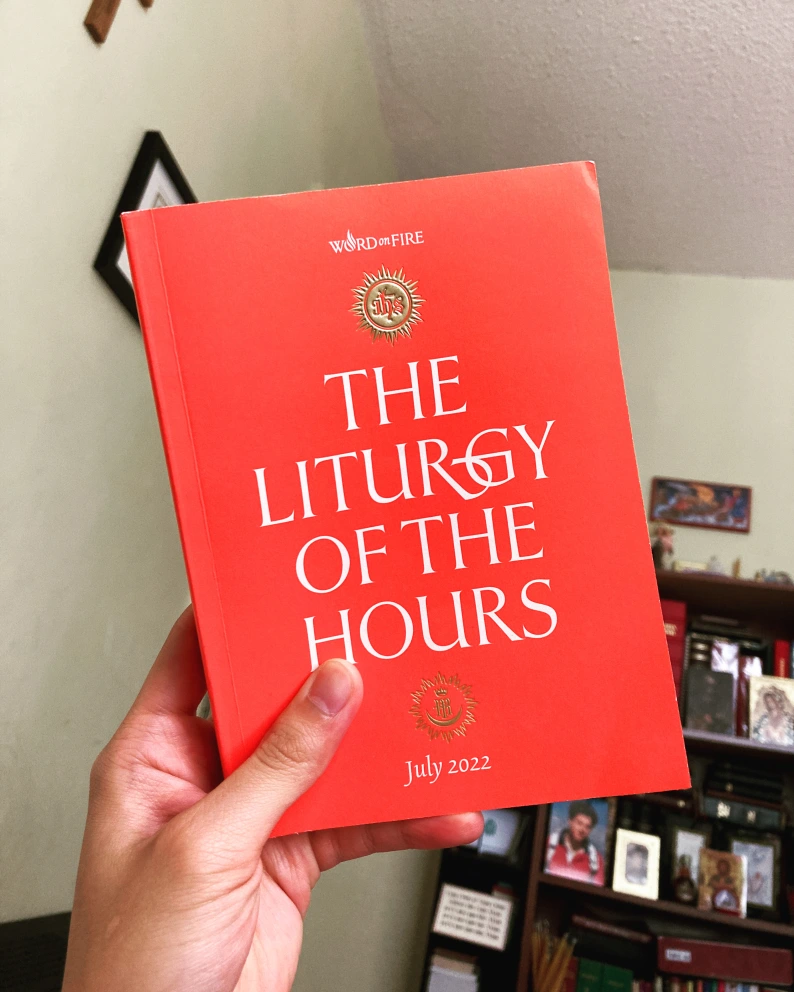
Liturgy of the Hours | Courtesy: The Catholic Man Reviews
4. Importance of the Choir
When we pray the Liturgy of the Hours in community, we go back and forth between two “choirs.” This term reflects the tradition in monasteries to sit in the choir portion of the church and go back and forth while reciting – or, more commonly, while singing – the psalms. By acting in tandem, the choir would be better able to get through the psalm with the extended breathing techniques required by Gregorian chant.
While we may not be singing Gregorian chant, reciting in choirs still allows us to increase our focus and take advantage of our time of prayer. We pray the psalms in a paused manner, giving ourselves time for reflection. We can almost imagine ourselves as two lungs of the Church, breathing in and out, repeating the words of praise that have been echoed down through the centuries.
5. Structure of Each Hour
All of the hours begin with an invitation to prayer. The first hour of the day (either Office of Readings or Morning Prayer) begins with an Invitatory and usually psalm 95. For the other hours of the day, there is a prayer for God’s help as we begin. This is followed by the hymn. Then we have the heart of the prayer, which are three psalms with their antiphons. At Morning Prayer and Evening Prayer, the second “psalm” is a canticle, which just means that it is a religious poem taken from the Old Testament.
After the psalms, there is a short reading, followed by a prayer. Morning and Evening Prayer also have Intercessions and the recitation or singing of the Our Father. As mentioned before, the Office of Readings includes a longer reading from the Old Testament and from some spiritual author.
Praying the Liturgy of the Hours may be challenging, but it is very rewarding. You may want to go deeper by reading A Layman’s Guide to the Liturgy of the Hours: How the Prayers of the Church Can Change Your Lifeby Fr. Timothy Gallagher. I have also enjoyed reading Praying the Psalms in the Voice of Christ: A Christological Reading of the Psalms in the Liturgy of the Hours by Fr. Frank Matera. What is your favorite experience of the Liturgy of the Hours?
Subscribe to the newsletter to never miss an article.

About Fr. Nicholas Sheehy, LC
Fr. Nicholas Sheehy is Assistant Chaplain at the Duke Catholic Center. He was ordained a Catholic priest in 2013 for the Legionaries of Christ. You can read more about the author here.
Previous Post
September 9, 2024
Discovering Jesus at the Beatification of Pope John Paul II
Next Post
September 19, 2024 Ambition is Just the Shadow of a Dream
Recent Comments
"Peace is a precious resource. Humankind and Planet Earth are thirsting for peace. Long live ..."
The Man Who Taught Nagasaki to ..."
"Searching and finding truth and traveling from truth to Truth is an exciting journey. The ..."
Your Writing Makes the Pope Happy
"Rich or poor, we are all fellow pilgrims enthusiastically marching together to our cherished destination. ..."
"There's no moral difference between avoiding conception by using 'artificial' contraception and using a 'natural' ..."
Browse Our Archives
Select a Category Church News Education Eucharist Faith and Mental Health Family Living the Faith Marriage Relationships Spiritual Direction Uncategorized Vocations Women Young Adults
Select a Month October 2026 September 2026 August 2026 July 2026 June 2026 November 2025 October 2025 September 2025 August 2025 July 2025 May 2025 April 2025 March 2025 February 2025 January 2025 December 2024 November 2024 October 2024 September 2024 August 2024 July 2024 June 2024 May 2024 April 2024 March 2024 February 2024 January 2024 December 2023 November 2023
Follow Us!
TAKE THE
Religious Wisdom Quiz
What does "Pharisee" mean?
Select your answer to see how you score.
Separated one Holy one Healer Teacher
Related posts from Formation Matters

Beyond Left and Right: Catholic Church on Immigration

The Treasure Meant to Be Shared
TRENDING AT PATHEOS Catholic

Looking at the Largest Orthodox Cathedral on Earth
There is often a considerable amount of anger and, shall we...

The Problem with False Prophets
Miller’s Station UMC| 10/18/26| Anchor Verse: Jeremiah 23: 1, 9-23 I...

Emotion in Early Christianity by Andrew Crislip
Andrew Crislip’s Emotion in Early Christianity examines an often overlooked dimension of...

16 Spiritual Touchstones for a More Grounded Life
After decades of spiritual study, here are 16 principles I try...

Catholic Evangelization: Sharing Your Faith Every Day
Welcome back to the Graceful Awakening mini-series called, “From Faith to Mission.” ...

The Pillar of the Boatmen: the Ancient Monument...
The Pillar of the Boatmen is a Romano-Gaulish sculpture that dates from...
view all Catholic blogs
What Are Your Thoughts?leave a comment
Ad-Free & Subscriber Log-In Subscription Support
- About Us
- 2026 Calendar
- Videos
- Podcasts
- Library of World Religions
- Faith In Media Tracker
- Advertise With Us
- Write for Us
- Privacy Policy
- Terms of Service
- Do Not Sell My Data
- Contact Us
- Radiant Digital
- Manage Newsletter Subscriptions
- Unsubscribe From Notifications
- Sitemap
Copyright 2008-2026, Patheos. All rights reserved.
Subscription Support Ad-Free & Subscriber Log-In
Follow Patheos