
BuddhistCatholicContemplativeEvangelicalGeneral ChristianHinduJewishLatter-day SaintMuslimNew VisionsProgressive Christian
Beliefs
- Buddhist
- Catholic
- Contemplative
- Evangelical
- General Christian
- Hindu
- Jewish
- Latter-day Saint
- More Voices
- Muslim
- New Visions
- Pagan
- Progressive Christian
Topics
- Religion News
- Food and Religion
- Sports and Religion
- Religious Art
- Religious Music and Entertainment
- Religious Events
- History and Religion
- Style and Religion
- Politics and Religion
- Women in Religion
- Recreation Outdoors and Religion
- Business Finance and Religion
- Careers Workplace and Religion
- Education and Religion
- Family Parenting and Religion
- Health Fitness and Religion
- Home and Religion
- Relationships and Religion
- Technology and Religion
- Travel and Religion
Columnists
- Buddhist Columnists
- Business Finance and Religion Columnists
- Careers Workplace and Religion Columnists
- Catholic Columnists
- Contemplative Columnists
- Education and Religion Columnists
- Evangelists Columnists
- Family Parenting and Religion Columnists
- General Christian Columnists
- Health Fitness and Religion Columnists
- Hindu Columnists
- History and Religion Columnists
- Home and Religion Columnists
- Jewish Columnists
- More Voices Columnists
- Latter Day Columnists
- Muslim Columnists
- New Visions Columnists
- Nonreligious Columnists
- Pagan Columnists
- Politics and Religion Columnists
- Progressive Columnists
- Recreation Outdoors and Religion Columnists
- Relationships and Religion Columnists
- Religion News Columnists
- Religious Art Columnists
- Religious Events Columnists
- Religious Music and Entertainment Columnists
- Sports and Religion Columnists
- Style and Religion Columnists
- Technology and Religion Columnists
- Travel and Religion Columnists
- Women in Religion Columnists
Resource Library
- 2026 Calendar
- Library of World Religions
- The 100 Most Holy Places on Earth
- Patheos Answers
- Podcasts
- Videos
- Faith Leaders Database
- Anglican Episcopalian
- Bahai
- Baptist
- Buddhism
- Christianity
- Confucianism
- Eastern Orthodoxy
- Hinduism
- Holiness and Pentecostal
- ISKCON
- Islam
- Judaism
- Lutheran
- Methodist
- The Church of Jesus Christ of Latter-day Saints
- New Age
- Paganism
- Presbytarian and Reformed
- Protestantism
- Religion Behind the Scenes
- Roman Catholic
- Scientology
- Shia Islam
- Sikhism
- Sufism
- Sunni Islam
- Taoism
- Zen
- See all religions
Research Tools
 Ad-Free & Subscriber Log-In Subscription Support
Ad-Free & Subscriber Log-In Subscription Support
Follow Patheos 

- Trending:
- Forgiveness
- |
- Marriage
- |
- Consciousness
- |
- Death Penalty
- |
- Election
- |
- Halloween

- Home
- Catholic
- Politics and Religion
- Growing Love by Degrees: Lessons from a Medieval Monk
Growing Love by Degrees: Lessons from a Medieval Monk
Last updated on: May 10, 2024 at 1:00 am by Fr. Nicholas Sheehy, LC
Growing Love by Degrees: Lessons from a Medieval Monk 2024-05-09T22:37:04-07:00 Fr. Nicholas Sheehy, LC
Patheos Explore the world's faith through different perspectives on religion and spirituality! Patheos has the views of the prevalent religions and spiritualities of the world.
That a monk wants to teach us to love clashes with our modern sensitivities. But when the monk was formerly a young nobleman famous for jokes, songs, and parties, our perspective shifts. The young man was so popular that when he decided to knock at the door of the monastery requesting admittance, 30 young noblemen went with him. St. Bernard of Clairvaux is one of the intriguing men to have lived in the 11th century. He grew up in a pious noble family in France and studied everything from dialectics to Sacred Scripture. He preached devotion to Mary frequently and his writings still ring true and beautiful today. After his mother’s death, he decided to join a Cistercian abbey and lead a life of prayer and contemplation. To this day, his writings enhance our understanding and appreciation of today’s Feast of the Ascension.
To complete your seamless robe, and so to complete our faith, you ascended through the air into the heavens before the very eyes of the apostles. In this way you showed that you are the Lord of all and are the fulfillment of all creation. Thus, from that moment every human and every living creature should bow at your name. And, in the eyes of faith, we can see that all creation proclaims your greatness (St. Bernard of Clairvaux).
Ascension of the Lord
The Ascension of the Lord makes it clear that we are called to enter heaven completely: body and soul, just as Jesus did.
The Lord Jesus, after he spoke to them, was taken up into heaven and took his seat at the right hand of God. (Mk. 16:19)
Often, we can fall into the trap of treating the spiritual life like an escape from “the real world.” This is not how Bernard of Clairvaux lived. I think Bernard’s view of the feast of the Ascension helps us to understand that the spiritual life is the real world, and that this world and its pleasures are passing away (cf. 1 Jn. 2:17). Throughout history, men and women religious have given witness to the reality of the spiritual world. In a practical and radical way, they show that we should live for God first, and then take care of our earthly matters as needed.
Bernard helped to make this very practical through his reflection in The Love of God. Here, he speaks about four degrees of loving God that we would do well to study and to integrate into our own spiritual lives.
First Degree of Love: Loving Yourself for Your Own Sake (Selfishness)
In the first degree of love, we love ourselves for our own sake. This is essentially selfishness, which is partly natural. We know that it is anti-natural to despise ourselves, as Paul writes to the Ephesians: “no one hates his own flesh but rather nourishes and cherishes it” (Eph. 5:29). St. Bernard exhorts us to
restrain our own self-love if we would avoid becoming transgressors. You can be as indulgent as you like about yourself, provided you shows the same indulgence with your neighbors. (St. Bernard of Clairvaux).
How often does our selfishness get us into trouble? We like to lie to ourselves that we are kind and good to everybody, but if we are honest, we will recognize how frequently we sin against others and harm them with our own selfishness.
Second Degree of Love: Loving God for Your Own Blessing (Dependence on God)
In the second degree of love, we love God not for his own sake, but because we want to be blessed. We begin to learn dependence on God in this degree of love. This is similar to imperfect contrition as when we go to confession only because “we fear the loss of Heaven and dread the pains of Hell.” This comes out in one of the formulas of the act of contrition. It is at least on the right road, but is still somewhat selfish.
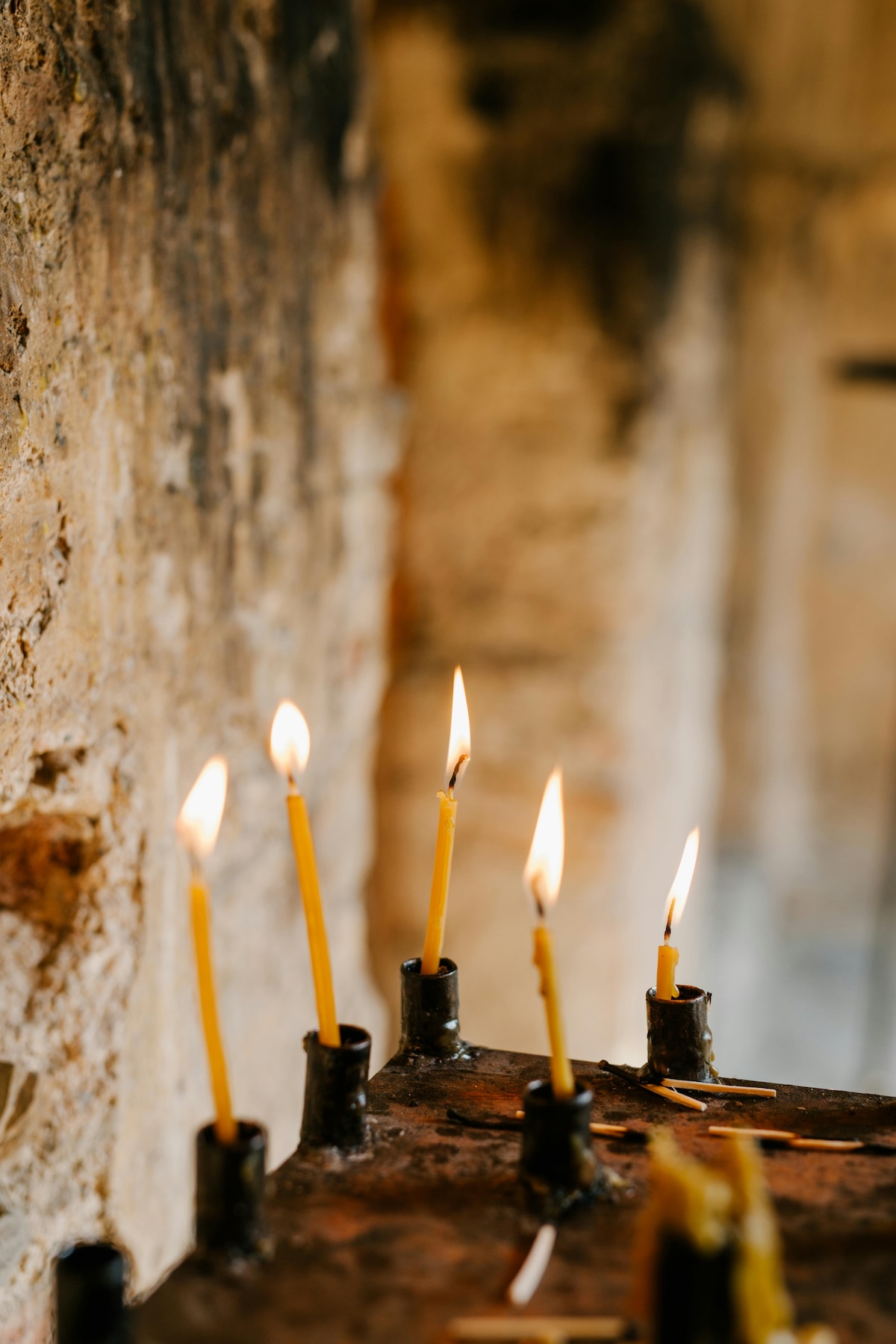
Monks often lit candles as a sign of their persevering prayer | Courtesy: Pexels.com
Third Degree of Love: Loving God for His Own Sake (Intimacy with God)
Soon after reaching the second degree of love, we should begin to aspire towards the third degree. This third degree consists of intimacy with God. In this degree of love, we love God for his own sake. Regarding confession of sin, now we begin to feel truly sorry for what we have done because it offends someone we love, not just because we will have to eventually pay the price of the sins we have committed. We can easily liken this to our experiences of being punished as a small child.
I remember once, I was playing around in my mother’s bedroom, and I broke a shelf where she had some of her precious keepsakes. All of the keepsakes shattered on the floor. I don’t even remember being punished, but I felt terrible about destroying something nice of hers. This is like the third degree of love of God. We begin to feel sorry for our sins because we don’t want to offend him.
Fourth Degree of Love: Self-love for God’s Sake (Being United in God’s Love)
The fourth degree of love allows us to love ourselves for God’s sake. This is to be united with him in love. We begin to see ourselves for who we truly are and this leads us to give glory to God. This is not falling into spiritual pride and thinking ourselves better than others. Rather, we begin to recognize the glory of God’s love and desire nothing more than to be with him.
To reach this condition is to be godly. For as a drop of water disappears in a barrel of wine, taking the taste and color of wine, so is this state. Or like a bar of iron that is heated and red-hot and becomes like the flame itself, so is this return to divine love. Or just as air becomes so radiant with the light of the sun that it appears to be the very sunlight itself, so it is with the saints whose human love is transmuted by the will of God Himself (St. Bernard of Clairvaux).
The Feast of the Ascension reminds us of the totality of the resurrection. It is not merely that Christ rises from the dead, but we are all called to rise from the dead and be united with him, body and soul, in heaven forever. This is great news; if we are called to be in heaven, we should work already during this life to fall in love with God. For this reason, it can be helpful to reflect on St. Bernard’s four degrees of love and integrate them into our lives. Let us love God for his own sake and make him the center of our existence.
What do you think? Can the love of God satisfy us here on earth? Comment below.
Subscribe to the newsletter to never miss an article.
General Christian
Relationships and Religion

About Fr. Nicholas Sheehy, LC
Fr. Nicholas Sheehy was ordained a Catholic priest in 2013 for the Legionaries of Christ. He has been involved in youth work including missions, retreats and apostolic outreach in Germany, Italy, the United States and Central America. He is passionate about the New Evangelization and formation for young adults and married couples. He is a spiritual director and retreat director, offering marriage preparation and marriage counseling through the Divine Mercy Clinic and Family Center. He is currently Executive Director and Chaplain of the Newman Center at St. Philip the Apostle Parish in Pasadena, California. You can read more about the author here.
Previous Post
May 8, 2024
The “Other” Christians: Re-Examining the Reformation
Next Post

May 13, 2024 Until The Churches Are Full
Recent Comments
"Peace is a precious resource. Humankind and Planet Earth are thirsting for peace. Long live ..."
The Man Who Taught Nagasaki to ..."
"Searching and finding truth and traveling from truth to Truth is an exciting journey. The ..."
Your Writing Makes the Pope Happy
"Rich or poor, we are all fellow pilgrims enthusiastically marching together to our cherished destination. ..."
"There's no moral difference between avoiding conception by using 'artificial' contraception and using a 'natural' ..."
Browse Our Archives
Select a Category Church News Education Eucharist Faith and Mental Health Family Living the Faith Marriage Relationships Spiritual Direction Uncategorized Vocations Women Young Adults
Select a Month October 2026 September 2026 August 2026 July 2026 June 2026 November 2025 October 2025 September 2025 August 2025 July 2025 May 2025 April 2025 March 2025 February 2025 January 2025 December 2024 November 2024 October 2024 September 2024 August 2024 July 2024 June 2024 May 2024 April 2024 March 2024 February 2024 January 2024 December 2023 November 2023
Follow Us!
TAKE THE
Religious Wisdom Quiz
True or False: In 2 Corinthians, Paul describes himself as having a thorn in the flesh.
Select your answer to see how you score.
TRUE FALSE
Related posts from Formation Matters

The Big Opportunity for Bishops After the SSPX...

Let Freedom Ring: Truth and the American Soul

Beyond Left and Right: Catholic Church on Immigration

TRENDING AT PATHEOS Catholic

Methodist Central Hall and Westminster Abbey
Situated on the same square is Methodist Central Hall and Westminster Abbey. ...

57th Dove Awards Honor Dolly Parton, Crown New...
On gospel music’s biggest night, the 57th annual GMA Dove Awards honored...

The First Eucharistic Controversy: Christ’s Real Presence
For Catholics, the Eucharist is the source and summit of the Christian...

What a Stop Sign Can Teach Us About...
How to Make a Decision When You Can't Hear God Main point:...

Archdiocese Hosts Military Marriage Retreat in Germany
RASTATT, Germany — The transient military lifestyle, with its frequent deployments and...

Nearly every morning, I make the drive to Detroit with my high-school-age...
view all Catholic blogs
What Are Your Thoughts?leave a comment
Ad-Free & Subscriber Log-In Subscription Support
- About Us
- 2026 Calendar
- Videos
- Podcasts
- Library of World Religions
- Faith In Media Tracker
- Advertise With Us
- Write for Us
- Privacy Policy
- Terms of Service
- Do Not Sell My Data
- Contact Us
- Radiant Digital
- Manage Newsletter Subscriptions
- Unsubscribe From Notifications
- Sitemap
Copyright 2008-2026, Patheos. All rights reserved.
Subscription Support Ad-Free & Subscriber Log-In
Follow Patheos