
BuddhistCatholicContemplativeEvangelicalGeneral ChristianHinduJewishLatter-day SaintMuslimNew VisionsProgressive Christian
Beliefs
- Buddhist
- Catholic
- Contemplative
- Evangelical
- General Christian
- Hindu
- Jewish
- Latter-day Saint
- More Voices
- Muslim
- New Visions
- Pagan
- Progressive Christian
Topics
- Religion News
- Food and Religion
- Sports and Religion
- Religious Art
- Religious Music and Entertainment
- Religious Events
- History and Religion
- Style and Religion
- Politics and Religion
- Women in Religion
- Recreation Outdoors and Religion
- Business Finance and Religion
- Careers Workplace and Religion
- Education and Religion
- Family Parenting and Religion
- Health Fitness and Religion
- Home and Religion
- Relationships and Religion
- Technology and Religion
- Travel and Religion
Columnists
- Buddhist Columnists
- Business Finance and Religion Columnists
- Careers Workplace and Religion Columnists
- Catholic Columnists
- Contemplative Columnists
- Education and Religion Columnists
- Evangelists Columnists
- Family Parenting and Religion Columnists
- General Christian Columnists
- Health Fitness and Religion Columnists
- Hindu Columnists
- History and Religion Columnists
- Home and Religion Columnists
- Jewish Columnists
- More Voices Columnists
- Latter Day Columnists
- Muslim Columnists
- New Visions Columnists
- Nonreligious Columnists
- Pagan Columnists
- Politics and Religion Columnists
- Progressive Columnists
- Recreation Outdoors and Religion Columnists
- Relationships and Religion Columnists
- Religion News Columnists
- Religious Art Columnists
- Religious Events Columnists
- Religious Music and Entertainment Columnists
- Sports and Religion Columnists
- Style and Religion Columnists
- Technology and Religion Columnists
- Travel and Religion Columnists
- Women in Religion Columnists
Resource Library
- 2026 Calendar
- Library of World Religions
- The 100 Most Holy Places on Earth
- Patheos Answers
- Podcasts
- Videos
- Faith Leaders Database
- Anglican Episcopalian
- Bahai
- Baptist
- Buddhism
- Christianity
- Confucianism
- Eastern Orthodoxy
- Hinduism
- Holiness and Pentecostal
- ISKCON
- Islam
- Judaism
- Lutheran
- Methodist
- The Church of Jesus Christ of Latter-day Saints
- New Age
- Paganism
- Presbytarian and Reformed
- Protestantism
- Religion Behind the Scenes
- Roman Catholic
- Scientology
- Shia Islam
- Sikhism
- Sufism
- Sunni Islam
- Taoism
- Zen
- See all religions
Research Tools
 Ad-Free & Subscriber Log-In Subscription Support
Ad-Free & Subscriber Log-In Subscription Support
Follow Patheos 

- Trending:
- Forgiveness
- |
- Marriage
- |
- Consciousness
- |
- Death Penalty
- |
- Election
- |
- Halloween

- Home
- Catholic
- Politics and Religion
- Did Jesus Mean What He Said At The Last Supper?
Did Jesus Mean What He Said At The Last Supper?
Last updated on: June 1, 2024 at 9:52 pm by Fr. Nicholas Sheehy, LC
Did Jesus Mean What He Said At The Last Supper? 2024-06-01T21:52:55-07:00 Fr. Nicholas Sheehy, LC
Patheos Explore the world's faith through different perspectives on religion and spirituality! Patheos has the views of the prevalent religions and spiritualities of the world.
My dad was a fastpitch softball pitcher and growing up, I spent many weekends accompanying him on trips throughout Southern California to various tournaments. I learned to keep score and to make my own lunch. One time, he made us peanut butter and butter sandwiches. From then on, I made sure to pack for myself. Often, the softball fields were far from civilization and the local snack bar was the only opportunity to buy something. For one larger tournament, however, we were in the middle of a city and I went and visited a local Christian bookstore.
Perusing Protestant Bibles
I moseyed around and perused one of their Bibles. When this happened, I must have been in High School and was already interested in apologetics, the art of arguing for the truth of the faith. I knew that the Sacrament of the Eucharist is a point of contention between Catholics and Christians of other denominations, so I opened this Protestant Bible to one of the passages that relates the Institution of the Eucharist. The Bible footnotes stated clearly that the words he spoke at the Last Supper were purely symbolic. It could sound like this explanation I found on a website from a small church in Memphis.
By referring to the bread and wine as His body and blood, Jesus was symbolically offering Himself as a sacrifice for the sins of humanity. This act of selfless love and sacrifice is a central tenet of the Christian faith and inspires Christians to follow Jesus’ example of serving others with humility and love (Nikki Halford, “The Last Supper: Understanding Jesus’ Sacrificial Love”).
I was a bit confused, because I had plenty of Christian friends from other denominations and they always insisted on taking the Bible at face value. What was it about this passage that made them take it differently? Normally, these Christians refer to the Bible as the rule of faith.
Rule of Faith
The Bible is the light that illumines itself. And reading light by light, according to the ancient tradition of the church, is to read the Bible by the rule of faith (Todd Hains, “The Rule of Faith Illumines the Bible by the Bible’s Own Light”).
Nevertheless, these same people would have us believe that when Jesus says literally “this is my body,” and “this is my blood,” we are to interpret it symbolically. He is “symbolically offering Himself,” instead of establishing the New Covenant that will be sealed by his blood shed on the cross.
Words of Institution
While they were eating,
he took bread, said the blessing,
broke it, gave it to them, and said,
“Take it; this is my body.”
Then he took a cup, gave thanks, and gave it to them,
and they all drank from it.
He said to them,
“This is my blood of the covenant,
which will be shed for many.
Amen, I say to you,
I shall not drink again the fruit of the vine
until the day when I drink it new in the kingdom of God” (Mk. 14:22-24).
If we take Jesus at his word, his disciples received his very body and blood at the Last Supper. We re-enact this moment each time that we celebrate Mass and when we receive Communion, we receive Jesus himself. In the Eucharist, Christ is truly, really and substantially contained.
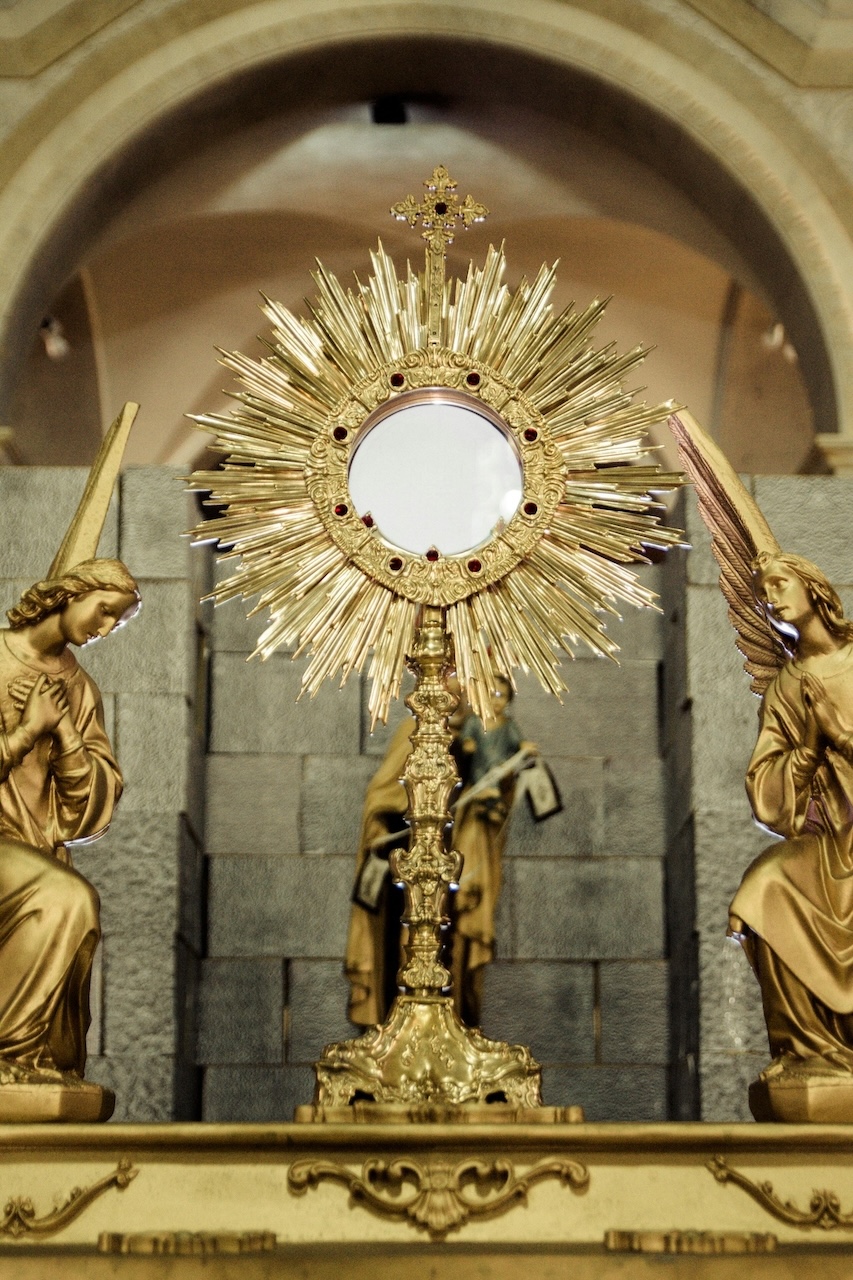
From the Last Supper to the Eucharist | Courtesy: Pexels.com
Real Presence
The mode of Christ’s presence under the Eucharistic species is unique. It raises the Eucharist above all the sacraments as “the perfection of the spiritual life and the end to which all the sacraments tend.” In the most blessed sacrament of the Eucharist “the body and blood, together with the soul and divinity, of our Lord Jesus Christ and, therefore, the whole Christ is truly, really, and substantially contained.” “This presence is called ‘real’ – by which is not intended to exclude the other types of presence as if they could not be ‘real’ too, but because it is presence in the fullest sense: that is to say, it is a substantial presence by which Christ, God and man, makes himself wholly and entirely present.” (Catechism of the Catholic Church, 1374).
Jesus is present in the fullest sense in the Eucharist. He makes himself present to all believers and we can learn much from Christians of other denominations who love the Lord truly. However, we should never wish to abandon the faith that allows us to come into contact with him really and substantially as happens through Holy Communion. As we celebrate the Solemnity of Corpus Christi, let us open our hearts and ignite our faith so that we can receive him more worthily.
What do you think? Comment below.
Subscribe to the newsletter to never miss an article.
General Christian
Food and Religion

About Fr. Nicholas Sheehy, LC
Fr. Nicholas Sheehy was ordained a Catholic priest in 2013 for the Legionaries of Christ. He has been involved in youth work including missions, retreats and apostolic outreach in Germany, Italy, the United States and Central America. He is passionate about the New Evangelization and formation for young adults and married couples. He is a spiritual director and retreat director, offering marriage preparation and marriage counseling through the Divine Mercy Clinic and Family Center. He is currently Executive Director and Chaplain of the Newman Center at St. Philip the Apostle Parish in Pasadena, California. You can read more about the author here.
Previous Post
May 27, 2024
I, Robot, the Pope, and Artificial Intelligence
Next Post

June 3, 2024 3 Reasons To Put Off Getting Married
Recent Comments
"Peace is a precious resource. Humankind and Planet Earth are thirsting for peace. Long live ..."
The Man Who Taught Nagasaki to ..."
"Searching and finding truth and traveling from truth to Truth is an exciting journey. The ..."
Your Writing Makes the Pope Happy
"Rich or poor, we are all fellow pilgrims enthusiastically marching together to our cherished destination. ..."
"There's no moral difference between avoiding conception by using 'artificial' contraception and using a 'natural' ..."
Browse Our Archives
Select a Category Church News Education Eucharist Faith and Mental Health Family Living the Faith Marriage Relationships Spiritual Direction Uncategorized Vocations Women Young Adults
Select a Month October 2026 September 2026 August 2026 July 2026 June 2026 November 2025 October 2025 September 2025 August 2025 July 2025 May 2025 April 2025 March 2025 February 2025 January 2025 December 2024 November 2024 October 2024 September 2024 August 2024 July 2024 June 2024 May 2024 April 2024 March 2024 February 2024 January 2024 December 2023 November 2023
Follow Us!
TAKE THE
Religious Wisdom Quiz
Who led the Israelites out of Egypt?
Select your answer to see how you score.
Moses Caleb Joshua Aaron
Related posts from Formation Matters

Beyond Left and Right: Catholic Church on Immigration



TRENDING AT PATHEOS Catholic

In one sense walking into Westminster Abbey is like walking down the...

'Super Scam Me' Exposes AI Jon Bon Jovi...
Leslie Pickett believed she was in a relationship with Jon Bon Jovi....

The Brazilian Remake of Kendricks' 'Flywheel' Opens in...
“Flywheel,” the story that launched the Kendrick Brothers’ filmmaking career is getting...

The Dangers of Gradual Accommodation (Winking at Sin)
Recently, the “law of gradualness” resurfaced during the opening of a weeklong,...

The Iron Gates and the Lion of the...
Yesterday, I didn't finish my report about, well, yesterday. So I'll...

The Image: On the Horror of Capitalism and...
The Image Then went the Pharisees, and took counsel how they might...
view all Catholic blogs
What Are Your Thoughts?leave a comment
Ad-Free & Subscriber Log-In Subscription Support
- About Us
- 2026 Calendar
- Videos
- Podcasts
- Library of World Religions
- Faith In Media Tracker
- Advertise With Us
- Write for Us
- Privacy Policy
- Terms of Service
- Do Not Sell My Data
- Contact Us
- Radiant Digital
- Manage Newsletter Subscriptions
- Unsubscribe From Notifications
- Sitemap
Copyright 2008-2026, Patheos. All rights reserved.
Subscription Support Ad-Free & Subscriber Log-In
Follow Patheos