
BuddhistCatholicContemplativeEvangelicalGeneral ChristianHinduJewishLatter-day SaintMuslimNew VisionsProgressive Christian
Beliefs
- Buddhist
- Catholic
- Contemplative
- Evangelical
- General Christian
- Hindu
- Jewish
- Latter-day Saint
- More Voices
- Muslim
- New Visions
- Pagan
- Progressive Christian
Topics
- Religion News
- Food and Religion
- Sports and Religion
- Religious Art
- Religious Music and Entertainment
- Religious Events
- History and Religion
- Style and Religion
- Politics and Religion
- Women in Religion
- Recreation Outdoors and Religion
- Business Finance and Religion
- Careers Workplace and Religion
- Education and Religion
- Family Parenting and Religion
- Health Fitness and Religion
- Home and Religion
- Relationships and Religion
- Technology and Religion
- Travel and Religion
Columnists
- Buddhist Columnists
- Business Finance and Religion Columnists
- Careers Workplace and Religion Columnists
- Catholic Columnists
- Contemplative Columnists
- Education and Religion Columnists
- Evangelists Columnists
- Family Parenting and Religion Columnists
- General Christian Columnists
- Health Fitness and Religion Columnists
- Hindu Columnists
- History and Religion Columnists
- Home and Religion Columnists
- Jewish Columnists
- More Voices Columnists
- Latter Day Columnists
- Muslim Columnists
- New Visions Columnists
- Nonreligious Columnists
- Pagan Columnists
- Politics and Religion Columnists
- Progressive Columnists
- Recreation Outdoors and Religion Columnists
- Relationships and Religion Columnists
- Religion News Columnists
- Religious Art Columnists
- Religious Events Columnists
- Religious Music and Entertainment Columnists
- Sports and Religion Columnists
- Style and Religion Columnists
- Technology and Religion Columnists
- Travel and Religion Columnists
- Women in Religion Columnists
Resource Library
- 2026 Calendar
- Library of World Religions
- The 100 Most Holy Places on Earth
- Patheos Answers
- Podcasts
- Videos
- Faith Leaders Database
- Anglican Episcopalian
- Bahai
- Baptist
- Buddhism
- Christianity
- Confucianism
- Eastern Orthodoxy
- Hinduism
- Holiness and Pentecostal
- ISKCON
- Islam
- Judaism
- Lutheran
- Methodist
- The Church of Jesus Christ of Latter-day Saints
- New Age
- Paganism
- Presbytarian and Reformed
- Protestantism
- Religion Behind the Scenes
- Roman Catholic
- Scientology
- Shia Islam
- Sikhism
- Sufism
- Sunni Islam
- Taoism
- Zen
- See all religions
Research Tools
 Ad-Free & Subscriber Log-In Subscription Support
Ad-Free & Subscriber Log-In Subscription Support
Follow Patheos 

- Trending:
- Forgiveness
- |
- Marriage
- |
- Consciousness
- |
- Death Penalty
- |
- Election
- |
- Halloween

- Home
- Catholic
- Politics and Religion
- Eucharistic Adoration and the Road to Emmaus
Eucharistic Adoration and the Road to Emmaus
Last updated on: April 12, 2024 at 1:00 am by Fr. Nicholas Sheehy, LC
Eucharistic Adoration and the Road to Emmaus 2024-04-11T11:50:51-07:00 Fr. Nicholas Sheehy, LC
Patheos Explore the world's faith through different perspectives on religion and spirituality! Patheos has the views of the prevalent religions and spiritualities of the world.
Jesus spoke the words of the Institution of the Eucharist and disappeared from their sight. We could almost look at the encounter with Cleopas and the unnamed disciple headed towards Emmaus as the first example of Eucharistic Adoration. This gives us a clue about what happens for us when we adore Christ in the Eucharist.
When we celebrate the Eucharist, we gather around Jesus, but it is not a funeral. However, we do commemorate the sacrifice that Jesus made on the Cross. To understand the context of today’s Gospel, we must understand that these two disciples mentioned at the beginning are the ones that encountered Jesus on the Road to Emmaus. They lost hope and decided to leave Jerusalem, only to encounter the Messiah walking on the same road that was taking them home. After a long conversation about how the Scriptures spoke of Jesus and how it was necessary for the Savior to die, they could not bear the thought of him leaving them. Jesus responds to this great desire by staying with them in his Eucharistic Presence.
Adoration of the Blessed Sacrament
When we come to the Blessed Sacrament for Eucharistic Adoration, we are in the presence of one whom we cannot perceive with our ordinary senses. Rather, we must trust our faith to know who is truly there. We must come with a sense of humility, knowing that while our external senses are important, they do not have the last word.
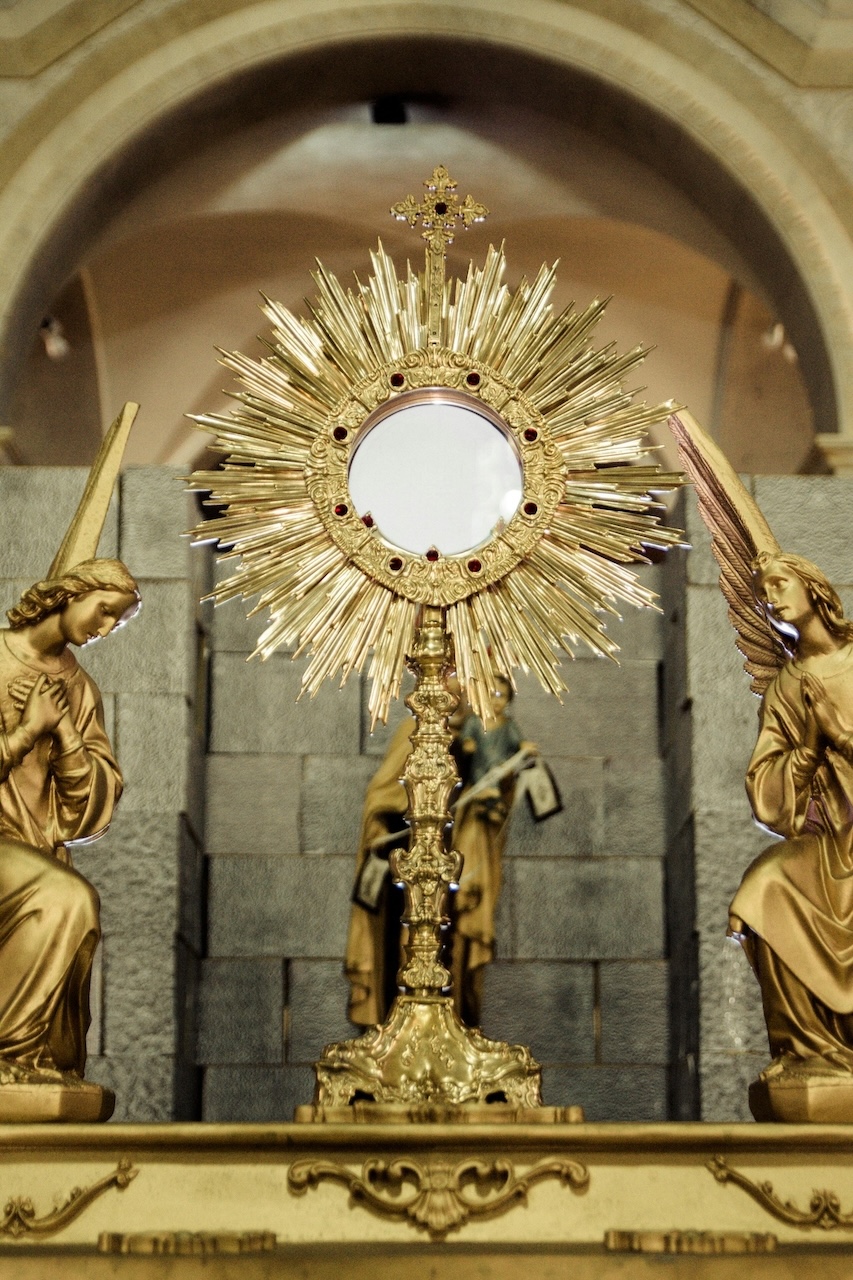
Adoration often takes place in front of a monstrance holding the consecrated host | Courtesy: Pexels.com
Tom Sawyer and a Hint at Mysterious Presence
I love the story of Tom Sawyer. He escaped from home to help his Aunt Sally’s slave Jim escape to freedom. While they are hiding out on the island, a search party arrives thinking that they have died. They shoot cannons over the water in the hope that this will somehow bring their bodies to the surface. As we would expect, this does not cause the desired result for two reasons: cannon balls do not bring bodies to the surface, and they were not actually dead to begin with.
Eventually, after being unable to find his body, they conclude that poor Tom has died, and they decide to hold a funeral for him. He finds out about this and decides to attend his own funeral; to Tom, it seems like way too much fun to miss. Although at first, he kept himself hidden from everybody at the funeral, it did not diminish the reality of his presence there. This may be an imperfect analogy, but it reminds me of the presence of Jesus at every Mass.
Disciples on the Road to Emmaus
We need Jesus and Cleopas and the unnamed disciple express this need in a very real way. However, the time for the earthly presence of Jesus was coming to an end, so he knew it was time to make himself present in the same miraculous way that he makes himself present to us in the Mass: in the “breaking of the bread.”
The two disciples recounted what had taken place on the way, and how Jesus was made known to them in the breaking of bread (Lk. 24:35).
“Breaking of the Bread” as a Technical Term
We hear “breaking of the bread” and perhaps think of a communal meal. However, in the New Testament, particularly in the writing of St. Luke, this phrase becomes a technical way of referring to the Eucharistic Celebration.
One of the earliest names for the Eucharistic celebration is the breaking of the bread (Lk 24:35; Acts 2:42, 46) (USCCB, “Liturgy of the Eucharist”).
This comes out in the passage when Jesus stops at the inn with the disciples on the way to Emmaus. Just imagine what it must have been like when Jesus sits down with the two disciples to eat and once he pronounces the words of the Institution of the Eucharist, he “disappears” from their sight. But is he really gone? Though it may seem like it, he remains with them, albeit under the species of the bread and the wine. He thus makes himself present sacramentally to them as the Eucharist for them to eat, so they might enter communion with the living God.
When the primitive community of the first Christians come together, St. Luke describes them in the book of acts as people who “devoted themselves to the teaching of the apostles and to the communal life, to the breaking of the bread and to the prayers” (Acts 2:42).
Consolation for Troubled Hearts
Just as the disciples on the way to Emmaus were troubled, Jesus notices the suffering hearts of the men he finds in the Upper Room. He makes it his mission to comfort them and to encourage them. This is what he also does for us each day in the Sacrament of the Eucharist, which is why the reality of Eucharistic Adoration is such a moving gift. We should really find time every week, or even every day, if possible, to pray in front of our Eucharistic Lord. While it is a privilege to be with Jesus when he is solemnly exposed, even praying in front of a tabernacle where the Blessed Sacrament is reposed, the trip is well worth our time. We must use these opportunities to grow in our love for Jesus in the Eucharist.
Testimony of Eucharistic Adoration
Nora shares her story of the power of Eucharistic Adoration.
I have been praying during my weekly hour of Adoration, over many years, for my husband to return to Mass and the Sacraments as he has been away from them for 26 years. He didn’t even enter the church when our children were making their first Holy Communions and Confirmations. On a wet and very cold winter’s day he dropped me down to the Adoration Chapel for my holy hour and asked me to hurry out after the hour as he wanted to go to an important meeting. After the hour he came to collect me and waited outside in the car. After waiting for an extra twenty minutes, he lost patience and ran into the Adoration Chapel to hurry me out. I pretended not to see him and he sat down very impatiently for some minutes.
Finally, I got up and left and he came speedily after me. I was expecting a lot of anger and complaints because I stayed longer than the hour and kept him waiting. Having got into the car he turned to me, and said, calmly and quietly, “I am not going to that meeting I mentioned but instead I am going the priest in the Parochial house and going to ask him to hear my confession. Something came over me as I entered that Adoration Chapel, and I feel God calling me back again,” He got confession that day and became a daily mass goer and a weekly Adorer for the very first time. I put this down to the power of prayer in front of the Blessed Sacrament (Testimonies and Comments from People who have experienced weekly Eucharistic Adoration).
I love the stories of the Resurrection and I feel convinced that part of their power is to increase in us the devotion to the Eucharistic Lord and our desire to participate in Eucharistic Adoration.
What are your thoughts? Please comment below.
Looking for more articles on the Eucharist? Look no further.
Why Are There So Many Names for the Eucharist?
General Christian
Food and Religion

About Fr. Nicholas Sheehy, LC
Fr. Nicholas Sheehy was ordained a Catholic priest in 2013 for the Legionaries of Christ. He has been involved in youth work including missions, retreats and apostolic outreach in Germany, Italy, the United States and Central America. He is passionate about the New Evangelization and formation for young adults and married couples. He is a spiritual director and retreat director, offering marriage preparation and marriage counseling through the Divine Mercy Clinic and Family Center. He is currently Executive Director and Chaplain of the Newman Center at St. Philip the Apostle Parish in Pasadena, California. You can read more about the author here.
Previous Post

April 10, 2024
How Objective Moral Authority and Compassion Fit Together
Next Post
April 12, 2024 The Pope On What Should Offend Us
Recent Comments
"Peace is a precious resource. Humankind and Planet Earth are thirsting for peace. Long live ..."
The Man Who Taught Nagasaki to ..."
"Searching and finding truth and traveling from truth to Truth is an exciting journey. The ..."
Your Writing Makes the Pope Happy
"Rich or poor, we are all fellow pilgrims enthusiastically marching together to our cherished destination. ..."
"There's no moral difference between avoiding conception by using 'artificial' contraception and using a 'natural' ..."
Browse Our Archives
Select a Category Church News Education Eucharist Faith and Mental Health Family Living the Faith Marriage Relationships Spiritual Direction Uncategorized Vocations Women Young Adults
Select a Month October 2026 September 2026 August 2026 July 2026 June 2026 November 2025 October 2025 September 2025 August 2025 July 2025 May 2025 April 2025 March 2025 February 2025 January 2025 December 2024 November 2024 October 2024 September 2024 August 2024 July 2024 June 2024 May 2024 April 2024 March 2024 February 2024 January 2024 December 2023 November 2023
Follow Us!
TAKE THE
Religious Wisdom Quiz
What did Moses do after breaking the tablets?
Select your answer to see how you score.
Fasted for 30 days Destroyed the calf Left the camp Returned to Sinai for new tablets
Related posts from Formation Matters

Beyond Left and Right: Catholic Church on Immigration


The Treasure Meant to Be Shared
TRENDING AT PATHEOS Catholic

Methodist Central Hall and Westminster Abbey
Situated on the same square is Methodist Central Hall and Westminster Abbey. ...

57th Dove Awards Honor Dolly Parton, Crown New...
On gospel music’s biggest night, the 57th annual GMA Dove Awards honored...

The First Eucharistic Controversy: Christ’s Real Presence
For Catholics, the Eucharist is the source and summit of the Christian...

What a Stop Sign Can Teach Us About...
How to Make a Decision When You Can't Hear God Main point:...

Archdiocese Hosts Military Marriage Retreat in Germany
RASTATT, Germany — The transient military lifestyle, with its frequent deployments and...

Nearly every morning, I make the drive to Detroit with my high-school-age...
view all Catholic blogs
What Are Your Thoughts?leave a comment
Ad-Free & Subscriber Log-In Subscription Support
- About Us
- 2026 Calendar
- Videos
- Podcasts
- Library of World Religions
- Faith In Media Tracker
- Advertise With Us
- Write for Us
- Privacy Policy
- Terms of Service
- Do Not Sell My Data
- Contact Us
- Radiant Digital
- Manage Newsletter Subscriptions
- Unsubscribe From Notifications
- Sitemap
Copyright 2008-2026, Patheos. All rights reserved.
Subscription Support Ad-Free & Subscriber Log-In
Follow Patheos