
BuddhistCatholicContemplativeEvangelicalGeneral ChristianHinduJewishLatter-day SaintMuslimNew VisionsProgressive Christian
Beliefs
- Buddhist
- Catholic
- Contemplative
- Evangelical
- General Christian
- Hindu
- Jewish
- Latter-day Saint
- More Voices
- Muslim
- New Visions
- Pagan
- Progressive Christian
Topics
- Religion News
- Food and Religion
- Sports and Religion
- Religious Art
- Religious Music and Entertainment
- Religious Events
- History and Religion
- Style and Religion
- Politics and Religion
- Women in Religion
- Recreation Outdoors and Religion
- Business Finance and Religion
- Careers Workplace and Religion
- Education and Religion
- Family Parenting and Religion
- Health Fitness and Religion
- Home and Religion
- Relationships and Religion
- Technology and Religion
- Travel and Religion
Columnists
- Buddhist Columnists
- Business Finance and Religion Columnists
- Careers Workplace and Religion Columnists
- Catholic Columnists
- Contemplative Columnists
- Education and Religion Columnists
- Evangelists Columnists
- Family Parenting and Religion Columnists
- General Christian Columnists
- Health Fitness and Religion Columnists
- Hindu Columnists
- History and Religion Columnists
- Home and Religion Columnists
- Jewish Columnists
- More Voices Columnists
- Latter Day Columnists
- Muslim Columnists
- New Visions Columnists
- Nonreligious Columnists
- Pagan Columnists
- Politics and Religion Columnists
- Progressive Columnists
- Recreation Outdoors and Religion Columnists
- Relationships and Religion Columnists
- Religion News Columnists
- Religious Art Columnists
- Religious Events Columnists
- Religious Music and Entertainment Columnists
- Sports and Religion Columnists
- Style and Religion Columnists
- Technology and Religion Columnists
- Travel and Religion Columnists
- Women in Religion Columnists
Resource Library
- 2026 Calendar
- Library of World Religions
- The 100 Most Holy Places on Earth
- Patheos Answers
- Podcasts
- Videos
- Faith Leaders Database
- Anglican Episcopalian
- Bahai
- Baptist
- Buddhism
- Christianity
- Confucianism
- Eastern Orthodoxy
- Hinduism
- Holiness and Pentecostal
- ISKCON
- Islam
- Judaism
- Lutheran
- Methodist
- The Church of Jesus Christ of Latter-day Saints
- New Age
- Paganism
- Presbytarian and Reformed
- Protestantism
- Religion Behind the Scenes
- Roman Catholic
- Scientology
- Shia Islam
- Sikhism
- Sufism
- Sunni Islam
- Taoism
- Zen
- See all religions
Research Tools
 Ad-Free & Subscriber Log-In Subscription Support
Ad-Free & Subscriber Log-In Subscription Support
Follow Patheos 

- Trending:
- Forgiveness
- |
- Marriage
- |
- Consciousness
- |
- Death Penalty
- |
- Election
- |
- Halloween

- Home
- Catholic
- Politics and Religion
- Catholics, Culture, And Community
Catholics, Culture, And Community
Last updated on: April 27, 2024 at 10:00 am by Fr. Nicholas Sheehy, LC
Catholics, Culture, And Community 2024-04-27T10:00:51-07:00 Fr. Nicholas Sheehy, LC
Patheos Explore the world's faith through different perspectives on religion and spirituality! Patheos has the views of the prevalent religions and spiritualities of the world.
During the Second World War, Karol Wojtyla, the future Pope John Paul II, would gather with friends from university to declaim and act out famous literature to celebrate their Polish heritage. They founded the Rhapsodic Theater as a means of cultural resistance against the Communist regime after the war. The Soviet Union wanted to erase Poland and by clinging on to their heritage and culture, they avoided losing themselves in the myriad of Soviet republics. They had a strong sense of community.
We can gain a sense of community from a sports team, or family, or a shared hobby. Community is deeper, however, when we gain the sense from shared values such as those that come from the faith. As a Church, it is worthwhile asking ourselves if we are truly a welcoming community. Too many people make the experience of St. Paul in the first reading. “When Saul arrived in Jerusalem he tried to join the disciples, but they were all afraid of him, not believing that he was a disciple” (Acts 9:26). The Eucharist is the key to community in the Church. If we want thriving communities, we need to form Eucharistic culture.
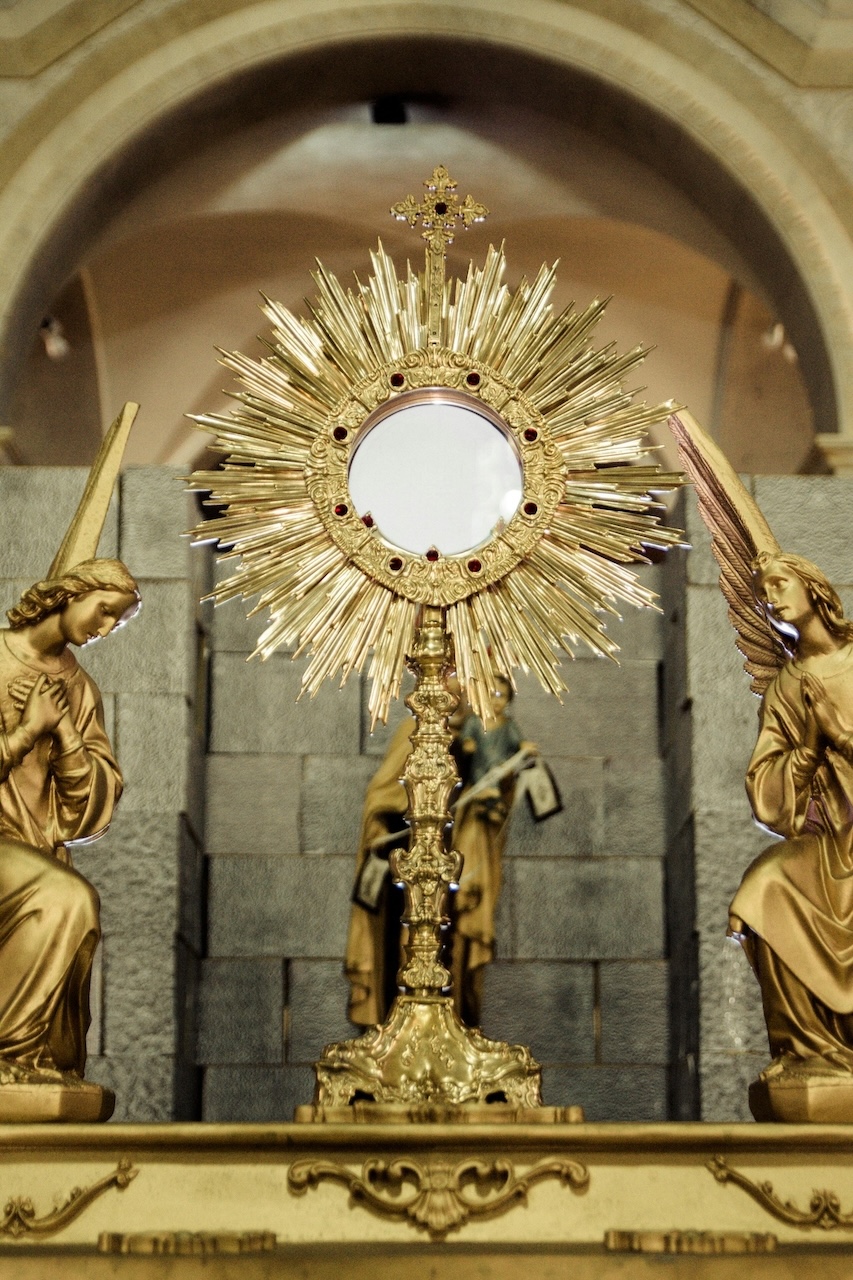
Eucharistic culture | Courtesy: Pexels.com
Confronting Community
Too often, instead of finding a welcoming group of persons when visiting a new church, newcomers face a sort of “Berlin Wall” when trying to approach the community. They are outsiders and to be treated as such. Perhaps there is not even any conscious decision to exclude them, but we prefer to continue in our own familiar circles and do not welcome newcomers. Some sociologists suggest that American society is undergoing a “great dechurching.” 40 million Americans have left churches and religious institutions over the course of the last 25 years.
Culture and Community
Community has to be about more than just culture but should include culture. There is a Catholic culture that we should be proud to promote. At the time of his conversion, Saul was dealing with a Christianity that was almost entirely Jewish. He became the “Apostle to the Gentiles” and had to show the Church leaders that Christian culture was more universal than Jewish culture. It is more important to be Christian than to follow Jewish cultural norms. To put it in the terms of today’s Gospel, it is to be “united to the vine.”
Vine and Branches
For a plant to flourish, it must be whole and integral. The same happens with the Church. We need roots, stock, and branches to be united so that the organism as a whole can be healthy. In the Church, we are all called to be united to the source and summit of holiness in the Church, which is the Eucharist. For us to be united to Christ in the Eucharist, we have to make sure that we maintain a life of grace. When we become aware of serious or grave sin in our life, we have an obligation to seek out the sacrament of reconciliation to enter once again into communion with Christ and his Church.
Catholic Culture
The greatest expression of Catholic culture is the Mass. If we are going to appreciate the Mass fully, we should do everything we can to understand it. Some people go to Mass to worship God. They are seeking to unite themselves to the vine. Others go to Mass because they are “trying to get something out of it.” They almost always fall away. We go to connect with God. This is why it is so important to recognize the value of the Mass. If we look at it as merely a symbolic representation, we quickly lose interest. If we look at it as something vital that restores life-giving energy to us, then we start to feel the anticipation and desire that help us to live our faith more deeply.
The Eucharist, as Christ’s saving presence in the community of the faithful and its spiritual food, is the most precious possession which the Church can have in her journey through history. This explains the lively concern which she has always shown for the Eucharistic mystery (Pope John Paul II, Ecclesia de Eucharistia, 9).
United to the Vine
Jesus is present to us through the Eucharist. It is like the vine and the branches. We need to be connected. We should want to receive the Eucharist frequently in Communion. But it is not enough to simply come to Mass and enter into the Communion line. We should make sure that we have the proper disposition to receive Jesus in the Eucharist. Think about the words “I love you.” They can be the most impressive words in the English language when we say them with meaning. They can also, however, be devoid of meaning when we have allowed their motivation to die in our heart.
Through the grace of the sacrament, we receive the Eucharist. But the good that this does us, the actual grace, depends on how well we have prepared ourselves for this miracle. The Eucharist can be source and summit of community when we all believe and participate actively in the Eucharistic celebration. Then, those around me receive the same Jesus who becomes our principle of unity. The Eucharist is Catholic culture. The Eucharist creates community. If I receive the Body of Christ, and you receive the Body of Christ, something much greater than either one of us unites us. This is more powerful than sharing a cultural heritage or a common language. We become members of the same Body. The Eucharist is the key to community.
What do you think? Comment below.
Subscribe to the newsletter to never miss an article.
General Christian
History and Religion

About Fr. Nicholas Sheehy, LC
Fr. Nicholas Sheehy was ordained a Catholic priest in 2013 for the Legionaries of Christ. He has been involved in youth work including missions, retreats and apostolic outreach in Germany, Italy, the United States and Central America. He is passionate about the New Evangelization and formation for young adults and married couples. He is a spiritual director and retreat director, offering marriage preparation and marriage counseling through the Divine Mercy Clinic and Family Center. He is currently Executive Director and Chaplain of the Newman Center at St. Philip the Apostle Parish in Pasadena, California. You can read more about the author here.
Previous Post
April 24, 2024
Upping Your Game at Mass And Living the Offertory
Next Post

April 29, 2024 Artificial Intelligence, Pope Francis, and the G7
Recent Comments
"Peace is a precious resource. Humankind and Planet Earth are thirsting for peace. Long live ..."
The Man Who Taught Nagasaki to ..."
"Searching and finding truth and traveling from truth to Truth is an exciting journey. The ..."
Your Writing Makes the Pope Happy
"Rich or poor, we are all fellow pilgrims enthusiastically marching together to our cherished destination. ..."
"There's no moral difference between avoiding conception by using 'artificial' contraception and using a 'natural' ..."
Browse Our Archives
Select a Category Church News Education Eucharist Faith and Mental Health Family Living the Faith Marriage Relationships Spiritual Direction Uncategorized Vocations Women Young Adults
Select a Month October 2026 September 2026 August 2026 July 2026 June 2026 November 2025 October 2025 September 2025 August 2025 July 2025 May 2025 April 2025 March 2025 February 2025 January 2025 December 2024 November 2024 October 2024 September 2024 August 2024 July 2024 June 2024 May 2024 April 2024 March 2024 February 2024 January 2024 December 2023 November 2023
Follow Us!
TAKE THE
Religious Wisdom Quiz
Who said, "Lord, do not hold this sin against them"?
Select your answer to see how you score.
John Peter Stephen Paul
Related posts from Formation Matters

Beyond Left and Right: Catholic Church on Immigration

The Treasure Meant to Be Shared

TRENDING AT PATHEOS Catholic

57th Dove Awards Honor Dolly Parton, Crown New...
On gospel music’s biggest night, the 57th annual GMA Dove Awards honored...

The First Eucharistic Controversy: Christ’s Real Presence
For Catholics, the Eucharist is the source and summit of the Christian...

What a Stop Sign Can Teach Us About...
How to Make a Decision When You Can't Hear God Main point:...

Archdiocese Hosts Military Marriage Retreat in Germany
RASTATT, Germany — The transient military lifestyle, with its frequent deployments and...

Nearly every morning, I make the drive to Detroit with my high-school-age...

The Real AI Story Is Adoption Without Trust
Artificial intelligence has crossed a political threshold. It is no longer a...
view all Catholic blogs
What Are Your Thoughts?leave a comment
Ad-Free & Subscriber Log-In Subscription Support
- About Us
- 2026 Calendar
- Videos
- Podcasts
- Library of World Religions
- Faith In Media Tracker
- Advertise With Us
- Write for Us
- Privacy Policy
- Terms of Service
- Do Not Sell My Data
- Contact Us
- Radiant Digital
- Manage Newsletter Subscriptions
- Unsubscribe From Notifications
- Sitemap
Copyright 2008-2026, Patheos. All rights reserved.
Subscription Support Ad-Free & Subscriber Log-In
Follow Patheos