
BuddhistCatholicContemplativeEvangelicalGeneral ChristianHinduJewishLatter-day SaintMuslimNew VisionsProgressive Christian
Beliefs
- Buddhist
- Catholic
- Contemplative
- Evangelical
- General Christian
- Hindu
- Jewish
- Latter-day Saint
- More Voices
- Muslim
- New Visions
- Pagan
- Progressive Christian
Topics
- Religion News
- Food and Religion
- Sports and Religion
- Religious Art
- Religious Music and Entertainment
- Religious Events
- History and Religion
- Style and Religion
- Politics and Religion
- Women in Religion
- Recreation Outdoors and Religion
- Business Finance and Religion
- Careers Workplace and Religion
- Education and Religion
- Family Parenting and Religion
- Health Fitness and Religion
- Home and Religion
- Relationships and Religion
- Technology and Religion
- Travel and Religion
Columnists
- Buddhist Columnists
- Business Finance and Religion Columnists
- Careers Workplace and Religion Columnists
- Catholic Columnists
- Contemplative Columnists
- Education and Religion Columnists
- Evangelists Columnists
- Family Parenting and Religion Columnists
- General Christian Columnists
- Health Fitness and Religion Columnists
- Hindu Columnists
- History and Religion Columnists
- Home and Religion Columnists
- Jewish Columnists
- More Voices Columnists
- Latter Day Columnists
- Muslim Columnists
- New Visions Columnists
- Nonreligious Columnists
- Pagan Columnists
- Politics and Religion Columnists
- Progressive Columnists
- Recreation Outdoors and Religion Columnists
- Relationships and Religion Columnists
- Religion News Columnists
- Religious Art Columnists
- Religious Events Columnists
- Religious Music and Entertainment Columnists
- Sports and Religion Columnists
- Style and Religion Columnists
- Technology and Religion Columnists
- Travel and Religion Columnists
- Women in Religion Columnists
Resource Library
- 2026 Calendar
- Library of World Religions
- The 100 Most Holy Places on Earth
- Patheos Answers
- Podcasts
- Videos
- Faith Leaders Database
- Anglican Episcopalian
- Bahai
- Baptist
- Buddhism
- Christianity
- Confucianism
- Eastern Orthodoxy
- Hinduism
- Holiness and Pentecostal
- ISKCON
- Islam
- Judaism
- Lutheran
- Methodist
- The Church of Jesus Christ of Latter-day Saints
- New Age
- Paganism
- Presbytarian and Reformed
- Protestantism
- Religion Behind the Scenes
- Roman Catholic
- Scientology
- Shia Islam
- Sikhism
- Sufism
- Sunni Islam
- Taoism
- Zen
- See all religions
Research Tools
 Ad-Free & Subscriber Log-In Subscription Support
Ad-Free & Subscriber Log-In Subscription Support
Follow Patheos 

- Trending:
- Forgiveness
- |
- Marriage
- |
- Consciousness
- |
- Death Penalty
- |
- Election
- |
- Halloween

- Home
- Catholic
- Politics and Religion
- Why Do We Use Bread and Wine at Mass?
Why Do We Use Bread and Wine at Mass?
Last updated on: March 6, 2024 at 1:13 am by Fr. Nicholas Sheehy, LC
Why Do We Use Bread and Wine at Mass? 2024-03-05T22:13:26-08:00 Fr. Nicholas Sheehy, LC
Patheos Explore the world's faith through different perspectives on religion and spirituality! Patheos has the views of the prevalent religions and spiritualities of the world.
What are we really doing at Mass? Is it just a remembrance or are we re-enacting a sacrifice? Why do we have to use bread and wine—wouldn’t it still work if we represented the Last Supper with Oreo cookies and Coca Cola? Anyone versed in ministry has probably encountered some funky attempts to answer these questions, some more successful than others. The answer, though, is quite clear: for a Catholic Mass to take place, we need bread and wine.
Heart of the Celebration
It is vital to remember that in our celebration of the Eucharist we are not play-acting but truly celebrating the Passion of Jesus. To do this effectively, we use similar materials to what he raised in offering at the Last Supper. This expresses the Incarnational element of our faith. Just as the Second Person of the Blessed Trinity became a real, physical man, God uses material realities to communicate spiritual goods to our minds. For the Eucharist, we need bread and wine:
At the heart of the Eucharistic celebration are the bread and wine that, by the words of Christ and the invocation of the Holy Spirit, become Christ’s Body and Blood (Catechism of the Catholic Church, 1333).
Moving from the Old to the New Covenant
Looking back to the Book of Exodus and the Old Covenant, we already see signs pointing forward to the mystery of Christ in the Eucharist, from the unleavened bread of the Passover to the manna in the desert. Jesus is the fulfillment of these signs when he institutes the Eucharist at the Last Supper, and the Church continues to perpetuate this through the Eucharistic celebration.
The remembrance of the manna in the desert will always recall to Israel that it lives by the bread of the Word of God (Catechism of the Catholic Church, 1334).
In the Line of Melchisedek
The king-priest of the Old Testament, Melchisedek, pre-figures Christ in his offering of bread and wine as a sacrifice. The Church considers this important to understand when considering why we offer bread and wine to become the Body and Blood of Christ. The bread and wine are a phenomenal example of how nature and human labor contribute together to prepare a worthy sacrifice.
The signs of bread and wine become, in a way surpassing understanding, the Body and Blood of Christ; they continue also to signify the goodness of creation. Thus in the Offertory we give thanks to the Creator for bread and wine, fruit of the “work of human hands,” but above all as “fruit of the earth” and “of the vine” – gifts of the Creator (Catechism of the Catholic Church, 1333).
There is a cooperation between God and man to prepare the offering. Human hands harvest the wheat and the grapes and put them through the process of becoming bread and wine. However, only God can make the seeds grow. The Offertory is a great moment of the mass to reflect on what we bring spiritually to offer to God. The more we give, the more we get out of the joy and celebration of the Eucharist.
Joy of the Cup and Sustenance of Bread
Just as the Old Testament prefigures the Eucharist, some of the miracles of Jesus prefigure using bread and wine for his Eucharistic Celebration. At the Wedding of Cana, things took an interesting turn when they ran out of wine. Jesus converted water into wine and signaled that he had come to introduce us into the wonder and joy of the heavenly wedding banquet prepared for us in Heaven. By turning water into wine, he prefigures the “cup of blessing” at his Last Supper, which was a celebration of the Passover with his disciples.
The “cup of blessing” at the end of the Jewish Passover meal adds to the festive joy of wine an eschatological dimension: the messianic expectation of the rebuilding of Jerusalem. When Jesus instituted the Eucharist, he gave a new and definitive meaning to the blessing of the bread and the cup. (Catechism of the Catholic Church, 1334).
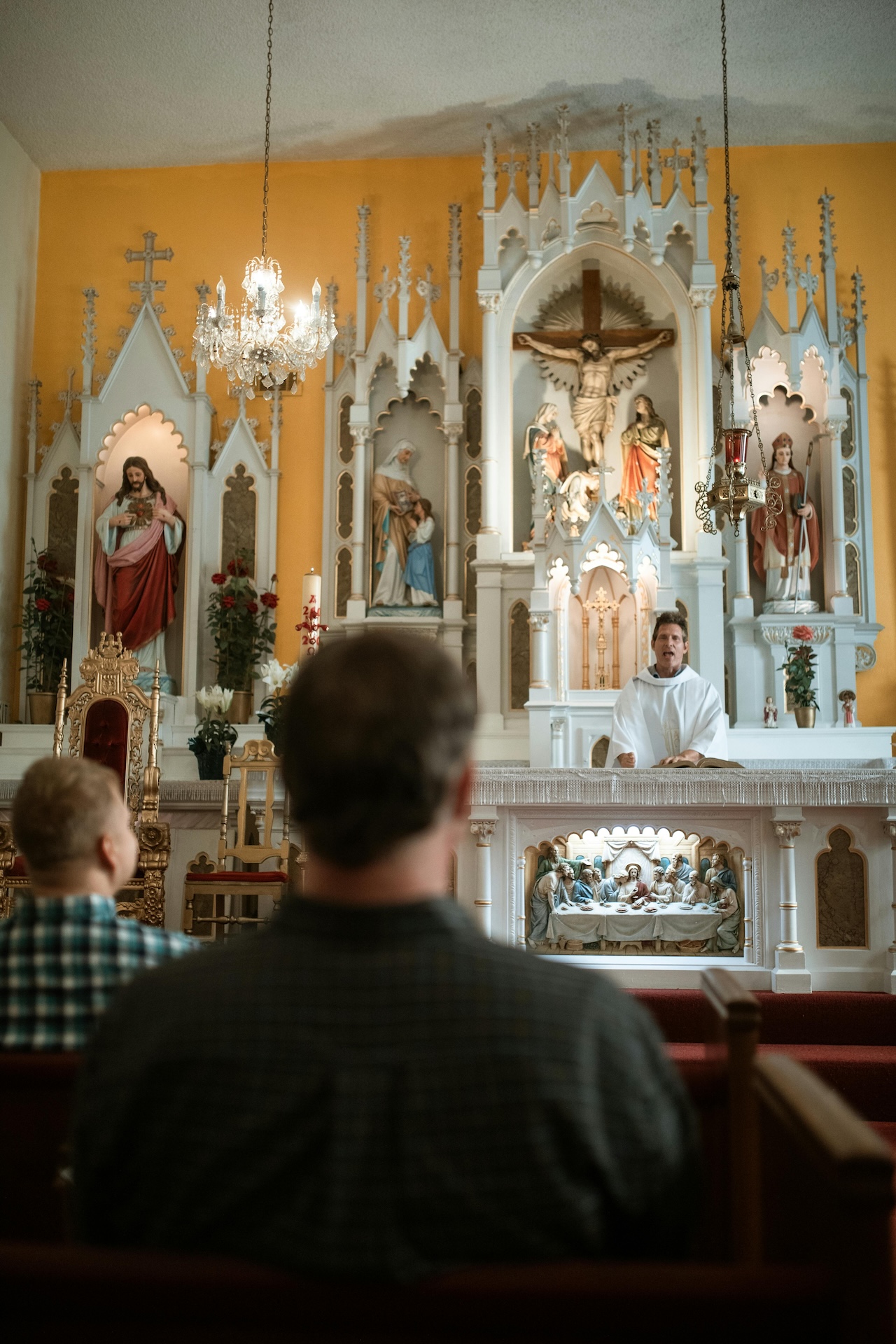
Bread and Wine become the Body and Blood of Christ at Catholic Mass | Courtesy: Pexels.com
Joy of the Kingdom
For the mass to be complete, the priest must consecrate both the bread and the wine and receive Communion under both species. By receiving from the cup, he prefigures
the wedding feast in the Father’s kingdom, where the faithful will drink the new wine that has become the Blood of Christ (Catechism of the Catholic Church, 1335).
One of his most familiar miracles is when he multiplies the loaves and the fishes at the Feeding of the Five Thousand. This is a prefiguring of how he calls us now to share at his Eucharistic table. The disciples broke apart the loaves as they distributed them to the people on the shore, symbolizing the unity of those who shared the meal. In the same way, we all share the one bread consecrated at the altar and this signifies our unity as the faithful.
How do we explain the greatness of what happens in the Eucharist? St. Thomas Aquinas had to coin a new term to communicate the depth of the mystery.
Transubstantiation
We might not able to fully comprehend the mystery of transubstantiation, but that is no reason to think that it is impossible. When St. Thomas Aquinas introduces the term “transubstantiation” in his Summa Theologiae, he reflects on God’s omnipotence. First, he talks about different types of material change that occur in nature before concluding that the change which occurs in turning bread into the Eucharist is fundamentally unique.
Since God is infinite act, he
can work not only formal conversion, so that diverse forms succeed each other in the same subject; but also the change of all being, so that, to wit, the whole substance of one thing be changed into the whole substance of another (St. Thomas Aquinas, Summa Theologiae, III, Q. 75, a. 4).
Although there have been attempts to explain the reality of the Eucharist with other terms, they all seem to fall short of the power and beauty of the explanation from the Angelic Doctor. What was bread and still looks, feels, tastes, and smells like bread is no longer bread. What was wine and still looks, feeds, tastes and smells like wine is no longer wine. They are converted into the Body and Blood, Soul and Divinity of Christ.
Challenge of Belief
We should not be surprised that the Eucharist is a belief that challenges Catholics. This was the case for the first disciples.
The first announcement of the Eucharist divided the disciples, just as the announcement of the Passion scandalized them (Catechism of the Catholic Church, 1336).
However, once they came to terms with the reality, it became a central element of the primitive Church. We read in the Acts of the Apostles that “they devoted themselves to the teaching of the apostles and to the communal life, to the breaking of the bread and to the prayers” (Acts 2:42). We must pray and act so that the Eucharist can once again be the center of all our Christian communities. What we are really doing at Mass is continuing this community of discipleship that was lived out in the primitive Church. When we take bread and wine and the priest consecrates them into the Body of Blood of Christ, we share in the same meal he presided over at the Last Supper. The Paschal Mystery is one and we are drawn in mysteriously through the Eucharistic Celebration.
Subscribe to the newsletter to never miss an article.
Looking for more articles on the Eucharist? Look no further.
Why Are There So Many Names for the Eucharist?
History and Religion

About Fr. Nicholas Sheehy, LC
Fr. Nicholas Sheehy was ordained a Catholic priest in 2013 for the Legionaries of Christ. He has been involved in youth work including missions, retreats and apostolic outreach in Germany, Italy, the United States and Central America. He is passionate about the New Evangelization and formation for young adults and married couples. He is a spiritual director and retreat director, offering marriage preparation and marriage counseling through the Divine Mercy Clinic and Family Center. He is currently Executive Director and Chaplain of the Newman Center at St. Philip the Apostle Parish in Pasadena, California. You can read more about the author here.
Previous Post

March 4, 2024
Celebrating the Patroness of Immigrants on Women’s Day
Next Post
March 8, 2024 Evangelization at its Finest, From Curiosity to Conversion
Recent Comments
"Peace is a precious resource. Humankind and Planet Earth are thirsting for peace. Long live ..."
The Man Who Taught Nagasaki to ..."
"Searching and finding truth and traveling from truth to Truth is an exciting journey. The ..."
Your Writing Makes the Pope Happy
"Rich or poor, we are all fellow pilgrims enthusiastically marching together to our cherished destination. ..."
"There's no moral difference between avoiding conception by using 'artificial' contraception and using a 'natural' ..."
Browse Our Archives
Select a Category Church News Education Eucharist Faith and Mental Health Family Living the Faith Marriage Relationships Spiritual Direction Uncategorized Vocations Women Young Adults
Select a Month October 2026 September 2026 August 2026 July 2026 June 2026 November 2025 October 2025 September 2025 August 2025 July 2025 May 2025 April 2025 March 2025 February 2025 January 2025 December 2024 November 2024 October 2024 September 2024 August 2024 July 2024 June 2024 May 2024 April 2024 March 2024 February 2024 January 2024 December 2023 November 2023
Follow Us!
TAKE THE
Religious Wisdom Quiz
Which harvest festival is also called the Feast of Booths?
Select your answer to see how you score.
Sukkot Hanukkah Passover Purim
Related posts from Formation Matters
Bridging the Chasm Between God and Man with...
Turning the Other Cheek: Strength not Weakness
Indifference and the Mystery of the Incarnation
TRENDING AT PATHEOS Catholic

Methodist Central Hall and Westminster Abbey
Situated on the same square is Methodist Central Hall and Westminster Abbey. ...

57th Dove Awards Honor Dolly Parton, Crown New...
On gospel music’s biggest night, the 57th annual GMA Dove Awards honored...

The First Eucharistic Controversy: Christ’s Real Presence
For Catholics, the Eucharist is the source and summit of the Christian...

What a Stop Sign Can Teach Us About...
How to Make a Decision When You Can't Hear God Main point:...

Archdiocese Hosts Military Marriage Retreat in Germany
RASTATT, Germany — The transient military lifestyle, with its frequent deployments and...

Nearly every morning, I make the drive to Detroit with my high-school-age...
view all Catholic blogs
What Are Your Thoughts?leave a comment
Ad-Free & Subscriber Log-In Subscription Support
- About Us
- 2026 Calendar
- Videos
- Podcasts
- Library of World Religions
- Faith In Media Tracker
- Advertise With Us
- Write for Us
- Privacy Policy
- Terms of Service
- Do Not Sell My Data
- Contact Us
- Radiant Digital
- Manage Newsletter Subscriptions
- Unsubscribe From Notifications
- Sitemap
Copyright 2008-2026, Patheos. All rights reserved.
Subscription Support Ad-Free & Subscriber Log-In
Follow Patheos