
BuddhistCatholicContemplativeEvangelicalGeneral ChristianHinduJewishLatter-day SaintMuslimNew VisionsProgressive Christian
Beliefs
- Buddhist
- Catholic
- Contemplative
- Evangelical
- General Christian
- Hindu
- Jewish
- Latter-day Saint
- More Voices
- Muslim
- New Visions
- Pagan
- Progressive Christian
Topics
- Religion News
- Food and Religion
- Sports and Religion
- Religious Art
- Religious Music and Entertainment
- Religious Events
- History and Religion
- Style and Religion
- Politics and Religion
- Women in Religion
- Recreation Outdoors and Religion
- Business Finance and Religion
- Careers Workplace and Religion
- Education and Religion
- Family Parenting and Religion
- Health Fitness and Religion
- Home and Religion
- Relationships and Religion
- Technology and Religion
- Travel and Religion
Columnists
- Buddhist Columnists
- Business Finance and Religion Columnists
- Careers Workplace and Religion Columnists
- Catholic Columnists
- Contemplative Columnists
- Education and Religion Columnists
- Evangelists Columnists
- Family Parenting and Religion Columnists
- General Christian Columnists
- Health Fitness and Religion Columnists
- Hindu Columnists
- History and Religion Columnists
- Home and Religion Columnists
- Jewish Columnists
- More Voices Columnists
- Latter Day Columnists
- Muslim Columnists
- New Visions Columnists
- Nonreligious Columnists
- Pagan Columnists
- Politics and Religion Columnists
- Progressive Columnists
- Recreation Outdoors and Religion Columnists
- Relationships and Religion Columnists
- Religion News Columnists
- Religious Art Columnists
- Religious Events Columnists
- Religious Music and Entertainment Columnists
- Sports and Religion Columnists
- Style and Religion Columnists
- Technology and Religion Columnists
- Travel and Religion Columnists
- Women in Religion Columnists
Resource Library
- 2026 Calendar
- Library of World Religions
- The 100 Most Holy Places on Earth
- Patheos Answers
- Podcasts
- Videos
- Faith Leaders Database
- Anglican Episcopalian
- Bahai
- Baptist
- Buddhism
- Christianity
- Confucianism
- Eastern Orthodoxy
- Hinduism
- Holiness and Pentecostal
- ISKCON
- Islam
- Judaism
- Lutheran
- Methodist
- The Church of Jesus Christ of Latter-day Saints
- New Age
- Paganism
- Presbytarian and Reformed
- Protestantism
- Religion Behind the Scenes
- Roman Catholic
- Scientology
- Shia Islam
- Sikhism
- Sufism
- Sunni Islam
- Taoism
- Zen
- See all religions
Research Tools
 Ad-Free & Subscriber Log-In Subscription Support
Ad-Free & Subscriber Log-In Subscription Support
Follow Patheos 

- Trending:
- Forgiveness
- |
- Marriage
- |
- Consciousness
- |
- Death Penalty
- |
- Election
- |
- Halloween

- Home
- Catholic
- Politics and Religion
- Why Are There So Many Names for the Eucharist?
Why Are There So Many Names for the Eucharist?
Last updated on: February 28, 2024 at 9:28 am by Fr. Nicholas Sheehy, LC
Why Are There So Many Names for the Eucharist? 2024-02-28T09:28:43-08:00 Fr. Nicholas Sheehy, LC
Patheos Explore the world's faith through different perspectives on religion and spirituality! Patheos has the views of the prevalent religions and spiritualities of the world.
“A rose by any other name would smell as sweet” (Shakespeare, Romeo and Juliet).
Since this sacrament is central to a Catholic understanding of the world, it is all the more important that we get to comprehend it as much as we can. There are many names we use to describe the Sacrament of the Eucharist, and each one can help us to appreciate different aspects of this great gift that we receive. By reflecting on the various names, we can deepen our understanding of this sacrament that is the “source and summit of ecclesial life” (Lumen Gentium, 11). “The inexhaustible richness of this sacrament is expressed in the different names we give it” (Catechism of the Catholic Church, 1328).
By reviewing Catechism numbers 1328-1332, we can dive into the five names of the Eucharist within Catholic theology.
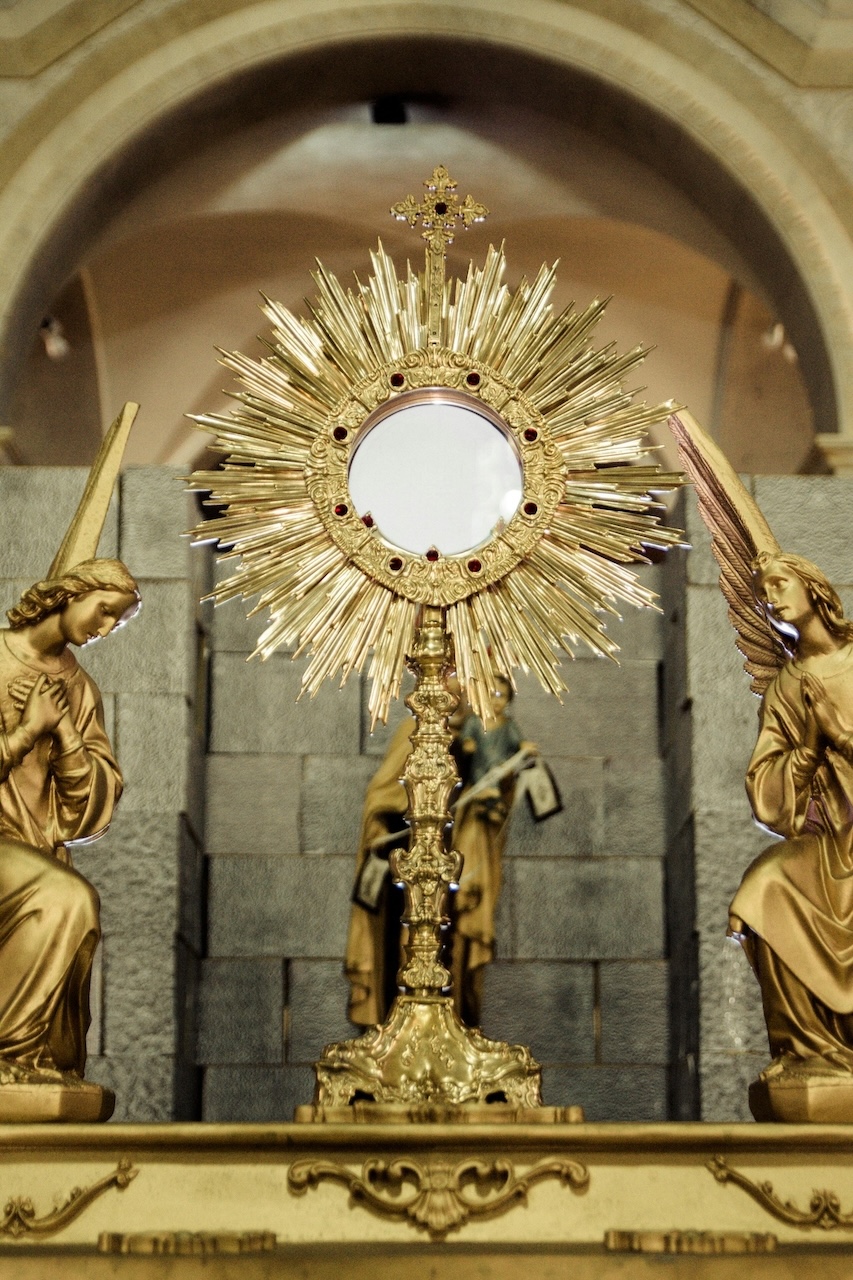
There are many names for the Eucharist | Courtesy: Pexels.com
Eucharist (CCC 1328)
The most common name for this sacrament is the “Eucharist,” which means “thanksgiving.” This comes from the Greek word for giving thanks: eucharistein. This term recalls especially the way that the Jews would give thanks and praise God during their meals. There is an aspect of this sacrament that is very tied to eating, blessing God, and continually expressing our thanksgiving towards God.
Last Supper (CCC 1329)
The Eucharist was celebrated first at the Last Supper and reminds us of the wedding feast of the Lamb in the heavenly Jerusalem. The Book of Revelation seems to describe some apocalyptic event completely removed from our earthly experience. However, when we read it through the prism of the Eucharistic Celebration, it becomes a description of what we experience at every Mass. The Last Supper, being a Passover dinner, connects this sacrament to the Jewish tradition from the book of Exodus and reminds us that this is truly a meal. The Passover dinner had a lamb; the Mass has the Lamb of God: Jesus, the Lord. The sacraments use sensible objects to turn our minds to heavenly realities. Baptism reminds us of being born and the Eucharist reminds us of our need for eating.
Breaking of Bread
At the Last Supper, the New Testament text refers to the Eucharist as the Breaking of the Bread. This is a formula that we can read as a celebration of the Eucharist.
The action of breaking the bread recalls the actions of Jesus at the Last Supper, when he broke the bread before giving it to his disciples. One of the earliest names for the Eucharistic celebration is the breaking of the bread (Lk 24:35; Acts 2:42, 46) (USCCB, “Liturgy of the Eucharist).
For the Jews, there is a ritual aspect to breaking bread, which requires a blessing to be pronounced. Because this was the norm, we can assume that Jesus always did this when he broke bread; we even have evidence of him pronouncing this blessing, berakah, at the Last Supper. The disciples on the way to Emmaus also recognized Jesus through his “Breaking of the Bread,” After pronouncing the words of blessing, he disappeared from their sight.
They ask Christ to stay for supper. “And it happened that, while he was with them at table, he took bread, said the blessing, broke it, and gave it to them” (Luke 24:30). Yes, it is the Mass, to be sure. All the basic actions of the Eucharist are there: He took, blessed, broke and gave. They are the same actions that took place at the Last Supper and that we repeat at every Mass (Msgr. Charles Pope, “The Road to Emmaus: We Will Know Him in ‘the Breaking of the Bread’”).
We can the vanishing of Jesus this as him remaining under the species of bread and wine.
Eucharistic Assembly (synaxis)
We celebrate the Eucharist within the context of a gathering of the faithful around the Eucharistic table. Having this name helps us understand the communal aspect of the Eucharist. So many people who love the Eucharist concentrate on their own personal benefit, but they would do well to remember always that the whole Church participates each time that we celebrate the Sacrifice of the Mass. When we can feel that we are few at the Eucharistic table, we should allow the powerful reality of the Mystical Body of Christ to roll over us like a crashing wave. Thus, we become aware of our being in the center of the Church each time that we celebrate the Eucharist.
Memorial (CCC 1330)
At the Eucharist, we remember the Passion and Resurrection of Jesus. So, we have “memorial” as one of the names of the Eucharist. Recently, I attended a memorial mass for Bishop David O’Connell of the Archdiocese of Los Angeles, who passed away tragically just over a year ago. During the homily, the priest described Bishop Dave as a “practical mystic.” I was fascinated by this phrase because it describes the deceased so well and it gave me an ideal for which to strive in my own life. This is part of what it means to have a memorial—to reflect on the ways in which the person being memorialized was worthy of admiration and imitation. It is for this reason that, at the celebration of the Eucharist, we remember Christ–not as a pious practice, but so as to imitate him in our own lives.
Holy Sacrifice
As the Catechism of the Catholic Church says, one of the names of the Eucharist is “holy sacrifice”
because it makes present the one sacrifice of Christ the Savior and includes the Church’s offering. The terms holy sacrifice of the Mass, “sacrifice of praise,” spiritual sacrifice, pure and holy sacrifice are also used,150 since it completes and surpasses all the sacrifices of the Old Covenant (Catechism of the Catholic Church, 1330).
A sacrifice is an important religious rite common to all religions. Our modern world has lost contact with the importance of sacrifice, missing the true nature of the Mass. To enter into the mystery, we must recover the nature of the Eucharist.
Holy and Divine Liturgy
The liturgy is a service that man offers to God, as we get from the original Greek leitourguia. Originally, the word refers to the work of the people and becomes the work of the congregation worshiping God. Every time that we follow a liturgical rite, we are fulfilling this basic duty of man to worship God. For example, we all participate in the liturgy of the Church when we go to a Catholic burial or have a house blessing. Furthermore, priests, deacons, and religious recite the Liturgy of the Hours. Above all of these, however, is the Eucharistic Celebration and for this reason we can refer to it as the Holy or Divine Liturgy.
Holy Communion (CCC 1331)
Communion is about receiving Jesus under the appearance of bread and wine. We speak about the Eucharist as Communion especially when referring to receiving Jesus in the host during the Mass or during a Communion visit. This is why we refer to the non-ordained ministers who help distributing communion as “Extraordinary Ministers of Holy Communion.” Their role is primarily to distribute Communion when there are not sufficient “Eucharistic ministers,” (priests and deacons) available. Bringing communion to the sick is a beautiful and key service that these ministers can fulfill when when given this ministry role by their pastor. Because of the gravity of the responsibility, “all ministers of Holy Communion should show the greatest reverence for the Most Holy Eucharist by their demeanor, their attire, and the manner in which they handle the consecrated bread or wine” (USCCB, “Extraordinary Ministers of Holy Communion at Mass”).
Holy Mass (CCC 1332)
We call the Eucharistic Celebration “holy mass” because of its missionary quality. In the liturgy, the conclusion in Latin reads “ite, missa est.” The priest or deacon commissions us to go out and preach the Gospel as recorded at the end of the Gospel of St. Matthew: “Go, therefore, and make disciples of all nations, baptizing them in the name of the Father, and of the Son, and of the holy Spirit” (Mt. 28:19)
Which of these names used in the Catechism is most appealing to you? Did one of the names surprise you or teach you something new about the Eucharist? Please comment below.
Subscribe to the newsletter to never miss an article.
Looking for more articles on the Eucharist? Look no further.
Food and Religion

About Fr. Nicholas Sheehy, LC
Fr. Nicholas Sheehy was ordained a Catholic priest in 2013 for the Legionaries of Christ. He has been involved in youth work including missions, retreats and apostolic outreach in Germany, Italy, the United States and Central America. He is passionate about the New Evangelization and formation for young adults and married couples. He is a spiritual director and retreat director, offering marriage preparation and marriage counseling through the Divine Mercy Clinic and Family Center. He is currently Executive Director and Chaplain of the Newman Center at St. Philip the Apostle Parish in Pasadena, California. You can read more about the author here.
Previous Post

February 26, 2024
Talking to God and Your Spouse About Your Parenting Style
Next Post

March 1, 2024 Is It Unchristian To Feel Anger?
Recent Comments
"Peace is a precious resource. Humankind and Planet Earth are thirsting for peace. Long live ..."
The Man Who Taught Nagasaki to ..."
"Searching and finding truth and traveling from truth to Truth is an exciting journey. The ..."
Your Writing Makes the Pope Happy
"Rich or poor, we are all fellow pilgrims enthusiastically marching together to our cherished destination. ..."
"There's no moral difference between avoiding conception by using 'artificial' contraception and using a 'natural' ..."
Browse Our Archives
Select a Category Church News Education Eucharist Faith and Mental Health Family Living the Faith Marriage Relationships Spiritual Direction Uncategorized Vocations Women Young Adults
Select a Month October 2026 September 2026 August 2026 July 2026 June 2026 November 2025 October 2025 September 2025 August 2025 July 2025 May 2025 April 2025 March 2025 February 2025 January 2025 December 2024 November 2024 October 2024 September 2024 August 2024 July 2024 June 2024 May 2024 April 2024 March 2024 February 2024 January 2024 December 2023 November 2023
Follow Us!
TAKE THE
Religious Wisdom Quiz
What mountain was the site of Elijah's showdown with Baal's prophets?
Select your answer to see how you score.
Mount Hermon Mount Tabor Mount Sinai Mount Carmel
Related posts from Formation Matters
Never Forget: What 9/11 Should Teach Us 25...


The Treasure Meant to Be Shared
TRENDING AT PATHEOS Catholic

57th Dove Awards Honor Dolly Parton, Crown New...
On gospel music’s biggest night, the 57th annual GMA Dove Awards honored...

The First Eucharistic Controversy: Christ’s Real Presence
For Catholics, the Eucharist is the source and summit of the Christian...

What a Stop Sign Can Teach Us About...
How to Make a Decision When You Can't Hear God Main point:...

Archdiocese Hosts Military Marriage Retreat in Germany
RASTATT, Germany — The transient military lifestyle, with its frequent deployments and...

Nearly every morning, I make the drive to Detroit with my high-school-age...

The Real AI Story Is Adoption Without Trust
Artificial intelligence has crossed a political threshold. It is no longer a...
view all Catholic blogs
What Are Your Thoughts?leave a comment
Ad-Free & Subscriber Log-In Subscription Support
- About Us
- 2026 Calendar
- Videos
- Podcasts
- Library of World Religions
- Faith In Media Tracker
- Advertise With Us
- Write for Us
- Privacy Policy
- Terms of Service
- Do Not Sell My Data
- Contact Us
- Radiant Digital
- Manage Newsletter Subscriptions
- Unsubscribe From Notifications
- Sitemap
Copyright 2008-2026, Patheos. All rights reserved.
Subscription Support Ad-Free & Subscriber Log-In
Follow Patheos